
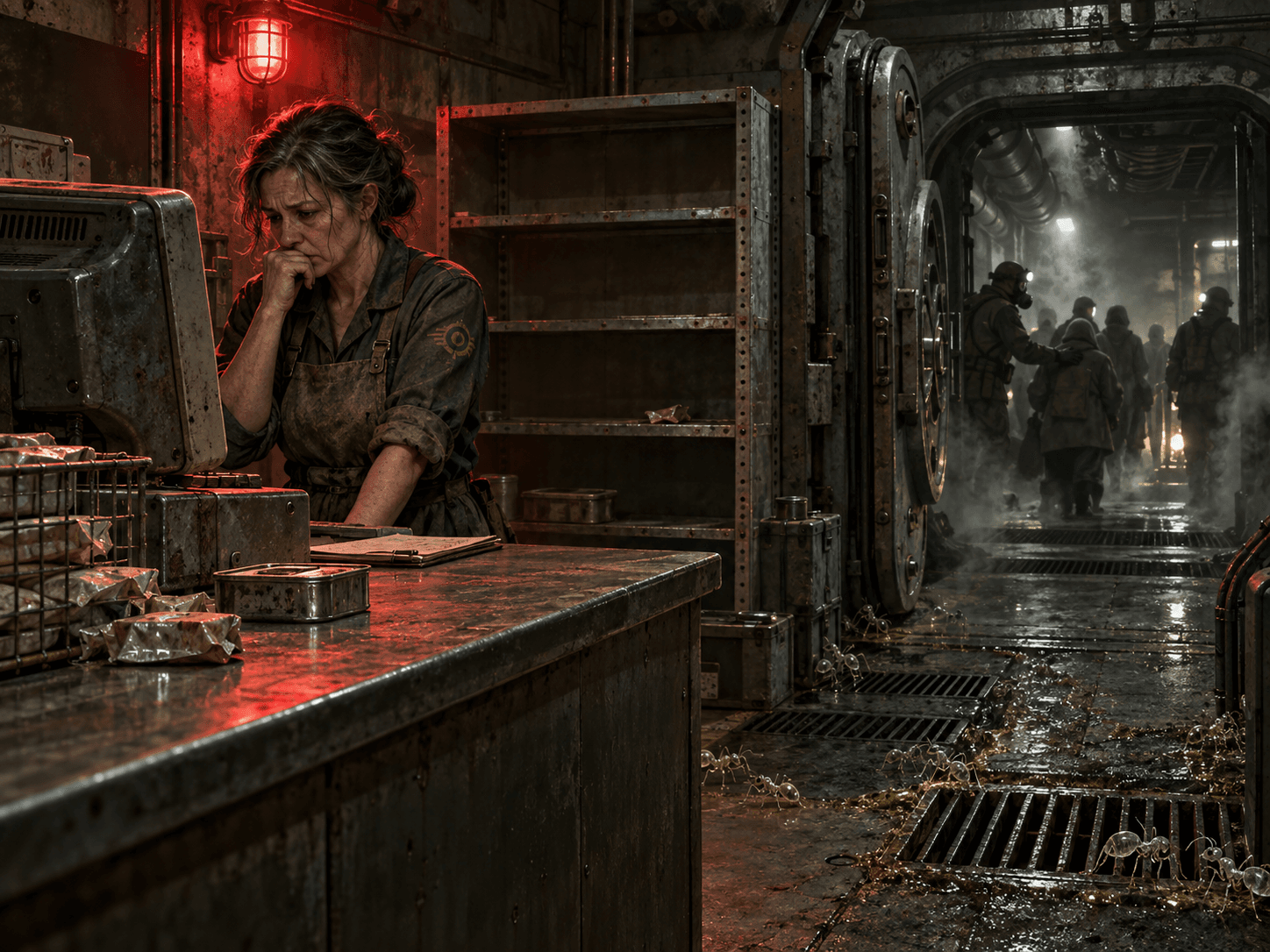
The emergency light above the storehouse blinked red, steady and unhurried.
Sara "Scale" Kres noticed it before she even opened the ledger. She noticed such things automatically: a change in the pump's rhythm, the tremor of a bulkhead, a damp streak under a valve, a pause too long between the scanner tone and the terminal's confirmation. After twelve years working in the Harvest Quarter of Vault Delta-7, the place was no longer a place to her. It was a system of symptoms.
Today the symptoms were calm.
That was worrying.
She sat behind the steel counter, pulled up the sleeves of her gray uniform, and spread the daily distribution list in front of her. The paper was thick, yellowed, and rough with dust that forced its way everywhere despite the filters. Each line held a name, household count, allotment, medical corrections, and recipient signature. Above the sheet hung a board with three numbers:
312 residents.
6 weeks of supply.
0 tolerance for discrepancies.
Sara liked that board. Numbers were more honest than people. They never promised more than they could give.
The first resident came at six-oh-five. A man from sector C, a pump worker, yellowish stains on the skin of his hands. His card listed a family of four, but his allotment had been reduced by ten percent because of "temporary unavailability of water infrastructure."
Sara scanned the card.
Beep.
She took three larger packets and one smaller one from the shelf. The scale under the counter twitched, then settled on the proper weight. The man looked at the packets, then at Sara, as if he wanted to say something. He did not. He took the ration and left.
"Next."
The queue moved slowly. People stood along the walls with their hands folded over their stomachs or pressed into their pockets. Some sat on the floor because they did not have the strength to wait standing. The air smelled of ozone, metal, and old grease. Somewhere behind the wall the main pump worked heavily and unevenly, as if every few turns it remembered that it might stop.
Sara issued rations, checked codes, marked names.
Every gram had its place.
Around ten, Marta entered the queue.
Sara recognized her by the way she walked. Her daughter moved carefully, slightly hunched, as if the floor might give way beneath her feet. She was sixteen and too tall for her weight. Her collarbones showed beneath the thin fabric.
After the respiratory illness in spring, she had never fully recovered. The doctor had said then that her lungs needed time and her body needed regular food. Sara had remembered both instructions. The second was harder to obey.
Marta stopped before the counter.
"Hey, Mom."
Sara did not look up from the ledger.
"Card."
Marta handed it over without a word.
Sara ran the identifier through the reader. The terminal sang a soft green note. Kres household: two people. Basic allotment, correction for a young person with incomplete work capacity. Everything matched.
"Three packets," Sara said.
"I know."
Sara counted two larger packets and one smaller one. The scale under the counter showed the proper weight. Paper rustled as she folded the bundles and tied them with thin wire.
"How do you feel?" she asked.
Marta looked at her sideways.
"Fine."
The word meant nothing. "Fine" could mean ordinary fatigue, shortness of breath, or that a person did not want to speak in front of the queue. Sara knew all those meanings.
"If the cough comes back, go to medical."
"I know."
"Do not wait until evening."
"I know, Mom."
Sara handed her the packets. Their fingers touched for a second. Marta's hand was cold.
"Next," Sara said.
Marta left. She did not look back.
Sara entered the pickup in the ledger and moved her eyes to the next name.
Behind the storehouse glass, the queue remained like a motionless river. Green overseer armbands moved along the walls. Now and then one stopped someone, measured a temperature, or checked a breath. No one raised their voice. Everyone knew the queue was ration, and ration was survival.
At the far end of the hall hung a laminated service board:
SECTOR D — 60% RATIONS
CAUSE: DOSING PUMP FAILURE
CHANNELS BELOW LEVEL 4 — GLASS ANT HAZARD
Under the last line someone had written in marker: *"AND FOR IDIOTS."
Sara did not have it wiped off. The warning did not work anyway.
Glass ants had entered the channels three weeks earlier through a damaged service filter. They were small, translucent, and almost invisible on wet metal. They left behind sticky residue that clogged valves and chemically ate into seals. Their bites did not kill, but they caused burning welts and swelling. Service insisted the problem was local and under control.
The commission used the word "secondary."
Sara did not like that word. In the Vault, everything secondary sooner or later entered the main balance.
After the morning distribution closed, she walked between the shelves. She checked seals, labels, and the temperature in the cooler part of the storehouse. At sector D she stopped for a moment.
The shelf was visibly less full than it had been three weeks ago.
Not because too much had been issued. The allotments were lower. That was what was supposed to be enough.
Temporarily.
Sara touched the label.
SECTOR D — 60% — UNTIL REPAIR
One corner of the paper had lifted. She pressed it down with her fingernail and returned to the office.
In the evening, when the queue was gone and the Quarter had gone quiet, she opened the audit.
It was the most orderly part of the day. No conversations, no requests, no eyes watching her hands. Only numbers meant to confirm that the world still held together.
Sara compared the issued rations with the storehouse ledger.
The result did not match.
She narrowed her eyes and started again.
The second result did not match either.
The shortage equaled seventy-two portions over the last four weeks.
Sara ran her finger along the column. Seventy-two. Not three, not four, not a random loss from damaged packaging. Seventy-two was a pattern. Eighteen portions a week. Two, sometimes three packets a day.
Someone had been taking rations outside the allotment.
She opened the access logs.
Every use of the storehouse had its record: identifier, time, section, and number of packets removed. Sara went through the last four weeks. At first she searched for a system error. Then she began searching for a person.
The trace appeared during morning distribution.
Code 7734-S.
Her code.
Hours when Marta helped her carry packets. Hours when Sara left the counter to check shelf levels or calm the queue. Hours when she trusted her daughter to do exactly what she had been told.
Sara rolled the screen back and checked the log again.
Then again.
The numbers did not change.
Something clicked in the storehouse. Sara raised her head. Behind the glass, the shelves stood in even rows. Red emergency light slid over foil and steel edges. From the lower ventilation grate came dry scratching.
Glass ants.
Sara waited for the sound to stop.
It did not stop at once.
She stood and locked the storehouse door from the inside. Then she returned to the terminal and reached for the wall phone. The handset was old, heavy, connected to central by a thick cable wrapped in tape.
She dialed the Resource Coordinator.
"Coordinator," a voice answered after the third tone.
"Scale from the Harvest Quarter. I have an audit discrepancy."
Silence on the other end.
"How large?"
"Seventy-two portions. Four weeks. The logs do not indicate a system failure."
"So theft?"
Sara looked at the code on the screen.
"Probably."
"Secure the storehouse. No one leaves and no one enters without my confirmation."
"Understood."
"I will be there in a few minutes."
The Coordinator arrived after twenty. He was perhaps ten years older than Sara, with gray hair and a face furrowed by small scars from old dust exposure. He did not carry a weapon. He did not need one. His signature was enough to close a storehouse, change allotments, and take a person out of their own section.
Two administrative workers with notebooks came in behind him.
Sara made room for them at the desk.
The Coordinator reviewed the printout without hurry. He did not look surprised. He looked tired.
"Your identifier," he said.
"Yes."
"Did you take these rations?"
"No."
"Who had access?"
Sara felt her throat tightening with dust, though there was no more of it in the room than usual.
"My daughter," she said. "She helped with issuing."
The Coordinator looked up.
"Marta Kres?"
Sara nodded.
For a moment no one spoke. From the ventilation came another scratch, weaker this time, as if something were moving inside the channel.
"You have until morning," the Coordinator said. "Find the source of the discrepancy and prepare an explanation."
"I found the source."
"You know what I mean."
Sara knew.
"If theft is confirmed, the matter goes to the ration commission," he continued. "Questioning, log verification, application of local protocol. Ninety days at seventy percent for the whole family."
Sara looked at the red light above the door.
"I understand."
The Coordinator set his hands on her desk.
"This is not punishment for punishment's sake, Scale. If we allow everyone to take as much as they think is needed, in two weeks there will be no ledger. Only hands at the shelves. And when the shelves run out, people will start choosing who gets to eat."
Sara said nothing.
"I return at six in the morning for your report," he added. "If you do not have an explanation, we take over the storehouse."
The Coordinator took the printout. Administration followed him out.
Sara remained alone.
For several minutes she sat motionless, palms flat on the desk. Then she turned off the terminal, closed the ledger, and checked the storehouse lock.
On the way to the living quarters she passed people waiting at the water dispenser. No one looked at her. Or everyone looked and pretended not to.
On level three she stopped before the door to her quarters.
Behind it, Marta was coughing.
Sara placed her hand on the handle.
She already knew that in the morning she would have to name the guilty person.
She did not yet know whether she could name her own child.
Sara opened the door.
Marta sat on the edge of the bed, bent over an old piece of paper. She pretended to read, but her eyes were fixed on one place. When she raised her head, a dry cough escaped from above her collarbone. Short, smothered in her sleeve.
Sara closed the door. The bolt rasped in its track.
"Where are the rations you carried out?"
Marta did not answer at once. The paper trembled in her hands.
"Mom..."
"Where?"
The girl set the paper on the bed. She was taller than Sara, but in the cramped room she looked smaller than usual. An oversized jumpsuit hung loose on her. Her face was pale, her cheeks hollow.
"I gave them to children," she said.
Sara did not take off her coat.
"Which children?"
"From sector D."
Of course.
Sara had known it from the moment she saw the code in the logs. Knowing it did not make it lighter. The opposite. Now it had her daughter's voice and the thin shape of her shoulders.
"How many?"
"I did not count."
"I did."
Marta lowered her eyes.
"Seventy-two."
Sara went to the table and sat. The chair was plastic, cracked near the back. For a while she looked at Marta's hands, at the small cuts around her nails, at skin reddened by detergents and cold.
"Four weeks," she said. "Three or four portions a day."
"Sometimes two."
"Sometimes four."
Marta was silent.
"Five children?"
"Yes."
"Their families fell out of the system?"
"Not completely." Marta rubbed the edge of her sleeve with her thumb. "After the pump failure some families were moved into temporary corrections. Then medical cards ran out of slots, then there were not enough people to check the cards. The children got sixty percent, and sometimes nothing if their guardian could not come down for rations."
"That did not mean you could take them from the storehouse."
"I know."
The answer came too fast. Sara felt anger rising in her, a warm wave.
"You know?"
"I know."
"You used my code."
"Your code opened the shelf."
"My code opened the storehouse."
"And that is why I could get in."
Sara stood. Narrow kitchen, bed, table, ventilation conduit under the ceiling. Everything was in its place, and yet the room seemed tilted, as if one wall had sunk a few centimeters.
"Do you know what the protocol says?" she asked.
"Ninety days."
"Say it."
Marta pressed her lips together.
"Ninety days at seventy percent allotment for the whole family."
"For you and for me. Not for the children in sector D. For us."
"I know."
"No, you do not." Sara felt her voice start to break, so she lowered it further. "Seventy percent is not a number on paper. It is less protein when the cough comes back. It is no extra tablet when your temperature drops. It is three days waiting for a scan because medical will be full. Do you remember the breathing chamber?"
Marta nodded.
"Do you remember not being able to draw breath?"
"I remember."
"The doctor said you were lucky. Luck is not an allotment. You cannot set it on a shelf and issue it when needed."
Marta turned her face away.
"And those children?" she asked. "Did they have an allotment?"
Sara did not answer.
"Did they?"
"They had a reduced one."
"Some were not getting even that."
"That is the commission's matter."
"The commission knows."
"The commission has a procedure."
"The procedure has already lasted three cycles."
Sara wanted to say that three cycles was not forever. That the pump required a filter, and the filter required channel decontamination. That parts would not appear just because someone looked at children. That every extra portion taken from the storehouse reduced the chance of repair.
All of it was true.
Marta looked at her as if truth were not enough.
"The youngest is seven," she said. "His name is Iwo. His mother sorts ash. She has been coughing blood for two weeks, but she cannot leave shift because then she loses caregiver correction. There is Nera, the twins Olek and Osa, and the boy without a surname on his card. They all sit by the grate when we issue rations. Do you know what they do? They count packets. Like you."
Sara felt a sting under her breastbone.
"You did not steal for yourself," she said.
"No."
That was worst. If Marta had eaten the portions herself, she could have been called foolish, selfish, afraid. Sara could have handed her to procedure and kept for herself a simple version of events.
"I thought that if I gave them a little, they would last until the repair," Marta said. "But the repair kept moving. Always to the next cycle."
Sara set her hands on the table.
"And now the Coordinator has the logs."
"I know."
"If I report you, you will be punished."
"I know."
"If I do not, they take over the storehouse. Then they will search for whoever falsified entries. They will find my code. They will find you. And maybe they will shut down the whole distribution system."
Marta clenched her fingers.
"But will those children live?"
The question stayed between them. There was no accusation in it. It was worse than that: a request for an answer Sara could not honestly give.
"I do not know," she said.
For the first time that evening, Marta looked away in shame.
Sara went into the kitchen. She did not turn on the light. Red glow from the corridor entered through the gap under the door. She sat at the table and opened her private notebook, the one without a code and without an inventory number.
She wrote:
72 — source confirmed.
Then beneath it:
Marta.
She looked at the two words for a long time.
She could say she had not known. She could submit an explanation in which her daughter was only an unauthorized user of the code. She could describe every procedural failure in the storehouse, the commission's delays, the faulty filter, the errors in sector D records. She could spread blame so wide that it stopped belonging to anyone.
She could also admit negligence. Say she had allowed Marta to help without a separate identifier. That for four weeks she had not compared access logs against the physical shelf state. That as Scale, she had failed to guard her own storehouse.
Every solution led to other shortages. In rations, in people, in responsibility.
At five in the morning the Vault shook from below.
First came a long metallic groan. Then something struck the pipes under the floor. A cup on the table slid a finger's width, and gray dust fell from the wall.
Marta sprang up from the bed.
"Pump."
Sara was already at the door.
The second sound was shorter and sharper. After it came a silence in which the air suddenly thickened. The ventilator in the quarters slowed. The red light beyond the door turned orange.
Emergency valves began to close.
One after another.
"Put on a mask," Sara said.
"I do not have one."
Sara took her own from the hook and handed it to her daughter. Marta tried to protest, but Sara was already opening the door.
In the corridor people were coming out of their quarters. Some were barefoot, others wore only thin night layers. All of them were listening to the same thing: the dull impact of bulkheads and the hiss of valves.
A pale shape fell out of the floor grate.
Then another.
A glass ant moved over the metal, almost invisible except for the shadow under its abdomen. Someone stepped on it. It cracked softly. A sharp sour smell rose from the floor.
"Ants are coming out of the channels!" someone shouted farther down.
Another voice answered:
"Children from D went below!"
Sara turned to Marta.
Her daughter was already taking the mask off.
"No."
"I have to go there."
"You do not have access to the channels."
"They are there because of me."
"They are there because of the pump failure."
"Because of me they know where the niche is."
Sara grabbed her wrist. She felt bone under her fingers.
"What did you do?"
"I left packets behind the third valve. In the service channel. They were supposed to go down, take the food, and come back before the valves closed."
"And you?"
Marta did not answer.
That was enough.
They ran down the corridor toward the storehouse. The alarm no longer howled continuously, only pulsed in short bursts. People gathered at the main bulkhead to sector D. Someone pounded a fist against the panel. Someone else tried to pull him away from the controls.
The bulkhead had stopped halfway closed. Through the gap flickered the dark inside of the channel.
"Open it!" a woman in the crowd shouted. "There are children in there!"
"If we open it, contamination goes to level two!" an overseer answered.
The Resource Coordinator stood at the control panel. Beside him were three commission members, including the Ration Commissioner. Sara had seen him before only at meetings. He had a broad face, gray brows, and a scar running from ear to jaw. He did not look like a man who liked giving orders. He looked like a man who had to give them too often.
The Coordinator saw Sara.
"Where is Marta?"
Sara did not answer.
From behind the bulkhead came a child's voice.
"Help!"
Marta tore free of Sara's hand and reached the gap.
"Iwo!"
Crying answered from the dark. Then coughing. Then the quick, dry scraping of many small legs on steel.
The crowd stepped back as several glass ants spilled from the ventilation grate. Their translucent bodies caught the orange alarm light. One climbed onto a man's boot. He kicked it off, and a thin caustic smear remained on the floor. The boot material began to smoke.
"Everyone away from the grate!" the Commissioner ordered.
People obeyed, but no one left. On the other side of the bulkhead were children.
The Coordinator tried to reset the panel.
"Control is locked by the pressure drop," he said. "We cannot open the channel from this side without a manual bypass."
"There is a bypass in the storehouse," Sara said.
The Commissioner looked at her.
"What kind?"
"Emergency bulkhead from the service reserve side. It opens a technical passage, but it requires my code and removal of the filter and decontamination fluid."
The Coordinator's jaw tightened.
"That reserve is meant for pump repair."
"I know."
"If we use it, sector D stays at sixty percent for the next cycle."
"I know."
"Not only sector D. The filter and fluid are part of the whole repair kit. Without them we cannot decontaminate the channels. The pump will keep drawing residue."
"I know."
The Commissioner watched Sara for a moment.
"And if we do not open?"
Marta's cry came from the channel:
"Mom!"
Sara flinched. Marta was on the other side of the bulkhead, in the dark, with five children. Her voice came through the metal distorted, thin, and close at once.
"The ants are near them!" she shouted. "I cannot see Iwo!"
The Coordinator turned to the commission.
"We have to cut off the channel," one member said. "If the swarm gets higher, we lose level two."
"There are five children there," the Coordinator replied.
"And behind them three hundred and seven people."
No one said it was a simple choice. It was not.
Sara knew that kind of silence. The silence of people counting someone else's life and their own supplies in their heads, then trying not to show which number weighed more.
The Commissioner stepped toward her.
"Scale," he said. "If you use the code without authorization, the system will record a violation. If you remove the reserve, it will be assigned to your identifier. If you then conceal the shortage of seventy-two portions, the audit will cover everything."
"I know."
"I am not saying this to stop you."
"I know."
"I am saying it so you do not later pretend you did not know what this decision cost."
Sara looked at the panel in the storehouse. Behind the doors waited shelves, filters, decontamination fluid, and emergency rations. Everything had a number, an owner, and a purpose. Every item had already been promised to someone, even if no one held it yet.
From the channel came scraping again.
Closer this time.
Marta screamed. One of the children began coughing so violently the sound broke in the middle.
Sara moved toward the storehouse.
The Coordinator took a step after her.
"Sara."
She turned.
"You can still let the commission take the decision," he said. "We close the bulkhead, seal the channel, and try evacuation when pressure returns. It could take an hour. Maybe two."
"And the children?"
The Coordinator did not answer.
Sara placed her hand on the reader.
The metal under her fingers was cold and slightly damp. For twelve years this code had opened only what was allowed to open. It issued rations, confirmed corrections, closed balances. Now it would open the way to a reserve meant for the future.
Behind her, the Commissioner said:
"Do you know what will happen if you do this?"
Sara entered the first digits.
"I know."
She entered the next.
"Do you know sector D will be left without repair?"
"I know."
"Do you know the audit can take everything from you?"
Sara looked back at Marta. The gap in the bulkhead was black. From within came children's breathing and the scrape of insects moving across metal.
"I know what waiting costs," she said.
She entered the final digit.
The lock answered with a dull click.
The storehouse door released. Sara went inside and took the canister of decontamination fluid and the heavy emergency filter from the shelf. The metal was cold and slick in her hands.
The Coordinator stood in the doorway with the Ration Commissioner.
"If you use that," the Commissioner said, "sector D stays at sixty percent rations for the whole next cycle. Pump repair is postponed."
"I know," Sara said.
She went out into the corridor. The crowd parted before her. Behind the bulkhead came the dry, insistent scraping of hundreds of legs.
Sara stepped to the emergency panel and entered her code. The bulkhead began to rise with a hydraulic groan. Hot, thick channel air struck her face.
She sprayed the decontamination fluid in a wide arc. The chemical hissed on metal and residue. The glass ants recoiled in panic. Their scraping became chaotic chittering, but it did not stop.
Service rushed into the channel. Two workers in masks carried out Marta and the five children. All of them were burned and weak. Marta was coughing, her forearm red with welts.
When the last person was behind the bulkhead, Sara closed the steel plate. The mechanism ground and locked. Scraping behind the steel did not stop. The glass ants withdrew deeper, but they were not defeated.
Sara returned to the storehouse. She sat at the terminal. The red audit light blinked above the desk.
She opened the ledger and entered:
"Technical losses — service channel contamination."
She confirmed the entry with her code.
The light remained red.
The terminal screen showed the balance:
312 / MINUS 72
Sara did not change the number.
She stood and went back behind the counter. She set the first ration packets on the top. The queue was already forming. People stood in silence, glancing at the empty shelf where the emergency reserve had been.
Marta stood in the storehouse doorway. She leaned against the frame, pale, her arm bandaged. The cough returned — dry, deep, and stubborn.
From the lower corridor came the persistent scraping of glass ants.
The red audit light blinked over Sara's head.
The queue moved forward.