
I
Idris always claimed you could not judge a wealthy house by its silver.
Silver could be borrowed.
A gilded candlestick could be rented for a wedding, a rug inherited from an aunt, and the three horses outside might just as easily belong to guests.
True wealth was measured in plates.
Dhorren Vael’s house had forty-seven.
Idris counted.
Twelve on the main table.
Eighteen on the side tables.
Seven being carried back to the kitchen.
Ten already empty.
Forty-seven plates and not a single chipped one.
That was money.
“You’re staring,” said the woman beside him.
Idris looked away from the porcelain.
“I’m admiring the art.”
“It’s a plate.”
“Exactly. That’s what makes it impressive. No one has yet forced it to symbolise the suffering of mankind.”
The woman raised an eyebrow.
She was an elf. You could tell even without the slightly pointed ears. She had the face of someone perhaps thirty years old and the calm of someone who had seen enough winters to stop rushing most answers. Her hair was pinned high. Her fingers were stained with ink, and one front tooth carried a faint blue mark, as though she had a habit of biting quills.
“Tavé Quin.”
“Idris Vale.”
He had invented the surname two hours earlier.
It was bland enough to sound expensive.
Tavé looked at his collar.
“You fastened that wrong.”
“That’s how we wear it in my region.”
“No.”
“In mine.”
“You said you were from the southern bank.”
“The northern part of the south.”
“Fascinating place.”
Idris smiled half a second too long.
He knew it.
So did Tavé.
She fixed his collar in one clean motion.
Idris automatically checked whether she had taken anything from his pocket while doing it.
No.
Good.
A professional.
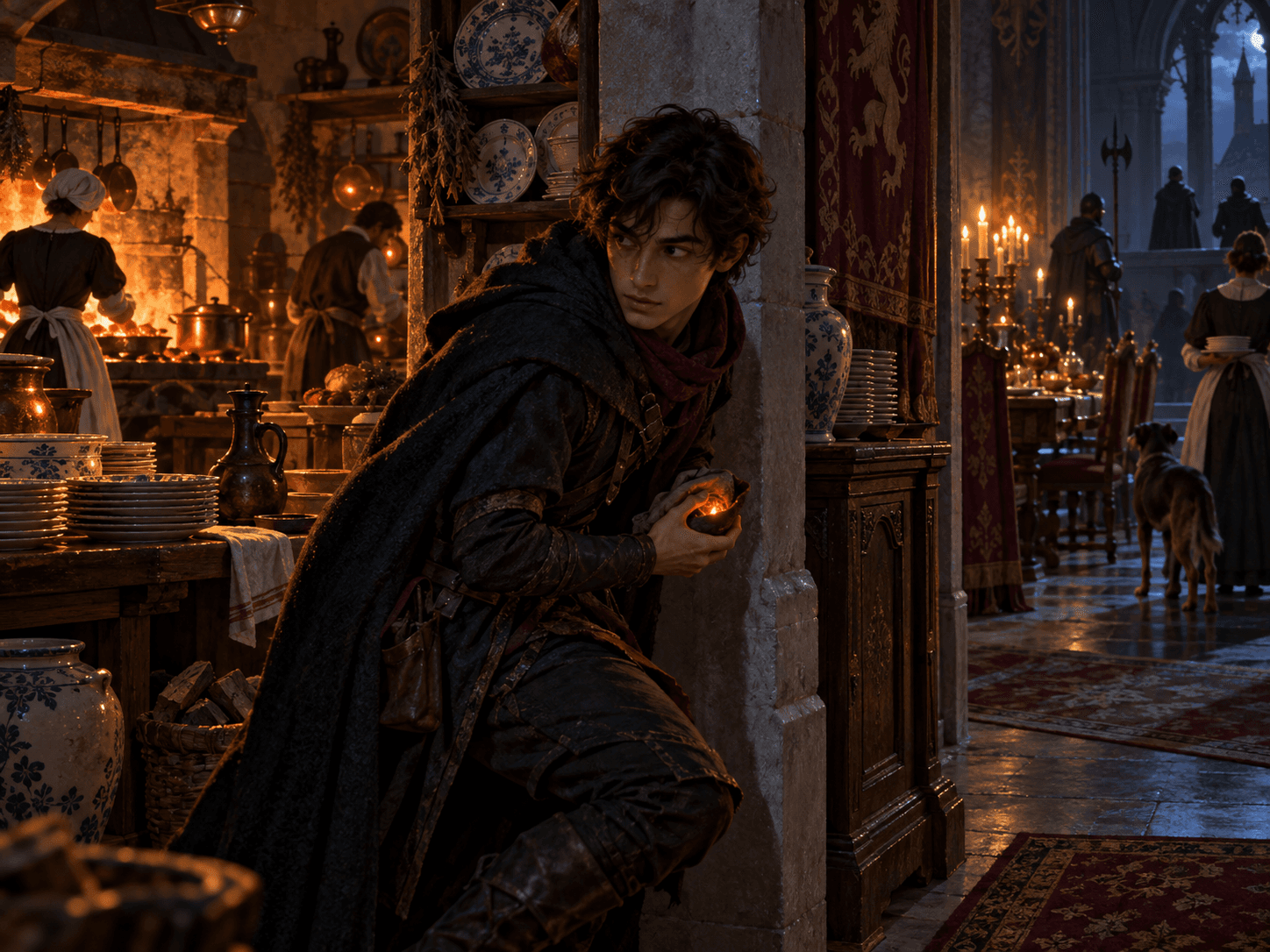
Around them, Vael’s salon pulsed with quiet wealth. Not the kind that shouted with gold. Worse. The kind that assumed everyone present already knew what things cost.
Dark wood.
Glass.
Wine poured into goblets thin as onion skin.
Maps on the walls. Tools. Fragments of cloth. Objects that had once been used to eat, work, marry or bury the dead, now resting beneath lamps with little labels beside them.
Some of the display cases shimmered with pale lines.
Dwarven preservation wards.
Fine geometric webs ran along the brass frames and disappeared into the stone floor. They stabilised humidity, temperature and material stress. Wood did not warp. Metal did not rust. Cloth did not rot.
Idris hated them a little precisely because they worked so well.
He passed a harvest knife with a horn grip.
ASHEN VALLEY DOMESTIC IMPLEMENT. PROVENANCE UNCERTAIN.
Provenance uncertain.
Very elegant words meaning:
someone had it, someone lost it, we bought it.
“Your field?” Tavé asked.
“Tools.”
“I thought it was hearths.”
“A hearth is a tool. People merely tend to become more attached to one than to a hammer.”
“You don’t?”
“I become very attached to hammers.”
“I can tell by your hands.”
She glanced at his fingers.
Idris’s nails were too neat for a craftsman, his hands too damaged for a merchant.
Exactly right for someone who wanted to be both.
“Magister Vael is waiting,” Tavé said. “You’re to authenticate the piece before the showing.”
“So I heard.”
“From whom?”
“The man paying.”
“Always a worrying answer.”
She moved off.
Idris followed.
On the way he stole a piece of cheese from a tray.
Tavé did not even turn.
“The kitchen is on the left.”
“I’m not hungry.”
“Of course.”
The cheese was excellent.
Also worrying.
*
The Hearth-Knot stood inside a glass case on red velvet.
Idris saw it and, for a moment, forgot the plates.
The plan.
Tavé.
How he was supposed to breathe.
The label read:
PORTABLE DOMESTIC FIRE VESSEL. ASHFOLK. LATE ASHEN VALLEY PERIOD.
Idris knew a better name.
Kol-Dur.
At home they simply called it:
the Knot.
This one was the size of a fist.
Dark porous clay held inside a woven copper cage.
Three old bands.
A loop for hanging from a belt or above a hearth.
Along one side ran a barely visible crack through the copper.
Idris knew it.
As a child he used to wedge a fingernail into it when Nereth was not looking.
She would smack him with a wooden spoon.
Once hard enough that for a week he claimed he had suffered a concussion.
Nereth claimed he would first have needed a brain.
Idris tasted ash on his tongue.
Not magic.
Not yet.
Body-memory.
Home.
A Vael ward glowed around the base of the case.
Five interlocking shapes cut into brass.
A dwarven preservation anchor.
Idris understood the principle, though not the details: anything under its protection was magically bound to the state in which it had been registered. Try to wrench it free and the whole network would trigger.
Not fire.
Not lightning.
Something worse for a thief.
The display would ring through the stone of the entire house.
“Well?” Tavé stood beside him. “Authentic?”
Idris did not answer.
Under the glass, the Kol-Dur looked wrong.
Too clean.
Someone had scrubbed away the old soot.
Polished the copper.
Picked the remains of herbs from the cracks in the clay.
Nereth’s home used to smell of juniper, scorched tallow, wet wool and a stew no sensible person tried to name.
Here the Knot smelled of nothing.
“Don’t touch it yet,” Tavé said.
“I wasn’t going to.”
“You lie better when you’re not looking at the object.”
She took out a catalogue card.
Then pressed two fingers to the side plate of the case.
The ward shifted.
It did not vanish.
It loosened.
The geometric light withdrew from one edge of the glass.
“Now.”
Idris looked at her.
“An elf opening a dwarven ward.”
“Does that complicate your worldview?”
“A little.”
“I studied.”
“For how long?”
Tavé considered.
“Longer than you’ve been alive.”
“You elves do enjoy saying things like that to humans.”
“You humans do keep giving us opportunities.”
Idris lifted the glass.
Reached inside.
The Kol-Dur was cool.
Not dead.
Cool.
He wrapped his fingers around the copper weave.
He knew the weight.
Uneven.
Pulled slightly to the left.
Nereth had always hung it to the right of the stove.
Idris closed his eyes.
Recoverers were taught not to let objects get to them.
Which was roughly like telling a drunk not to let drink get to him.
He felt the crack beneath his thumb.
One of the bands.
The porous clay.
And then something beneath his hand moved.
Tavé stepped back half a pace.
A dark red line appeared inside the cracks of the clay.
Thin.
Like embers beneath ash.
It ran around the whole sphere.
Then another.
Then a third.
The copper cage warmed.
It did not burn.
It simply stopped being cold.
And the atrium suddenly smelled of:
juniper,
roasted turnip,
old fat,
wet timber,
and something Idris had no other word for than *Nereth’s home*.
He opened his eyes.
Tavé was staring at the Knot.
“It’s never done that.”
Idris said nothing.
“Never,” she added.
“How long has it been here?”
“Thirty-two years.”
The red line pulsed.
Once.
Twice.
Like breathing.
Something tightened beneath Idris’s ribs.
Not a memory.
Not a voice.
Not a vision.
More like a certainty the body understood before the mind could name it:
the same fire.
Fire changes timber, pots, cities.
But the continuity was there.
Thin.
Alive.
“Authentic,” he said.
Tavé watched him.
“You’re certain?”
“Now I am.”
“What just happened?”
Idris took his hand away.
The glow began to fade.
The smell of home dissolved into the cool gallery air.
“It said hello.”
“The object?”
“The house.”
Tavé looked at him.
“Is there a difference?”
“For you?”
“I’m asking you.”
Idris looked at the Knot.
“All of it.”
Tavé slowly closed the glass.
The dwarven ward returned.
Pale geometry wrapped around the Kol-Dur.
The red glow in the clay died.
To Idris it suddenly looked like something living frozen beneath ice.
And that was when the job stopped being work.
It became personal.
II
“Don’t steal my hearth,” Nereth had said that morning.
Idris had taken it as a joke.
He should have known better.
His grandmother joked most often when she did not want someone to notice the knife.
She sat on a low stool beside the Nest’s shared hearth, legs wrapped in an old blanket, wooden spoon in hand.
She was human.
Ashfolk.
Seventy-something, perhaps more.
No one in the family knew for certain.
Nereth claimed she had been born in the year three goats entered the tax collector’s house and ate the register.
It was impossible to verify.
The Nest smelled of wet clay, alder smoke and a dark stew thickening over the communal fire. Several families shared the courtyard, bread oven and a bench on which someone slept every day despite objections from everyone else.
Children ran between drying pots.
Someone upstairs was arguing about charcoal.
A young woman by the well smacked a boy across the backside with a wet cloth, and he received it with the dignity of a man defeated in philosophical debate.
Idris sat beside his grandmother.
“I’m not stealing.”
“Of course.”
“I’m recovering.”
“You change the word because the first smells worse.”
“Good words are half the trade.”
“The other half is fast legs.”
Nereth handed him a bowl.
Idris tasted it.
“Too salty.”
“You’re lying.”
“Why would I lie about soup?”
“To annoy me.”
“Is it working?”
“No. Try harder.”
The stew was thick with turnip, mutton, chickpeas and juniper.
Idris took another spoonful.
“Vael has it in his collection.”
“I know.”
“You knew?”
“The whole city knows. He sent invitations.”
“And you did nothing?”
“What am I supposed to do? Walk onto the Upper Terrace and hit a dwarf over the head with a spoon?”
Idris looked at the spoon.
“It would be culturally significant.”
“I raised you with it. Results mediocre.”
“I’ll bring back the Knot.”
Nereth snorted.
“Bring salt. Cheaper.”
“Grandmother.”
“Don’t ‘grandmother’ me now. ‘Grandmother’ is when you carry coal.”
Idris leaned closer.
“It’s our Kol-Dur.”
“It was.”
“It still is.”
“Everything is ‘still’ something if a young man avoids looking long enough.”
Idris stared at her.
“Do you want it?”
Nereth kept eating.
“I want you to stop asking me like I’m a client.”
“Meaning?”
“You come in here, make that face, put the hero on the table and ask whether I’m buying.”
“I don’t make a face.”
Nereth looked at him.
Idris automatically adjusted it.
“You do.”
At the far end of the courtyard, a girl tore the crust from a loaf of grey bread and tossed it into the hearth.
The flame caught.
For a moment a red line moved across the copper Knot hanging above the fire.
The house answered.
Nereth watched.
“Don’t bring me a hearth if you have to burn half the world to put it on my table.”
“I won’t.”
“I know you.”
“So do I.”
“You know yourself? That’s new.”
Idris smiled.
“I’m handsome in profile. From the front you can see the defects.”
“From the front you look like your mother.”
The smile vanished.
Nereth returned to her meal.
“Put on clean drawers.”
“What?”
“If they catch you. Let them have shame, not lice.”
Idris laughed.
So did she.
But when he rose to leave, she caught his sleeve.
Hard.
“Idris.”
He turned.
Nereth rarely used his name without a joke attached.
“When you go in there as them, come out as us.”
“I always come out.”
“I’m not talking about your feet.”
She let go.
Idris believed he understood.
He did not.
III
The plan had seven points.
Idris maintained that simple plans were best.
He still considered seven morally simple.
Point one had already succeeded:
enter legally.
Point two:
learn the defences.
Point three:
gain access to the catalogue.
Tavé led him through the collection’s service corridors.
Here Dhorren Vael’s house shed its velvet.
The passages were narrower.
The stone colder.
Servants moved quickly and showed little interest in the fate of civilisation.
Fine dwarven ward-lines ran along some walls.
Tavé touched one mark.
“Don’t step there.”
Idris stopped with one foot raised.
“Why?”
“It counts the weight of people crossing.”
“Why?”
“If more people pass at night than are registered as servants, the stone wakes the steward.”
Idris looked down at the mark.
“Your collection is paranoid.”
“Dhorren is a dwarf.”
“That is not an answer.”
“For him it is.”
Idris stepped around the plate.
“The study has a second catalogue.”
Tavé did not look at him.
“How do you know?”
“Houses with forty-seven plates always have a second catalogue.”
“Forty-nine.”
Idris stopped.
“What?”
“Plates.”
“Two were stolen?”
“Two are being repaired.”
“Doesn’t count.”
“It counts in inventory.”
“You are dangerous.”
Tavé opened a door.
The room beyond smelled of vinegar, parchment, dust and glue.
Shelves of cards.
Hundreds.
Perhaps thousands.
Every object in the house had a second life here.
Not the real one.
The written one.
“This is worse than a cemetery,” Idris said.
“Why?”
“At least people in a cemetery know they’re dead.”
Tavé sat down.
“What are you looking for?”
“Access to the case.”
“You have access.”
“Without you.”
“No.”
“Why?”
“Because yesterday you introduced yourself as Idris Vale, and this morning the gate guard told me your horse responds to commands in a language you supposedly don’t speak.”
Idris sat opposite her.
“The horse is educated.”
“You do not own a horse.”
“All the more impressive.”
Tavé lifted a card.
“Who are you?”
Idris looked at the door.
Two steps.
The shelf.
Three.
Window closed.
One heavy ledger within reach.
“The man you invited.”
“That I know.”
“That’s already a lot.”
Tavé sighed.
“I’m not going to call the guard.”
“Then please don’t use that tone. Makes a man nervous.”
“You want to take the Kol-Dur.”
Idris said nothing.
She had not used the catalogue term.
She had used the right word.
That was worse.
“I said I’m not calling the guard.”
“Yet.”
“Yet.”
She placed a card before him.
PORTABLE DOMESTIC HEARTH. ASHFOLK. ACQUIRED LAWFULLY.
Idris felt irritation rise.
“Acquired lawfully.”
“Yes.”
“Beautiful.”
“I’m not claiming it is sufficient.”
“What are you claiming?”
Tavé rested her chin on one hand.
“That I am eighty-nine years old and have already seen three times as many objects destroyed as you will ever recover.”
Idris looked at her face.
She appeared younger than he felt after certain nights.
“Eighty-nine.”
“Yes.”
“And you still chew quills.”
“Time doesn’t heal everything.”
“To you, eighty years is recent.”
“To an elf? Yes.”
“To a human it’s three funerals.”
Tavé fell silent.
Good.
Idris stood.
Walked over.
Adjusted her collar.
“What are you doing?”
“It was crooked.”
“It wasn’t.”
“It’s better now.”
“What did you steal?”
“Trust.”
“Giving it back?”
“No.”
Tavé caught his wrist.
Idris leaned in.
“Kiss me or call the guard.”
“Those are your two standard methods?”
“I have a third. It requires a ladder.”
Tavé held his gaze.
“Guard,” she said softly.
Idris smiled.
Tavé kissed him.
Briefly.
Like a signature.
When she drew back, Idris noticed the small key missing from his belt.
“You steal.”
“I recover.”
She placed the key in his palm.
“Do not enter the second catalogue.”
“Of course.”
“I mean it.”
“So do I.”
Tavé looked at him.
“That is exactly what worries me.”
IV
Dhorren Vael was a dwarf who looked as if someone had carved a man from a block of stone and then decided correcting the proportions would waste material.
Short.
Broad.
Heavy hands.
A grey beard braided into four short plaits, each bound with a steel sleeve.
Idris would have preferred him to be a bastard.
Bastards were easier to rob.
Dhorren was polite.
Worse.
“Master Vale.”
“Magister Vael.”
“Tavé tells me the Knot answered you.”
“She says a great deal.”
“That is why I pay her.”
They stood in the Cabinet of Curiosities.
Dhorren went to the case.
“In thirty-two years I have never seen a single ember.”
“Because you put it beneath a dwarven anchor that magically forbids it from changing.”
Dhorren looked at him.
“It preserves it.”
“Exactly.”
“And that is bad?”
Idris breathed out.
“For the Knot?”
“Go on.”
“It is supposed to change.”
The dwarf looked at the Kol-Dur.
“A masterwork should not be dismantled without need.”
“And who decides need?”
“The person who understands the object.”
“That is supposedly why you hired me.”
Dhorren laughed.
Low and deep.
“You are correct.”
Idris immediately became suspicious.
“Don’t make a habit of that.”
Dhorren ran one hand along the brass frame.
The ward shone.
“There is a hinge in this house older than my grandfather’s grandfather. It still works.”
“My congratulations to the hinge.”
“A thing properly made should outlive its maker.”
“And a home?”
Dhorren frowned.
“Pardon?”
“Should a home outlive a person?”
“If it is well built.”
Idris shook his head.
“And there we have the problem.”
“What problem?”
“We build so the home can walk with the person.”
Dhorren watched him for a long moment.
“You humans live terribly short lives to invent complications like that.”
“That’s why we invent faster.”
The corner of the dwarf’s mouth moved.
“I like you.”
“That weakens my professional position.”
Dhorren turned toward the collection.
“The first thing I bought from the Valley was a knife. Rusted. No handle. The seller used it to pry floorboards.”
“A tragedy.”
“It was beautiful.”
“You think beauty is enough.”
“No. I think it is enough to make someone stop.”
Dhorren’s voice remained calm.
“You have seen what time does to objects. Wood rots. Metal corrodes. Cloth disappears. My wards can halt that for centuries.”
“Sometimes stopping is exactly the problem.”
“So humans say.”
“I am human.”
“I noticed.”
Idris snorted.
“Tomorrow the Knot is formally authenticated,” Dhorren continued. “I want its provenance properly recorded.”
“Why?”
“So that in one or two hundred years no one has to guess.”
“Two hundred years.”
“Not long.”
“For you.”
Dhorren shrugged.
“Objects are more patient than races.”
“And that is why you prefer them?”
The question came out sharper than Idris intended.
Dhorren did not take offence.
“Perhaps.”
He looked toward the case.
“I have no children.”
Idris said nothing.
“The collection will remain after me.”
There it was.
Underneath everything, the same thing.
Not love of history.
Fear of ending.
Dhorren simply had more money.
“Do you ever intend to return these things?”
“To places capable of preserving them.”
“Not people?”
“People die.”
He said it without cruelty.
That was why it hurt.
Idris looked at the Kol-Dur.
“Objects do too.”
“Not if they are cared for.”
Idris thought:
Not if you never allow them to live.
V
The second catalogue was kept beneath the stairs.
Idris entered twenty-three minutes later.
Tavé’s key did not fit.
Of course.
The lock was dwarven.
Heavy.
Three mechanical tumblers.
One magical.
Idris drew out a thin copper shim.
He dealt with the mechanism in two minutes.
The magical catch did not move.
“Damn.”
“Technical term?” Tavé asked behind him.
Idris turned.
“Very old one.”
“Move.”
The elf knelt.
Pressed her fingers to the stone.
No incantation.
No whispered spell.
She took a short rod of dark metal, touched it to the mark and studied the ward-pattern like a craftswoman examining a fracture.
“Vael changed the anchoring.”
“Treachery.”
“Two months ago.”
“Worse.”
Tavé turned the rod.
The mark dimmed.
“You studied longer than I’ve been alive?”
“More or less.”
“Unfair.”
“Nature rarely consults you.”
They opened the door.
Ledgers.
Cards.
The second lives of things.
Tavé pulled a volume from the bottom shelf.
Found the Kol-Dur entry.
Idris bent over it.
Date.
Broker.
Price.
Origin.
Mark.
Three strokes held beneath an arc.
He knew it.
Nereth cut it into spoons.
Chests.
The underside of tables.
Anything she considered hers and someone might mistake for someone else’s.
“No,” Idris said.
Tavé did not speak.
Idris read again.
TRANSFEROR: NERETH VETCH.
Price:
two measures of grain.
Passage rights for five persons.
One residency document.
Idris sat down.
“Impossible.”
“Why?”
“Because they took it.”
“Who?”
Idris opened his mouth.
He did not know.
It had always been they.
Merchants.
Guards.
Crown people.
Looters.
Someone.
Never a person with a name.
“Grandmother said—”
What?
That the Knot had been in their home.
That it had not come with them.
That people had lost things.
That he was an idiot.
Never:
they stole it from me.
Anger rose.
First at Nereth.
Then at himself.
That was worse.
“She sold it.”
“Looks more like an exchange.”
“For grain.”
Tavé ran a finger down the page.
“And passage.”
Idris read the names.
Five people.
One was his mother.
She had been seven years old.
He closed his eyes.
The sacred Kol-Dur.
The stolen home.
Two measures of grain and the right to cross a gate.
That was what the legend weighed.
“Idris.”
For the first time Tavé used his real name.
“Shut up.”
“All right.”
Almost worse.
Idris looked back at the card.
“Does Dhorren know?”
“He knows he bought it legally through a broker.”
“About my grandmother?”
“No.”
“You knew?”
Tavé hesitated one second too long.
“I suspected.”
Idris laughed.
Without humour.
“That is why you brought me here.”
“I needed someone the Knot would answer.”
“An Ashfolk signature on paper.”
“Yes.”
“A handsome one?”
“An unfortunate addition.”
Idris stood.
“Tomorrow you write ‘acquired lawfully’.”
“I can write the truth.”
“Which one?”
“That Nereth Vetch surrendered it during a famine in exchange for food and safe passage for her family.”
Idris stopped.
“Vael will allow that?”
“The catalogue is mine.”
“The house is his.”
“The handwriting is mine.”
They looked at one another.
“Why?” he asked.
Tavé shrugged.
“Because ‘lawfully’ is sometimes a truth that lies.”
Idris stared at her.
“I don’t like you.”
“You’re lying.”
“Yes.”
Tavé stepped closer.
“Good.”
“What?”
“You’re finally using your own voice.”
Only then did Idris hear that he had lost the accent of his disguise.
That frightened him more than the ward.
VI
The plan died at nine seventeen.
Idris knew because the mint bell rang from the lower city.
Point one:
legal entry.
Succeeded.
Point two:
reconnaissance.
Succeeded.
Point three:
disarm the case.
Tavé did it for him.
He counted that as a personal success.
Point four:
remove the Kol-Dur.
Here the world objected.
First, a dog.
Large.
Expensive.
Ordinary.
Which made it far harder to trick than anything magical.
Idris stepped from a side corridor.
The dog was already there.
“Good boy.”
The dog did not believe him.
Idris produced cheese.
“We are men of business.”
The dog growled.
“Apologies. A dog of business.”
He threw the cheese.
The dog did not move.
Idris felt respect.
And fear.
A servant came out of the kitchen.
Looked at him.
“I know you.”
Bad.
“Possible. I have a public face.”
“The fair by Ash Gate.”
Worse.
“You sold locks.”
“I traded.”
“You stole Master Dovan’s purse.”
“Slander.”
“I saw you.”
“Weak evidence, but emotionally compelling.”
The servant grabbed his wrist.
Idris hit him with a jug of cream.
The jug shattered.
Cream and blood.
The dog decided negotiations had ended.
Idris ran.
*
Tavé waited by the display case.
“What did you do?”
“Diplomacy.”
“You have cream on your sleeve.”
“Regional custom.”
The dwarven ward glowed.
Tavé touched the first node.
Then the second.
“I cannot disable the whole thing.”
“Why?”
“Dhorren changed the anchor after the last maintenance.”
“Everyone is changing things without asking today.”
“I can open the upper field. If you lift the Knot, the anchor will try to hold it.”
“Try?”
“I do not know how the Kol-Dur will react.”
“Wonderful.”
Tavé looked into his eyes.
“Idris.”
“What?”
“If both systems pull in opposite directions, the clay may crack.”
He did not want that.
Not after all this.
“Open it.”
The ward loosened.
Idris reached inside.
The Kol-Dur woke immediately.
Red moved through the clay.
Nereth’s scent filled the atrium.
Juniper.
Pickling brine.
Wet cloak.
Old smoke.
Tavé inhaled sharply.
“Gods.”
“No. Grandmother.”
Idris lifted the Knot.
The ward answered.
White lines shot out from the base and tightened around the copper weave.
Not physically.
The space around the Kol-Dur thickened.
It felt like pulling something through frozen water.
Red lines flared inside the clay.
Dhorren’s white wards held.
The Kol-Dur tried to return to motion.
Two magics.
Two ideas.
Preserve.
Carry on.
The copper groaned.
“Put it down!” Tavé said.
Idris did not.
He looked at the weave.
And understood.
He did not need to remove the object.
Dhorren had preserved the *form*.
Not the fire.
Idris slid a fingernail beneath the first band.
Tavé seized his wrist.
“What are you doing?”
“Moving house.”
“You’ll destroy it!”
“No.”
“Idris!”
“This is not a thing you own.”
He bent the weave.
Copper gave.
The white wards burned brighter.
The Kol-Dur answered in red.
The clay cracked.
Did not crumble.
Opened.
Inside:
old ash,
salt,
charred fibres,
a tiny piece of wood or bone.
And one ember.
Tiny.
Dark red.
After thirty-two years.
Tavé stopped breathing.
“That’s impossible.”
“No.”
Idris pulled out a small clay vessel.
Poured the core into it.
The ember detached from the old clay.
Moved.
Truly moved.
A thin line of red ran across his fingers without burning him and slid into the ash of the new vessel.
At once the new core warmed in his palm and released the smell of juniper, old wool, roasted turnip and wet wood.
And inside the case something completely different remained.
Cold copper.
Furniture wax.
Glass.
No trace of home.
The white wards settled.
They had what they wanted.
The old form still lay on the velvet.
Preserved.
Empty.
Idris felt laughter rising somewhere in his belly.
“Oh gods,” Tavé whispered.
“Still Grandmother.”
Dhorren Vael stood in the doorway.
Two guards behind him.
The dwarf looked at the empty weave.
Not at Idris.
“What have you done?”
Idris held the clay vessel against his chest.
“Took the house.”
Dhorren stepped forward.
“You destroyed an object older than—”
“No.”
“There is nothing left in it—”
“Exactly.”
Dhorren looked at the ward.
Then the empty shell.
The preservation magic was still functioning.
Perfectly.
Protecting what remained.
“This is absurd,” he said.
“For a dwarf?”
“For any craftsman.”
Idris looked at him.
“Not every craft exists to keep a thing unchanged.”
Dhorren fell silent.
One guard moved.
Tavé stepped between them.
“No.”
“Tavé.”
“If you knock him over now, the core may die.”
She did not know that.
She sounded excellent.
Idris nearly kissed her.
No time.
“You are aiding a thief.”
“I am assisting the object in accordance with its established cultural function.”
Dhorren closed his eyes.
“That is the worst sentence I have heard today.”
“Thank you.”
The dog barked in the corridor.
Idris sighed.
“And now we proceed to the less academic part of the evening.”
The guard moved.
Idris threw the wooden display base at him.
Tavé opened a side door.
“Kitchen!”
“I knew you liked me.”
“I want my catalogue back!”
“More romantic.”
They ran.
VII
The kitchen smelled of fat, onions and panic.
Idris came through first.
Tavé behind him.
The guards behind her.
The cook looked up.
“No.”
“Sorry.”
“No.”
“Truly.”
“Not here.”
Idris grabbed a pot.
“What is it?”
“Sauce.”
“Hot?”
“Yes.”
“Excellent.”
He poured it across the floor.
The first guard went down.
The second went around.
Tavé threw a chopping board.
Missed.
“You have no training.”
“Shut up.”
The staff struck Idris beneath the ribs.
Not like in stories, where a hero merely hisses and keeps running.
All the air vanished.
Idris folded.
Could not inhale.
Could not even swear.
For several seconds there was only stone beneath his knee, the sour taste of cream and blood in his mouth, and the absurd certainty that he was going to die beside a barrel of onions.
The guard raised the staff again.
Tavé moved first.
She snatched up a heavy copper pan and struck his forearm.
The man cursed.
Idris still could not breathe.
The elf stepped between them.
“Get up.”
Idris opened his mouth.
Nothing.
Tavé blocked another blow with the pan.
“This would be an excellent moment for one of your clever remarks.”
Idris made an obscene gesture.
“Better.”
Air returned all at once.
A painful broken gasp.
His ribs protested as if each had acquired an opinion.
Idris stood crookedly.
The guard advanced.
Idris drew his knife.
Not at the man.
At his belt.
One cut.
The heavy coat slid to the guard’s hips.
His legs tangled.
Tavé kicked him in the shin.
Now Idris could speak.
“Now you have training.”
“Shut up and breathe.”
“Commanding.”
“Alive.”
“That too.”
They ran toward the ash chute.
Every step pulled at Idris’s ribs.
He could no longer pretend nothing was wrong.
Tavé saw.
Said nothing.
Instead she slowed by half a pace.
Idris noticed.
Did not comment.
It was almost more intimate than the kiss.
At the chute Tavé looked down.
“No.”
“Yes.”
“There’s ash down there.”
“The name is accurate.”
“And a sewer.”
“Another advantage.”
Idris jumped.
Mistake.
The landing squeezed the last of the air from him.
He fell sideways into packed ash and lay there for a moment.
Tavé landed beside him, this time not on him.
“Idris?”
“Alive.”
“I wasn’t asking.”
“See? Nereth is already influencing you.”
He slowly sat up.
Movement stabbed.
Tavé offered a hand.
Idris took it.
Without a joke.
That worried her more.
He checked the clay vessel.
The ember remained.
Weak.
Pulsing.
Once.
Twice.
Like a little heart that could not be lost.
A voice came from the channel.
“You’re late.”
Keth.
Idris’s human cousin sat on a stone.
Beside him stood a fence.
Idris knew the man.
Enough.
“What is he doing here?”
Keth avoided his eyes.
“I needed money.”
Idris tried to straighten.
Immediately regretted it.
“So did I. That’s why I have a profession.”
The fence held out one hand.
“The Knot.”
“Don’t have it.”
“I’m not blind.”
“That isn’t the Knot.”
“What’s the difference?”
Idris looked at him.
Exactly.
That was the whole difference.
The fence drew a knife.
Tavé turned sideways.
“How many?”
“One.”
“Why am I asking?”
“Because you’re sensible.”
“And you?”
“I have a rib.”
The fence came in.
The channel was narrow.
Water to mid-shin.
Slippery stones.
Idris tried to dodge.
Too slow.
Pain beneath his ribs stole half a step.
The blade cut sleeve and skin along his arm.
It burned.
Tavé grabbed a plank.
Keth stood still.
“Help!”
“Who?”
“Family, idiot!”
Keth lunged at the fence.
They crashed into the water.
The knife flashed.
Idris took an elbow to the face.
The world flickered.
He checked his teeth with his tongue.
All present.
The metallic taste of blood filled his mouth.
Dignity later.
He headbutted the fence.
Badly.
It hurt Idris more.
Tavé connected with the plank.
The fence staggered.
Idris cut his side.
Shallow.
Enough.
The man sank against the wall, pressing a hand to the wound.
“I’ll kill you.”
Idris spat blood into the water.
“Write it down.”
He looked at Keth.
And punched him in the face.
His cousin fell.
“What was that for?”
“The sewer.”
“I saved you!”
Idris pressed a hand to his ribs.
“That’s why only once.”
Tavé wiped her cheek.
“Are all your relatives like this?”
“No.”
“Good.”
“Some are worse.”
Dogs barked overhead.
Idris tried to move.
Pain speared his side.
He stopped.
Tavé slid his arm over her shoulder.
“I don’t need help.”
“Of course.”
“I can walk.”
“Then walk faster.”
Idris sighed.
“I’m beginning not to like you.”
“You’re lying.”
“Unfortunately.”
They moved.
The ember in the vessel brightened faintly.
“Where?” Tavé asked.
Idris looked at it.
“Home.”
For the first time that night, he did not have to wonder which one he meant.
VIII
Nereth was awake.
Of course.
She sat beside the hearth wrapped in a blanket, a bowl on her knees.
When Idris entered with a split lip, a bloody sleeve, one arm over an elf’s shoulders, wet boots and ash in his hair, his grandmother looked at him.
“Drawers clean?”
Idris closed his eyes.
“I almost died.”
“Wasn’t what I asked.”
Tavé covered her mouth.
Nereth looked at her.
“You who?”
“Tavé.”
“Elf.”
“Yes.”
“Wife?”
“No.”
“Shame. Looks like she can read.”
“I can.”
“Stay.”
Idris sat carefully.
His ribs hurt with every breath.
He took out the clay vessel.
Set it beside the fire.
A dark red glow pulsed through a crack in the core.
Nereth stopped eating.
Her face changed slightly.
“What did you do?”
“Moved it.”
Nereth held out her hand.
The ember reacted.
Immediately.
Brightened.
The air around her stool filled with the smell of:
juniper,
smoke,
old wool,
baked bread.
Tavé stopped breathing.
Idris watched his grandmother.
“Vael said it never woke once in thirty-two years.”
“It had no one to wake for.”
Nereth closed her hand around the vessel.
Red lines moved between her fingers.
Did not burn.
Recognised.
“Ours,” she said.
Idris felt relief.
Stupid.
Childish.
“I knew.”
Nereth looked at him.
“You knew nothing.”
“You sold it.”
The red light dimmed.
“You found the paper.”
“You sold it.”
“Yes.”
“For two measures of grain.”
“Yes.”
“Passage.”
“Yes.”
“A residency card.”
“For your mother.”
Idris clenched his jaw.
“My whole life I thought—”
“Your thinking returns.”
“You could have told me.”
“You could have asked.”
“I did ask!”
“You asked, ‘who took it?’ Never, ‘what did you do?’”
“That’s semantics.”
“Don’t talk catalogue-elf at me.”
Tavé raised one finger.
“I object.”
Nereth looked at her.
“Good.”
Idris drew a breath.
It hurt.
“You sold the house.”
Nereth looked at him for a long time.
“I sold clay, copper and ash.”
“The Kol-Dur.”
“Kol-Dur can be made again.”
Idris froze.
Nereth put down the bowl.
“You thought that one was the first?”
“It was ours.”
“Yes.”
“For generations.”
“Yes.”
“Then how—”
Nereth held out her hands.
Her fingers were crooked.
Nails dark with soot.
“I made them.”
“What?”
“The Knots.”
“You?”
“No, the dwarven collector.”
Tavé laughed.
Nereth looked at her.
“I like this one.”
Idris did not.
“Why did you never tell me?”
“Because you never asked how to make one. You only asked where the old one was.”
Nereth opened a box beside the wall.
Inside:
black clay,
copper wire,
salt,
fibres,
resin,
small pieces of wood.
Materials for a Kol-Dur.
Idris stared.
“You could have made another.”
“I could.”
“Then why—”
Nereth tapped his knee with the spoon.
“Because I wanted to see whether one day you’d stop stealing the past and learn to make the future.”
Idris looked at Tavé.
“Is she always like this?”
“I’ve known her for two minutes,” Tavé said. “But I hope so.”
Nereth mixed some of the recovered ash into fresh clay.
“Sit.”
“I am sitting.”
“Then stop looking as if you’re doing me a favour.”
“I’m injured.”
“You have another hand.”
Idris sighed.
“At least pretend you’re worried about my rib.”
“If it were broken, you’d be whining less.”
Tavé looked at Idris.
“She’s right.”
“Betrayal.”
Nereth handed him the wire.
“Twist.”
He did.
“Wrong.”
“I just started.”
“Already wrong.”
Idris looked at Tavé.
Tavé smiled.
“Not a word.”
“Provenance uncertain,” she said.
Nereth laughed.
Idris began again.
IX
Tavé returned to Vael’s house at dawn.
Dhorren waited in the Cabinet of Curiosities.
He had not slept.
The empty weave rested on red velvet.
The dwarven preservation ward glowed calmly around it.
Preserving form.
Perfectly.
Dhorren watched it.
“You destroyed it.”
“No.”
“There is no ember.”
“The ember was not yours.”
Dhorren turned his head.
Tavé placed a new card beside the case.
The dwarf read:
**KOL-DUR — DOMESTIC HEARTH-KNOT.
ASHFOLK CRAFT.
TRANSFERRED BY NERETH VETCH DURING FAMINE IN EXCHANGE FOR FOOD AND SAFE PASSAGE FOR HER FAMILY.
CORE MOVED ACCORDING TO THE TRADITION OF HEARTH CONTINUITY.
REMAINS OF ORIGINAL WEAVE.**
Dhorren read for a long time.
“‘Remains.’”
“Yes.”
“Its collector value has fallen.”
“Significantly.”
“The object’s magic has also vanished.”
“Moved.”
“Semantics.”
“Culture.”
Dhorren looked at the empty weave.
“In my family, a hammer passed from master to apprentice for eleven generations.”
“Among the Ashfolk, sometimes you had to leave the hammer and take the fire.”
The dwarf did not answer.
Tavé continued.
“You preserved the object for thirty-two years.”
“And he dismantled it in a minute.”
“And because he did, for the first time in thirty-two years it did what it was made to do.”
Dhorren looked at the ward.
Then the card.
“You want me to display this?”
“Yes.”
“An empty shell?”
“Evidence that the object lived.”
Dhorren breathed out.
“An elf explaining to a dwarf that permanence is not the highest value.”
“We live long lives. We can afford irony.”
A very small smile appeared on Dhorren’s face.
“The guard claims you helped a thief escape.”
“The guard also claims the kitchen attacked them with sauce.”
“Meaning?”
Tavé adjusted the card.
“The documentation of events remains incomplete.”
Dhorren sighed.
“Provenance uncertain?”
Tavé looked at him.
“You’re learning.”
X
The new Kol-Dur was ugly.
Idris considered that an insult.
Nereth considered it a good sign.
“Too much copper.”
“You gave me that much.”
“I gave it. You used it.”
“Do you see the problem?”
“Yes. You.”
Idris sat before the Nest’s shared hearth.
His ribs still hurt. Every deeper breath reminded him of Vael’s kitchen, but at least he could laugh now without folding in half.
The courtyard smelled of grey bread.
Someone was frying goat fat.
Children ran around with a clay bird that whistled like a boiling kettle.
Keth had a black eye.
So did Idris.
They were not speaking.
Temporarily best for the family.
Tavé sat on the bench.
Without her curator’s clothes.
Nereth had already interrogated her about work, ancestry, earnings, age, marriage plans and how an elf almost ninety years old still tolerated a dwarf correcting her catalogue.
Tavé answered.
Idris began to fear her.
“Now the salt,” Nereth said.
Idris added some.
“Too much.”
“How much?”
“Less.”
“That isn’t a unit.”
“It has worked for centuries.”
“That’s why elves end up making catalogues.”
Tavé cleared her throat.
Nereth looked at her.
“No offence.”
“Of course.”
“Good girl.”
Idris rolled his eyes.
Nereth handed him a pinch of the recovered ash.
From the old Knot.
“You.”
Idris held it between his fingers.
Dark.
Ordinary.
Some soot.
Some salt.
A splinter of wood.
There was no ancestral voice in it.
No vision of the Valley.
No revelation he could show an official and say:
this proves I am myself.
It was ash.
Nereth pointed to the new core.
“Pour.”
Idris did.
“Close it.”
He twisted the wire.
More slowly than before.
Nereth remained silent this time.
That was worrying.
When he finished, she handed him the Kol-Dur.
“Now.”
She took a thin coal from the common hearth.
Touched it to the opening in the clay.
Idris blew.
Once.
Twice.
Nothing.
Third.
A dark red point appeared inside.
Idris waited.
The glow spread through the clay.
One line.
Then another.
Then a third.
The copper weave warmed his hands.
The air changed its smell.
Old ash.
Juniper.
Nereth.
And then something new.
Tavé’s vinegar and ink.
The sewer.
Wet Nest clay.
Grey bread.
Idris frowned.
“It doesn’t smell like the old home.”
Nereth snorted.
“Of course it doesn’t.”
“Why?”
“Because it isn’t the old home.”
Idris watched the ember.
Kol-Dur did not recreate the past.
It was not memory trapped in an object.
It took continuity and carried it forward.
The difference struck him all at once.
He thought of all the chests he had stolen.
Knives.
Bowls.
Hairpins.
Things he hid, polished and called recovered.
Dhorren did exactly the same.
He simply had better glass.
Nereth handed him the Knot.
“Hang it.”
Idris hung it above the hearth.
Crooked.
Copper uneven.
Clay still damp.
One band definitely too loose.
“Ugly.”
“Yours.”
“That isn’t comforting.”
“Wasn’t meant to be.”
Tavé came closer.
“May I?”
Idris looked at Nereth.
His grandmother shrugged.
Idris took a small coal from the hearth.
Placed it on an iron spoon.
Tavé scattered dried herbs into a little dish.
Idris gave her the ember.
The elf lit them.
Smoke smelled of juniper.
The Kol-Dur brightened slightly.
As though accepting a guest.
“And now?” Tavé asked.
Nereth answered:
“Now you’re a guest.”
“And before?”
“Inventory.”
Tavé laughed.
Idris sat.
Someone brought grey bread.
Nereth cut off the first crust.
Threw it into the fire.
The flame caught.
Idris watched.
His whole life he had thought home was something that had been taken from someone.
Stones.
Valley.
Threshold.
Knot.
An object beneath glass.
Now he sat on an uneven bench, ribs aching, Keth offended, Tavé smelling of sewer water and vinegar, Nereth criticising the way bread was cut, while the new Kol-Dur hung crooked above the hearth and pulsed with a calm red glow.
It was loud.
Greasy.
Too warm.
Someone upstairs had started arguing about charcoal again.
Nereth handed Idris a slice.
“Eat.”
“I’m busy having an internal experience.”
“Have it with your mouth full.”
Idris bit.
The bread was sour.
Heavy.
Burned on one side.
Wonderful.
“Grandmother.”
“What?”
“Why did you never tell me you knew how to make Knots?”
Nereth chewed.
“Because you never asked how.”
Idris looked at the new Kol-Dur.
Then at his own hands.
Dirty.
One finger burned.
Clumsy.
His.
“Tomorrow we make another.”
Nereth laughed so loudly the children turned around.
“Don’t get ambitious. First learn to make one.”
Idris wanted to answer.
Found nothing better.
So he ate.
Above them the copper bands of the new Kol-Dur tapped softly against the hook.
Red lines in the clay pulsed in time with the fire.
And no one tried to put it behind glass.