
I
The coin remembered the betrayal better than its owner did.
Hlan discovered that after tapping it with his fingernail for the third time.
“Again,” he said.
The merchant across the table flushed red.
“Three times already—”
“I know how many times. I can still count to three. It’s one of the things the guild continues to charge me dues for.”
The merchant pressed his lips together.
Hlan lifted the coin toward the light.
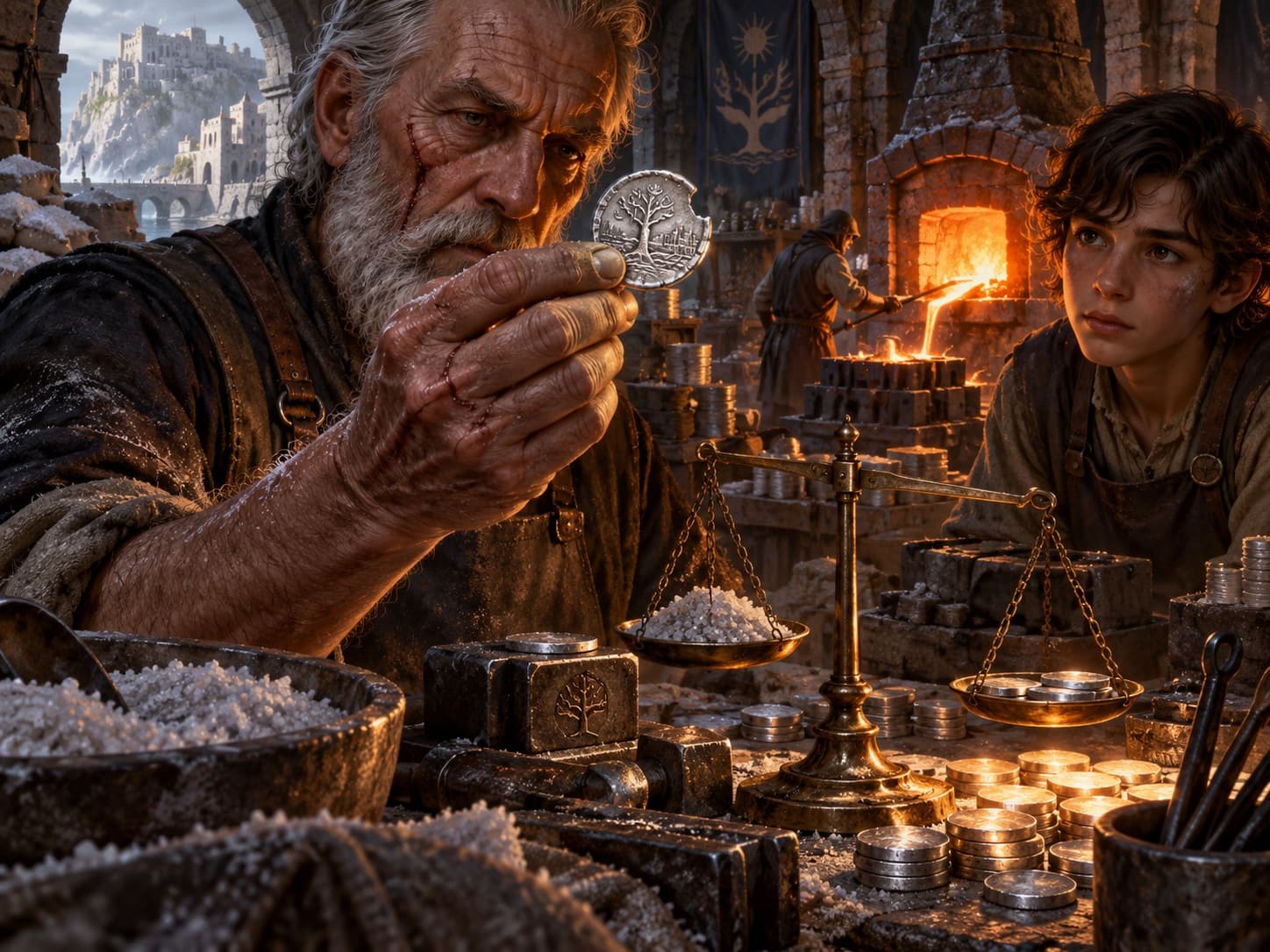
The silver was old, worn smooth across the nose of the woman stamped on its face and nearly featureless around the rim. Nothing remarkable. Half of Sólbrzeg carried coins at their belts more exhausted than their owners.
But this one felt heavier than an ordinary coin.
Not on the scales.
In the fingers.
Hlan pressed his thumb against the obverse.
The smell of wet wool.
Sour wine.
A woman’s hair plastered to her cheek.
Laughter somewhere behind a door.
And that ugly, deep twist in the stomach a man recognises before he even knows what he is about to see.
Hlan lifted his thumb.
“It doesn’t remember your wedding.”
“Exactly!” The merchant leaned across the table. “That’s what I’ve been saying!”
“It remembers your wedding perfectly well. It simply doesn’t remember the version you would prefer.”
A snort came from the back of the workshop.
Hlan did not need to turn.
“Wena.”
“I didn’t say anything.”
“The worst kind of laughter.”
The fifteen-year-old girl sat on a sack of salt by the furnace, knees drawn up beneath her chin, a piece of bread in one hand. She wore one of Hlan’s aprons, much too large and tied twice around her waist. A few strands of dark hair clung to the skin at her temple.
The merchant looked at her resentfully.
“Master, I paid for a record of my marriage oath.”
“And you received one.”
“My wife claims the coin shows how I looked at her sister.”
Hlan tapped the coin against the stone worktop.
The note rang clean.
Not perfect.
But clean.
“Because you looked at her.”
“That was not part of the oath.”
“Memory does not know your clauses.”
The merchant opened his mouth.
Hlan placed the coin on one scale-pan and began setting weights on the other.
“Silver is sound. Binding stable. No fractures. No foreign grain. Your memory. Your wife had the courage to touch it. What happened after that is no longer my responsibility.”
“I want my money back.”
“For the betrayal?”
Wena snorted.
“For the coin!”
“The coin works.”
“For a defective coin.”
Hlan sighed.
“Master Vesk, if a smith makes you a good knife and you cut off your own finger with it, you do not return to the smith to complain about the edge.”
“This is fraud.”
“No. Fraud would be if I had struck you a memory in which you never looked at your wife’s sister.”
The merchant froze.
“You can do that?”
Hlan peered at him over the rim of his lens.
“Get out.”
“But—”
“Now.”
The merchant took his coin and left muttering about old swindlers and guild cartels.
At the door he nearly collided with an apprentice carrying a tray of heated blanks.
“Watch it, damn you!”
The apprentice jumped aside.
The tray tilted.
One silver blank slid onto the stone, bounced once and rolled beneath a table.
Another landed on the back of Wena’s hand.
She hissed.
Hlan was beside her before the blank hit the floor.
He seized her wrist and shoved her hand into a bowl of cold brine.
Too hard.
Wena drew breath through her teeth.
“Grandfather.”
“Hold it there.”
“I am.”
“Don’t pull it out.”
“I’m not.”
Hlan pushed the hot blank aside with a pair of tongs.
Only then did he look at her face.
The girl was watching him.
She was not crying.
That was worse.
“You’ll blister,” he said.
“I noticed.”
“Could have been worse.”
“That always improves the mood.”
The apprentice stood against the wall, white as flour.
“Master, I—”
“If you’re going to apologise, put the tray down first. Apologies do not cool silver.”
The boy obeyed.
Wena tried to pull her hand free.
Hlan kept it submerged a moment longer.
“Now.”
She lifted it out.
The skin was red.
Hlan smeared it with fat from a small clay jar.
Wena grimaced.
“Smells like ram.”
“The ram didn’t complain.”
“It died.”
“Exactly.”
He released her.
The first blank was still lying under the table.
Hlan bent down.
His knee answered with a sharp bolt of pain.
He stopped halfway.
Wena looked over.
“Need help?”
“No.”
He straightened.
Waited.
Tried again.
This time he reached the coin.
Picked it up.
Turned it between his fingers.
And stopped.
Had he already picked it up?
He looked at the blank.
At the floor.
At his own hand.
For a moment he was absolutely certain the coin had been lying on the table just seconds before.
Not under it.
And then equally certain he had not touched it yet.
“Grandfather?”
Hlan slipped the blank into a box.
“What?”
“Nothing.”
Wena watched him too long.
Hlan snapped the lid shut.
“Eat.”
“I am eating.”
“Then eat more quietly.”
“I’ve already apologised to the bread.”
Someone knocked on the door three times.
Not like a customer.
Evenly.
With a pause after the second knock.
Hlan knew the rhythm.
Official.
“If they’ve brought me another form on silver-dust losses, I’m burning down the town hall,” he said.
Wena smiled.
“You’d weigh the ashes first.”
Hlan did not answer.
Because for a moment he was trying to remember whether he had closed the eastern window that morning.
And he could not.
⸻
That evening the soup was too salty.
Wena added more.
Hlan watched her darkly.
“Your mother used less.”
“No.”
“She did.”
“Grandfather, you salt everything as if the mines paid you by the spoonful.”
“I know the taste of my own house.”
“Did Mama?”
Hlan put his spoon down.
The question looked innocent.
It was not.
Wena kept eating.
“She had a way,” he said at last. “Three fingers. Never a spoon.”
“That isn’t an answer.”
“It is an answer.”
“To a question I didn’t ask.”
Hlan reached for the bread.
Wena was looking at the hollowed wooden block beneath the scales.
She knew.
Of course she knew.
Children do not find things because they are good at searching. They find them because adults believe children are not looking.
“No,” said Hlan.
“I haven’t done anything yet.”
“You even hold thoughts badly.”
“I only want—”
“No.”
Wena threw a crust onto the board.
“You don’t even know what I’m going to ask.”
“I do.”
“Then say it.”
Hlan looked at the soup.
“The coin.”
Silence.
“My mother is in it.”
“No.”
Wena recoiled.
Hlan tightened his hand around the spoon.
“The coin contains my memory of your mother.”
“So her.”
“No.”
“Do you hear yourself sometimes?”
“More often than I’d like.”
“You let some stranger test his wedding betrayal, but I’m not allowed to touch my own mother?”
“She isn’t yours.”
“The coin or my mother?”
Hlan looked up.
Wena resembled Sanna most when she wanted to hurt someone and had not yet decided whether she was allowed.
“The coin,” he said.
“And my mother?”
Hlan stood.
His knee complained again.
“Eat.”
“Wonderful. As always.”
“Wena.”
“Yes, Master?”
The word was small.
She made a knife of it.
Hlan gathered the bowls.
“The Reeve of Measures comes tomorrow.”
“The one from the Pact?”
“The one from the papers.”
“Radek Mir?”
Hlan stopped.
“How do you know?”
“The apprentices talk.”
“The apprentices talk because I pay them for their hands and their tongues are free.”
“They say he used to be your apprentice.”
“He did.”
“And he knew Mama.”
Hlan put the bowl down too hard.
Ceramic knocked against wood.
“Bed.”
“What did she smell like?”
Hlan looked at her.
Wena was no longer being cruel.
That was worse.
“Mama,” she said. “What did she smell like?”
Hlan opened his mouth.
He saw a wet porch.
Warm skin.
Smoke.
A long braid.
And then the coin hidden beneath the scales.
Silver.
Apples.
No.
Had there really been apples?
“Soap,” he said.
Wena nodded.
“What kind?”
Hlan did not answer.
The girl stood.
“Exactly.”
She left.
Hlan remained with two empty bowls.
And one answer that weighed too little.
⸻
II
Radek Mir entered the mint like a man who still remembered where the third floorboard creaked.
He stepped over it without looking.
That irritated Hlan more than it should have.
Radek was perhaps twenty-some years younger. His hair had gone grey at the temples, but his back was still straight. His official coat was well cut without being gilded into stupidity. He wore no sword at his belt.
He wore a small travelling scale.
“Old master.”
“Old official.”
“I’m not old yet.”
“Office counts double.”
Radek smiled.
Wena brought three cups of thin small beer.
Radek nodded to her.
“You’ve grown.”
“You’ve shrunk.”
Hlan raised an eyebrow.
Radek laughed.
“Sanna used to say the same.”
Wena stopped for half a step.
Hlan heard the change in her breathing.
“What do you want?” he asked.
Radek set a sealed packet on the table.
“The Salt Pact.”
“Still a stupid name.”
“It has worked for forty years.”
“That does not improve the name.”
Radek unfolded the document.
Załomie.
Sólbrzeg.
Caravans.
Prices.
Crossings.
Winter deliveries.
Nothing Hlan had not heard for the past month in taverns and at market tables.
The old agreement had expired.
The new one had stalled.
Załomie demanded fixed salt measures and reduced crossing fees. The merchants of Sólbrzeg demanded guaranteed purchase of entire caravans and compensation for wagons lost on the mountain roads.
Without an agreement, the caravans would not leave before the first snow.
“Paper is enough,” Hlan said.
Radek shook his head.
“Not after last winter.”
“The paper didn’t freeze.”
“Trust did.”
Hlan snorted.
“Put that on the office crest.”
Radek took a small unworked disc of silver from its case.
He placed it on the table.
Hlan did not touch it.
“We want a Measure,” said Radek.
Wena put down the jug more slowly than necessary.
Hlan noticed.
“Official?”
“Yes.”
“After all these years?”
“After all these winters.”
Measures were used rarely.
Not because people did not wish to remember.
Because most did not understand the price.
For an ordinary contract, paper, witnesses and seals were enough.
A Measure mattered when words were too little.
A chosen witness held the blank during the strike. The minter guided the binding, and the silver held that witness’s memory of a specific moment.
Not truth.
Not the words written in the record.
What the witness remembered.
Later, the parties could press a thumb to the coin and enter that fragment of memory: feel the cold of the chamber, smell the wine, the tension in the belly, hear broken pieces of speech, see faces as the witness had remembered them.
It was not perfect.
But it was harder for a man to deny an agreement when he could touch the moment in which he himself had nodded.
“Who is the witness?” Hlan asked.
“Merek Taal.”
Hlan knew the name.
River merchant.
Sensible.
Rich.
Honest enough for a wealthy merchant who still wished to look into a mirror.
“He was at the talks?”
“All the official ones.”
Hlan slowly pushed the blank with one finger.
The silver was good.
Too good for an official commission.
“And the unofficial ones?”
Radek set both hands on the table.
“You were always unbearable.”
“That is why I never became an official.”
“We want you to strike the Measure in six days.”
“No.”
“You haven’t even read the terms.”
“Exactly.”
Radek sighed.
“Hlan.”
“Radek.”
“If the Pact has no Measure, Załomie will not sign.”
“They will.”
“They won’t.”
“Then let them not.”
Wena looked at her grandfather.
So did Radek.
“Do you know what happens next?”
Hlan said nothing.
“The caravans stop. The merchants divert their salt to the southern route. Załomie buys grain at twice the price or doesn’t buy it at all. The first frost closes the pass. Then people come to town who were right on paper and hungry in the flesh.”
Hlan looked at the silver.
Radek went on.
“I’m not asking for a miracle. I’m asking for one good coin.”
“It always starts with one.”
“You know why I chose you.”
“Because everyone better is dead.”
“Because when you strike, people trust the weight.”
Hlan looked at him.
“Dangerous sentence.”
Radek smiled sadly.
“That is why I brought it to you.”
Hlan pulled the document toward himself.
“Leave it.”
“You’re accepting?”
“I said leave it.”
Radek shut the case.
At the door he paused beside Wena.
“Still want into the guild?”
Wena looked at Hlan.
“I want into the mint. The guild is an occupational disease.”
Radek snorted with laughter.
“Sanna would have said the same.”
Hlan stood.
“Out.”
Radek watched him for a moment.
“I’ll come tomorrow.”
“Is that a threat?”
“Administration.”
When he was gone, Wena gathered the cups.
“I liked him.”
“Five minutes.”
“Enough.”
“That is not a virtue.”
“Did Mama like him?”
Hlan spread the document across the table.
“I don’t know.”
Wena stopped moving.
Only after a moment did Hlan understand what he had said.
He did not remember.
Or perhaps he had never known.
⸻
III
Merek Taal had the memory of a man who had made his living from precision.
Three days later, when Hlan ran a trial binding on a thin strip of silver, the memory entered the metal without trembling.
A cold room.
Wet cloaks.
Sour apples on the table.
Two sides seated opposite one another.
Radek by the wall.
The voice of Załomie’s representative:
“Four measures to the barrel.”
Merek:
“Three and three quarters.”
Someone swore.
Laughter.
Then a long negotiation.
The memory was dull.
Good.
Good agreements usually are.
Hlan ran his thumb along the trial strip.
Wena stood two steps away, hands behind her back.
She was not allowed to touch.
She disagreed.
“Again,” said Hlan.
Merek sighed.
“Third trial.”
“Memory is not a barrel. It won’t split from turning.”
“My head might.”
Hlan dipped the strip into brine.
It hissed.
Small crystals of grey salt burst across the surface.
“Again.”
Merek closed his eyes.
The memory returned.
Voices.
Table.
Three and three quarters.
Crossing guarantee.
Compensation.
Silence.
Signatures.
End.
Hlan drew the strip away.
“The end is missing.”
Radek sat against the wall.
He did not move.
Merek frowned.
“I stayed to the end.”
“Which end?”
“We signed.”
“After?”
Merek thought.
“Then I left.”
“Who stayed?”
“I don’t know. People from Załomie. Radek. Maybe the ferryman…”
Hlan turned his head.
Radek looked at him calmly.
“You told me he was at every negotiation.”
“The official ones.”
“I asked about the unofficial ones.”
“I remember.”
Wena’s eyes moved from one man to the other.
Merek went pale.
“What happened after the signing?”
Radek did not answer.
Hlan stood.
“Out.”
“Hlan—”
“Merek, you too.”
The merchant looked at Radek.
Radek nodded.
When they were alone, Hlan pulled a pipe from a drawer even though he had not smoked in ten years.
He held it in his hand.
“What concession?”
Radek approached the table.
“The last one.”
“What?”
“Załomie agreed to three and three quarters. After the formal close, the merchants agreed to return one eighth of the crossing levy in food if snow closed the second route.”
“Why isn’t it in the record?”
“Because it was added later.”
“Why isn’t it in the witness?”
“Because Merek left.”
Hlan put the pipe down.
“So you choose a man who remembers everything except one thing.”
“He remembers the signed pact.”
“Not all of it.”
“Hlan—”
“All of it.”
Radek sighed.
“If that amendment enters the Measure as an equal term, the merchants withdraw before winter.”
“Because it costs them.”
“Yes.”
“So they agreed and now wish to forget.”
“They agreed under pressure.”
“They still agreed.”
Radek braced both hands on the table.
“Listen to me. With that clause, the Pact does not survive the Merchants’ Council. Without the Council, not one wagon moves. Without the wagons, all your moral beauty remains ink on paper.”
“And the Measure without the clause?”
“Passes.”
“And Załomie will remember receiving less than it received.”
“No. It will remember what the official witness remembers.”
Hlan laughed without humour.
“Do you hear yourself?”
“Every day.”
“That should help.”
Radek clenched his jaw.
“I am not asking you to invent an event. Merek lies about nothing.”
“He merely knows nothing.”
“Sometimes ignorance is cheaper than hunger.”
Hlan went to the window.
In the yard Wena was carrying sacks of salt with an apprentice.
She laughed.
The apprentice said something and got hit in the shoulder with a sack.
Radek came to stand beside him.
“Wena has a hand.”
Hlan said nothing.
“Better than half the boys in first year.”
“I know.”
“The guild won’t take her without a sponsor.”
“I know.”
“I can.”
Hlan turned his head.
Radek spoke evenly.
“Official training. Assay room. Not sweeping. Not carrying water. Real work.”
“For the coin?”
“For work that keeps the Pact alive.”
“Name things properly.”
“You taught me that.”
Hlan met his eyes.
Radek drew out a small box.
Opened it.
Inside lay a fresh blank.
White silver.
Clean.
Beside it, on a square of linen, rested grey salt.
“There’s little of this left,” Radek said. “Northern seam. Best I’ve seen in twenty years.”
Hlan felt his tongue stick to the roof of his mouth.
“Why are you showing me?”
“You know.”
“Say it.”
“You can strike her again.”
Someone in the workshop swung a hammer.
Once.
Twice.
Three times.
Radek closed the box.
“Properly this time,” he added.
Hlan stood still.
“Get out.”
“Hlan—”
“Out.”
Radek left.
This time he stepped over the creaking board.
Hlan watched him go and for a moment hated him for still remembering where it was.
⸻
IV
That evening Wena wore Sanna’s dress.
It was too long.
Hlan noticed mud on the hem.
“Take it off.”
“No.”
“It’s too long.”
“For whom?”
Hlan clenched his teeth.
“You’ll ruin it.”
“It’s clothing.”
“Your mother’s.”
“Exactly.”
“Not everything left by the dead needs using.”
“You don’t say that about the coin.”
Silence.
Wena knew she had struck true.
Hlan turned away.
“Take it off.”
“No.”
“Wena.”
“What?”
“You don’t look like her.”
The girl froze.
Hlan already wanted to take the words back.
He did not.
Wena slowly nodded.
“I know.”
She walked past him.
“And good.”
The door slammed.
Hlan sat.
He took out Sanna’s coin.
It was smaller than modern Measures.
The silver had warmed in colour from thousands of touches. On the obverse he had struck a simple mark: a branch with three leaves.
Nothing on the reverse.
He had needed no more.
He pressed his thumb to it.
Rain.
Sanna on the porch.
Hair tied carelessly.
Wena small, still in a cradle.
Sanna singing.
Softly.
Cleanly.
First verse.
Second.
Third.
Fourth.
Sanna looked at him and smiled.
Hlan lifted his finger.
The door creaked.
Wena stood in the doorway.
Still wearing the dress.
“You’re listening.”
“No.”
“You’re standing in the door.”
“That is not listening. That is architecture.”
Hlan closed his hand around the coin.
“Bed.”
“Was she singing?”
He did not answer.
“A lullaby?”
“Yes.”
“Which one?”
Hlan named it.
Wena frowned.
“She sang out of tune.”
“What?”
“Mama. Always.”
Irritation came at once.
Defensive.
“No.”
“Yes.”
“She had an ear.”
“Not on the third verse.”
“Wena—”
“She always dropped too low. Then laughed at herself.”
Hlan looked at the coin.
“You were small.”
“I was six when she died.”
“A child’s memory—”
“Is worse than a coin?”
He had no answer.
Wena came closer.
“Let me.”
“No.”
“Grandfather.”
“No.”
“You can listen to her every day, and I have to believe I remember wrong?”
“This isn’t—”
“What?”
“You don’t know what the coin does.”
“Then tell me.”
Hlan was silent.
Wena held out her hand.
“Let me.”
“No.”
“Because you’re afraid I’ll hear her wrong?”
“Because I’m afraid you’ll hear her the way I do.”
Wena lowered her hand.
It was the first honest sentence he had given her that evening.
They sat opposite one another.
The coin lay between them.
“Sing it,” she said.
Hlan frowned.
“What?”
“The lullaby.”
“No.”
“If you remember.”
“I do not sing.”
“I know.”
“Then why ask?”
“Sing the third verse.”
Hlan looked at the coin.
He heard Sanna.
Cleanly.
He tried to hum.
The third verse came out true.
Wena shook her head.
“No.”
She hummed it.
At the end of the phrase she dropped just slightly too low.
The flaw was almost invisible.
Then Wena smiled without meaning to.
A small laugh.
Hlan’s throat tightened.
It was not Wena laughing.
It was Sanna.
Not exactly.
Not truly.
But enough.
Hlan picked up the coin.
Pressed his thumb to it.
First verse.
Second.
Third.
Perfect.
No laugh.
No wrong note.
Hlan suddenly smelled apples.
He did not know whether Sanna had truly smelled of apples.
Perhaps once.
Perhaps only that evening.
Perhaps never.
He remembered the branch on the coin.
Remembered choosing the mark.
Remembered not wanting to preserve her tired.
Not wanting to preserve the shadows beneath her eyes.
Not wanting the arguments.
Not wanting the day she told him she would not spend her whole life asking permission.
Not wanting the day she slammed the door.
So when he had struck the coin after her death, he had chosen the evening on the porch.
Arranged it in his mind.
Cleaned it.
Balanced it.
Straightened the third verse.
Hlan lifted his thumb.
Wena watched him.
“What?”
“Nothing.”
“Grandfather.”
“Nothing.”
“You’re lying.”
Hlan closed his eyes.
“The coin does not lie.”
“Good.”
“I lied when I struck it.”
Wena said nothing.
Hlan opened his hand.
The coin lay against his skin.
Small.
Beautiful.
Too clean.
“I didn’t understand,” he said. “I thought… if I remembered her properly…”
He stopped.
Wena looked at him.
“You corrected her.”
Hlan felt the words enter between his ribs.
“Yes.”
“Even dead.”
He did not defend himself.
Wena stood.
“I don’t want her to be good.”
Hlan looked up.
“I want her to be.”
She left.
Hlan remained alone with the coin.
After a while he touched it once more.
Sanna sang perfectly.
This time Hlan lasted only two verses.
⸻
V
He found the black disc the following night.
Not in the strongroom.
Not in a secret chest.
At the bottom of an old cooling vat, beneath layers of mud, salt and slag no one had cleaned since Hlan still had black hair and too many opinions.
He pulled it out with tongs.
It was cold.
That irritated him immediately.
Metal had no right to remain cold after a day beside the furnaces.
He dropped the disc onto the worktop.
He heard the metallic note a fraction of a second before the object struck the wood.
Hlan froze.
“No,” he said.
He picked it up.
Oval.
Dark.
Matte as graphite.
He marked one face with chalk.
Turned it over.
The chalk remained on top.
Hlan looked at his own hand.
Turned the object again.
The chalk was still on top.
“Either someone failed to finish the world,” he muttered, “or the apprentices have been pissing in the scrap.”
He set a measure against it.
The dimensions were correct.
Then they were not.
Then they were again.
Hlan swore.
On the edge he found a mark.
A broken circle.
Three strokes.
He did not know it.
He set the dark disc beside a trial die.
For the die he had been considering two ornaments: a wave and a branch.
He chose the wave.
Struck.
The silver blank took the pattern.
The black object clicked.
Beside the wave, a second form rose from the fresh silver.
A branch.
Real.
Raised.
Hlan ran a fingernail over it.
It was there.
After a dozen breaths it began to soften.
Sank into the surface.
Disappeared.
Only the wave remained.
Hlan pushed back his chair.
He was not frightened.
He was furious.
That felt more honest.
He placed the black disc in a lead box.
Closed it.
Then stood by the door for a long time trying to remember whether, before the experiment, he had intended to melt down the trial blank or keep it.
He remembered doing one.
And the other.
Both with equal certainty.
“No,” he said again.
He slid the box beneath the lowest shelf.
He did not touch it again.
At least not that night.
⸻
VI
Wena stole Sanna’s coin before dawn.
Hlan knew because of the emptiness beneath the scales.
Not the trace.
Not the open compartment.
The emptiness.
As if someone had removed one weight from the room and everything else had immediately become too light.
He found her in the old assay room.
She sat on the floor between broken scales.
The coin lay beside her.
Wena stared at the wall.
“You didn’t touch it.”
She said nothing.
“Wena.”
“I did.”
Hlan leaned against the doorframe.
“How many times?”
“Once.”
“How long?”
“I don’t know.”
“What did you see?”
“I don’t know.”
“What did you feel?”
Wena turned.
Her eyes were dry.
“You.”
Hlan said nothing.
“You everywhere.”
“It is my memory.”
“I know.”
“I told you.”
“No. You told me it wasn’t her. I thought you were guarding your toy.”
“Wena.”
“She smelled of soap.”
Hlan felt a stab.
“Yes.”
“What kind?”
He did not know.
Wena laughed once.
Ugly.
“The coin didn’t know either.”
Hlan stepped inside.
“Give it back.”
“No.”
“Give me the coin.”
“Why?”
“Wena.”
“So you can correct her again?”
“Give it back.”
Wena stood.
“You knew it was wearing away?”
Hlan did not answer.
“You knew.”
“Every record wears.”
“And you used it every day?”
“Not every day.”
“How many times?”
“I don’t know.”
“Of course.”
Wena kicked an old weight.
Metal struck the wall.
“You’re eating her.”
“No.”
“Every time you take another piece and call it saving her.”
“That is not how it works.”
“Then how?”
Hlan knew exactly how.
Mnemonic memory smoothed with use.
Edges vanished first.
Contradictory details.
Small differences.
Then smells.
Then tone.
That was why good Measures were kept sealed and brought out only in disputes.
Private memory coins were rare.
Not because people did not wish to keep the dead.
Because after a few years most learned that every touch was a small consumption.
Hlan had learned too.
And had kept touching.
“Give it back,” he said more quietly.
Wena held the coin.
“Radek says he can take me into training.”
Something hardened inside Hlan.
“Of course.”
“I didn’t ask him.”
“You didn’t need to.”
“He’ll give me a place.”
“He’ll give you a leash.”
“You don’t even give me that. You keep me outside the door.”
“You are fifteen.”
“You were an apprentice at fifteen.”
“I was stupid.”
“You still are. Just more expensive.”
Hlan held out his hand.
“The coin.”
Wena stared at him.
“Radek knew Mama.”
Hlan lowered his hand.
“Yes.”
“He said he’ll tell me about her.”
“Radek remembers her his way.”
“Everyone remembers their own way!” Wena shouted. “That’s the part you don’t understand.”
Hlan felt the floor shift beneath him.
“At least he admits it’s his version.”
That was unfair.
And true.
Hlan said the first thing that could win the argument.
“If she were alive, you wouldn’t have been enough for her either.”
Wena went still.
Hlan despised his own tongue.
Too late.
The girl placed the coin on the floor.
Very carefully.
“All right,” she said.
“Wena—”
“No.”
She passed him.
Hlan did not try to stop her.
He remained in the assay room.
The coin lay on the floor.
He did not pick it up immediately.
For a moment he wanted to kick it against the wall.
Instead he sat.
His knee hurt.
His back hurt.
His hand trembled.
The coin remained where it was.
Hlan thought that old age did not make a man wiser at all.
It only gave him more time to learn how many times he could say something that could never be taken back.
⸻
VII
Radek came before noon.
Alone.
Hlan did not invite him in.
Radek entered anyway.
“Wena came to me.”
“I know.”
“You don’t.”
“She came back angry. That means she was with someone who listened.”
Radek sat.
“She wants training.”
“She wants a mother.”
“One does not exclude the other.”
Hlan pulled the Pact record from a drawer.
“I found the ferryman.”
Radek looked up.
“Who?”
“Leto Varr.”
A shadow crossed Radek’s face.
“He is not an official witness.”
“He was at the end.”
“He was drunk.”
“He still remembers.”
“Hlan—”
“I went this morning.”
Radek rubbed his face.
Hlan continued.
“He was there for the final concession. Remembers who proposed it. Remembers the merchants agreeing to return part of the crossing levy in food if the pass closed.”
“Do you know what happens if that enters the Measure?”
“Yes.”
“The Council may walk away.”
“It may.”
“And if it does?”
“I know.”
Radek struck the table with one finger.
“Then stop behaving as if you discovered a crime.”
“I didn’t.”
“It was a compromise.”
“It was an incomplete memory chosen because it was convenient.”
“A true memory.”
“Incomplete.”
“Truth is always incomplete.”
Hlan looked at him.
Radek smiled bitterly.
“You taught me that too.”
“No.”
“Of course you did.”
Radek stood.
“When you struck Sanna, you chose one moment.”
Hlan felt cold.
“Do not speak about her.”
“Why?”
“Radek.”
“You chose the porch.”
“Shut up.”
“You didn’t choose the day she threw a cup at you.”
“Radek.”
“You didn’t choose the day she said she hated the mint.”
Hlan struck the table with his palm.
“Get out.”
“You didn’t even choose her laugh after the third verse.”
Hlan froze.
So did Radek.
“How do you know?”
Silence.
Radek looked aside.
“Because I remember it.”
Hlan’s mouth went dry.
“You were there?”
“Not on the porch. In the workshop. She sang everywhere. Badly.”
Hlan stared at him.
“You—”
“I knew her, Hlan.”
“You were a boy.”
“I was two years older than she was.”
Wena had never said.
Perhaps she did not know.
Hlan sat.
Radek’s voice softened.
“I wasn’t her lover, if that’s what you want to ask.”
Hlan did not want to.
He did.
“I was someone she talked to when you weren’t listening.”
That hurt more.
“And that is why you choose Merek’s memory?”
“No.”
Radek moved closer.
“I choose it because someone has to keep this Pact alive. You see a coin. I see wagons.”
“And Wena?”
“I see a girl you refuse to let be good at the thing she is good at.”
“Do not use her.”
“You have been using Sanna for eight years.”
Hlan rose so quickly the chair toppled.
Radek did not step back.
For a moment they were master and apprentice again.
Twenty years younger.
More foolish.
Stronger.
Once Hlan would have struck him.
Now he merely pointed at the door.
“Out.”
Radek left.
On the table he left a small card.
Wena’s acceptance into assay training.
Signed.
No conditions.
Hlan looked at it for a long time.
Then turned it over.
On the back Radek had written:
Not everything is a bargain.
Hlan snorted.
“An official,” he told the empty room. “Starts writing aphorisms.”
But he did not throw the card away.
⸻
VIII
Hlan kept the last measure of grey salt in a clay jar locked inside an iron box.
Net weight: two hundred and thirty-seven grams.
Jar: eighty-two.
The salt came from a seam no longer worked.
It was ugly.
Grey.
Black-veined.
Good material rarely looked like something bards sang about.
Hlan had meant to use it one day to strike Sanna again.
He had never admitted that, even to himself.
The plan had no date.
Only when needed.
Now it was needed.
Just not for her.
Wena returned late in the afternoon.
Without speaking she laid Radek’s training card on the table.
“Taking it?” Hlan asked.
“I don’t know.”
“It’s a good place.”
“I know.”
“You should.”
“I know.”
Hlan grimaced.
“Say ‘I know’ once more and I’ll charge you rent.”
“It’s your room.”
“All the more reason.”
She sat.
For a while they heard only the furnace, the hiss of brine and the dull hammering from the main hall. Somewhere a cart of ore crossed the stones; its dry axle shrieked at every turn as though protesting the rotation of the world.
“I’m sorry,” Hlan said.
Wena looked at him.
“For what?”
“The sentence.”
“Which one?”
“You know.”
“I don’t want to guess.”
Hlan felt irritation.
Not with her.
With the fact that apologies required precision.
“That you wouldn’t have been enough for your mother.”
Wena looked down.
“I don’t know whether I would have.”
“No one is enough for anyone.”
“Excellent apology.”
“I’m trying.”
“It shows.”
Hlan pushed the training card toward her.
“Go.”
“Did Radek buy you?”
“No.”
“Me?”
“He’s trying.”
“And?”
“If they buy you, make sure they pay full weight.”
Wena smiled from one corner of her mouth.
“That’s better.”
Hlan took out the clay jar.
Set it between them.
Wena looked at it.
“What is it?”
“The last measure.”
“Of what?”
“Good salt.”
“You’ve half a storehouse.”
“Not this.”
He told her.
About the plan.
About Sanna.
About why he had kept it.
Wena listened.
“You wanted to strike her again?”
“I did.”
“Better?”
Hlan closed his eyes.
“Yes.”
“So correct her again.”
“Yes.”
Wena touched the jar.
“And now?”
“Now I need it for the Pact Measure.”
“Radek wins.”
“No.”
“If you make the coin, he gets his Pact.”
“He does.”
“So he wins.”
“A true one.”
“He wants the incomplete one.”
“Exactly.”
Wena looked at him.
Hlan drew out two thin strips of trial silver.
One carried Merek Taal’s memory.
The other Leto Varr’s.
“You cannot bind two memories into one Measure without cracking it,” he said.
“So?”
“I don’t have to.”
He ran one finger along the strips.
“An official Measure is meant to witness the final agreement. The problem is not that Merek lies. The problem is that he did not see the end.”
“Then use Varr.”
“The Council rejects him. Drunk. Ferryman. Man of Załomie.”
“So Radek wins.”
“No.”
Hlan smiled.
Wena looked suspicious.
“I don’t like it when you smile like that.”
“Neither do I.”
“What did you think of?”
Hlan picked up the hammer.
“A minter does not choose which memory is true.”
“Then what does he do?”
Hlan weighed the hammer in his hand.
“He weighs.”
⸻
IX
The Hall of Measures was the ordinary mint hall, except that on this day someone had cleaned it.
Which made it suspicious.
The apprentices had scrubbed the stone. The scales shone. Marks of Sólbrzeg and Załomie hung from the wall, and smoke from the furnaces had gathered beneath the beams in a grey ceiling heavier than morning fog.
The mint cat, which recognised no politics, slept beneath the warmest furnace.
Radek stood by the long table.
Merek Taal beside him.
On the opposite side stood Leto Varr in an old coat whose smell suggested he had indeed fortified himself before the ceremony.
Merchants whispered.
The Załomie delegation watched grimly.
Wena stood beside Hlan in an apron without pockets.
Not as an assistant.
As a second pair of hands.
The guild elder tried to object.
Hlan looked at him.
“You may leave.”
The elder stayed.
Radek approached.
“What are you doing?”
“A Measure.”
“With Varr?”
“With the end of the agreement.”
“He is not the official witness.”
“That is why there are two.”
Radek went pale.
“You cannot bind two memories.”
“I’m not going to.”
Hlan raised his voice.
“Merek.”
The merchant stepped forward.
“Tell us the last hour of negotiations.”
“Here?”
“Don’t sing.”
A few people laughed.
The tension loosened slightly.
Merek spoke.
Three and three quarters.
Compensation.
Guarantees.
Signature.
End.
Hlan pointed to Varr.
“You.”
The ferryman scratched his beard.
“After the signing, Załomie’s people stayed.”
“Who?”
Varr named them.
One name belonged to a man now standing at the table.
The delegate nodded.
“The merchants came back,” Varr said. “It was about the northern route closing. They said if the snow came early, half the crossing fees would be returned in food.”
“One eighth,” Radek corrected.
Varr looked at him.
“One eighth of the total caravan cost.”
“Which equals half the crossing levy,” said Radek.
Hlan looked at Wena.
“Hear that?”
“Yes.”
“Not the same.”
Radek shut his eyes.
Hlan addressed the hall.
“Merek remembers the truth.”
A murmur.
“Varr remembers the truth as well. Only later.”
Radek approached.
“Hlan.”
“Not yet.”
He placed the blank on the scale.
On the other pan he measured the grey salt.
Slowly.
The wooden measure creaked beneath his fingers.
One portion.
Then less.
Then he removed a few grains.
Salt ground against the pan like tiny shards of glass.
The hall held only the sound of metal from neighbouring stations, the hiss of brine and someone’s heavy breathing.
Radek spoke quietly.
“If the Council walks, the caravans do not move.”
“I know.”
“If you include that amendment—”
“I am not including an amendment.”
“What?”
Hlan raised the blank.
“A Measure is not a ledger. It cannot hold the whole Pact. It can hold a moment.”
He looked at both parties.
“So we choose the moment where the versions meet.”
Radek understood first.
“No.”
Hlan smiled.
“Yes.”
He asked both witnesses to stand opposite one another.
They could not bind memory together.
But they could reconstruct the same conversation.
Out loud.
Here.
Now.
In front of people who remembered their own fragments.
Radek glared.
“This is not procedure.”
“Procedure is what you call it when an official knows what will happen.”
Wena snorted.
Hlan looked at her.
“Do not help.”
The conversation began again.
Merek gave his version.
Varr corrected him.
A Załomie delegate filled a gap.
A Sólbrzeg merchant shook his head, then confirmed something.
It was not a beautiful truth.
It was sticky.
Full of interruptions.
“I did not say that.”
“You did.”
“Not then.”
“After the wine.”
“That still counts.”
Someone at the back laughed nervously.
Someone else hissed for silence.
Finally one of the Sólbrzeg merchants slammed his fist on the table.
“Damn it, we agreed to the return!”
Silence.
Radek closed his eyes.
Hlan looked at him.
“We have a witness.”
“Who?”
Hlan pointed to the man who had just shouted.
The merchant went pale.
“Me?”
“You were there?”
“Yes.”
“You remember?”
“Yes.”
“You agree that was the final arrangement?”
The merchant looked at his own people.
Then at the Załomie delegation.
The hall was growing hotter. Sweat ran from beneath Hlan’s woollen headband and stung the corners of his eyes. Acrid smoke curled above the crucible, and heated salt smelled almost like lime.
The merchant swallowed.
“Yes.”
Radek whispered a curse.
Hlan set the blank.
“Hand.”
The merchant stepped forward.
Pressed his thumb against the metal.
Hlan poured the grey salt.
The hiss was sharp and violent.
Several people flinched.
Salt clung to the rim of the blank while the thin silver beneath the die began fading from bright red to deep cherry.
The furnace breathed dry heat across their faces.
Wena offered the tongs.
Hlan took them in his left hand.
His right was trembling.
“Grandfather.”
“I see.”
“You don’t.”
“Then I’d be an official.”
She smiled nervously.
The blank went beneath the die.
Hlan heard his own breathing and the dull hammer-strike from two stations away. Every sound seemed too loud.
The first strike opened the structure.
The second bound.
The third closed.
He raised the hammer.
First blow.
Clean.
Metal rang.
Second.
The memory entered.
Hlan felt someone else’s cold, smelled wet cloth and sour apples, felt the merchant’s embarrassment at having accepted a concession and regretted it immediately.
Third.
His hand trembled.
The hammer fell slightly crooked.
“Stop!” Radek shouted.
At whom, no one knew.
Hlan saw the blank shift beneath the die.
The cherry glow was already dulling.
Seconds.
No more.
Wena lunged for the tongs.
“No!”
Too late.
The blank slipped from the socket.
Hlan caught it with his bare hand.
Not the whole thing.
The edge.
Enough.
Pain arrived white.
Without a scream.
His hand opened by itself.
The smell of burned skin reached him a second later.
Wena caught the tongs.
The disc had already darkened.
Another moment and the structure would close.
Wrong.
Forever.
“Strike!” she shouted.
Hlan looked at his right hand.
The skin on his fingers was reddening.
“Grandfather!”
Left hand.
Hammer.
It felt wrong.
Badly balanced.
Too heavy.
Hlan lifted it.
Wena held the tongs.
Their eyes met.
“Don’t let go.”
“Don’t miss.”
Hlan struck.
The sound was dirty.
Not perfect.
Short.
Almost dull.
For a moment he thought:
I ruined it.
Then he heard a second note.
Lower.
Like the wrong third verse.
Wena looked at him.
“It’s there.”
Hlan raised the die.
The Measure lay on the table.
Uneven at one edge.
A small scar across its face.
It was not beautiful.
Radek approached.
“That is supposed to go to two cities?”
Hlan held out his hand.
“Touch it.”
“Hlan—”
“Touch it.”
Radek placed his thumb on the coin.
Closed his eyes.
Memory.
Imperfect.
Voices crossing.
Argument.
Returned fees.
Agreement.
Fear.
Exhaustion.
And above all, that one moment when the merchant—not the official, not the chronicler—knew he had agreed.
Radek opened his eyes.
“The Council will be furious.”
“It happens.”
“They may walk.”
“They may.”
“And if they don’t?”
Hlan looked toward the delegates.
“Then they get exactly what they agreed to.”
Radek looked at the coin.
Then at Hlan’s burned hand.
“Do you always have to do things the most expensive way?”
“Cheap work is what offices are for.”
Radek laughed.
Briefly.
Tired.
Wena still held the tongs.
Hlan looked at her.
“You can let go now.”
“I know.”
She kept holding on for one more second.
Then set them down.
⸻
X
The Council did not walk.
It threatened to for three days.
The merchants shouted.
Załomie threatened to close its own stores.
Radek spent two nights negotiating.
In the end, the caravans moved.
Not because everyone suddenly became honest.
Because winter was close, salt was heavy, and hunger heavier still.
Hlan lost his position as official Master of Measures.
The notice arrived four days later.
Wena read it aloud.
“‘Due to gross violation of certified procedure—’”
“Pretty.”
“‘—and unauthorised expansion of the recognised witness body—’”
“I always said witnesses multiply.”
“‘—Master Hlan is suspended from official contracts for a period no shorter than—’”
She stopped.
“How long?”
“Five years.”
Hlan considered.
“Could have made it ten.”
“You’re seventy-three.”
“Exactly.”
Wena folded the notice.
His right hand was bandaged. The fingers still moved.
Not all of them well.
He could continue working.
Just not the same way.
Radek came that evening.
He brought rye spirit.
“I don’t drink.”
“Since when?”
“Tomorrow.”
They sat.
Radek poured two cups.
Wena got water.
“Discrimination,” she said.
“You start assay training on Monday,” Radek replied. “You may file a complaint.”
She looked at Hlan.
“Really?”
Hlan shrugged.
“Someone has to teach them the trade.”
“They’re supposed to teach me.”
“That is exactly my concern.”
Radek drank.
“The Council wants the Measure kept in the vault.”
“Good.”
“Załomie wants a copy.”
Hlan shook his head.
“There is no copy.”
“I know.”
“Tell them.”
“I did.”
“And?”
“They didn’t believe me.”
“Good.”
Radek looked toward the compartment beneath the scales.
“You still have it?”
Hlan knew what he meant.
“Yes.”
Wena knew too.
She said nothing.
Radek stood.
“Good.”
At the door he stopped.
“Sanna truly sang out of tune.”
Hlan looked up.
“I know.”
“Terribly.”
Wena smiled.
“On the third?”
“Mostly.”
Something warm moved in Hlan.
Not memory.
Perhaps relief.
“Get out,” he said.
Radek laughed and left.
⸻
Later, Hlan took out the coin.
Set it on the table between himself and Wena.
“Take it.”
The girl did not move.
“What?”
“It’s yours.”
“No.”
Hlan raised an eyebrow.
“You wanted it for a month.”
“I wanted Mama.”
“It’s all I have.”
“No.”
He looked at her.
Wena touched the coin with one finger.
Did not awaken the memory.
“It’s all you made.”
Hlan wanted to answer sharply.
He found no need.
“What will you do with it?”
“I don’t know.”
“Good answer.”
“Finally.”
She slipped the coin into a small pouch.
Not around her neck.
Into a drawer with things.
Between a ribbon, a broken comb and three sheets covered in her handwriting.
An ordinary place.
Hlan turned toward the furnace.
On the lowest shelf he saw the lead box.
The Unstruck Reverse.
For a moment he considered taking it out.
He did not.
Wena brought two ordinary blanks.
“Can I?”
“What?”
“Strike a trial.”
“I’ll correct you with my left hand.”
“Your right can’t do much anyway.”
“No respect.”
“Knee, not respect.”
Hlan looked at her.
“Insolent.”
“Family trait.”
She set the blank beneath the die.
Hlan handed her the hammer.
“Not like that.”
“I haven’t even struck yet.”
“You’re already holding it wrong.”
“How can you know?”
“Fifty years of practice.”
“And a burned hand.”
“That was a demonstration.”
“Of what?”
“The cost of error.”
Wena rolled her eyes.
Then she began to hum.
The lullaby.
Hlan went still.
First verse.
Second.
On the third she dropped just slightly too low.
Wrong note.
Small.
Familiar.
Wena laughed at herself.
Hlan looked at the drawer.
He knew he could open it.
Touch the silver.
Check.
Compare.
Force memory to stand on the scales.
He did not.
He picked up the wooden measure that had held the grey salt.
It was empty.
Not a single grain remained.
He set it beside the blank.
“Again,” he said.
“What?”
“The third verse.”
Wena looked at him.
She sang it.
Wrong again.
Hlan listened.
And this time he corrected nothing.