I
Kharra kissed pillars before she worked.
Not out of devotion.
If the stone was warmer than her lips, water was moving somewhere behind it. If it was colder, that was when you started worrying.
That morning, the pillar kissed back.
Kharra drew her head away.
“Bad.”
The young apprentice standing two paces behind her swallowed.
“What?”
Kharra pressed her cheek to the granite.
“Nothing.”
“You said ‘bad.’”
“You. For asking before listening.”
Level Nine of Kadar-Belan was not a place any sensible creature chose to linger.
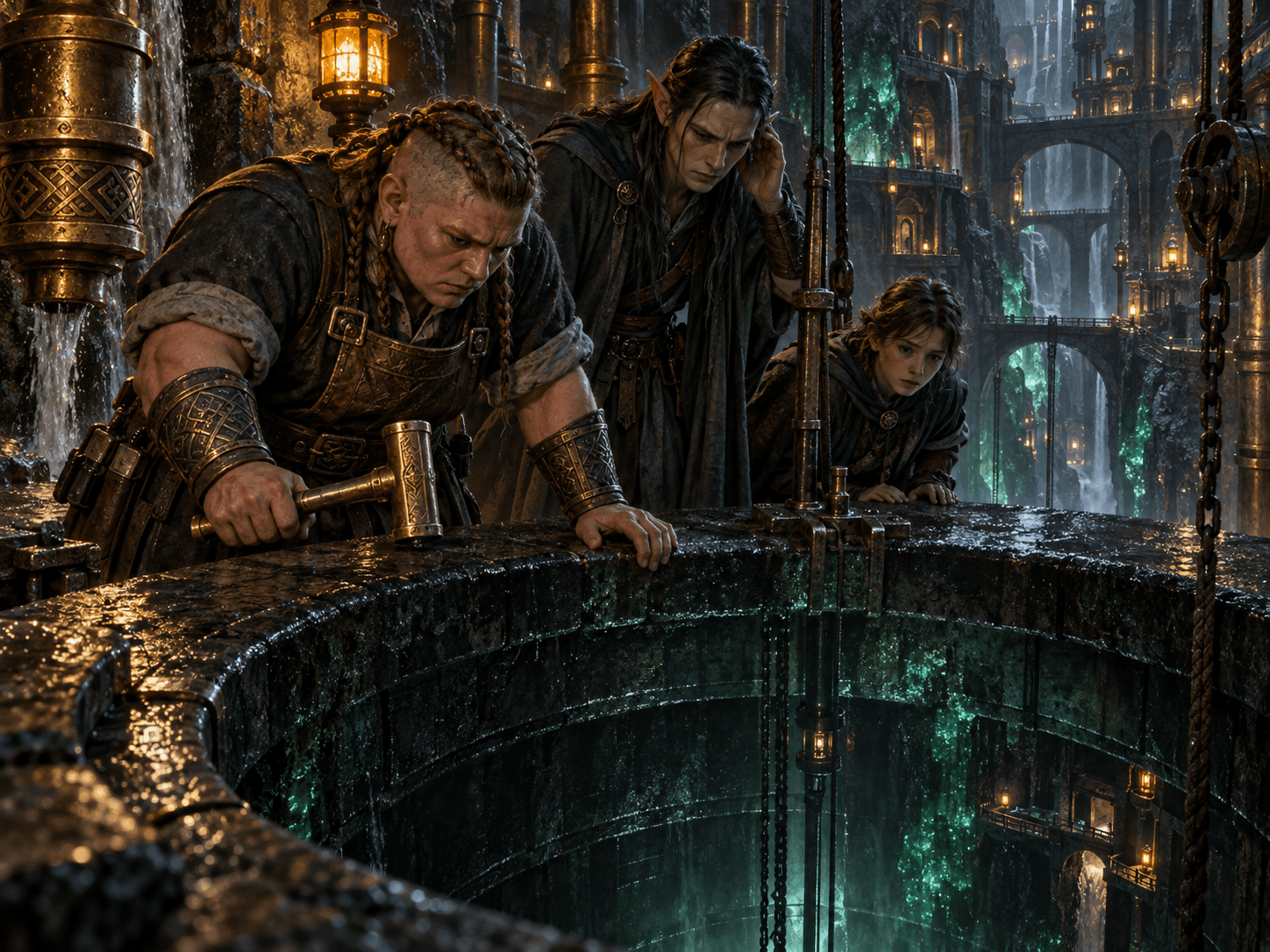
The walls here were old, dark and sweating. Water gathered in the pores of the granite, ran in thin threads down the joints and dripped into metal gutters leading toward the lower reservoirs. Brass pipes crossed overhead, and higher still, behind stone no one could see through, the wheels of the great pumps thundered.
All of Kadar-Belan had a vertical axis.
Far above them, the Crown caught real daylight through fractures in the mountain. Mirrors drove it downward, so that once each day a golden shaft cut through the city almost as far as Level Eight.
Below that lay workshops, suspended markets, forges and dwellings.
Deeper still — wells, pumping stations and old foundation halls.
Level Nine was the first place where Kadar-Belan stopped pretending to be a city and began to resemble a wound in the rock.
Kharra drew a brass tuning hammer from her belt.
It was not large.
It did not need to be.
The worst things in stone rarely required large tools.
She struck once.
The note passed through the pillar.
High.
Clean.
Too clean.
Kharra frowned, then struck again. The answer came back lower.
The apprentice looked at her.
“It changed.”
“You have ears.”
“What does that mean?”
“That you’re still using them.”
She took out a listening horn. The cone of thin copper narrowed to a small bone tip, which she fitted into her ear.
First came the pump.
Then the water.
Far-off tapping from a bell-crab somewhere inside a pipe.
And beneath all of it, something low.
So low she felt it more in her teeth than heard it.
Booom.
Pause.
Booom.
Not an echo.
Not an answer.
Something in between.
Kharra lowered the horn.
“Who’s working beneath us?”
“No one. Lower shaft’s been sealed for six days.”
“Why?”
“The Board.”
“That isn’t a reason. It’s an illness.”
The apprentice smiled nervously.
Kharra did not.
She walked to the rope hanging down the black technical shaft.
“Hold this.”
“Alone?”
“No. With my stupidity. It weighs enough.”
She wrapped the rope around her harness and checked the knot. Humans often misjudged the weight of a dwarf. Kharra was short, broad through the shoulders and heavy as a properly seated block.
In a shaft, that had advantages.
Wind threw her around less.
It also had disadvantages.
If the rope failed, more Kharra fell.
She stepped to the edge.
Darkness below.
Water dripped somewhere far down.
Very far.
She took a breath.
She hated the moment before the descent.
Not the descent itself.
That was where Darin always returned.
Not his face.
Not his voice.
Only the sound.
A short, dry crack.
Then the roar of stone lasting three seconds.
And after that, a silence so complete everyone knew.
Kharra tightened her grip on the rope.
“Give me two cubits.”
She descended.
Stone slid past her face. The pressure lamp at her belt threw a blue circle against the wet wall.
Five cubits.
Ten.
Fifteen.
“Stop.”
The rope jerked.
Kharra hung there, too heavy for the draft to spin her but close enough to brace her boots against the wall.
She placed a hand on the rock.
There was vibration.
Regular.
Not the pump.
Too slow.
Booom.
Pause.
Booom.
“Half a cubit more!”
The rope lowered.
Something caught her hair.
Her head snapped backward.
Her long, heavy braid went taut so violently her neck burned.
The darkness beneath her stopped being an abstraction.
It became a direction.
“Hold!”
The apprentice hauled on the rope.
Kharra slammed one shoulder into the wall. Her braid kept pulling downward, as if someone below had taken hold of it.
She did not scream.
She drew a wedge.
With one movement, she cut the braid close to the nape of her neck.
It vanished into the black.
Without a sound.
Kharra was left with a head suddenly light as after a fever.
“Kharra?!”
She looked down.
Nothing.
Only water.
She knew what had happened.
Suction.
A narrow fissure was drawing water and air into a side chamber. Her braid had entered the flow.
No hand.
No monster.
The deep did not need fingers to kill.
“Quiet,” she said.
“What?!”
She touched the severed hair.
“It’s listening to the haircut.”
The apprentice swore.
And then the stone beneath her hand began to sing.
Not a rumble.
Not a crack.
A note.
Pure.
Metallic.
It passed through the granite and through her bones.
Kharra froze.
The note rose.
Then fell.
As though something far below were trying to find the correct pitch.
The brass hammer at her belt answered by itself.
Softly.
Ting.
Kharra stared into the dark.
“Pull me up.”
This time the apprentice did not ask why.
*
An hour later she sat before the Water Board.
Her severed braid lay on the table between her and three officials.
She had put it there deliberately.
The Board’s chairman, Orvek Sann, regarded it with visible discomfort. He was a human with remarkably clean hands for a man responsible for all the water in Kadar-Belan.
To his left sat the dwarven guildmaster Hadrun Kel.
When Kharra entered, he had not looked first at her face.
He looked at her hair.
Long work braids were neither sacred nor compulsory among dwarves, but in the older guilds they signified continuity of craft: years beside furnaces, shafts and hammers that had never required beginning again.
Hadrun now looked at Kharra’s cropped neck the way a craftsman might look at a master’s damaged tool.
Kharra immediately disliked him no more than usual.
To Orvek’s right sat the elven harmonic assessor, Ilaeth, wax earplugs hanging on a thin brass chain.
Kharra disliked three-race committees.
Too many ways to ignore the obvious in one room.
“Does the braid have to be on the table?” Orvek asked.
Kharra tapped the wood.
It answered hollowly.
“The table’s worse.”
“I mean the hair.”
“Mine.”
“We can see that.”
“Good.”
Orvek closed his eyes for a moment.
“Again,” Hadrun said.
“The stone is singing.”
Orvek sighed.
“Let’s use technical language.”
“Technically: the stone is singing.”
Ilaeth raised an eyebrow.
“The ward?”
“Healthy.”
“The pump?”
“Regular.”
“Stress?”
“Present.”
“As always.”
Kharra leaned forward.
“Not as always.”
“What did you hear?”
“A note.”
“What note?”
“Low.”
“That isn’t a unit.”
Kharra looked at her.
“It was dark, wet, and something was trying to suck my hair into a fissure. Next time I’ll bring an orchestra.”
Hadrun was still glancing at the back of her neck.
“The main well shaft has started sounding too.”
Kharra turned.
“Since when?”
“Three days.”
“And you tell me now?”
“We had wellmen.”
“Then why am I here?”
Orvek slid a card toward her.
Board seal.
Guild seal.
Harmonic seal.
“Because now six wells are singing.”
Kharra read.
“And?”
“People have started hearing voices.”
She put the card down.
“People hear voices after badly distilled draft-spirit.”
“Children hear their own names.”
“Children hear their names everywhere. Their parents shout them constantly.”
Ilaeth removed her earplugs.
Her long ears shifted slightly.
“I heard it too.”
Kharra looked at her.
“Words?”
“No.”
“Then not a voice.”
“The human brain does not require words to recognise calling.”
“The human brain sees saints in mould on cheese.”
Orvek slid another document across the table.
“We want you to fix it.”
Kharra laughed once.
“What exactly?”
“The sound.”
“Excellent. I’ll repair winter this afternoon.”
Hadrun did not smile.
“If you determine the cause and restore stability, your petition for the full master’s mark passes without another trial.”
Kharra went silent.
Orvek noticed.
Of course.
Officials heard silence very well when it benefited them.
“The full mark?”
Hadrun nodded.
“Your Level Ten work was technically sufficient. You lacked a task of civic significance.”
“And now you give me one.”
“If you want it.”
Kharra looked at her braid.
Then the seals.
The full mark.
At last.
Not good for Terald’s daughter.
Not good touch, soft hand.
Not after what happened to Darin, perhaps she should work higher up.
The full mark.
Hers.
“Who runs the wells?” she asked.
Orvek grimaced before answering.
Kharra already knew she would dislike the name.
“Sammel Uth.”
She leaned her head against the chair.
“That singer?”
Ilaeth corrected her.
“Wellman.”
“He calls himself a singer.”
“He is certified.”
“So is the tavern called The Leak.”
“Renewed twice,” Orvek said.
Kharra stood.
Picked up her braid.
“The ward is healthy. Which means the problem has teeth.”
II
Sammel Uth was singing into an empty mug.
Not metaphorically.
He stood at the bar of The Leak, holding a clay vessel level with his face and producing one low, clean note.
The mug answered slightly higher.
Sammel wrinkled his nose.
“Poor firing.”
The barkeeper did not even look up.
“Third one today.”
“The first two were honest.”
“You’re drunk.”
“Not yet.”
Kharra stopped in the doorway.
Sammel had silver hair tied low and the face of an elf who looked perhaps thirty-something at first glance and, on the second, like someone who remembered streets being rebuilt before most of his companions were born.
Brass tuning forks hung from his belt.
A broad collar protected his throat from the icy drafts of the wells.
Ilaeth had been right.
He probably had the certificate too.
Shame.
Sammel noticed Kharra.
Looked at her cropped hair.
Said nothing.
Plus one.
“Tuner.”
“Wellman.”
“Stoneworker.”
“Singer.”
“Is that an insult?”
“I haven’t decided yet.”
Sammel put down the mug.
“Beer?”
Kharra tapped the tabletop.
“Crooked.”
“I meant the beer.”
“That too.”
The barkeeper placed a cup of iron tea in front of her.
“You’re not drinking today.”
Kharra looked at him.
“Since when?”
“Since shafts started cutting your hair.”
Sammel smiled.
“Suction?”
“Yes.”
“Good.”
“What’s good?”
“That it wasn’t a ghost.”
Kharra drank.
The tea tasted of metal and bitter lichen.
“Fourth Well.”
Sammel stopped smiling.
“When?”
“Now.”
“In an hour the lifts will be quieter.”
“Now.”
Sammel sighed.
“Elves are allowed to wait.”
“Stone doesn’t know you’re an elf.”
“All the more reason it should learn.”
Kharra stood.
Sammel emptied his mug in one swallow.
“I drink because a dry throat lies worse than a drunk one.”
“Say anything like that again at the well and I’ll put a wedge through your knee.”
“Is that dwarven courtship?”
Kharra stared at him.
Sammel raised both hands.
“Technical question.”
*
Fourth Well lay on Level Seven, inside a circular hall faced with old black granite.
Several dozen people had gathered around the rim.
Kharra disliked crowds around wells.
The well did not need an audience.
Audiences, on the other hand, always needed a disaster.
Orvek stood at the entrance with two guards.
“Clear them out,” Kharra said.
“We tried.”
“Poorly.”
Sammel passed her.
“I’ll try.”
He stepped onto the rim.
“If anyone falls in, the Board charges a corpse-retrieval fee!”
The crowd moved back immediately.
Kharra looked at Orvek.
“See?”
Sammel removed his collar and took out one tuning fork.
He struck it.
The note was barely audible.
Then he put it away.
“Don’t need it?” Kharra asked.
“I want to hear what came first.”
“Superstition.”
“Craft.”
Sammel closed his eyes.
Breathed in.
Sang.
One low note.
Pure.
Kharra felt it in her breastbone.
The sound descended into the well.
One second.
Two.
Three.
Four.
Five.
Six.
The echo returned.
But not the same note.
Kharra lifted her head.
Sammel opened his eyes.
The echo split first into two notes, then three.
Metallic.
Deep.
As though somewhere below, enormous bronze bowls had been struck.
The stone beneath their feet trembled.
The hall went silent.
Kharra looked at Sammel.
“Did you do that?”
“I wish.”
The well answered with a fourth note.
Lower.
It did not belong to the chord.
Sammel frowned.
“That isn’t an echo.”
“I know.”
“It’s an answer.”
“Resonance.”
“Every answer is the resonance of something.”
Kharra knelt and placed a hand on the granite rim.
It was trembling.
Not regularly.
The pattern shifted.
Sammel sang again.
Another note.
The well waited.
Answered lower.
“It doesn’t repeat,” Kharra said.
“No.”
“It shifts.”
“Yes.”
“Why?”
“If I knew, we wouldn’t need you.”
Kharra looked at him.
“First sensible thing you’ve said.”
Someone in the crowd shouted:
“The ancestors!”
An old woman clutched a child.
“My father worked this well! I heard him yesterday!”
“What did he say?” Kharra asked.
The woman froze.
“Not… words.”
“Then he didn’t say anything.”
“He was calling.”
Kharra opened her mouth.
Sammel touched her shoulder.
Lightly.
“Not now.”
“Why?”
“Because people prefer a dead father to a pipe.”
“It isn’t a pipe.”
“Worse.”
A child’s voice came from the side passage.
“Sammel!”
A thin boy in a leather cap pushed through the adults. He was perhaps ten, with a coil of fine line over one shoulder and a small copper horn at his belt.
“Vetch,” Sammel said. “Why aren’t you on Eight?”
“Because Eight is singing.”
“They’re all singing.”
“Not like this.”
Vetch reached the rim.
Kharra caught him by the collar.
“No.”
“I work here.”
“You don’t anymore.”
The boy looked at Sammel.
“Tell her.”
“She’s right.”
Vetch grimaced.
His hands were already too hard for a ten-year-old. His nails were black with pipe grease.
“It changed the ending,” he said.
Kharra released his collar.
“What?”
“The well.”
Sammel became serious.
“Show us.”
Vetch hummed three short notes.
Ugly.
Childish.
The well answered.
Not with an echo.
With a fourth note.
Exactly the one Vetch had not sung.
Someone dropped a metal cup.
Vetch smiled, not triumphantly. More like a worker finally believed about a leak.
“It’s been doing that since morning.”
Sammel went pale.
“Again.”
Vetch sang another sequence.
The well completed it.
The short hairs at Kharra’s neck lifted.
Sammel said:
“It isn’t repeating.”
“I know.”
“Is it learning?”
Kharra stared into the dark mouth of the well.
Below, something sang without being asked.
III
The Water Board prohibited use of the word voice.
The next morning, all of Kadar-Belan was talking about voices.
At the Hanging Market, vendors sold spirit-plugs for wells.
At Second Well, a man offered conversations with the dead for two lift tokens.
Copper threads appeared around Fifth Well.
On Echo Square, two priests argued in public over whether the sound should be blessed or exorcised.
The Board responded with a form.
Kharra held it in her hand.
“‘Report of Unauthorised Vocal Phenomenon.’”
Sammel drank tea.
“Elegant.”
“Item four: ‘Does the phenomenon identify itself as an ancestor, spirit, saint, or employee of the Board?’”
“If it claims to work for the Board, we seal the well.”
Vetch sat on a crate cracking open a bell-crab with a stone.
Kharra looked at him.
“You should be on shift.”
“They cancelled it.”
“Have you eaten?”
Vetch shrugged.
Kharra pushed half her flatbread across.
He took it.
Did not thank her.
She preferred that.
The table held tuning forks, crack needles, damp cards covered in notes and two wire cages of bell-crabs.
The crustaceans were restless.
Their claws tapped the wire.
Tick.
Tick-tick.
Tick.
Kharra watched.
“That isn’t a leak.”
Sammel nodded.
“Started an hour ago.”
“All of them?”
“Only those from below Six.”
Vetch swallowed the bread.
“They hear it earlier.”
“Crabs don’t hear songs,” Kharra said.
“Then why are they tapping together?”
Sammel lifted the cage.
They were almost in rhythm.
Tick.
Tick-tick.
Tick.
Pause.
Kharra took out her hammer and answered on the tabletop.
The crabs stopped.
Then, all at once:
Tick-tick-tick.
Sammel looked at her.
“I don’t like that.”
“Good.”
“Why good?”
“Because at last we agree.”
*
They descended to Level Ten in a ballast cage.
It had no walls.
Only a timber platform, three rows of chain and a black drop around them.
Kharra stood with her feet wide apart. Her low centre of gravity helped on a swaying platform, though her grip on the chain was too tight.
Sammel noticed.
Said nothing.
Vetch sat on a coil of rope and began letting his legs hang over the edge.
Kharra caught the back of his coat.
“Legs.”
He pulled them in.
No joke.
Good.
The cage descended.
Kadar-Belan opened around them.
At Level Five they passed Echo Square.
At Six, a shaft of real sunlight crossed the chasm, setting brass pipes and wet bridges briefly aflame with gold.
At Seven there was washing strung over the void.
At Eight the damp began.
At Nine the air turned colder.
At Ten there was no daylight.
Only amber lamps.
Lichen globes.
Pipes.
And the endless sound of water.
Sammel removed his earplugs.
Touched a finger to one ear.
“What?” Kharra asked.
“Nothing.”
“You’re lying.”
He looked at her.
“How do you know?”
“You sing too clean when you lie.”
Sammel smiled.
Too late.
Kharra remembered.
The cage stopped with a groan.
The operator, a man with no eyebrows, opened the lock.
“Walking from here. Lower Hope is down.”
Kharra looked at the plate.
BALLAST CAGE NO. 6 — HOPE
Underneath, someone had written in charcoal:
ROPE — WE’LL SEE
Sammel snorted.
Kharra only shook her head.
*
The corridor leading to the old well lining was empty.
Too empty.
Kharra took out a lichen globe.
Green light revealed wet walls.
“No flame,” Sammel said.
“I know.”
“I was talking to Vetch.”
“I know too,” the boy muttered.
Kharra crouched.
Placed a hand on the floor.
“Gas.”
Sammel looked at her.
“You feel it?”
“No.”
She pushed a crack needle into a seam. The drop of wax on its tip trembled.
“Air is draining downward.”
Vetch handed over the copper horn.
Sammel listened.
“The echo dies.”
“Pocket.”
“Yes.”
Vetch was already tying a wet cloth over his mouth.
Kharra caught his shoulders.
“You’re going back.”
“The passage is too narrow for you.”
“I know.”
She did not like the word.
Sammel said:
“Six cubits. Then a grate. He takes the lichen and a line.”
“You send children into gas pockets.”
“We send listeners where adults don’t fit.”
“That doesn’t sound better.”
Vetch stood still.
Not excited.
Simply waiting for the adults to decide whether he would get paid that day.
That angered Kharra more than his earlier mouthiness.
She knelt and tightened the knot at his belt.
“If the lichen dims, you come back. If you get dizzy, you come back. If the line jerks twice without your hand—”
“I come back.”
“Good.”
Vetch slipped into the gap.
Disappeared.
Kharra held the line.
Six cubits.
Ten.
Twelve.
“Too far.”
Sammel placed fingers on the cord.
“He’s moving.”
“I know.”
“You’re shaking.”
“The line.”
“No.”
Kharra looked at him.
Sammel was not smiling.
“Darin?”
“No.”
“Good.”
“What’s good?”
“I didn’t want you to talk about it.”
Vetch called from the dark.
“There’s a grate!”
Kharra returned to work immediately.
“What’s beyond?”
“Water.”
“How much?”
“Can’t see the bottom.”
Sammel crouched.
“Vetch. One note.”
Kharra turned sharply.
“No.”
“We need to know if the answer comes through that chamber.”
“The boy is sitting in a gas pocket.”
Vetch sang before either could stop him.
Short.
Low.
Kharra swore.
Silence.
Then an answer.
Not through air.
Through stone.
The wall beside her shoulder trembled.
The lichen globe brightened.
Sammel stood.
“That travelled sideways.”
Kharra put a hand against the wall.
The tone ran through the granite.
Deeper.
Farther.
Not from the well.
The wells merely gathered it.
The line jerked.
Once.
Twice.
Kharra pulled.
Sammel helped.
Vetch emerged pale but conscious.
Kharra checked his pupils.
“What?”
He was breathing fast.
“It’s warm in there.”
“The water?”
“The stone.”
She touched his hand.
Too warm.
“What else?”
Vetch looked back into the crack.
“The wall moved.”
Sammel became serious.
“Cracked?”
“No.”
The boy moved one hand very slowly.
“Like… like a belly when someone’s asleep.”
Kharra said nothing.
Under her own palm, the wall did the same.
A minute rise in pressure.
Then release.
Like a breath.
IV
Kharra did not sleep that night.
She lay facing the wall.
As she always had since Darin died.
A cup of iron tea stood on the table.
Cold.
Across the room, her severed braid lay coiled like a dead animal.
Kharra stared at the wall.
Was it breathing?
No.
Of course not.
Stone worked.
Bent.
Released pressure.
Responded to heat and water.
She knew a hundred explanations.
A hundred and one.
She disliked all of them.
Something tapped behind the wall.
Tick.
Pause.
Tick-tick.
Tick.
Kharra sat up.
Crab?
No.
Too high.
She stood and put her ear to the wall.
The same rhythm as the cage.
“No.”
The wall did not answer.
She lay down.
Five minutes later she was dressed.
*
Sammel lived two levels higher.
He opened after the third knock.
Shirtless.
Kharra looked one second too long.
She disliked that too.
“Do you have the tone?”
Sammel looked into the corridor.
“Good evening to you as well.”
“The tone.”
Kharra tapped the rhythm against the doorframe.
Tick.
Tick-tick.
Tick.
Sammel became serious.
“Where?”
“My wall.”
He let her in.
The room was small.
Three tuning forks, two empty mugs and a pot containing something that had clearly lost a fight with cooking.
Kharra looked inside.
“What is that?”
“Dinner.”
“Was.”
Sammel sighed.
“Elves don’t have to be good at everything.”
“Try food.”
She sat and tapped the table.
“Crooked.”
“I rent.”
“Repeat the tone.”
Sammel hummed.
The second time, a glass trembled.
Kharra looked at him.
“What?”
“Nothing.”
“You’re singing too clean again.”
Sammel stopped.
“What is it with you and that?”
“When you lie, you’re too pure.”
He was silent for a long time.
“I can’t hear it,” he said.
“What?”
“The lower component.”
“You heard it today.”
“I watched your reactions. I knew the pattern. I filled in the rest.”
Kharra stared.
“Since when?”
“A few years.”
“A few?”
“Recent, for me.”
“For a human, that’s three funerals.”
Sammel lifted an eyebrow.
“Oddly specific.”
“True.”
Kharra stood.
“You can’t lead the wells.”
“I can.”
“You can’t hear.”
“I hear enough.”
“That isn’t a unit.”
Sammel smiled without humour.
“You sound like the Board.”
“I withdraw it.”
“Thank you.”
“You sound like an idiot.”
“Better.”
Kharra went to the opening cut into the stone wall. It looked out not onto sky but into a ventilation shaft dotted with lamps.
“Why didn’t you tell anyone?”
“Because my craft is dying.”
“Your hearing.”
“Same thing.”
Kharra turned.
“No.”
Sammel looked at her.
“Easy to say with good ears.”
Kharra touched the belt where her hammer normally hung.
It was not there.
Strange.
“My brother died in a collapse.”
Sammel did not move.
“I know.”
“You don’t.”
“I know his name.”
“That isn’t the same.”
“No.”
Kharra looked at him.
“Since then, when I hear the wrong note, I want to silence it.”
Sammel nodded.
“I understand.”
“Don’t say that.”
“All right.”
“And don’t sing.”
“That’s harder.”
She nearly smiled.
Something low vibrated through the wall.
Sammel turned his head.
“I don’t hear it.”
Kharra pressed a hand to the stone.
The vibration was obvious.
“I feel it.”
Sammel stepped closer.
“Show me.”
She took his hand.
Placed it against the granite.
His fingers were longer and lighter than hers.
“Here.”
Sammel frowned.
“Nothing.”
She moved his hand the width of a nail, keeping her own over it.
“Now?”
His eyes widened.
“Yes.”
Neither of them moved their hands immediately.
Kharra noticed.
So did Sammel.
He withdrew first.
“This may become a problem for my entire identity.”
“You’ll survive.”
“Comforting.”
“I don’t comfort.”
“I know.”
Kharra said:
“I’ll teach you to listen with your hands.”
“If?”
“You teach me to sing badly.”
Sammel smiled.
“That I can do.”
V
Two days later, Kadar-Belan nearly drowned on Level Six.
Not in a great flood.
Something worse.
Water appeared where it had no business being.
First a thin stream emerged from the wall of an apartment above a bakery.
Then another from a ventilation channel.
Then the main line on Level Seven made a sound like a tooth cracking.
Kharra heard it from the Hanging Market.
Sammel, standing at a stall of dried meat, turned at the same instant.
Vetch spoke first.
“It’s running.”
Kharra was already moving.
*
A column of water was climbing the stairwell.
Not falling.
Climbing.
That was what frightened people.
Water was not supposed to go upward.
Pressure had no interest in what was supposed to happen.
Level Six filled with residents.
Children.
Sacks.
Quail cages.
One cradle floated between the steps.
Kharra reached the main line.
A jet no thicker than an arm was cutting through the wooden railing.
“Don’t touch it!”
A man with a bucket stopped.
“I was going to—”
“You want fewer fingers?”
Sammel arrived beside her.
“From where?”
Kharra pressed the hammer to the wall.
Did not strike.
Listened through the handle.
“Below.”
“Everything is below.”
“Not now.”
Another impact.
Kharra looked toward the lift shaft.
Hope was approaching.
Empty.
The operator was trying to haul it upward.
“Stop it!”
“I can’t!”
“Cut the ballast!”
“Are you mad?”
“Yes!”
Sammel was already running for the lever.
The operator grabbed him.
“Don’t touch that!”
Kharra struck the man in the chest with the flat of her wedge.
Not hard.
Hard enough.
“Protocol doesn’t float.”
Sammel released the ballast.
The cage dropped half a level.
“Rope!” Kharra shouted.
“Which one?”
“We’ll See!”
Sammel stared for one second.
“Really?”
“Now?!”
They cut the guide.
Hope swung sideways and slammed into the narrow gap between two walls.
Metal screamed.
The platform jammed across the channel.
Water struck it.
For a moment, the cage became a dam.
“Children first!” Sammel shouted.
“Anyone with legs, run!” Kharra corrected.
Vetch stepped into the water.
“Vetch!”
The boy did not look around.
He caught the floating cradle, pushed it toward a woman higher up and only then backed away.
Kharra was about to drag him out when the shaft gave a metallic groan.
Hope was bending.
“Three minutes,” she said.
Sammel looked at her.
“How do you know?”
“I don’t.”
“Comforting.”
“Two.”
The water rose.
To knees.
To thighs.
Sammel stood on the stairs issuing orders in a voice that cut through the roar.
He was not singing.
He was speaking.
Kharra noticed the difference.
When the last family reached the upper level, the metal groaned again.
“Now!”
Sammel grabbed Vetch.
Kharra moved after them.
Hope failed.
Water burst through the shaft.
The impact threw Kharra against the wall.
For a moment she could not see.
Then someone was dragging her by the collar.
Sammel.
“Get up!”
“I know!”
“Then get up!”
Her fingers would not release the grate.
They had locked so hard her knuckles were white.
Sammel saw.
He did not pull harder.
He simply placed his hands over hers and peeled her fingers loose one by one.
Kharra let him.
First.
Second.
Third.
Only when her hand was free did she look at him.
“No one.”
“What?”
“No one.”
“Of course.”
They ran.
Behind them, the water carried boards, pots, part of a table and one terrified quail riding an overturned bucket.
Kharra snorted with laughter.
Sammel did too.
Not because it was funny.
Because it almost wasn’t.
*
An hour later they sat on a wet grate.
Kharra’s elbow was cut.
Sammel’s nose was bleeding.
Vetch was eating a pale-root flatbread with both hands.
“The main line was healthy,” Kharra said.
Sammel wiped his nose.
“I don’t like that word anymore.”
“Neither do I.”
“The water ran against the fall.”
“Pressure.”
“From what?”
Kharra looked down.
“Something that breathes.”
Sammel did not joke.
Vetch swallowed.
“Do we get paid for today?”
Kharra looked at him.
“We should.”
“If they close the level, the landlord still wants rent.”
Kharra took out a coin.
Vetch stared.
“That’s too much.”
“I know.”
He took it.
Did not thank her.
Sammel sat close enough that their soaked shoulders touched.
“The Board will seal the lower wells.”
“Yes.”
“And wedge them.”
“Yes.”
“Can you stop them?”
Kharra was silent for a long time.
“My full mark is sitting on their table.”
Sammel looked at her.
“Ah.”
“Don’t say ‘ah.’”
“I have nothing else.”
“Good.”
Kharra looked at her hands.
“If it’s a fault, I repair it.”
“And if it isn’t?”
Sammel touched her shoulder.
As he always did before something important.
“Then perhaps, for once in your life, you don’t have to.”
VI
They went below Level Thirteen without Board permission.
Kharra believed permission was most useful when a person intended to return by the same route.
Vetch was meant to stay above.
Naturally, he did not.
Kharra discovered him when he sneezed behind them.
She turned.
“No.”
“They cancelled my shift anyway.”
“You’re going back.”
“Alone?”
Kharra looked at Sammel.
The elf raised his hands.
“I am not his guardian.”
“You’re older than my grandmother.”
“That does not make me wiser.”
“Finally, truth.”
They continued downward.
The stone changed.
Granites darkened.
There were fewer joints.
Some walls looked water-smoothed despite being dry.
Kharra touched one.
Warm.
“This isn’t dwarven work,” Sammel said.
“Don’t start.”
“I didn’t say pre-human.”
“You thought it.”
“Obviously.”
“Humans and elves enjoy it when something is older than they are.”
“Dwarves don’t?”
“We prefer it well made.”
They passed beneath an old foundation ward.
Its sign had been carved into a monolith.
Kharra stopped.
“Healthy.”
“That word again.”
The ward glimmered faintly.
Kharra held her brass hammer and studied tiny quartz fractures through an amber lens.
She was not looking for a miracle.
She struck.
Observed.
Compared.
Read the geometry of stress from the way the stone returned the impulse.
The hammer touched rock.
The ward answered.
But the note did not fade.
Instead, the same clean sound appeared thirty paces farther along the wall.
Then farther still.
Then somewhere overhead.
Sammel looked upward.
“That went through the whole city.”
“The wards aren’t linked that way.”
“They were just now.”
Kharra pressed her cheek to the stone.
Vibration.
Not the ward.
Something below.
Sammel struck a tuning fork.
Nothing.
He moved half a step.
Went pale.
“What?”
“Standing-wave node.”
Kharra felt it a moment later.
Pressure in the stomach.
Nausea.
Blood ran from Vetch’s nose.
“Back!”
They moved aside.
The symptoms vanished.
“Standing wave,” Sammel said.
“From what?”
“You tell me.”
Kharra stared down the tunnel.
She had no answer.
That was beginning to irritate her more than fear.
*
The chamber lay lower than any Board map.
It was not perfectly round.
It had not been built.
That pleased Kharra.
If it had been built, someone would immediately invent a civilisation to explain everything.
The chamber was natural.
Enormous.
Its ceiling vanished into darkness.
Veins of white calcite and quartz hung down like roots.
Black water moved below.
Kharra placed a hand on the wall.
Warmth.
Vibration.
Slow pressure.
“Here.”
Sammel stepped beside her.
“What?”
“It’s growing.”
“Stone?”
“I don’t know.”
“Very technical.”
Kharra moved her hand.
Under her fingers the structure was not like ordinary granite.
Thin layers overlaid one another.
Like stone building itself upon stone.
Vetch touched lower down.
“Softer.”
“Don’t touch.”
“You’re touching.”
“I’m older.”
“So is Sammel.”
“That is not an argument,” Kharra said.
Sammel sang one short note.
The chamber answered with hundreds of minute tremors.
Quartz overhead quivered.
The water rippled.
Kharra felt the pattern beneath her palm.
Sammel sang higher.
The response changed.
“It reacts,” he said.
“Yes.”
Vetch frowned.
“Not like the well.”
“How?”
“The well finishes. This… breathes the song.”
Kharra did not want the metaphor.
It came anyway.
The structure beneath the city was not a single block.
It was a network of mineral layers.
Water passed between them.
Pressure opened and closed them.
Slowly.
Very slowly.
It grew.
Not like a plant.
Not like an animal.
But it grew.
Kharra felt cold.
Not from the chamber.
From the thought.
“Darin.”
Sammel said nothing.
Kharra removed her hand.
“If stone can carry sound for years…”
“Kharra.”
“No.”
“You don’t know.”
“No.”
“And precisely because—”
“No.”
She placed the hammer against the rock.
Struck the pattern used in Darin’s collapse.
Three short.
Two long.
Alive beneath rubble.
She waited.
The chamber answered.
Three short.
Two long.
Kharra stopped breathing.
“Again.”
She struck.
Three.
Two.
The answer.
The same.
“Darin?”
Sammel caught her arm.
“No.”
“Let go.”
“No.”
“Sammel.”
Vetch suddenly slapped the stone in another rhythm.
Four quick.
One slow.
The chamber answered.
Four.
One.
Then Vetch changed.
The chamber changed.
Sammel looked at Kharra.
He did not need to speak.
It did not remember Darin.
It was responding now.
To them.
To every new pattern.
Hope broke inside her without sound.
Kharra stepped back.
“It isn’t him.”
“No.”
She struck the ground once.
Hard.
Quartz answered with an ugly snap.
“It isn’t even a voice.”
“No.”
“Then why do people hear people?”
Sammel looked at the water.
“Because the well shapes vibration into something close to what we know. The rest the mind supplies.”
Vetch said:
“Like hearing your own name in a crowd when no one called.”
Kharra stared into the dark.
Darin was not beneath them.
Never had been.
There was stone.
Water.
And something moving so slowly it took generations for anyone to notice movement at all.
Kharra knelt.
Placed both hands on the wall.
Felt pressure.
Growth.
And for the first time, she did not immediately search for the place where a wedge belonged.
VII
For the next two days they taught one another.
Sammel tried to listen with his hands.
Kharra tried to sing.
The first went badly.
The second worse.
“Again,” Sammel said.
They stood in a dry chamber between Levels Eight and Nine.
Kharra breathed in and produced a low sound.
Sammel winced.
“Wrong.”
“You told me to sing badly.”
“Badly. Not murder music.”
Kharra stepped toward him.
“One more word.”
Sammel raised his hands.
“It’s deep. Rough. Untrained.”
“You’re still talking.”
“The chamber likes it.”
Kharra stopped.
“What?”
Sammel pointed toward a resonance pipe.
“My clean note strengthens the response. Yours spreads it across several frequencies.”
“My voice is better?”
Sammel looked physically pained.
“I would not use the word better.”
“Use it.”
“No.”
Kharra caught the strap of his flask and pulled him close.
She kissed him.
Briefly.
Dirty.
It tasted of iron tea, stone dust and something that had been waiting between them since he loosened her locked fingers on the flooded level.
Sammel froze.
Kharra released him.
“That was for insulting my voice.”
“If that is punishment—”
“Don’t finish.”
“Technically—”
“Sammel.”
He smiled.
There was no romantic silence.
An empty cup fell from the floor ledge.
Both turned.
It struck.
No echo returned.
Kharra immediately stopped thinking about the kiss.
“Bad.”
“Very.”
The silence was too complete.
Kharra knelt and touched the floor.
Nothing.
“Where’s the resonance?”
Sammel sang.
The note died half a pace from his mouth.
“Kharra.”
“I know.”
Silence was moving through the chamber.
Not sound.
The absence of sound.
Where it passed, the pump vanished.
Water.
Footsteps.
Sammel said something, but Kharra saw only his lips move.
She grabbed his sleeve.
Not his voice.
They backed away.
One step.
Two.
On the third, sound returned all at once.
The cup clattered.
Water dripped.
Sammel breathed.
Kharra swore.
“What was that?”
“Two resonances cancelling almost perfectly.”
“In our language.”
“What’s beneath us is changing rhythm faster.”
Kharra looked downward.
“It’s growing.”
“Yes.”
“And we’re squeezing it with new boreholes.”
“And we rerouted the water after the rupture.”
Sammel fell silent.
Kharra looked at him.
“What?”
“The Board plans the Great Wedging tomorrow.”
“What?”
“Signed this morning.”
Kharra moved.
Sammel caught her forearm.
“You cannot repair this by striking faster.”
She turned.
“I know.”
“Do you?”
Kharra opened her mouth.
Closed it.
“No.”
It was the most honest answer she had.
VIII
The Water Board had twenty-three seals.
Kharra wondered whether they could plug a well with them.
“The Great Wedging is standard procedure,” Orvek said.
“For dead rock.”
“Rock is dead.”
“Not this.”
Silence.
Orvek looked at Hadrun.
Hadrun looked at Kharra.
Ilaeth sat with her earplugs removed.
“Explain.”
Kharra did not want to.
Every word sounded more foolish than stone beneath the hand.
“The structure under the city is growing.”
Orvek closed his eyes.
“Stone.”
“Yes.”
“Growing.”
“Yes.”
“Like a plant?”
“No.”
“Like fungus?”
“No.”
“Then how?”
Kharra struck the table with her palm.
“Like stone.”
Orvek stared.
“In layers. Through water. Under pressure. It reacts to vibration. It redistributes stress. It is not one dead block.”
Ilaeth said:
“That is possible.”
Orvek looked at the elf.
“On what basis?”
“On the basis of measurements you do not understand, made by people you hired precisely because they do.”
Hadrun leaned forward.
“Even if we accept that it behaves like a living system, the city needs water.”
“The Great Wedging will damage it.”
“How do you know?”
“I feel the stress.”
“That isn’t proof.”
“Neither is a wedge.”
Orvek slid a document toward her.
“Since the rupture, five thousand residents have restricted water. Two levels are partly evacuated. Lifts run on half flow.”
“I know.”
“We begin tomorrow.”
Kharra looked at the paper.
At the bottom:
FULL MASTER’S MARK FOR LEAD STABILISATION ENGINEER.
Her name was already written there.
Hadrun said:
“This is your work.”
“No.”
“You asked for a civic trial.”
“This isn’t repair.”
“People want silence.”
Kharra raised her head.
“Silence does not mean the roof is healthy.”
Hadrun answered:
“And singing does not mean we survive the night.”
He was right.
That hurt most.
Kharra took the document.
Tore it in half.
Orvek went pale.
“What are you doing?”
“I’m not signing.”
Hadrun stood.
“Then you do not lead the works.”
“Good.”
“Your mark will be withheld.”
“I know.”
Something moved beneath the table.
Vetch.
Naturally.
The boy stared at half the document lying beside his boot.
He picked it up.
“Paper this good buys half a bowl of soup at the depot.”
Kharra looked at him.
Vetch tucked it under his shirt.
“What? You don’t need it.”
Sammel turned his head to hide a smile.
Even Hadrun snorted.
Orvek did not.
*
The Great Wedging began before dawn.
Without Kharra.
With her watching.
No one had asked.
Hadrun led.
Kharra stood on the upper platform of the main shaft and watched workers drive the first oak wedges into the stabilisation sockets.
Heavy.
Good tools.
Wrong place.
Sammel stood beside her.
Vetch worked lower down with the listening crew.
“They won’t let you stop it,” Sammel said.
“I know.”
“What do we do?”
Kharra watched the wedge.
“We listen.”
Hadrun gave the signal.
The first hammer fell.
BOOM.
The whole shaft answered.
Not with an echo.
With the scream of stone.
Kharra felt pain in her teeth.
Water burst from valves in white jets.
Old foundation wards lit simultaneously across six levels.
Pale lines cut the dark.
Sammel covered his ears.
“Kharra!”
“Not yet!”
Second hammer.
BOOM.
A wave came from below.
The bridge beneath them rose the width of a finger.
Then dropped.
People shouted.
Hadrun raised his hand.
“Stop!”
Too late.
The alarm rang from below.
Three quick.
Two long.
Kharra froze.
The signal.
Alive beneath rubble.
Darin.
No.
Not Darin.
Now.
“Vetch,” Sammel said.
Kharra was already running.
IX
The main shaft did not collapse.
Not yet.
First, the water vanished.
All of it.
The lower reservoir emptied in less than a minute.
Then something beneath it broke, and the water returned from below, warm and under such pressure that it slammed the lower service gate shut like a door.
Vetch and two sludge-scrapers were trapped on the far side.
The geometry was simple and ugly.
Above them ran the *main vertical shaft*, the direct path by which pressure could climb into inhabited levels.
To the left lay an *old relief channel*, unused for years, now pinched almost shut by displaced stone.
Between them stood the gate.
Pressure from below held it so tightly that no one could move it.
Kharra looked once and understood:
first she had to open the side relief.
Only then would the gate release.
Only after the trapped workers were hauled above the cutoff ledge could she close the main shaft.
Not before.
“Rope.”
The operator handed one over.
Sammel caught Kharra’s arm.
“I’m going down.”
“No.”
“Kharra.”
“You can’t hear the low note.”
Sammel froze.
People shouted around them.
Water rose.
The elf answered calmly:
“I know.”
It was the first time he had said it in front of others.
“You stay on the upper ledge,” Kharra said. “Vetch gives you the pitch. I give you the stone.”
Sammel nodded.
“Rope.”
He tied it around her harness.
Touched her shoulder.
“Don’t comfort me,” Kharra said.
“I won’t.”
“And don’t sing beautifully.”
“That wounds me professionally.”
“You’ll survive.”
Kharra descended.
*
The lower ledge was flooded to her knees.
Then her thighs.
The water was warm.
She could feel vibration inside it, as if the entire reservoir had a pulse.
Behind the gate, Vetch clung to a brass pipe. One sludge-scraper lay on the platform; the other fought to keep his head above water.
“Kharra!”
“You’re alive.”
“That’s not a question.”
“Too much Sammel.”
The boy nearly smiled.
Kharra examined the gate.
Jammed.
Pressure on the far side held every hinge.
No point cutting.
She looked left.
The old relief channel.
Its mouth had almost vanished beneath a new mineral layer.
Not rubble.
Something had slowly grown across it.
Kharra placed a hand on the stone.
It trembled.
“Sammel!”
His voice fell from above.
“Here!”
“I need the note!”
Sammel sang.
Beautiful.
Pure.
The water immediately rose by the width of a hand.
Kharra swore.
“UGLIER!”
A second of offended silence above.
“What?”
“UGLIER!”
Sammel dropped out of purity.
Lowered.
Split the tone.
The water stopped rising.
Vetch put an ear to the pipe.
“Lower!”
Sammel sang badly.
Deliberately.
Kharra placed both hands on the rock beside the side channel.
She felt the stress alter with pitch.
Higher — the opening tightened.
Lower — the load moved downward.
A rough interval made one mineral layer vibrate slightly out of phase with another.
Kharra understood.
She did not need to smash the growth.
She needed the instant when it released itself.
“Vetch! Copy his bad note!”
The boy sang.
Ugly.
Loud.
Sammel answered from above.
The deep answered in stress.
Kharra set the first wedge along the edge of the relief channel.
Shallow.
A second opposite it.
Waited.
“Lower now!”
Sammel dropped half a step.
The stone softened in vibration.
Kharra struck.
Not to close.
To open.
A thin crack ran along the old channel.
Water hissed.
“Again!”
Vetch sang.
Sammel went flat.
Kharra guided the fracture.
Second wedge.
Third.
The rock released.
The side channel opened with a roar.
Water punched into the darkness to the left.
The level behind the gate began to fall.
“The gate!”
Vetch and the standing scraper pushed.
This time it moved.
Kharra jammed a wedge between the bars and leaned all her weight into it.
The gate gave.
“Injured man first!”
They pulled the scraper through.
Sammel and workers on the upper ledge hauled him by rope.
Then the second.
Then Vetch.
The boy climbed onto the higher shelf and only then looked down at Kharra.
“You too!”
“In a moment.”
“Kharra!”
“UP!”
Vetch went.
Only when all three silhouettes were above the old cutoff ledge did Kharra look upward.
The main shaft groaned.
She knew that sound.
Too well.
The Great Wedging had damaged the eastern wall.
If she left the main vertical path open, the next pressure wave would run directly toward the city again.
The side channel was clear now.
That was the water’s new path.
The old shaft had to go.
“Sammel!”
“Yes?!”
“Clear the upper platform! I’m closing the main!”
Silence.
“If you bring it down, they won’t reopen it for years!”
“I know!”
“The lower levels lose half their flow!”
“I know!”
“Kharra—”
She laughed.
“What mark?!”
Nothing for a moment.
Then Sammel called:
“Two minutes!”
“Finally, a pessimist!”
Kharra stepped beneath the main support.
Now she had to do the thing she feared most.
Not prevent a collapse.
Cause one.
Precisely.
So that the lower part of the shaft dropped *below the upper rescue ledge*, closing the pressure path upward without burying those already pulled above the cutoff line.
The collapse that killed Darin had been chaos.
This one had to be craft.
She set the first wedge on the eastern side.
A second lower.
A third opposing it.
Not into the fractures.
Beside them.
Making new ones.
Darin returned.
Not as a voice.
As memory in the hands.
That roar.
Dust.
Three seconds.
Kharra felt her fingers stiffen.
“No.”
She put one hand on the support.
“You don’t break wrong.”
Fourth wedge.
“You break somewhere other than where I want.”
Fifth.
Stone groaned.
“That is my fault. Not yours.”
Above, Sammel was singing.
Out of tune.
Beautifully wrong.
Vetch answered from the upper ledge.
Kharra felt the pattern beneath her hand.
Not words.
Not a plea.
Stress.
Water was already running into the side channel.
The main vertical shaft was emptier now.
Ready.
“Here.”
The final wedge entered.
Kharra struck.
Once.
The fracture ran along the line she had chosen.
Not toward the people.
Downward.
The support failed.
“NOW!”
The rope snapped tight.
Kharra leapt for the upper ledge.
Sammel and two workers hauled.
Vetch grabbed her belt.
Below, a massive block of granite settled into the main shaft.
It did not explode.
It simply dropped several cubits and wedged itself between the walls.
The roar passed through Kharra like memory.
The main vertical path closed beneath them.
With nowhere left to climb, the water thundered into the opened side relief.
Pressure fell.
Kharra lay on the ledge.
For one second she was back with Darin.
Too late.
Then Vetch bit her hand.
Kharra jerked.
“What?!”
“Let go!”
Only then did she notice she was holding the boy so hard his coat buckle was digging into his ribs.
She released him.
“Sorry.”
Vetch stared at her.
Kharra stared back.
“You said—”
“Don’t get used to it.”
The boy rubbed his side.
“Wasn’t planning to.”
Behind them, the deep was singing.
Not louder.
Different.
Calmer.
X
Kadar-Belan survived.
Not elegantly.
The main shaft remained closed.
Level Ten lost part of its flow.
Levels Eleven and Twelve lived on rationed water for two weeks.
Three lifts stopped operating.
Food prices rose at the Hanging Market.
The Water Board convened seven meetings.
At the eighth, it decided seven had been excessive.
Kharra did not receive the master’s mark.
Hadrun handed her the official notice.
She read:
“‘Gross deviation from approved stabilisation procedure.’”
“Yes.”
“‘Intentional destruction of municipal infrastructure.’”
“Yes.”
“‘Actions nevertheless resulting in the rescue of three workers and stabilisation of water flow.’”
“Yes.”
Kharra looked at him.
“You couldn’t choose a tone.”
Hadrun sighed.
“The Board.”
“Of course.”
“The mark is deferred.”
“I know.”
“You may appeal.”
“No.”
Hadrun frowned.
“No?”
Kharra folded the paper.
“I don’t want it for a repair I didn’t make.”
“Then what did you do?”
She thought.
“Tuned it.”
Hadrun snorted.
“That is not a profession.”
“Not yet.”
Hadrun looked at the short hair growing back around her neck.
This time not with distaste.
More like a craftsman looking at a tool that had returned from a job different from the one that had left.
“The braid will grow back,” he said.
Kharra looked at him.
“Was that comfort?”
“I’m not good at it.”
“Good.”
*
Sammel was still losing his hearing.
It did not stop.
One morning he could no longer hear the highest of Fourth Well’s three tones.
He told Kharra.
No joke.
She did not comfort him.
She gave him the hammer.
“Hand.”
Sammel pressed the handle to the well rim.
Kharra sang.
Badly.
The well answered.
Sammel felt the vibration.
Smiled.
“Your pitch remains dreadful.”
“And remains useful.”
Vetch, sitting on the rim, said:
“Mine’s better.”
Kharra and Sammel together:
“No.”
Vetch shrugged and returned to cleaning his copper horn.
*
New practices began spreading through the city.
Not officially.
Not yet.
Wellmen sang before changing flow.
Stoneworkers placed hands on pillars before using wedges.
Lift operators learned one particular low note as a signal to stop the cage.
Children learned it first and immediately began using it to halt lifts for fun.
The Board prohibited this.
That only made it worse.
The Leak introduced a new drink.
Deep Falsehood.
Sammel tasted it.
“Too sweet.”
Kharra tapped the mug.
“Poor firing.”
The barkeeper threw a cloth at them.
“Out. Both of you.”
They stayed.
*
Darin remained below.
Kharra went alone to the sealed tunnel of the old collapse.
For the first time in years.
Not to listen.
She knew now that she would not hear him.
She brought a fragment of an old wedge.
The same kind they had used that day.
She placed it beneath the wall.
She did not carve his name.
There was no need.
Darin was not in the stone.
He was in her.
That was enough.
Kharra touched her knuckles to her cheek.
Then to the wall.
“All right,” she said.
The wall was silent.
This time the silence did not hurt.
XI
A month after the collapse, Kharra, Sammel and Vetch descended into a new side shaft.
It did not yet belong to any guild.
The Board did not know how to classify it.
Kharra considered that its finest quality.
Vetch brought a lichen globe.
Sammel three tuning forks.
Kharra her hammer.
They sat beside a damp wall.
“What now?” Vetch asked.
“Nothing.”
“Why did we come down?”
“To listen.”
The boy looked at Sammel.
“Did she break?”
“Probably.”
Kharra placed the hammer beside her.
Not in her hand.
She put her ear to the stone.
Vetch did the same.
Sammel sat a little farther away.
He did not sing.
He no longer pretended to hear everything.
For a while there was only water.
Then the distant wheel of a pump.
Then a bell-crab.
Tick.
Tick-tick.
Tick.
And deeper—
one long, low note.
So low Kharra felt it more in her ribs than in her ears.
It was not a name.
Not a message.
Not a prophecy.
It did not say what it wanted.
It said nothing.
It lived.
Vetch opened his eyes.
“You hear it?”
Kharra nodded.
From above, in the passage, a worker called:
“The ancestors singing again?”
Kharra opened her mouth.
She wanted to correct him.
Explain that the ancestors had nothing to do with it. That it was water, pressure, growth and resonance inside something alive at a pace their lives had never been slow enough to recognise.
Sammel looked at her.
Vetch waited.
Kharra closed her mouth.
Pressed her cheek more firmly against the wet stone.
“Not now,” she said.
The deep waited half a beat.
Then answered.