Three hundred and seven head. Including the lame heifer standing at the edge of the herd with her head down, already looking that morning like an animal unlikely to survive ten days on the trail.
Oakes rested his forearms on the top rail of the pen and counted again. Before dawn, as always. Counting before dawn had one advantage: the cattle were still, so you could take them in without constantly correcting the number. It had one drawback: in gray light every cow looked the same, and cattle that all looked the same told you nothing about their condition. So Oakes counted twice—once before dawn for the number, once after for the quality.
The air was cold—the kind of October cold on the High Prairie that did not lift with first light but waited until the sun climbed higher. The cattle stood packed close. The breath of three hundred animals hung above the pen like a low, moving cloud. The smell—manure, wet hide, earth—was so thick it was almost something you could touch.
Three hundred and seven.
The heifer favored her left foreleg. Tendon or hoof—he could not tell from that distance, but the way she shifted her weight told him enough. Oakes opened his notebook, wet the tip of his pencil with his tongue, and put a cross beside a number that no longer meant much, because the animal had no name, though over the years he had learned to write down anything that might change between dawn and noon.
Harlan Fitch stood beside him, looking at the herd the way men looked at money—quickly, hoping there was more of it than there seemed to be.
“Good three hundred,” Fitch said.
“Three hundred and seven,” Oakes said. “Maybe three hundred and six by evening.”
“What’s wrong with that one?”
“She’s lame. Won’t make Red Junction.”
“Nobody buys anything here,” Oakes said before Fitch could suggest selling her.
Eagle Flat lived off cattle passing through. It had no rail station and no slaughterhouse worth the name. Farther on was Red Junction—loading ramps, stock cars, and men who paid for animals that could walk into those cars under their own power.
Fitch saw a few lost dollars in the heifer. Oakes saw an animal that would slow the drag and sooner or later force a decision somewhere there would be no one to leave her with.
“The contract,” Fitch said. “You want to look it over again?”
Oakes did not. He had read it twice the night before, by lamp, in a room rented for fifty cents that smelled of damp and the previous tenant. The terms were simple: bring the herd to Red Junction, to the rail ramps, inside a ten-day window from departure. Forty dollars for on-time delivery. Standard rate per head. Losses above five percent deducted.
The terms were worse than last year. Last year had been worse than the year before. The arithmetic did not change. It just got smaller every time Oakes looked at it.
“The contract is clear,” he said.
“Good.” Fitch held out his hand.
Oakes shook it. Fitch’s hand was hard and dry, the hand of a man who had worked cattle himself before he started paying others to do it. Dust from the pen left a pale stripe across the dark skin of Oakes’s palm. If Fitch had a better way to move this herd, he would not be standing here at dawn with Oakes.
Oakes climbed down from the fence and walked the line of horses, counting them. Seven. Two remounts. One of those—a chestnut gelding he had bought two years earlier in Dusthaven—had a little swelling above the left fetlock. Nothing serious. But over ten days on the trail, “nothing serious” had a habit of becoming serious somewhere halfway through, thirty miles from the nearest person who could help.
The horses stood quietly, steaming in the cold. Oakes checked the hooves of his bay—his main mount—picked a stone from the left hind shoe, and ran a hand over the fetlocks. Warm, but not too warm. Fine. With the bay, everything was fine. Oakes had known him five years and the horse knew him just as well; between a rider and a horse like that, words did little work. The body did the rest.
He wrote down the condition of the horses. The page was already half full—a list of things that could go wrong. Oakes believed a man who kept no such list was either a genius or a fool. In forty-six years, he had met only fools.
There was so much work before departure that nobody had time for conversation, which was the best way to learn people—by watching how they worked when they were not talking.
Nate Calhoun was checking saddles. He was fifty-one, gray at the temples, with hands like leather straps and a habit of humming under his breath something that might have been a church hymn or a song whose words he had forgotten years ago. Oakes had known him eleven years. They had ridden four drives together, worked two roundups, and survived one disastrous winter move near Cimarron neither of them liked to discuss. Nate lifted a saddle, inspected the hide beneath it, laid a hand along the horse’s back, and checked for rubs. Methodical. Unhurried. As always.
“This cinch needs one hole shorter,” he said to no one in particular.
“Then shorten it,” Oakes said.
“Planning to.”
That was Nate. He did not ask permission. He reported. He was the best senior hand Oakes could get for the money Fitch was willing to pay, and both men knew that was not praise.
Tomás Baca packed a pannier with a precision Oakes did not see often. Everything had its place. Rope coiled beside rope. Spare horseshoes wrapped in cloth so they would not clatter. Thirty-one years old, from the country around Santa Luz. Oakes had seen him work two roundups before and remembered one thing: Baca did not do what he did not know how to do, and what he did know how to do, he did without needing to talk about it.
Webb Kinney saddled fast—too fast for Oakes’s taste. Twenty-two. Shoulders broadened by ranch work, jaw carrying the kind of confidence that had not yet struck the world hard enough to crack. He hauled the cinch tight in one motion, the horse blew out, Webb slapped its neck and moved to the next task. Oakes noticed he had not checked the back beneath the saddle.
“Kinney.”
“Yes?”
“Check the back.”
Webb went back, lifted the saddle, checked. Nothing there—no sores, no rubs. But that was not the point. The point was the habit. Oakes said nothing more. Webb shut his mouth and returned to work.
The chuck wagon was in a condition Spoon Dillard described in three words, then carried on packing with the resignation of a man who had cooked on the trail for thirty years and seen worse. Spoon was sixty-one and seemed built entirely from veins, hide, and stubbornness. He packed cookware in an order he had imposed on himself years ago and no argument could change: big pot on the bottom, little pot inside the big one, kettle to the side, skillet flat, wooden spoon through his belt. The spoon was the only tool he never packed because he never had to look for it.
“I got flour for eight days,” Spoon told Oakes without looking up. “Coffee for six. Salt for twenty, but there’s always too much salt because nobody eats it as fast as folks think. Dried meat for seven. Beans’ll hold.”
“Beans always hold,” Nate said.
“Because nobody likes them enough to eat much,” Spoon said.
Fitch rode up on his own horse and sat looking like a man who understood that his money had just grown four legs and might never come back. He did not help load. He did not interfere. He simply waited for the men he was paying to finish doing what they knew how to do.
Oakes swung onto the bay, circled the pen, and gave the signal. Nate opened the gate.
Three hundred and seven head of cattle spilled onto the prairie like a slow, heavy river.
The first day on the open High Prairie was not hard, which was the point. Oakes knew that well: the first day was for men and cattle to learn one another again and for the system to settle before anything began breaking it apart.
Nate and Tomás rode near the head. Webb took the rear flank and all the dust. Spoon kept the wagon on firmer ground, a little off to the side. Fitch followed him. Oakes moved wherever he could see the head, both sides, and the drag at once. When the view closed, he changed position.
The cattle moved slowly—two, maybe three miles an hour. Faster made no sense. Cows that went too fast on the first day did not go at all on the third. Oakes, Nate, and Tomás knew that without speaking. Fitch was paying for days.
The High Prairie opened ahead of them like something without an end. The horizon lay far and clean, the grass dry and short—the end of the season, end of summer, the time of year when the prairie gave up what it had grown and prepared for winter. The sky was so high the birds looked like pencil dots. Wind came down from the northwest carrying a cold that promised winter without yet being winter.
Oakes knew this kind of road. He knew the smell of prairie in the morning when cattle had just started moving—grass, dust, leather, manure, sweat from a horse’s neck. He knew how the sound of a herd changed, from the nervous bawling at departure to the steady pounding of hooves at noon to the quiet breathing of tired animals toward evening. He knew the first day was the easiest, and that the last day that felt easy usually meant a man had missed something.
At noon they stopped an hour by a creek whose name, if it had one, appeared on no map. Cattle drank. Horses drank. The men ate what Spoon had put together that morning—cold beans, hardtack, coffee rewarmed over a small fire he built with the speed of a man for whom fire was as natural as breathing.
Oakes ate from the saddle. In twenty years he had learned that a trail boss who sat down to eat lost sight of the herd, and a herd nobody was watching would soon do something stupid. The beans were warm and tasted like beans, which was to say like nothing, but warm nothing was better than cold nothing.
Tomás watered his horse separately, away from the cattle, because he knew what Oakes knew: a horse drinking beside a nervous cow could get kicked, and a kicked horse on the first day meant trouble for the rest of the trail. Oakes marked the fact in silence. Men who needed teaching cost time. Men who taught themselves cost only respect.
Fitch rode over.
“How many miles?”
“Eight. Maybe nine.”
“We could make twelve.”
“We could,” Oakes said. “We won’t.”
Fitch opened his mouth. Closed it. For a moment he looked ready to say something about time, money, and the loading window at Red Junction, but instead he nodded and rode away.
Oakes watched the cattle drink. The nearest steer—a big reddish longhorn with one broken horn—lifted its head, looked at him, and went back to the water. Oakes checked direction, wind, and the rest of the herd by reflex. Everything was where it should be.
Toward evening they made camp on a flat stretch where the grass was short and hard but sufficient. Oakes assigned night watches—Nate first, Webb second, Tomás third—and explained how they were to circle the herd: slow, a stone’s throw out, moving with the wind rather than into it, because cattle that caught a rider’s scent before seeing him spooked faster than cattle that watched him come. Webb listened with the attention of a man writing things down in his head because he had no notebook. Tomás listened with the attention of a man who already knew and did not interrupt.
Spoon set up the kitchen with a practiced order that looked chaotic only because Spoon’s order resembled no one else’s. Pot here, kettle there, skillet somewhere else, spoon through his belt. Supper was beans and what remained of cornbread he had baked that morning on a flat stone. The bread was hard but better than hardtack, and nobody complained because complaining about Spoon’s food was like complaining about weather—reasonable and useless.
Oakes checked the horses. The chestnut gelding with the swelling looked worse than he had in the morning. Not dramatically worse. Worse. Oakes lifted hooves, checked shoes, felt fetlocks. The bay was clean. Tomás’s mare—low, broad, patient—was clean. The others were fine. Only the chestnut.
He wrote it down. The page grew fuller.
On the third day they reached the fence.
Oakes saw it first, a mile ahead of the herd, from the crest of a low rise where he rode out in front every morning because a trail boss rode ahead and saw an obstacle before the herd reached it. What he saw was plain enough: four strands of barbed wire stretched between fresh wooden posts, running east to west as far as he could see. The wire was new, bright in the morning sun, not yet rusted by its first winter. The posts were new, the cut faces pale instead of weathered gray. The earth around them was still raw. Someone had dug here recently, two weeks ago maybe, three.
Oakes stopped his horse and took out his notebook. He turned back several pages to a map he had drawn himself—simple but accurate, built from memory and use. The trail line ran straight through the place now occupied by wire. The trail was where he had written it. The ground was where it had always been. The passage was gone.
The herd stopped behind him. Three hundred head standing still on open prairie looked peaceful but were not. They were three hundred separate animals, any one of which could decide at any moment it wanted to go somewhere else.
“What is it?” Fitch rode up and looked at the wire. “That wasn’t here.”
“It is now,” Oakes said.
A rider came out from the low country to the right. He wore a faded brown hat and the expression of a man who had expected this meeting and did not enjoy it. He stopped on the far side of the fence.
“Morning,” he said. “Mr. Oakes?”
Oakes did not ask how he knew. On the High Prairie, news of three hundred cattle in motion traveled faster than the cattle themselves.
“Oakes.”
“Name’s Garrett. I work for Emmett Sullivan. This is his land now.” He pointed at the wire. “Creek to that ridge. We fenced it two weeks ago.”
“Herds have come through here for years,” Fitch said from behind Oakes. His voice made it sound like a question. It was not.
“Used to,” Garrett said without hostility. “Sullivan bought this strip in August. Fence is legal. I can show you the papers if you want, but I’m not looking for a fight. I just don’t want cattle through here.”
Oakes looked at the wire. Four strands, even posts, fresh cuts in the wood. Someone had brought in material, men, and money, then spent days putting that line exactly where it stood. It did not look temporary.
“If we cut it—” Fitch began.
“We’re not cutting it,” Oakes said.
“That’s three days around.”
“One. Maybe a day and a half. I know a detour through the south valley.”
“Worse water.”
“There’s water.”
Fitch looked at the wire, at Garrett, at Oakes. He was calculating. Oakes could see it in his eyes—not anger, arithmetic. Every extra day was feed the cattle burned instead of carrying on their ribs. Every extra day brought the closing load window nearer.
“Mr. Garrett,” Oakes said. “The detour through the south valley. Open?”
“Should be. Water’s poor this time of year. Pronghorn Creek’s barely running.”
“Thank you.”
Oakes turned his horse. Behind him, three hundred and six head—the lame heifer no longer among them—waited on a decision they did not understand.
He opened the notebook to the map. Crossed out the old trail line and drew a new one, bowing south through the valley, toward the creek that barely ran. His pencil was dull. The line came out thick. On paper the detour looked small—an inch, maybe two. On the prairie it meant twenty extra miles, poorer grass, weaker water, and a day he could not get back.
He closed the notebook and put it inside his coat.
“We go south,” he told Nate.
Nate nodded. Did not ask why.
Turning three hundred cattle was not something done with one gesture. It took time. Cattle did not like to turn. They wanted to keep going the direction they had been going because they remembered the last direction and disliked changes. Oakes, Nate, and Tomás worked on them for half an hour, bending the head in a slow curve while Webb and Fitch kept the drag from coming apart like a broken string of beads.
When the herd finally moved south, Oakes looked back once at the fence. Garrett stood on the other side, leaning on a post, watching three hundred cattle leave his boundary. He did not wave. He did not shout. He simply stood and guarded what was his.
Oakes understood him. It did not make things easier.
Pronghorn Creek was running, though running was too generous a word for what Oakes found on the afternoon of the fourth day. The water was red with clay, two feet across, maybe a foot deep at its deepest point. Under ordinary circumstances it would have been enough for thirty horses or fifty cows. Not three hundred.
“One group at a time,” Oakes told them. “Fifty head. The rest wait.”
“That’ll take time,” Fitch said.
“It will.”
The first fifty came down calmly. They drank hard, churning the soft bank, turning it to mud that deepened with every group. By the third group, the ground beneath them was thick brown paste and the water they were approaching was so turbid a man could question whether it deserved the name.
“Don’t push them off too fast,” Oakes told Webb, who was clearing cattle away from the creek. “Let them drink.”
“They’re drinking.”
“Not enough. They don’t want that mud. Give them time.”
Webb did. But with the fifth group he made a mistake, letting them come too close together, leaving no room for the animals already drinking to back out. Two cows knocked heads, one backed straight into Webb’s horse, and the horse shied. Instead of giving the cow room, Webb tried to turn her with his quirt.
“Leave her,” Oakes said, his voice hard. “Leave her, damn it. Give her the reins. Your horse knows better.”
Webb let go. The cow moved away. Nothing happened—and something had happened, because Oakes had spoken louder than necessary and both of them knew it.
“Next time a cow comes at you,” Oakes said, riding closer, “you don’t fight her. You make room. She weighs eight hundred pounds. You weigh a hundred seventy and you’re sitting on a horse smarter than you. Let her through.”
Webb said nothing. His face tightened—not with fear, but with the silence of a man who knows the criticism is fair and still thinks it could have been delivered differently.
Tomás held the left flank without raising his voice and without a whip. The movement of his horse was enough. Oakes noticed and said nothing.
By evening every animal had watered. Oakes counted losses: zero. But they had lost half a day, and the creek behind them looked like a battlefield—banks torn up, a brown pool where water had been, hoofprints thirty feet in every direction. The grass around it was trampled, broken, mixed with clay and manure. Anybody coming through tomorrow would know exactly what had happened. Three hundred cattle in one place did not leave a track a man could hide.
Oakes checked the horses. The bay was fine. Nate’s horse had a slight cinch rub—nothing serious, but it needed salve. Webb’s horse was restless, stepping in place and tossing its head. It remembered the cow hitting it and did not like the memory.
That evening, after camp was made, Oakes walked over to Webb. The young man sat by the fire cleaning tack with mechanical precision, eyes down.
“Kinney.”
Webb looked up.
“It was tight at the water. Next time leave more space between groups. Two cow-lengths at least.”
Webb nodded. Oakes stayed another moment, as though something else might come, then walked away. Webb went back to the tack.
On the sixth night the fire snapped unevenly because the wood Spoon had brought in the wagon was the last dry wood they had, and the next dry wood, as Spoon had repeated several times, existed only in the theoretical sense somewhere between here and Red Junction, assuming a man could imagine a tree growing on the High Prairie, which required the kind of imagination fit for fiction.
“Trees don’t grow on the prairie,” Spoon said, stirring the pot. “Grass grows on the prairie. Dust. Trouble. Beans too, if somebody plants them.”
“Nobody plants beans out here,” Nate said.
“Exactly.”
The soup was better than usual that night, which meant Spoon had dropped in a piece of salt pork he had kept hidden at the bottom of a box since the start of the drive and told no one about. The pork moved the beans from edible to almost good, and the whole crew ate in concentrated silence, the highest compliment a tired man could pay a cook.
Oakes ate and thought about tomorrow’s route. But his thoughts did not stay on the route. They went where he had not sent them. To the horse with the swelling, worse now. To Webb across the fire, looking at nobody. To the heifer they had left behind on the second day because she could no longer keep up. To the three calves that had slipped away on the third day and were not worth the time to chase.
Three hundred and three. Tight margin.
Webb pulled off his boots and examined the blisters on his heels with the expression of a surgeon assessing a patient. His socks were wet, still damp from a puddle he had ridden through that afternoon because he saw it too late. He hung them from a stick by the fire and sat barefoot with his toes toward the heat.
“You hung your socks over my soup,” Spoon said.
Webb moved the stick.
“Far enough.”
“Far enough is Texas. Hang them there.”
“I’m not going to Texas.”
“Pity. Your socks ought to.”
Nate laughed under his breath. Tomás smiled with one corner of his mouth, the kind of smile that hid more than it showed. Even Fitch, sitting at the edge of the light wearing the same expression he had worn for two days—the arithmetic of loss—gave a short snort.
The horses stood in a line behind the wagon, tied to a rope stretched between two stakes. Oakes got up to check them. The chestnut gelding held his left foreleg slightly raised. Oakes crouched and ran a hand over the fetlock. Warm. Too warm. The swelling had not gone down. The gelding was finished for riding. He might carry light packs, but no man.
One remount instead of two. Four days left. Maybe five, after the detour.
He returned to the fire. Nate shifted to make room.
“The chestnut?” Nate asked quietly.
“Fetlock.”
“Bad?”
“Not good.”
Nate nodded. He knew what it meant. Six men and seven usable horses meant nobody could afford a bad day. There was nothing left to rest on.
For a while they sat in silence. The cattle lay in the dark breathing heavily, every so often giving that low, mindless bawl of an animal uneasy but not yet uneasy enough to stand.
Nate put the last piece of dry wood on the fire and watched it catch. For a moment he looked as if he wanted to say something. Then as if he did not. Then he said it.
“Gus Wheeler’s got a place at the stables in Red Junction. Needs somebody with horses. Steady work.” Nate waited. “Said I could start in November.”
Oakes did not answer right away. He picked up a stick and shifted the coals. Sparks lifted into the black.
“Stables,” he said at last.
“Stables.”
“You want to work in stables?”
Nate turned toward him. In the dying firelight his face looked older than it was—or maybe exactly as old as it was, and daylight usually lied.
“I want to work,” Nate said. “Not necessarily here.”
“Here where?”
“Here.” Nate gestured into the dark. At the prairie, the cattle, the open space where six people sat inside a ring of light and nothing stood beyond them.
Oakes said nothing. He got up and went to check the horses though he had checked them five minutes before.
Spoon was scouring the pot with sand and the last of the water, attacking the bottom with personal hatred.
“This pot’s no good,” he told Oakes as Oakes passed. “Bottom’s thinner than paper. Two more drives and I’ll be cooking on bare sheet metal.”
“Buy another pot.”
“With what? What Mr. Fitch so generously pays?”
“With that.”
“With that I can buy half a pot. Bottom or side. I’ll take the bottom. Soup needs a bottom.”
Nate laughed again, louder this time. Even Webb looked up and almost smiled. Spoon kept scrubbing with the face of a man who had no intention of laughing, which made it better.
Oakes came back from the horses and lay down in his blanket. After a few minutes he sat up again.
Stables. Steady pay. A roof.
He pulled the blanket around his shoulders and went to check the herd, though it had been less than an hour since the last pass. It was two in the morning. Tomás had watch. Oakes found him sitting his horse on the western edge of the herd, still as a post, hat low over his eyes.
“Quiet,” Tomás said without turning. He knew who was coming by the sound of the steps.
“Quiet,” Oakes said.
They stood in a silence full of wind, cattle breathing, insects, and a far coyote.
“You ever ride through here before?” Oakes asked.
“Not here. Farther west. With the López outfit, four years ago. Two hundred head to Millstone.”
“Millstone’s closed.”
“I know.”
“And the Lópezes?”
“Still got a ranch near Santa Luz. Smaller than it was. But they got it.”
Oakes nodded. He did not ask why Tomás was not working for them. The reasons could be personal. Could be economic. Could be both.
“Go sleep,” Tomás said. “Nothing’s going to happen here.”
Oakes returned to camp. He did not sleep for another hour.
Before dawn he took out his purse and laid the money on a ground cloth beside the notebook. There was not much. He separated what belonged to the men from what he could call his own, though it was not his yet. Nate would get his day wages whether the herd reached the rail window or not. Spoon too. Webb too, even if the boy did something too fast again tomorrow. Oakes counted the bills twice and put the purse away before anyone woke.
When Spoon raised his head from the coffee pot, all he saw was Oakes sitting by the fire with the notebook on one knee.
“Don’t count the beans,” Spoon said. “Beans take offense.”
“I’m counting days.”
“Days take offense too. Especially when you shorten them.”
Oakes closed the notebook.
“How much flour?”
Spoon looked at him as though the answer were a personal wrong.
“Six days. Five if Webb learns how to eat. Four if Nate keeps pretending a second helping is his first.”
Nate, still under his blanket, said, “I’m asleep.”
“Then sleep quieter. The flour can hear you.”
Tomás came in from the herd only when the sky began to gray. He handed off the watch to Oakes with one short nod. Oakes noticed Baca did not ask if he had slept. Men who worked nights did not ask questions like that without a reason.
On the seventh day they came to Drucker’s ranch.
Oakes remembered the place from earlier trips. Two years ago they had crossed here without asking. Now the house had a newer roof, a ditch cut along the pasture, and a man who came out to meet them before the first cow could leave the track.
His name was Drucker. He had a large beard, a small ranch, three dogs that barked at the herd from the distance dogs used when they wanted to look dangerous without finding out whether they were, and an opinion he stated plainly.
“I’m not letting three hundred cattle across my ground. Last herd through here left me a sick bull and three trenches in the pasture.”
“That wasn’t my herd,” Oakes said.
“Don’t care whose it was. I care about my pasture.”
Fitch rode up. Oakes could feel the owner preparing to solve the problem with money or threats, in that order, and neither answer was good. Threats did not change the problem. They would still have to cross another man’s ground, and a man threatened today usually woke up tomorrow ready for trouble.
“Mr. Drucker,” Oakes said, “how far from here to the crossing by the dry wash?”
“Five miles. Maybe six. Still my ground both sides.”
“We need a strip fifty feet wide. Six miles. My cattle don’t stop, don’t graze, don’t drink your water. They pass through. They pass through and don’t come back.”
“And if they spread?”
“They won’t.”
Tomás dismounted, walked several dozen yards along the wash, and came back with mud on his boot.
“Not down the middle,” he told Oakes. “Past the willows the bank holds. This way’s shorter, but more than twenty head and it turns to bog.”
Oakes looked toward the lower line of willows. Longer.
“Willows,” he decided.
Drucker watched them a while, then looked at the herd.
“Fifteen dollars.”
“Ten.”
“Fifteen. And if one cow leaves me trouble, you come back and fix it.”
“Agreed.”
Fitch looked ready to say something about the fifteen dollars. Oakes did not let him. He turned his horse and began setting the herd for the passage, a fifty-foot corridor across six miles of somebody else’s land.
It took work. Cattle did not like going narrow. They wanted to spread, hunt grass, step off a worn line. Holding three hundred animals inside fifty feet required four riders in constant motion—head, drag, both sides—and uninterrupted attention. Tomás rode the left wing with a precision Oakes did not have to correct once. Webb rode the right and made two small mistakes, letting three cows drift too far before turning them, but he corrected both himself, without help. Oakes noticed and said nothing.
By evening they were through. Drucker’s pasture looked almost untouched, which belonged to Oakes and the crew, not the cattle. Cattle had no conscience.
With the last fifty head, the wet bank by the wash began to give. Oakes was about to move the herd toward the rockier center when Tomás raised a hand.
“Not there. Ten more minutes and it drops.”
“Rock holds.”
“Rock does. Ground under it doesn’t.”
Tomás slid from the saddle and drove his heel into the edge. A slab of earth peeled away, soft with water beneath. Oakes looked at it, then at the remaining cattle.
“Willows to the end,” he said.
Tomás mounted without comment. Webb, who had heard the exchange, widened the right flank on his own and caught three head before they stepped into the mud. He did not wait for an order. Oakes noticed it the way he noticed a bad cinch or a horse shortening its stride: without praise, but not without meaning.
When the last cow came through, Tomás looked at him.
“Notebook wouldn’t have told you that.”
“Notebook didn’t have boots in the mud today.”
Tomás smiled once.
“Then why carry it?”
Oakes pushed the notebook deeper into his coat.
“So I know when somebody’s right and the notebook isn’t.”
Fitch rode over as the last animal cleared Drucker’s line.
“Fifteen dollars for six miles of grass,” he said quietly.
“Cheaper than going around.”
“I know. But…” Fitch shook his head. “Five years ago nobody would’ve made us pay to cross open prairie.”
“Five years ago it wasn’t somebody’s prairie.”
Fitch did not answer. Ahead lay the same grass and the same wind. Drucker put the money in his pocket and shut the gate behind the herd.
Oakes paid him with Fitch’s money, counting the bills slowly and carefully, as a man counts somebody else’s money more closely than his own because somebody else’s money must be accounted for. Drucker counted it again, tucked it away, and said:
“Next time it’s twenty-five.”
Oakes did not answer because he was not sure there would be a next time.
On the eighth day, things began to go wrong quickly.
They reached Willow Creek, a branch of a larger stream Oakes remembered from earlier drives as shallow, broad, and easy. It was not that now. Recent rain somewhere in the mountains—the prairie here had been dry a week—had raised the water. The current Oakes remembered as mild ran quick and brown with clay, a good foot deeper than it should have been.
Oakes dismounted and walked down to the bank. He stepped onto a large flat rock he remembered, one that had always been there. This was the right crossing, but water that once barely washed the stone now reached halfway up his calf. The bottom was rock with a skin of clay that slid under his boots. The current pulled—not hard, but enough that a man had to think about balance.
Oakes went deeper. To the knees. The water was cold—autumn water straight from the mountains, not prairie water—and the cold went into bone and stayed there. The bottom shifted slightly beneath him, clay over stone like soap on wood. A thousand-pound steer would scarcely notice that current. A two-hundred-pound calf might lose its legs. A horse that lost footing could take a rider with it.
He came out, boots sloshing. Took out the notebook and sketched the channel fast—stone, sand, strongest current, weakest current—then went back to the crew.
“We cross,” he said.
“You sure?” Nate asked.
“Probably not. We got nowhere to wait.”
That was true. Pronghorn was spent behind them. The next certain water lay beyond Willow Creek. Three hundred and three head needed water, and the water was on the other side.
Oakes stood on the bank longer than the others wanted. Watched where foam traveled, where rock vanished, where cattle would try to turn.
“Tomás, take the first twenty. Go in below that rock—see it? Big flat one. Bottom’s hard there. Angle with the current, not into it. Come out on that sand patch. Nate, thirty behind him, but not until Tomás is up. Webb, you’re third. Don’t rush. If a cow stops in the middle, don’t push her. Circle and let her decide.”
“And if she doesn’t?” Webb asked.
“Then you wait. A cow standing in current is better than a cow panicking in current.”
Tomás went first. His mare—low, broad, solid as oak—moved through the water with her head low, ears forward, so steady the cattle behind her looked as if they were walking a road instead of a swollen creek. Twenty cows followed and came out on the far side wet, nervous, intact.
“Good,” Oakes said. “Next thirty.”
Nate led the second bunch. Harder. More cattle, more disorder. Two steers fought the current in the middle, turning in circles until Nate swung wide and eased them toward the far bank. They came out whole.
Trouble came with Webb’s third group. The current was stronger than it looked from shore, and one young bull, big with a white patch on his forehead, fought the flow instead of moving with it, dragging three cows into panic around him.
“Webb!” Oakes shouted. “From below! Don’t let them take the current!”
Webb moved. He was fast—Oakes had to give him that—and brave enough to ride into water at his horse’s chest and cut the bull off from the others. Then the current struck broadside. The horse lost footing behind and tipped. For a second, maybe two, horse and rider balanced on the edge. Oakes saw exactly what came next: the horse would go down, Webb would hit the water, and five hundred pounds of wet, panicked bull would walk over both.
Tomás was faster.
From the far bank, in a full run before Oakes could shout, Tomás drove back into the creek, caught Webb’s bridle, and hauled the horse upstream while using his own mare to turn the bull away. Tomás’s mare planted herself in the current as if set in stone—hooves on rock, muscles hard, head low—and held while Webb’s horse found its feet. The bull turned, found bottom, and moved toward the far bank.
Maybe eight seconds.
Oakes let out a breath he did not remember holding.
“Webb! Get to shore!”
Webb came out. Pale, wet, silent. Tomás followed, patted his mare’s neck quietly, with the respect a man gave something that had just saved a life, and said nothing.
Oakes took over the rest of the crossing. He put each group in himself, holding his horse in the current on the large flat rock he had found earlier and keeping the cattle on the line he had chosen. Nate worked from the far side, gathering animals that spread. Tomás patrolled the middle, ready to move. Oakes entered the water four times whenever a group began to fail. Water reached his waist, his horse’s chest, and seemed colder each time, or maybe he was simply more tired.
With the fifth group the bay slipped in the clay and lost his hind footing for a moment. Oakes felt the saddle roll, clamped with his thighs, shifted his weight, and the horse came upright—two heartbeats, maybe three. It looked like nothing. One more wrong movement and both would have been down. Oakes patted the bay’s neck and told no one.
It took three hours. Three hours they did not have. When the last cow climbed out, Oakes took off his hat, wiped his face with a wet sleeve, and counted.
Two losses. A calf carried off and found half a mile downstream, dead. An old cow with a broken leg—Oakes had her put down.
Three hundred and one.
Nate rode up while they stood on the east bank watching the crew pull itself together. Wet. Tired. Quiet.
“Good work,” Nate said softly.
Oakes did not answer. He took out the notebook, wet at the edges but readable, and wrote: two losses, difficult crossing, current stronger than expected, three hours. Closed it.
Five percent meant fifteen head before penalty; the sixteenth triggered a deduction. They had lost six. They were within the contract. Barely. Red Junction was still three days away—maybe four after the delays—and every day could take more.
Spoon set a pot on the bank and made something he optimistically called soup, which in fact was hot water with beans, scraps of dried meat, and hope.
“Eat,” he said. “Tomorrow might not be better.”
Webb sat by the fire drying his boots. He did not look at Oakes. Did not look at Tomás. Oakes knew he should say something—not about a mistake, because Webb had not made one; he had done what he was supposed to and the current was worse than it looked—but about what Tomás had done. Good work. Current was worse than it looked. Anything that did not sound like judgment.
Instead he checked the horses, wrote hoof condition in the notebook, and went to sleep.
On the tenth day Fitch came back with news from Red Junction that smelled like trouble.
The herd owner had ridden ahead the previous evening, alone, to meet a rider sent out by the RB&W agent in Red Junction. He returned around noon while the cattle moved sluggishly across a dry stretch of prairie—slow because they were tired, because the grass was short, because the October sun had been merciless since morning.
“The window’s closing,” Fitch said. He swung down and stood beside Oakes, breathing hard. “Our cars are assigned for the morning three days from now. If we’re not in the pens by then, we lose priority. After that we hold cattle in Red Junction, pay feed, pay yardage, and sell later into a full market.”
“How much do we lose?”
“Your bonus for certain. Price difference. Holding costs. All in”—Fitch worked it in his head—“a hundred fifty, two hundred dollars maybe.”
Oakes did not need to calculate. His bonus was forty dollars. Forty dollars was a month of life the way Oakes lived—carefully, rented rooms, one horse, one saddle, one set of tools. Losing forty dollars did not mean hunger. It meant winter without a reserve. It meant looking for the next job with an empty pocket instead of a full one.
“We have to move faster,” Fitch said.
Oakes looked at the herd. Three hundred and one tired animals that had been walking ten days, drinking worse water than they should, crossing a swollen creek, and losing six head along the way. Slower now. More nervous. Some lame.
“I can shorten the night,” Oakes said. “Leave before light, camp after dark. Gain maybe five miles a day.”
“Enough?”
“Should be.”
“Should be isn’t enough.”
“Should be is what I have, Mr. Fitch.”
Fitch looked at him. There was no anger in his eyes. Only the same arithmetic Oakes had seen at the fence: subtraction producing a smaller number every time.
“All right,” Fitch said. “Push them.”
Oakes pushed them. He did not tell the crew why. He did not need to. When a trail boss said they were moving faster, no one asked because the answer was always money or weather, and one was as relentless as the other.
That evening he made camp an hour later than usual. The next morning he had the men up an hour earlier. Spoon protested not with words—Spoon never protested with words first—but by packing the pot five seconds slower than usual and wearing an expression worth five minutes of speech. The cattle protested in the quiet, passive way tired animals protested: by moving slower, no matter how much shouting, whipping, or swearing men tried. But five extra miles a day were real, and Oakes took them.
The cost was fatigue. First in the men and horses; cattle could pretend longer that nothing was happening. A cow getting less water and more miles than she should did not complain. She thinned, slowed, and one day stopped, and then it was too late. Oakes knew that. He tried to stay short of the line, but the line grew harder to see because he was tired too. Webb, youngest of them, had gone gray in the face after two days of the pace. Nate, oldest after Spoon, closed his eyes whenever he could between watches. Spoon cooked faster and worse because there was no time for better, and said so loudly, because a cook who cooked badly in silence was a cook who had given up, and Spoon did not give up.
Oakes was tired too. On the second day of the faster march he cut the noon halt by half an hour though the bay needed more. Then he ordered them moving again before full light. Nobody forced him. Fitch merely looked at the watch he did not own.
That evening Oakes wrote two extra miles in the notebook. The number looked good. The horses looked worse.
Tomás found him with the bay while the others ate. Oakes was working the tendon above the fetlock with his hand, judging heat.
“He won’t give you the same tomorrow,” Tomás said.
“He will.”
“He will because you tell him to. Not the same thing.”
Oakes let go of the leg. The bay set it square but kept his weight on the other side a fraction too long.
“How much would you give him?”
“Normally? Nine. Now seven. Eight if the ground’s hard.”
“I need ten.”
“I know.”
Tomás said nothing else. He went for his portion, leaving Oakes with the horse and a number that would not change because he stared at it.
The next morning Oakes gave them nine miles, not ten. Fitch counted the difference at once but said nothing this time. At noon the animals traveled easier and the bay set his foot square. Oakes did not treat it as a victory. He simply wrote nine.
That afternoon they heard hammers for the first time. Far off, irregular, as though wind carried a few blows of metal from another world and lost the rest. Webb raised his head.
“Red Junction?”
Nate spat into the dust.
“Or the Lord’s fixing a roof.”
Spoon looked at the sky.
“If He is, He started wrong. There isn’t a roof out here.”
Tomás glanced at Oakes and said nothing. Oakes said nothing. An hour later the sound returned, clearer. Hammer, pause, hammer. The cattle did not react yet. The horses did.
On the twelfth day they saw the bridge.
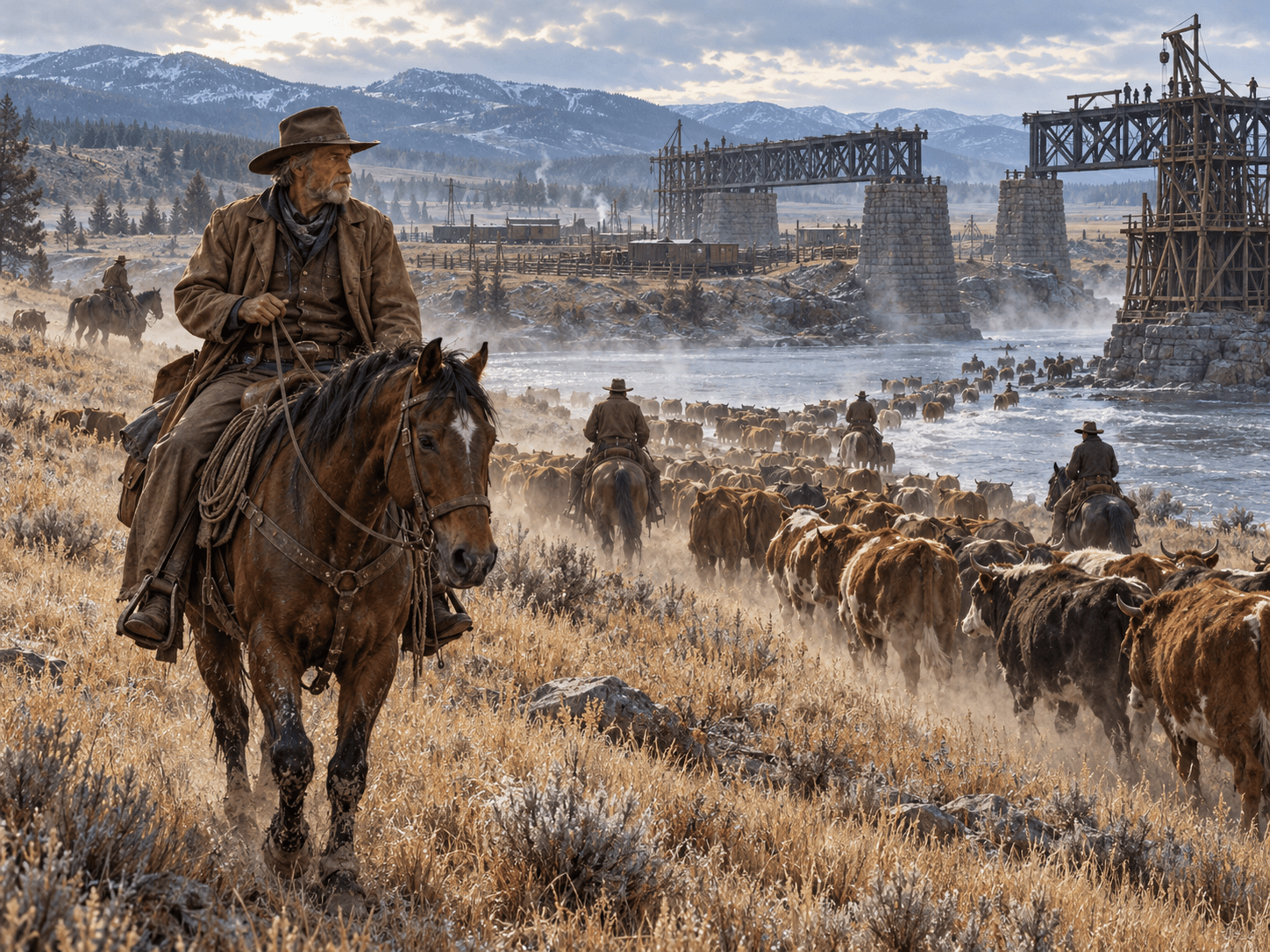
They came over a low line of hills—the last before the Cold River valley—and there it was. It did not look like something assembled one piece at a time. It looked grown out of the earth: massive stone-and-brick piers, steel girders standing in the air like ribs of an unfinished skeleton, timber scaffolding hung with rope, and men—a dozen, maybe more—moving across it like ants on a branch. The west-bank worksite rose in piles: timber, barrels, sections of rail, workers’ tents, two heavy wagons under load. Smoke from a field forge mixed with morning mist above the river.
Oakes stopped his horse.
The sound reached him a second later—metallic pounding, hammers, creaking timber, workers calling to one another. The horses put their ears forward. Several cows at the head slowed.
Beyond the bridge, on the far side of Cold River, lay Red Junction. Oakes could see roofs, smoke, wooden buildings, the loading ramp, cars standing on sidings. He could see track—a bright line of steel coming in from the east, ending here at the unfinished bridge that would one day carry it west.
Nate stopped beside him.
“Well,” he said. “There it is.”
Tomás came up on the other side and looked at the bridge without speaking. After a moment he said quietly:
“Big.”
It was big. Oakes tried to judge it—one hundred feet? One fifty? Hard to know with something unfinished. Completed piers stood firm in the river while steel spans waited for continuation, resting on temporary timber works that were themselves larger than anything Oakes had ever built.
Oakes did not answer. He watched Cold River under the bridge, broader than he remembered, faster, full of autumn water. The main current ran hard, while near the banks the river curled into eddies that looked gentle and were not. Oakes knew this kind of river. When autumn rain came, Cold River gained depth faster than width, which meant stronger water in the middle and softer ground at the edges.
Three hundred yards downstream lay what he was looking for—the old cattle crossing, used for years. Sand. Easy banks.
At least that was how he remembered it. Now the banks looked softened and the water deeper than it should be. Same rains that had raised Willow Creek.
“Ford looks worse,” Tomás said at his left. He was not asking.
“Looks worse,” Oakes agreed.
Fitch came up at a gallop.
“We’re here. We cross.”
Oakes looked at the sun. There was enough light left to try. With rested cattle, he might have chosen to try himself. But two days earlier he had shortened their night, the day before he had shortened their halt, and now part of the herd stood heads low, shifting heavily on their front legs.
Tomás returned from the ford.
“Can be done today,” he said. “If we start now. Middle’ll be dark.”
Fitch caught it at once.
“You hear that? It can be done.”
“It can,” Oakes said.
For a while he watched the river. In the last light there was still sand visible at the entrance. In two hours there would be nothing but the lamps from the construction works reflected on the surface.
“Tomorrow.”
Fitch dismounted.
“Our cars take cattle tomorrow from first light. If we don’t cross today, the assignment goes, and so does the bonus. Your forty. I lose more.”
“I know.”
“This isn’t madness, Oakes. We can cross.”
“We can.” Oakes looked at Tomás. Tomás neither nodded nor shook his head. “And we can lose five head. Or fifteen. Or a horse. I don’t know how many.”
“You can lose some in the morning too.”
“I can.”
Fitch wiped his face with one hand.
“I don’t have money to make this up. You’ve got your bonus. I’ve got my window. Both are on the other bank tonight.”
Oakes knew where the herd’s fatigue had come from. Some of it carried his name, though he had never written it down.
“We cross at first light,” he said. “If you take the bonus, take it.”
Fitch watched him a long time. Then turned his horse and rode back toward the herd without another word.
Oakes did not sleep.
He lay in his blanket on the west bank of Cold River, three hundred yards from the unfinished bridge whose hammers worked for another hour after dark before going quiet. Then came a silence unlike prairie silence. Silence by the bridge carried an echo—the metallic tick of lines in the wind, the groan of scaffolding, water moving among timber piles. A foreign sound. Like sleeping in somebody else’s house.
Cold River sounded low and steady. In the dark it was hard to judge its width. Easy to hear the current.
Across the dying fire Spoon snored softly. Webb lay under the wagon with his hat over his face. Fitch slept twenty feet away with his back turned. Nate had watch. Tomás slept lightly. The cattle lay in the dark, quieter than Oakes expected. Maybe too tired to be nervous. Maybe already used to the bridge noise.
Oakes got up, took the notebook, and walked to the river.
In the dark the water looked black and smooth, but sound said otherwise—the low rush of current, depth, force. Oakes crouched and put his hand into it. Cold. Quick. Rocky bottom, soft in places where clay mixed with sand.
He took out the notebook and began to draw. Not for beauty. For use. Bank. Slope. Ford. Direction of current. Harder sand. Lowest exit. Where to enter so the cattle would come out above the ramps rather than below them where there was no road.
He drew slowly. The pencil was dull. There was almost no light. Several times he stopped, went down to the edge, then returned and corrected the line of the bank.
When he finished, he sat by the river. Downstream the unfinished bridge stood over the water as a dark mass, the skeleton of something enormous. Under the stars the steel girders shone dully. Oakes thought about morning. How to put three hundred cattle into the water at dawn. How to place his men. Which horse went first. How long the crossing would take if it went right and how long if it did not.
That was what he knew. Planning. Anticipation. Reading water, cattle, people, ground.
He returned to camp and lay down. Tucked the notebook under the blanket against his chest because habit was stronger than comfort. This time he slept.
Dawn came gray and cold.
Oakes was up before anyone else. Checked horses. Checked the wagon. Went to the river and studied the ford again in growing light that turned black water gray, then brown, then almost clear, though Oakes knew the clarity was a lie.
The river had dropped overnight. Maybe two inches. Along the west bank it exposed a strip of pale sand and several flat stones hidden the evening before. Not much, but enough for Oakes to see what he needed—the sandy bottom at the broadest part of the ford, where the current was weakest. That was the window.
“Up,” he said when he returned to camp.
Nobody argued. Not even Fitch. They were too close to the end to argue about anything.
Oakes gathered them.
“Tomás goes first with twenty head. Broadest part of the ford, where you can see sand. Don’t go straight. Angle with the current so you come out above the ramps. Nate, second group. Webb, third. I’ll work the middle and correct. Spoon, wagon last, across the bottom—not the deepest line. Mr. Fitch, stay on the bank and turn anything that starts downstream.”
“The wagon won’t make it,” Spoon said.
“It will.”
“Wheels’ll bury.”
“Not if you go fast and straight.”
“Nobody’s paying me for a drowned wagon.”
“Nobody’s paying you for anything if the herd doesn’t reach the other bank.”
Spoon shut his mouth. His face finished the sentence.
Tomás entered first. His mare moved surely—hooves on sand, head low, ears forward. Tomás did not pull the herd. He left the lead animals room to choose and moved only when they moved behind the mare. Twenty crossed clean. Wet cattle came out shaking themselves on hard sand, where the road ran straight toward the Red Junction pens.
Nate went in with thirty. Harder—more cattle, more disorder, deeper water through the middle. One cow stopped halfway and refused to move. Nate circled, leaned his horse into her side—not cruelly, firmly—and she went on. All came out.
Webb entered with the third group. His hands were tight on the reins—Oakes could see that from shore—but he rode straight and steady, correcting cattle that drifted with calm movements of his horse. One cow stopped in the middle. Webb did not push. He circled. Gave her time. She moved on her own. Oakes nodded to himself, not to Webb. Something had changed in the way Kinney moved. Not experience; that took years. Maybe respect for what he did not know. Maybe memory of Willow Creek, where the current nearly took him, Tomás pulled him out, and Oakes said nothing afterward.
Group after group. Three hours. Oakes went into the river four times whenever something began to go wrong. Two bulls started fighting midstream. A calf floated with the current until Nate caught it. One cow stopped and would not move until Oakes rode to her himself and eased her toward the far bank, soaked to the waist, water running from his coat.
Spoon crossed the wagon last. The wheels sank deep, but Spoon drove fast and straight, giving the clay bottom no time to take hold. The wagon came out on the far side dripping from every seam, and Spoon looked personally insulted, but the supplies were dry because he had wrapped them in canvas the night before. Oakes marked it as proof that a cook past sixty with a wooden spoon through his belt knew more about crossings than most men on either side of the river.
The last cow climbed out on the east bank.
Oakes counted.
Three hundred.
One lost—a young bull swept downstream and gone. Oakes watched the brown shape shrink in the gray water for a second, then turned and counted again.
Three hundred.
Downriver the unfinished bridge stood in morning light—stone, steel, timber, men beginning another day’s work. Somebody struck metal with a hammer and the sound carried clean and sharp across the cold air.
Red Junction smelled of smoke, lumber, and manure.
The stock pens stood at the south end of town beside the loading ramps and the tracks where empty stock cars waited—wooden boxes on wheels, slatted high enough for cattle to breathe and too high for them to jump. Oakes knew those cars. He had seen them in other towns at other ramps. They were the same everywhere. Same as track. Same as schedules.
Loading took until noon. Three hundred cattle—twenty to a car—went up the ramps one at a time under men who did this every week in Red Junction and did not care who owned the animals, where they came from, or who had brought them in. To those men they were units. Numbers in a loading register. One loader, young and red-haired in a stockyard apron, asked Oakes where the herd came from.
“Eagle Flat.”
“Eagle Flat? On foot?” The boy looked as though Oakes had told him the cattle flew.
“On foot.”
The boy shook his head and went back to work.
Oakes stood beside the ramp and watched. Head by head disappeared into the cars. The man at the doors counted faster than Oakes liked but never missed once. On a siding a locomotive took water.
Fitch came over when the last car closed.
“Three hundred,” he said. “Buyer in Kansas City takes three hundred. Losses within the contract allowance.”
“Seven lost.”
“Within the allowance,” Fitch repeated. He held out an envelope. “Your rate. No bonus.”
Oakes took it. He did not open it at once. Then he opened it, because not opening an envelope of money was not dignity, only foolishness. He counted the bills. Three hundred times the per-head rate, without the forty-dollar bonus. He knew arithmetic. The number was what it ought to be. It was simply smaller than it might have been. He put the money into his inside pocket—the pocket opposite the notebook, across his chest. Money and notebook. Everything he had to show for twelve days’ work.
Fitch opened his mouth. Closed it. Opened it again.
“You brought them in well.”
“That’s the job.”
“I know. But…” Fitch looked at the cars, the track, the smoke from the locomotive at the end of the string. “I don’t know if I’ll have another herd. Not this year. Maybe not next.”
Oakes nodded. Fitch watched the cars another moment, then offered his hand. Oakes shook it, same as twelve days earlier at the Eagle Flat pen, except Fitch’s grip was weaker now and lasted a second longer.
Fitch walked away.
The crew came apart the way crews always did at the end of a drive: men started talking about what came next, and next was not the same place for any two of them.
Spoon went first.
“I’m heading to Millstone. Meaning where Millstone used to be. Man’s building an inn. Needs a cook.”
“An inn,” Nate said.
“An inn. Four walls, roof, stove that doesn’t travel.” Spoon shook his head as if describing paradise. “Can you imagine?”
“I can.”
Spoon came over to Oakes.
“Good twelve days.”
“Good,” Oakes said.
Spoon climbed onto the wagon and drove off, wooden spoon still sticking from his belt.
Webb came second. Cleaner than he had been on the trail—he had washed at the creek behind the pens—and younger-looking without the dust.
“Mr. Oakes. I wanted to say thank you.”
“For what?”
“The trail. I learned.”
Oakes looked at him. Wanted to say something about Willow Creek, about the moment Tomás had pulled him out of the current. Instead he asked:
“What next?”
Webb put his hands in his pockets. He looked different from twelve days ago. Not older, but as if the lines of his face had settled into something more certain. As if he knew something now that he had not known when he mounted up in Eagle Flat.
“There’s work in Red Junction. Loading pens. Steady.”
“Loading pens.”
“Yeah. Cars, ramps, cattle. Only…” Webb hesitated. “I don’t lead anybody on trail. Cattle come in, cattle go into cars, cattle leave. I stay.”
Oakes nodded. There was something in that he understood and could not say aloud: Webb, twenty-two, built for ranch work and with eyes that had learned to read current before putting a horse into it, had chosen a job where cattle arrived by rail and left by rail, and between those two facts there was no prairie, no night, no trail. There was ramp, car, schedule. It made sense. It hurt more than the lost bonus.
“Good luck.”
Webb held out his hand. Oakes shook it.
Tomás came last. Nate stood nearby, waiting.
“The Lópezes have work,” Tomás said. “Winter roundup near Santa Luz. Smaller than it was, but it’s there.”
“Good.”
“If you ever need somebody…” Tomás did not finish. Did not need to.
“I know where to find you.”
Tomás touched the brim of his hat and rode away. Oakes watched until horse and rider disappeared into the dust on the Santa Luz road.
Nate stayed.
“Stables?” Oakes asked.
“Stables. Start next week. Gus Wheeler. Good terms. Steady pay. Roof.”
Oakes looked at the man he had worked beside for eleven years. Four drives. Hymns under his breath. Never late to watch.
“Nate.”
“Hmm?”
Oakes wanted to say something important. The words that came were different.
“Take care of yourself.”
“You too.”
Nate walked away. Did not look back.
Oakes stayed beside the ramp.
The cars were closed. The locomotive breathed at the end of the train. Men along the track checked couplings, oiled axles, traded short signals Oakes did not know.
His bay stood beside him, tired, head low, Cold River mud still on his fetlocks. The saddle on his back was old—Oakes had bought it eleven years earlier in a town whose name he no longer remembered—and worn so long the leather had taken the shape of Oakes’s hips, his thighs, the way he sat a horse.
Inside one coat pocket was the envelope of money. In the other was the notebook.
Oakes took out the notebook and opened it to the last written page. The map of the Cold River ford was still damp at the edge. He turned several pages back: water, miles, losses, old crossings. On one older map the line still ran through a place where fresh wire now stood.
He closed the notebook and put it away.
The locomotive whistled. The cars jerked. The train began to move—slowly, steel grinding, then faster—and rolled east.
The cattle rolled east inside closed cars.
Oakes stood on the ramp with his horse, saddle, and notebook.
Behind him, above Cold River, someone struck steel with a hammer. Then again.
Oakes took the bay by the reins. The horse raised his head and waited.
Oakes did not tell him where. For a while there was no need. The horse stood quietly, and behind them the rails rang beneath the departing train.