
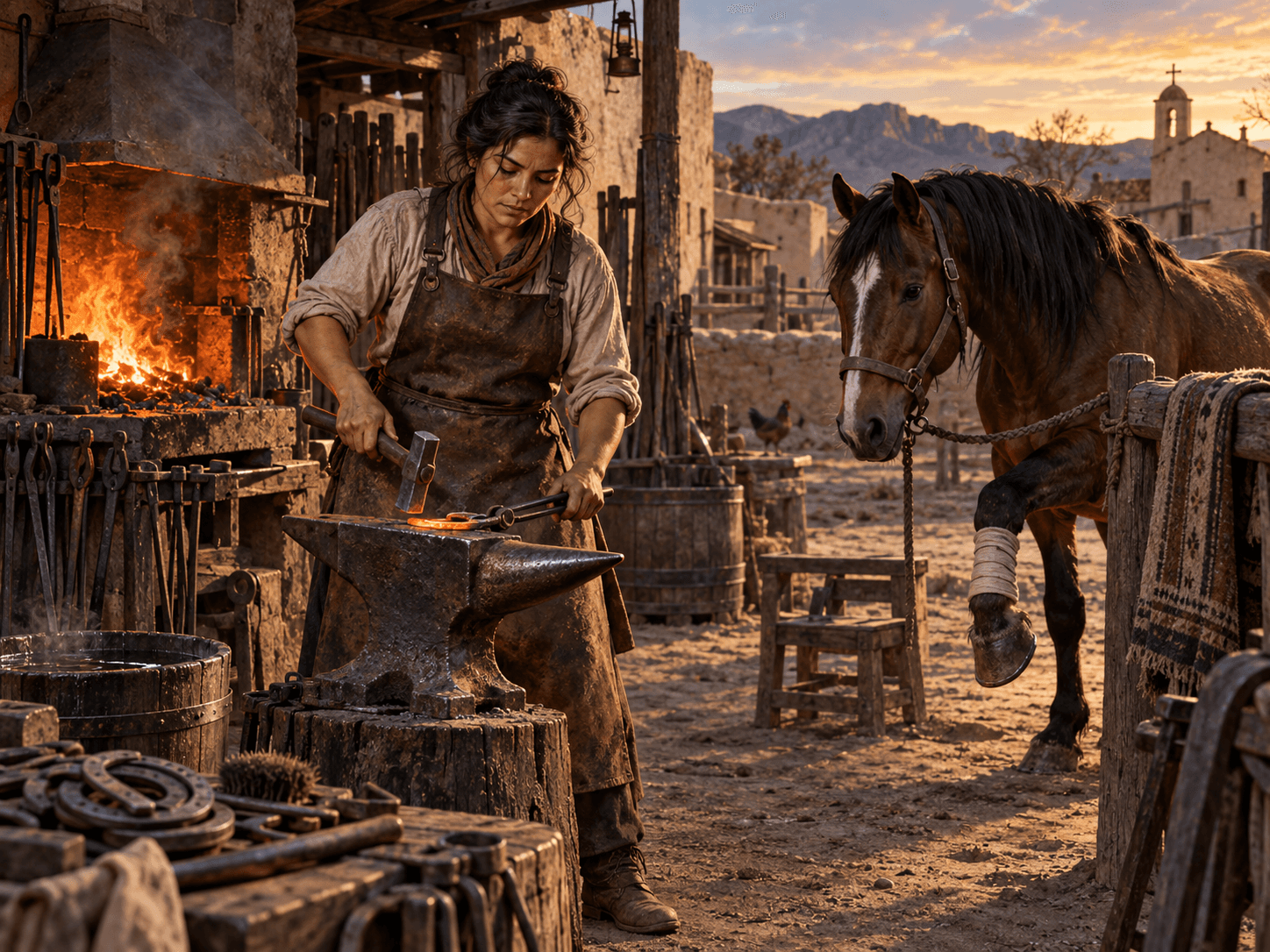
The horse came into the forge yard with a slight lean to the left. Not much. Enough for Inés to see it before Bernal managed to speak.
"Something in his shoulder," Bernal said, leading the animal by the bridle. "I rode out to Padilla's yesterday and he kept laying himself over to the left. Like on a turn. I think he strained it. My neighbor had the same thing with a mare and turpentine rub helped."
Inés did not answer. She stood beside the anvil with one hand on the edge of the table and watched the horse set down his left fore. The hoof landed a fraction shorter than the right, as if the horse were testing the ground before putting weight on it.
Bernal tied him to the post and kept explaining. The horse was old, maybe it came from working the slope, somebody had told him hay and vinegar poultices helped in cases like that, and by the way did Inés still have those shoes she had made for the Garcias, because Garcia did not want his anymore and maybe he could-
The horse turned his head and tried to bite Bernal's hat. Bernal stepped back half a pace without breaking the sentence and tilted his head away. The hat stayed on. The horse tried again, caught the brim in his teeth this time, and pulled. Bernal snatched the hat free and moved another step away.
"...so I say it is the shoulder, because it looks like the shoulder," he finished.
Inés came up on the left side, laid her hand on the horse's shoulder, and ran it down, feeling the muscle. The animal stood quietly under her hand, a different animal from the one that had just tried to take the hat off his owner's head. She tapped his side to shift him one step, then stepped back.
"Walk him."
Bernal led the horse along the yard, from the gate to the wall and back again. Inés watched the gait. Front, hind, front, hind. The horse shortened the step on the left fore. Not the shoulder. Lower. The shoulder moved clean, the upper leg did not catch. It was in the hoof.
"Again. Slower."
Bernal turned him and led him more slowly. On the third step the horse set the left down with more care, with a little hesitation, as if waiting for a pain that did not always come but might.
Inés came in, stood beside the horse, and lifted the left foreleg. She rested the hoof on her own knee, holding the pastern with one hand. With the other she took the hoof knife from the table, broad and curved and sharpened that morning, and began cleaning mud and packed stone out of the frog. The horse stood patiently.
Under the mud, the hoof told its story. The side wall had been cut unevenly. Someone had trimmed it recently, but too flat on the outside, leaving the inner edge higher. The shoe sat crooked, tilted by a millimeter, maybe two, invisible to anyone who was not looking for it. But a millimeter was enough. The inner edge carried more weight than it should, the horse compensated in the joint, and the joint compensated in the shoulder.
Inés turned the hoof toward the light.
"When was he shod?"
"Three weeks ago. Delgado's place, beyond Santa Luz."
Inés let the leg down and straightened. The horse set the hoof down and immediately stepped on Bernal's boot. Bernal hissed and jerked his foot away.
"His shoulder does not hurt," Inés said. "The shoe sits wrong. It loads the inside wall, so he compensates in the shoulder to avoid pressure. I will shoe him again."
"You are sure? Because yesterday he really-"
"Sure."
Bernal nodded with the face of a man who would like to argue a little longer but knows he has nothing to argue with. He went to the wall and sat on the bench in its shade beside two other customers, one with a molly mule waiting for new shoes, the other waiting to pick up a repaired wheel rim. Someone handed him water from a jug. They spoke quietly in Spanish about the rain that had not come for three weeks, the price of hay at Thursday market, somebody who had bought a new wagon and regretted it before he made it home.
The wall's shade was the most valuable thing in the yard before noon. The bench stood exactly where the adobe threw coolness over the packed earth, and customers shifted along it as the sun moved through the sky, wordlessly, like people who had been doing it for years. The man with the molly asked whether Inés still had those narrow shoes she had made for his brother. She said she did, and that his brother had owed her forty cents for them since March. The man laughed and said he would tell him. In Santa Luz everyone knew who owed whom, and since when. It was one of the things that held the town together, and one of the things that sometimes choked it.
Inés took the shoeing pincers, bent, and lifted the horse's leg. The first nail came easy. Twist, pull, out. The second had rusted in the hole and she had to turn it twice while pressing her thumb against the hoof wall so the horn would not crack. The third came wrong and left a sliver in the wall. Inés took the rasp and gently evened the edge, taking out the splinter of horn. The old shoe fell to the ground with a small ring.
The forge had been lit since morning. The air inside smelled of charcoal, burned horn, and iron, a smell Inés had stopped noticing years ago and outsiders recognized at once, stepping back from it. Under the low adobe wall in the yard stood a row of ready shoes in three sizes, most for ordinary work horses, a few narrower ones for mules. Inés chose a shoe, measured it to the hoof, too wide by half a finger, and put it in the fire.
She waited, watching the color of the metal. When the iron began to glow cherry red, she drew it out with tongs, set it on the anvil, and began to shape it. The hammer blows were short and even, three to each side. Turn. Three blows. Turn. The metal rang differently under the hammer than cold iron, brighter, cleaner, as if complaining. A check against the hoof. Still too wide on the outside branch. Two blows, harder this time, at the end of the branch. Turn. One more, correcting the bearing angle on the inside to balance the weight Delgado had not balanced. The water hissed when she quenched the iron, and a cloud of steam rose.
At the fitting the horse twitched, but Inés held the leg with her knee and set the hot shoe to the horn. Smoke came thick and greasy. Burned horn, a smell outsiders thought disgusting and which told Inés the iron lay flat. If the smoke rose evenly, the shoe fit. If not, it needed correction.
The smoke rose evenly.
Six nails. Each driven outward at an angle so it came through the wall in the right place. Too high and the horn would crack. Too low and it would not hold. Each nail bent over with the pincers. File over the clenches so they would not cut. Done.
She lowered the leg. The horse set the hoof down, transferred weight, and stood straight. No hesitation on the left. No testing the ground.
"Walk him."
Bernal got up from the bench and led the horse. The gait was even. He did not shorten the step. Bernal looked back with clear surprise, as if he still expected the shoulder to announce itself.
"How much?"
"Two and a quarter."
"Can I pay Friday?"
"You can pay now."
Bernal did not have the money on him. He never did. He came with horses, not with a purse, as if one thing had nothing to do with the other. Inés opened the ledger, a thick cover cut from pasteboard where she kept the pages of accounts, and wrote: Bernal, left fore, $2.25, Friday. He was the third customer that week paying later. But Bernal always paid, Friday or Saturday, never later, and he always brought something extra with him, eggs or dried chiles, as if to make up for not having cash on Wednesday.
"And never take that horse to Delgado again," Inés added without looking up from the ledger.
"I will not," Bernal said, and sounded as if he truly believed it at that moment.
The molly mule was waiting. Her owner, an older man Inés knew from church, held her by the bridle and spoke to her in Spanish, softly and with conviction, as if she answered him.
Inés was already taking up the rasp to trim the mule's hooves when Fernando Montoya came into the yard.
He had not come for work. Montoya supplied iron, charcoal, leather stock, and small metal goods to half the craftsmen in Santa Luz. He was short and heavy, with a neatly clipped mustache and a waistcoat that remembered better days. He always spoke politely, and he always came in person when it was about money.
"Inés."
"Fernando."
"I came to leave the bill. Sixty-eight dollars. The twentieth."
He put the paper on the table beside the anvil, under a stone so it would not blow away. He smiled, briefly, like someone who did the same thing with every craftsman in town and did not take it personally. He nodded and left. The whole visit took less than a minute.
Inés finished the mule, a simple trim, thirty minutes, one dollar, arranged with the wheel-rim owner for the day after tomorrow, and closed the yard gate when the sun was low and the wall's shadow reached halfway across the shop.
That evening, at the table beside the stove, which was still giving off heat, Inés opened the ledger and began to count.
Iron from Montoya: sixty-eight dollars. Due the twentieth. Eleven days.
Current work: Bernal, two and a quarter, Friday. Sánchez, wheel-rim repair, one dollar fifty, promised next week, but Sánchez promised different things depending on whether he had sold hay. Vigil, two horses, four fifty, half paid, the rest "soon." Old Arellano, mule trim, seventy-five cents, to pay next time he came. The rest: twenty-three dollars in scattered small accounts, of which maybe ten would come before the twentieth, and maybe not.
Cash in the box: eighteen dollars and seventy cents.
The forge had work. Three, four horses a day in a good week, two in a bad one. There was no week when nobody came. The problem was not that people did not come. The problem was that they came with horses and promises, and the money came after them, sometimes a week later, sometimes a month.
Inés closed the ledger and looked at Montoya's paper. Sixty-eight. Charcoal for the past six weeks: three deliveries at four dollars each. Iron for shoes and wheel rims: twenty-five dollars, because she had bought a larger lot ahead. The rest: a piece of leather for a bellows repair, wire, small parts. All of it needed. Nothing she could have gone without.
She counted again. If everyone paid on time, there would be enough for Montoya and maybe five dollars left. But not everyone paid on time. Bernal did. Vigil usually did. Sánchez depended.
She rose and went into the kitchen, a small room behind the shop with a clay stove, one table, and two chairs. On the table lay three tortillas from morning under a cloth. She ate one, cold, with a little salt, and wrapped the other two for tomorrow.
The apron hung from a nail by the door. Heavy leather, with pockets for small tools: nail pincers, hoof knife, a piece of chalk for marking. The leather had cracked along the edge of the main pocket, not for the first time, but wider this time. Normally she would have bought a new strap from Montoya, thirty cents, maybe forty. Instead she took an awl and heavy thread from the repair box and began to stitch. The stitch was plain, the same as for harness repair. Pierce, pass, pull, tighten. The apron would last a few more weeks. It had already lasted two years longer than it should have.
She set the awl down and went back to the table. On Montoya's paper, under the amount, she wrote in pencil: charcoal: delay order until 22nd. Iron: enough for 5 days. Flour: Monday.
She had managed worse. There had been the winter three years ago when she had one customer a week for six weeks and ate rice and beans every day until the sight of a tin made her sick. There had been the spring when the bellows tore at the worst possible moment and she had to borrow from the church, then work off the debt repairing the ironwork in the bell tower. There had been the year when Montoya, not this one, this one's father, waited until June for payment and never once raised his voice.
Every time, she came through the same way: she moved herself. Not the customer, not the horse, not the price. She ate less, bought later, repaired instead of replacing, waited. It had been her method for twenty years.
She had managed. She would manage this time.
Someone knocked at the shop gate. At that hour it was not a customer.
The Mendoza boy, thin, dark, in boots too large for him, stood with a note.
"From Mr. Kerr. He said he would like to speak tomorrow morning. About horses."
Inés took the note. A short text, written in a plain, clear hand: I would like to discuss a job for freight horses. Tomorrow, if convenient. E. Kerr.
She put the note in the pocket of her apron and gave the boy five cents.
Kerr arrived the next morning while Inés was already working. She had a wagon rim for Sánchez on the anvil and did not stop when Kerr dismounted and tied his horse to the post by the wall.
He was a tall man with a dry, clean-shaven face and hands that did not look like rancher's hands, too clean, too smooth, but did not look like town hands either. He wore a better hat than most people in Santa Luz, but not a new one. A good work coat, plain, with no trim. He spoke like someone with a long list of business and no intention of wasting time on things that did not concern him.
He waited until Inés finished the rim. He stood by the wall, did not sit on the bench, did not peer into the shop. He did not hurry her. It was not courtesy. He simply knew that interrupting a blacksmith halfway through a blow would not make the work go faster.
"I have a proposal for you," he said when Inés set the hammer down and wiped her hands on her apron. "Five freight teams. About thirty horses. I need them ready in two weeks."
Inés leaned against the edge of the anvil. The metal was still warm.
"Ready means?"
"Looked over, trimmed, shod. Whatever needs repair, repaired. One horse not ready means one wagon standing. One wagon standing means a driver waiting. Freight not moving. A client getting angry. I need you to have them in the line and finish them."
Kerr spoke without pressure, but also without asking. He was laying out the situation, not pleading.
"Not all the horses need the same thing," he continued. "Some need full shoeing. Some only need the feet checked and trimmed. Maybe a few will have to be redone if the old shoes are worn. I pay for whatever is needed."
"How much?"
"Two dollars for a full shoeing. One seventy-five for a trim. Volume rate. For the whole lot, known in advance."
Inés counted in her head. At her normal rate she took two and a quarter for shoeing, two for a corrective trim. Kerr was offering less per animal, but thirty horses meant at least sixty dollars, maybe seventy-five at the upper end. In two weeks. As much as she normally made in five or six weeks, spread across dozens of small jobs, half of which paid late.
"There is a condition," Kerr said. "Priority. My horses go first. If you have something else, it waits. That is the price of volume."
Inés looked at the yard. The neighbor's mule stood under the wall, waiting since morning. Beyond the wall she could see the carpenter's roof and a slice of the church square. The wall's shade was still short. Only nine o'clock.
"I have regular customers," she said.
"I know. That is why I pay for priority. Your customers can wait a day, two. My wagons cannot." Kerr rested a hand on the wall and looked at her directly, not pushy, not yielding. "If I could spread this over a month, I would not ask for priority. But I cannot. That is why I am paying more than Delgado."
He was right. At least in that. Delgado would take less per horse, but Delgado had one forge, two hands, and his own work. He would not take thirty horses in two weeks because he would have nowhere to put them. Kerr had not come to her because she was cheaper. He had come because she had space, a fire that could run all day, and hands that worked fast. He was paying for what Delgado could not give: volume and time.
Inés counted again, already knowing what she would say. Thirty horses. Montoya closed, maybe a little left over. It did not solve winter. But it solved the twentieth.
"Twenty dollars in advance," Inés said. "Before the first horse."
Kerr's face did not change. He did not bargain.
"I can do that tomorrow morning."
"How many horses in the first lot?"
"Six. Dawes will bring them. He handles my crews. He will arrange times with you."
Kerr reached into his coat pocket and took out two ten-dollar notes, folded in half, like a man who carried cash not because he wanted to but because he had to. He laid them on the anvil beside Sánchez's rim.
"Tomorrow at seven," he said. "First six."
He untied his horse and rode out through the gate without looking back.
Inés took the notes. She put them in the wooden cash box in the shop, locked under the tool table. She went back to the rim, but did not lift the hammer at once. She stood at the anvil with her hand on the metal and looked at the empty yard.
Sixty dollars at the low end. Montoya needed sixty-eight. The advance, twenty, plus the cash in the box, eighteen seventy, made almost thirty-nine. The rest had to be worked for in two weeks.
She took up the hammer and went back to the rim.
Only that evening, writing in the ledger, Kerr, freight contract, $20 advance, start tomorrow, did she think that beginning tomorrow, for two weeks, the forge was hers, but the day inside it was not entirely hers. She put the thought aside. Twenty dollars lay in the box, and Montoya was waiting on the twentieth. The rest were worries for later. She had learned long ago that worries had to be taken one at a time, like horses: one on the anvil, the rest at the wall.
Kerr's first horses arrived the next morning at half past six, half an hour before the agreed time, with a man who introduced himself as Dawes.
Dawes was thin and red-haired, with a face on which nothing was wasted, neither skin nor expression. He wore a coat too large for him and carried a leather-bound notebook in which he had every animal written by name, number, assigned wagon, and date of departure.
"This first one is Boone," he said, pointing to a heavy bay gelding who barely fit through the shop gate. Inés had to move the tool table for the horse to pass. "Then Chester, then that mare at the end. Mr. Kerr would like to know what time they will be ready."
"When they are ready," Inés said.
"Yes, but roughly? An hour, two? I have to send a wagon out this afternoon, and if Boone is not ready by-"
"When they are ready," she repeated.
Dawes wrote something in the notebook. Inés was not sure what. It could not be a specific hour, because she had not given one. Perhaps he wrote: Does not give hours.
The forge filled within an hour. Six large freight horses took up the space normally held by two or three work animals. They were bigger, heavier, less settled in an unfamiliar forge. Dawes tied them to posts, to the wall, to the frame of the gate, places where nothing was usually tied. One horse kicked the wooden box of spare shoes under the anvil. Shoes scattered across the dirt with a clatter, and the horse looked at them with an expression that held no remorse. Dawes jumped to gather them. Inés did not.
She began with Boone. Large, heavy, calm, the kind of animal that stands patiently because he knows he is too heavy for anyone to move him. Left fore hoof: old shoe, still holding; walls clean, frog healthy. Right hind: unevenly worn, shoe loose. New shoe, shaping, fitting. Normal work.
But everything around the normal work was different. Normally there was a break between one horse and the next, time to set a tool down, drink water, exchange a word with a waiting customer. Now there was no break. As soon as she lowered Boone's leg, Dawes brought the next horse in. The fire had to burn without stopping, so Inés kept breaking off to add charcoal. The yard, which could hold three horses with space to spare, was packed with six. Big hindquarters blocked the sun, tails flicked at faces, hooves worked mud into the ground faster than anyone could clear it. The smell was thicker than usual: sweat from six horses, smoke, burned horn, fresh manure. By noon Inés's shirt stuck to her back.
Around noon, Refugio Padilla came into the yard.
Padilla was one of Inés's regular customers. He had two horses and a molly mule and came every six or eight weeks for trimming and shoe checks. A quiet man, steady, in a hat that looked older than he was. Always with the same question: "Do you have time?"
Inés had her hands up to the elbows in the hoof of Kerr's third horse, a big gray mare that would not stand quiet and kept pulling her leg back.
"Refugio, I cannot take you today. I have a contract. The whole forge is full until the end of the day."
Padilla looked around the yard. Six large freight horses, Dawes with his notebook on the bench, tools laid out on every flat surface, shoes still partly on the ground.
"When?"
Inés opened the ledger with one hand, holding the mare's hoof with the other. Padilla was written down for Thursday. It was Tuesday.
"Maybe Friday. Or Saturday morning. I have to see how the rest goes."
"All right," Padilla said. "I will come Friday."
He nodded and left. He did not ask why. He did not complain. That was worse than complaint, because complaint could be answered and politeness could not.
Inés set the mare's hoof down for a moment and reached for the ledger. She took the pencil and crossed out the entry: Padilla, Thurs. In its place she wrote: Kerr, team 2. She looked at the empty line beneath it, where she would normally have written Padilla's new time.
She wrote nothing. She closed the ledger and went back to the mare.
Kerr came by that afternoon to check which horses were ready and which were waiting. He did not comment on the work, did not handle anything. He looked, kept notes in his head, asked short questions.
"I need my place clear tomorrow morning," he said before leaving. "Dawes will bring the second team."
He did not say "my forge." He said "my place." And Inés heard "my."
After he rode out, she stood in the yard for a while and looked at the forge. Her forge. Her anvil, her fire, her wall, her tools. She had bought the shop twenty years ago, saving cents for half a decade. She had built the second wall with her own hands. She knew every scar in the anvil and every bad angle in the floor. No one had ever told her what to do in her own forge.
Kerr's shoes lay in a row along the wall, waiting to be taken. Dawes was gathering himself to leave and writing the last notes in the notebook where, Inés was certain, her forge appeared as one line between a wagon and the pass.
Inés set the tools in their places and closed the gate.
She was the owner. Nothing about that had changed. The deed lay in the box, she paid the tax, the key to the gate was hers.
But tomorrow morning her place had to be clear at seven because Dawes was bringing the second team. And she had not decided that.
By the fourth day of the contract, Inés could see the system.
Team A waited to be shod so it could join a wagon that stood loaded outside town. Team B was coming back from a short run with a horse that had thrown a shoe on a stony stretch, a hot replacement, ahead of everything else in the line. Team C was due in the morning, but Dawes moved it to the afternoon because the wagon had not yet been loaded. Each piece depended on the next. The horse depended on the shoe. The shoe depended on Inés. The wagon depended on the horse. The freight depended on the wagon. The delivery date depended on the freight. Kerr depended on the date.
There was no slack. Nowhere.
Inés worked from five in the morning until dark. For the third day in a row she finished after sunset, by the kerosene lamp hanging from the hook over the anvil, putting away tools that had not had time to return to their places during the day. Her wrists hurt, not from one blow, but from hundreds, from holding the hooves of heavy horses that weighed three times as much as the neighbor's mule.
The work itself was not worse than usual. Every hoof needed judgment: condition of the walls, symmetry, wear of the frog, depth of the clefts, condition of the heel. Every shoe had to fit the particular animal, and freight horses were larger than local horses. Their hooves carried more weight, cracked differently, wore shoes faster. Some horses were calm like Boone. Others, like the gray mare, fought for every leg as if it were being taken from them for good.
That morning, on the second horse of the third team, Inés found the rhythm and thought of nothing else. Lift the leg. Brace it on the knee. Clean: hoof knife, short strokes, mud, stone, rotten horn. Judge: walls, frog, clefts, heel. Rasp: level. Shoe from the fire to the anvil. Three blows, turn. Three blows, turn. Check the shape. Fitting: hot shoe to hoof, hiss of steam, thick smoke of burned horn. Correction: one blow on the left branch. Water: hiss. Nails: six, each angled, each by feel, not too high, not too low. Clinch. File. Lower the leg. Next.
The smell of burned horn hung over the yard all day. It soaked into the apron, the glove leather, the hair, the shop walls. The charcoal in the forge had to be fed every two hours. Normally every three, because normally she did not heat iron without a stop.
Not every horse would enter the rhythm. The fourth that day, a heavy black gelding with a white sock on the left hind, would not stand. He shifted, pulled his leg away halfway through the trim, once leaned his whole weight against Inés so that she had to push with her shoulder to get out from under him. He weighed four times what she did. You did not fight a horse like that. Push him and he pushed harder. Inés slowed, spoke to him softly in Spanish, held the leg low and briefly, let him set it down when he had to, then lifted it again without hurry. It took twice as long as Boone. Dawes would probably have written in his notebook that Inés was slow. Inés knew that a horse forced through the work would throw the shoe in a week or crush someone. Better slow than twice.
Dawes sat on the bench and every so often asked, "And that one, what time?" Inés stopped answering after the first day. Dawes wrote anyway, in his own way, in his own notebook, according to his own system, which Inés did not understand and had no wish to understand.
On the third day, Dawes decided to measure how long one horse took. He sat on the bench with his notebook and pencil and watched Inés over a bay gelding waiting in the line, like a judge at a race.
"Starting now," he announced when Inés lifted the first leg. "I need an average per horse so I can lay out the week."
Inés did not answer. She cleaned the hoof, judged it, trimmed it. Dawes wrote numbers. At the second leg, the gelding, bored, turned his head and caught the notebook Dawes held on his knee between his teeth. He pulled. Dawes jerked back. The notebook tore in half, part of it left in the horse's teeth, part in Dawes's hands. The gelding chewed the paper with clear satisfaction, taking apart a week arranged by the minute.
"That was the whole list for Wednesday," Dawes said, staring at the scrap in his hand.
"Now you know how long a horse takes," Inés said without lifting her head.
Dawes took a second notebook out of his coat pocket. He had a spare. He moved farther from the horses. He did not measure time again.
At the end of the fifth day, Kerr came and paid the first forty dollars. Exactly what was due for the shod and trimmed horses, counted by animal, by rate. He did not round up, did not add a tip, did not say keep the change. He laid the notes on the table beside the ledger.
"For twenty-three horses," he said. "The rest after the next lot."
He was exact. He paid on the date he had set, the amount he had calculated. His side of the bargain worked without fault.
Inés put the money away. Forty plus the twenty-dollar advance. Sixty. Montoya needed sixty-eight.
That evening, closing the forge, she stood at the gate and looked at the yard. Empty now. Kerr's horses had left with Dawes, the next lot tomorrow morning. Her tools lay where she had dropped them in haste: tongs on the ground, rasp on the bench instead of the table, hammer propped against the wall instead of in its holder.
She thought of Dawes and his notebook. Of how Kerr knew exactly when each wagon had to leave, and how each wagon waited for horses, and the horses waited for her. One day's delay cost Kerr more than her whole contract: driver, freight, customer, reputation.
He could go to someone else. Delgado, beyond Santa Luz, but Delgado had his own orders and a smaller forge. Old Griegos, beyond the pass, two days away. No one could step into thirty horses in the middle of the contract and finish on time.
Kerr could replace her.
But not fast enough.
Inés did not think of it as something to name. The word a town merchant might have used for that situation did not occur to her. She thought in simpler things: that the sixth team would not go until the fifth came back; that the fifth would not come back until the chestnut was ready; that the chestnut would not be ready until she made him ready. All Kerr's wagons stood in one line, and she was one of the people holding the first wagon. Not the only one. But one who could not be quickly changed out.
For years she had thought of herself as someone who waited. For customers, for payment, for spring. Kerr waited too. For the first time she noticed that he waited for her. She did nothing with it. She set it aside the way she set aside a tool she did not yet need, on a shelf within reach.
Refugio Padilla returned on Friday, as arranged.
Inés had the fourth horse from Kerr's new lot in the shop, a large mare, heavy in the shoulder and restless. Dawes sat on the bench with his notebook. Two of Kerr's horses waited by the wall, tied to the posts.
Padilla stood at the gate with his horse, a low bay that stood quietly and waited like his owner.
"Still?" he asked.
"Refugio, I will not get to him today. Tomorrow at the earliest, but I do not know what hour."
Padilla nodded. He looked at the yard, at the big freight horses, at Dawes, at the tools everywhere, and did not have to ask why.
"I need him Saturday," he said. "Wood from the cut. I cannot wait."
"I know."
"I will go to Delgado."
He did not say it with complaint. He said it as information. The same way Montoya laid a bill on the table, without emotion, without explanation.
"I understand," Inés said.
"Nothing personal." Padilla untied the horse from the post by the gate. The horse turned after him obediently. "See you."
Inés did not answer "see you," because she was not sure it was true. Padilla mounted and rode down the street, toward the southern road.
Inés went back to Kerr's mare. The mare still would not stand quiet, backing away, turning her head, trying to bite anything in reach. Inés caught her by the pastern, lifted the hoof, and held tight. The mare jerked. Inés did not let go. After a moment the mare settled and allowed the work.
Kerr arrived an hour later. He looked at the empty place by the gate where Padilla's horse had stood that morning and did not comment. Either he did not see anything particular in it, or he saw it and did not count it as his problem.
"Mare ready?" he asked.
"In an hour."
"Good. Dawes needs her for tomorrow." He checked something in memory. "Then two more from the fifth team on Monday."
Inés did not answer at once. She thought of Padilla: Delgado was closer, cheaper, and a customer who changed blacksmiths once because of time did not always come back. Padilla had not taken offense. That was the worst of it.
It was not that Kerr had cheated her. He paid the agreed rate, on time, to the cent. The problem was that the agreed rate changed the shape of the shop, not by terms, not by trickery, but by scale. People who had come to her for years were beginning to go somewhere else. Not because they were offended. Because her forge had no room for them.
That evening she opened the ledger to the page with Padilla's crossed-out entry. The line beneath it, where she would normally have written a new time, was still empty. She would not write one.
For a while she held the pencil over that line, as if she could change something. Padilla went to church every Sunday, same as she did. They would see each other. He would nod, she would nod, and beside that nod Delgado would now stand, not as an enemy, only as a fact.
She closed the ledger without adding anything.
In the second week of the contract, with the fifth team, Inés examined a large chestnut gelding that pulled one of Kerr's heavier wagons.
The horse stood uneasily, shifting weight from the right hind to the left and back again, as if searching for a position in which nothing hurt. Inés lifted the right hind and rested the hoof on her knee.
Along the side wall of the hoof, at the quarter, ran a crack. A thin line, beginning just below the coronet and running down the length of a thumb, maybe a little more. Not deep. But plain.
Inés turned the hoof and looked closer. The horn beside the crack was dry and brittle, more than it should have been in a horse whose hooves were regularly trimmed. The shoe sat tight, but at that point the wall was no longer carrying its full share. The crack had taken part of the strain, like a line in a wall that begins as a blemish and then starts to work.
She set the horse's leg down and went to Dawes.
"This horse has a quarter crack," she said. "It is holding for now, but if he pulls a heavy wagon over stony road, the crack will run. The wall has to be unloaded, and he needs several days without heavy work."
Dawes wrote something in the notebook.
"How many days?"
"Three minimum. Five would be better."
"Mr. Kerr needs him Wednesday. Fifth team leaves Wednesday."
"He will not be ready Wednesday if we do this right."
Dawes went for Kerr. Kerr arrived within the hour, faster than usual, as if he felt this problem was different from the others.
He stood beside the horse and looked at the hoof Inés showed him. He did not pretend to understand more than he did. He was not a blacksmith and did not try to be one. But he listened closely and looked where Inés pointed.
"I understand. Can you do something for now, to get him through Wednesday? Then a proper repair when he comes back?"
"I can correct the shoe so the crack does not carry weight. But that is a matter of days, not weeks. If he goes far with a full load, the crack will worsen."
"How much worse?"
"I cannot promise that either way. The horn is dry. He may make the run and come back the same. He may split it halfway. I will not tell you it will be all right, because I do not know."
Kerr accepted this without displeasure. He preferred a blacksmith who said "I do not know" to one who promised and proved wrong halfway over the pass.
"On a short run, with a lighter wagon?"
"Short run, lighter wagon gives him a better chance. But he comes back to me as soon as he returns. Not the next day. Immediately."
"Agreed."
Inés made the temporary correction. She removed the shoe and drew it on the anvil so the edge near the crack would not bear weight. She moved the nail holes toward the sound side of the wall, left the cracked quarter more room, and checked whether the horse set the foot down evenly.
He set it down. He did not limp, but Inés could see him unloading that side a little, by instinct, like someone with a rub in a boot setting the foot slightly aside.
Kerr rode out. Inés stood by the anvil and looked at the schedule in the ledger. Fifth team: Wednesday. Sixth: Friday. Returns from short runs: Thursday. The gelding's crack needed a proper repair, half a day's work, then at least three days under watch.
The margin in Kerr's schedule was almost none. Everyone was going close to the edge. If one horse was out longer, a wagon stood, freight shifted, a date moved. If two horses were out, the whole schedule broke.
Inés did not think of it in terms Kerr would recognize. She thought in horses, nails, and days: this horse needs a week, that one leaves Wednesday, the third has not yet been looked over. But the result was the same.
The gelding came back Thursday morning, and Inés knew from the first step that he was worse.
Dawes led him by the bridle, and the horse walked carefully, setting the right hind with a hesitation that had been barely visible before and was now clear. The crack had widened. The line from the coronet now ran almost halfway down the hoof wall, and the edges of the crack had opened by a millimeter, maybe two. The horn at the edge had separated from the live tissue beneath.
"How much did he pull?" Inés asked.
"Short run. Lighter load. Came back last night." Dawes looked at the hoof with the face of a man counting horses instead of money and coming up short.
Behind him, along the wall, stood two horses from the sixth team waiting for trimming. At the gate, one from the fifth, due to leave tomorrow with freight eastbound. The forge yard was full: tools on every flat surface, harness on hooks, water buckets under the anvil, firewood stacked along the wall, chewed by hooves. The fire had been going since five in the morning and threw heat like August, though it was only September. The air was heavy with smoke, sweat, and heat, even at nine. One of Dawes's men stood by the gate and kept looking at the sun as if he could hurry it along. The eastbound wagon was supposed to be loaded by noon, and the man already wanted to know which horse would go. Two horses from the sixth team pulled at their ties, impatient and strange to the crush. A forge that took three calm animals in the morning now held five and two men, and every one of them wanted something at the same time.
Inés heard nothing but the horse in front of her.
She lifted the gelding's leg. The crack was unstable. Pressure made a piece of the wall move slightly under her fingers. The horse snatched at the leg and Inés held harder, bracing her back against his side. He must have weighed twelve hundred pounds.
She ran a finger along the crack. Live tissue under the horn showed at the widest place: pink, tender, wet.
"He is not going," she said to Dawes.
"Mr. Kerr needs him tomorrow. Fifth team comes back with this horse."
"It does not come back with this horse tomorrow."
Dawes opened the notebook. In his face Inés saw arithmetic: five horses to a wagon, this one out, four could not pull the full load, shift freight to another wagon, change the schedule, delay.
"What if-"
"No."
Inés took the hoof knife, knelt, and began carefully removing dead horn around the crack. The horse stood uneasily but allowed her to work, perhaps because the leg hurt less when Inés held it than when he stood on it. She took away only what was loose, opened the edge of the crack, and cleaned it of dirt and stone.
She took the rasp and gently evened the horn edges so further chipping would not deepen the crack. Then she checked the shoe. The temporary correction she had made still held, but the crack now reached beyond the area she had unloaded. He needed a new shoe, with a different bearing angle, one that would carry weight on the sound side of the hoof and leave the cracked quarter quiet.
She worked steadily, without haste. The horse needed at least temporary relief. This was not a matter of agreement, contract, schedule. It was a matter of an animal standing before her in pain. Behind her Inés heard the impatience of the rest of the yard: two horses from the sixth team pulling at their ties, one of Dawes's men saying something about the wagon that had to be loaded by noon. She did not turn. First this horse, then the talk.
Only when the cracked quarter was unloaded and the horse stood carefully but without a sharp jerk did Inés allow herself to think of the rest.
Kerr arrived as she was finishing the securing. The edges were clean, pressure taken off the cracked section of wall, the leg set so the horse could stand without full weight on the damaged place.
He stood by the wall. Watched.
"How bad?"
"The crack has run. The temporary correction will not hold for a longer trip. The whole quarter has to be unloaded, a corrective shoe made, and he needs a week without pulling."
"A week?"
"Minimum. If he goes with a load, in three days the crack will reach blood and the horse will be down for a month. Or longer."
Kerr did not argue with the diagnosis. He did not ask whether she was sure. He argued with the time.
"That was in the contract. Repair, trimming, shoeing. Whatever is needed."
Inés lowered the horse's leg. She straightened. Her back hurt from bending, her hands from holding. She wiped them on the apron. She set the rasp on the anvil, calmly, without throwing it.
"The contract covered shoeing and routine repairs," she said. "This is not a routine repair. This is correcting a load-bearing crack. It needs a new shoe, new measurements, and time. It is separate work."
"How much?" Kerr asked.
"Three fifty for the corrective shoe. Plus time: half a day. And the horse stays with me for observation until Monday."
"That is more than the normal rate."
"Because it is not normal work."
Kerr looked at the horse, then at the yard, at the horses waiting by the wall, at Dawes, at the fire.
Inés waited.
They stood in the forge, Inés by the anvil, Kerr on the other side of the fire. The gelding with the cracked hoof stood between them, tied to a post, the dressed leg held a little above the ground. Heat came off the forge. On the anvil lay an unfinished shoe from earlier work.
"Since we are speaking about terms," Inés said, "I have a proposal. Not only for this horse."
Kerr waited. He did not sit, did not lean. He stood straight and watched.
"Normal rate for shoeing. Two twenty-five per horse. Emergency work separate, three fifty. No exclusivity. Not all my times go to your horses. I set the order."
"I have a contract," Kerr said. His voice was calm, but there was a hard bottom under it. "I pay for priority. That was the arrangement."
"The arrangement covered shoeing thirty horses at volume rate. It did not cover emergency work. It did not cover this" - she pointed at the gelding's hoof - "and it did not cover closing my forge to everyone else for two weeks."
"Your customers could wait a few days. That is what I paid you for."
"One could not."
Kerr frowned, but did not comment.
"If every supplier changes terms halfway through a contract," he went on, "my business becomes impossible to run. I have dates. I have men. I have freight. I make arrangements with a dozen people east of the pass, and each of them counts on me to have the wagon arrive when I said it would. If a blacksmith in the middle of a contract says, 'Pay more because I can,' tomorrow the driver says it, the next day the hay man. And what is left of an agreement?"
He was right. Inés knew it. The contract she had signed gave him the right to priority. He paid for it and kept the terms: to the cent, to the day, to the horse. He had not broken the agreement. He had not threatened. He had not cheated. He had bought priority and used it exactly as they had agreed.
"We agreed on thirty horses," she said. "Not that this one would come back with the wall torn because he went against what I advised."
"You allowed him to go."
"On a short run. With a lighter wagon. You asked whether he could make it, and I said under one condition. The condition was not kept, or the road was worse than someone thought. Either way, the horse is here now and needs a week, not a day."
Kerr did not deny it. It was a truth they both knew. The margin had been his, not hers, and the margin had run out.
The gelding jerked and tried to lower the raised leg. Inés stepped in, caught the pastern, and held him. The horse rested his heavy head against her shoulder, hot and wet with sweat. Inés checked the dressing. It held. The horse breathed hard, snorted, shifted on the sound leg.
"I am not saying you cheated me," she said, without letting go of the horse's leg. "I am saying the situation changed. You have a horse that needs work we did not plan for. You have wagons that depend on my schedule. And I have customers I lost because your horses took all my time."
"Lost?" Kerr asked, and there was a surprised note in his voice, as if only now he understood that Padilla was not a shift of one day but something else.
"One for certain. Maybe more."
Inés let go of the horse's leg and went back to the anvil.
"I am not trying to ruin you," she added. "I am trying to work honestly. But not under terms that ended when this horse came back worse than he left."
Kerr looked at her. Then he looked around the forge: the tools, the horses, the smoking fire, Dawes on the bench studying a blank wall with great attention.
The horse beside them shifted from one leg to another and bumped his head against the wooden nail box. The nails rattled.
"Give me an hour," Kerr said, and left.
For that hour, Inés worked on the gelding.
She removed the temporary shoe and began preparing the hoof for the corrective one: cleaning, measuring, judging how much wall could be unloaded without weakening the rest. Her hands knew what to do and did it by themselves, which was good, because her mind was elsewhere.
She wondered whether she had gone too far. Kerr paid on time. Kerr did not cheat. Kerr had given her a contract that was supposed to close Montoya, and halfway through she had changed the terms, exactly as he had said: "Pay more because I can." From his side of the anvil, it must have looked that way.
For two weeks she had moved herself, not the customer, until there was no customer left to move. She had lost Padilla. She had eaten one tortilla instead of two. She had stitched the apron instead of buying a strap. All of it to keep terms that no longer fit the horse standing in front of her.
She set the rasp to the hoof wall and drew it in one even, sure stroke. When Kerr returned, the horse stood quiet, and Inés already had the shoe's shape ready on the anvil.
He came back before noon. Without Dawes. Alone, on his own horse, which he tied to the post in the yard.
He stood at the anvil and laid a paper on it, covered in figures written in the same plain, clear hand as the note he had sent with the Mendoza boy the week before.
"One hundred twenty dollars," he said. "Now. In hand. It covers your debt to Montoya and leaves you fifty-two in reserve. In exchange, you are my main blacksmith permanently. Priority for my horses. Guaranteed volume: minimum twelve horses a month, even in winter. Rate: two dollars for shoeing, one seventy-five for trimming, three dollars for emergency work."
Inés took the paper. The figures were clear. Beside each line, a short description: priority, guaranteed volume, main blacksmith, rates as above.
One hundred twenty dollars. Montoya closed. Sixty-eight dollars of debt gone. No counting whether Vigil would pay, whether Sánchez had sold hay. No looking at the bill under the stone on the table.
And twelve horses a month through winter.
Inés knew winter in Santa Luz. She had known it for twenty years. From November to February maybe five, six customers came in a month. Mules, a few work horses, an occasional repair. In January there were weeks when nobody came through the gate. She sat in the forge with one lamp, rice and beans for supper, and counted in her head how many weeks she could go on before borrowing or selling something she did not want to sell.
Twelve Kerr horses was another world. Warm months in the middle of winter. Iron bought without waiting on credit. Food that did not require counting how many tortillas for today and how many for tomorrow.
Inés read the paper again. Priority. Guaranteed volume. Main blacksmith.
She looked at the ledger lying beside it: the page with Padilla's crossed-out entry, the list of arrears, Montoya's bill. Then at the gelding with the cracked hoof, standing by the post with the dressed leg. Then at the forge doors, the square beyond them, the piece of street where her customers' horses usually stood.
One hundred twenty dollars. No winter to fear.
But priority. Exclusivity. A schedule that was not hers.
She thought about it. Not three seconds. A long time. Kerr stood on the other side of the anvil and waited. He did not hurry her. Heat from the fire moved between them.
The gelding at the post shifted weight and lowered the dressed leg too far. Inés saw him wince and pull back. She set the paper on the anvil, went to the horse, lifted the leg again, and braced it against her own knee so he would not press the wound. The horse breathed hard against her shoulder. She checked the dressing with her fingers. It held.
Without letting go of the leg, she kept thinking.
She thought of February the year before: three weeks without work, Montoya asking politely but more often, the night she counted everything and came out with six weeks and then nothing. Twelve horses a month meant she would never again count tortillas for tomorrow. Montoya would no longer set a bill under a stone. Iron would be waiting on the shelf before she needed it, not the other way around.
It was a good arrangement. Inés knew it was good. Kerr had not offered a trap. He had offered exactly what she had feared through twenty winters.
The horse tried again to lower the leg. Inés braced it harder.
One hundred twenty dollars, and no winter would ever be that winter again.
But she lifted her eyes and saw what the arrangement required in order to be true. Twelve horses a month meant twelve times hearing, "I need my place clear." Twelve times crossing out entries. Twelve times "when are they ready" from Dawes or someone like Dawes. The line beneath Padilla's crossed-out entry would stay empty not because there was no one to write there, but because there would be nowhere to write him.
The forge would survive. The day inside it would not be hers. She would sell it every month, piece by piece, for a price that would never hurt again and would never be wholly hers again.
She lowered the horse's leg, carefully, as much as the horse could bear. She straightened. Wiped her hands on the apron.
Inés took the paper from the anvil and set it back, closer to Kerr.
"Normal rate," she said. "Two twenty-five. Emergency work at three fifty. No exclusivity. I set the line. If your horses need priority, we agree in advance, not from one day to the next. No guaranteed volume."
Kerr did not smile. He did not nod in understanding. He did not say he respected her decision. He looked at her as he looked at a column of figures, searching for the result.
"You know winter is yours," he said. "Not mine."
"I know."
"And you know I can find someone else. Not this week, but for the next job."
"You can."
Kerr looked at the gelding with the cracked hoof. Then at the forge wall, the clock with the broken face, the row of shoes hanging on hooks.
He counted. Inés could see him doing it, not on paper but in his head, fast, like someone who had been counting money for twenty years. If he left without this horse, the fifth team stood. A day standing meant driver, freight, storage. Delgado was two days away, a blacksmith who did not know these horses. Griegos, three.
He did not look at her with admiration. He did not nod to show he valued her stubbornness. To him this was not a question of character or principle. It was a column in which one side cost more than the other. Changing blacksmiths in the middle of the season cost more than paying normal rate to someone who already knew his horses and had them in the yard. That was all that counted. Inés had no illusion that she had won anything beyond that one column. If Delgado had been one day closer, the conversation would have ended differently.
"Fine," he said. "But this horse must be ready by Monday."
"He will be."
Kerr took notes from his pocket, a thick fold doubled over. He counted them on the anvil. Not one hundred twenty, because that was not the agreement. Sixty for the remaining contract horses, recalculated at the new rate. Three fifty for correcting the hoof. The rest to make up the difference between the old rate and the new on the work already done.
"Total?" he asked.
Inés counted. Eighty-seven dollars and fifty cents.
Kerr counted it out, laid it on the anvil, and left.
Inés looked at the money. Then she took the hammer, went to the gelding with the cracked hoof, and drew iron from the fire.
The corrective shoe required precision different from ordinary work. More support on the sound side of the hoof. Less pressure on the cracked quarter. Nails where the wall held, not where it was ready to give. Inés put the shoe in the fire, waited until the metal glowed cherry red, and drew it out with tongs to the anvil.
For the first time that day, the hammer blow sounded clear. Not fast, not slow. Clean. The metal answered under the hammer with a bright, hard note. Turn. Three blows. Turn. Check against the hoof. Correction. Water. Hiss.
Inés worked.
Kerr's freight left Santa Luz on Tuesday morning.
Not perfectly. The fifth team went with five horses instead of six, because the gelding with the cracked hoof stayed with Inés under observation. Dawes spread the load across two wagons, found a sixth horse from someone outside town, and left an hour later than he had planned, with an expression suggesting his notebook had not provided for this scenario. But he left. The wagons turned east toward the pass, and the dust behind them settled before Inés reached the gate. Kerr was not ruined. He lost an hour, maybe a day on the road, a horse he had to borrow. The freight would arrive.
Kerr paid the rest before leaving, exactly what was due at the new rate for the last horses. No extra money, no gesture, no word about what had happened at the anvil the day before. He laid the money on the anvil, counted it in front of her, and rode after the wagons. At the gate he stopped for a moment.
"The gelding is to be ready when I come back for him," he said. "Let Dawes know when."
"I will let him know when," Inés said.
Kerr nodded and rode on.
Inés put the money in the box and counted everything. Together with what she had already received and what she had received yesterday, there was enough to pay Montoya fifty dollars, buy charcoal for three weeks, and leave a few dollars for something that might happen. Not fifty-two. Not quiet months. Eighteen dollars at Montoya's still remained.
Winter was still a problem.
That afternoon she washed the shop floor on her knees, with water from a bucket and a brush. She did it every two weeks, but for the two weeks of the contract the floor had not seen a brush. Thick layers of dust, scale, horn, mud, scattered nails. She hung the tools on their hooks. Tongs, hook by the anvil. Rasp, table. Hammers, wall rack, heavy to light. Hoof knives, drawer. For two weeks the tools had lived where they fell. Now they returned to their places. The forge breathed.
Around three, a man came with a mule.
The man was short and dark, in a hat that had seen more than one rain. The mule was gray, old, and wore an expression of deep dignity and unwillingness to cooperate.
"My wife says shoot him," the man said. "I say clean his feet. The mule says nobody touches me."
"Tie him here."
The mule had no intention of being tied. The man pulled. Inés pushed. The mule stood like he had been set in stone and looked at them with deep philosophical disapproval. When he finally stood by the post, Inés lifted the left fore. The mule took it back at once. She tried again. The mule took it back. On the third try he allowed three seconds, then turned his head and tried to bite her sleeve.
Inés worked patiently, calmly, with hands that had been doing this for twenty years and had seen worse mules. The hoof was hard and neglected: frog overgrown, horn grown out, a little rotting tissue in the clefts. She cleaned, trimmed, leveled. The mule kept trying to take the leg away, or bite anything in reach. Once he got the wood of the post. Once, air. Once, almost Inés's ear.
"Is he always like this?" Inés asked between one hoof and the next.
"Only when he is not asleep," the man said. He stood aside, holding the bridle loosely, with the face of a man who had long ago stopped having any influence over anything. "My wife says it is bad character. I say he is just old. He says nothing, because at the moment he is biting."
The mule, as if in confirmation, caught the edge of Inés's apron in his teeth and pulled. Inés took the apron back and set her shoulder against his side to keep him standing. The mule sighed, a deep offended sigh, and let her finish.
It was ordinary work. The kind of work there had not been for two weeks: one animal, one owner, no notebook, no wagon waiting outside town. Only a mule who would not, and a man who had to.
Dawes, still in Santa Luz waiting for return wagons, came to collect spare shoes he had left in the forge.
"That next one when?" he asked, pointing at the notebook.
"When," Inés said. One word. No accent. A schedule.
Dawes wrote something and left.
The man with the mule paid one dollar fifty in cash, at once, no "Friday," no "when I sell hay," and went off, pulling the mule behind him. The mule set his new feet carefully, as if unsure whether he liked them.
The forge was quiet. The gelding with the cracked hoof stood in the pen behind the shop, under observation, with a leg healing slowly, but healing. One of Kerr's mares waited to be picked up Wednesday. The rest were gone.
That evening, after closing, Inés sat at the table with the ledger. She looked over the page with Kerr's contract. Everything closed, the amounts matched. She counted what she could give Montoya and wrote on a slip: Montoya — $50 — tomorrow morning. $18 remains.
She counted the money from the box and set fifty dollars aside, wrapped in a cloth, for tomorrow. Eighteen stayed in the ledger, not in the air. What she had in hand fit in one palm. Enough for charcoal, for flour, for a few weeks. Not enough to stop counting. Montoya would set another bill under a stone, in six weeks, in eight, when the iron ran out. Winter would come as it did every year, and January would be empty as it was every year. None of that had changed. The gelding in the pen, the money in her hand, winter ahead of her: that was everything she had, and all of it was uncertain.
She could have had certainty. It had lain on the anvil that morning, written in a plain hand, one hundred twenty dollars and twelve horses a month. She had set it back.
She turned to a new page.
Clean paper. No entry. No appointment. No team, no schedule, no Dawes with a notebook.
She took the pencil. Held it over the paper for a while without writing. The kerosene lamp cast warm yellow light across the blank page. The forge was quiet, only the crackle of charcoal in the cooling fire and the sounds of the street beyond the wall.
Behind the shop, in the pen, the gelding with the cracked hoof shifted from one leg to another. Inés heard it: the small strike of hoof against hard ground, the change of weight, the heavy breath through the nostrils.
Inés set the pencil down.
She rose to the horse.