
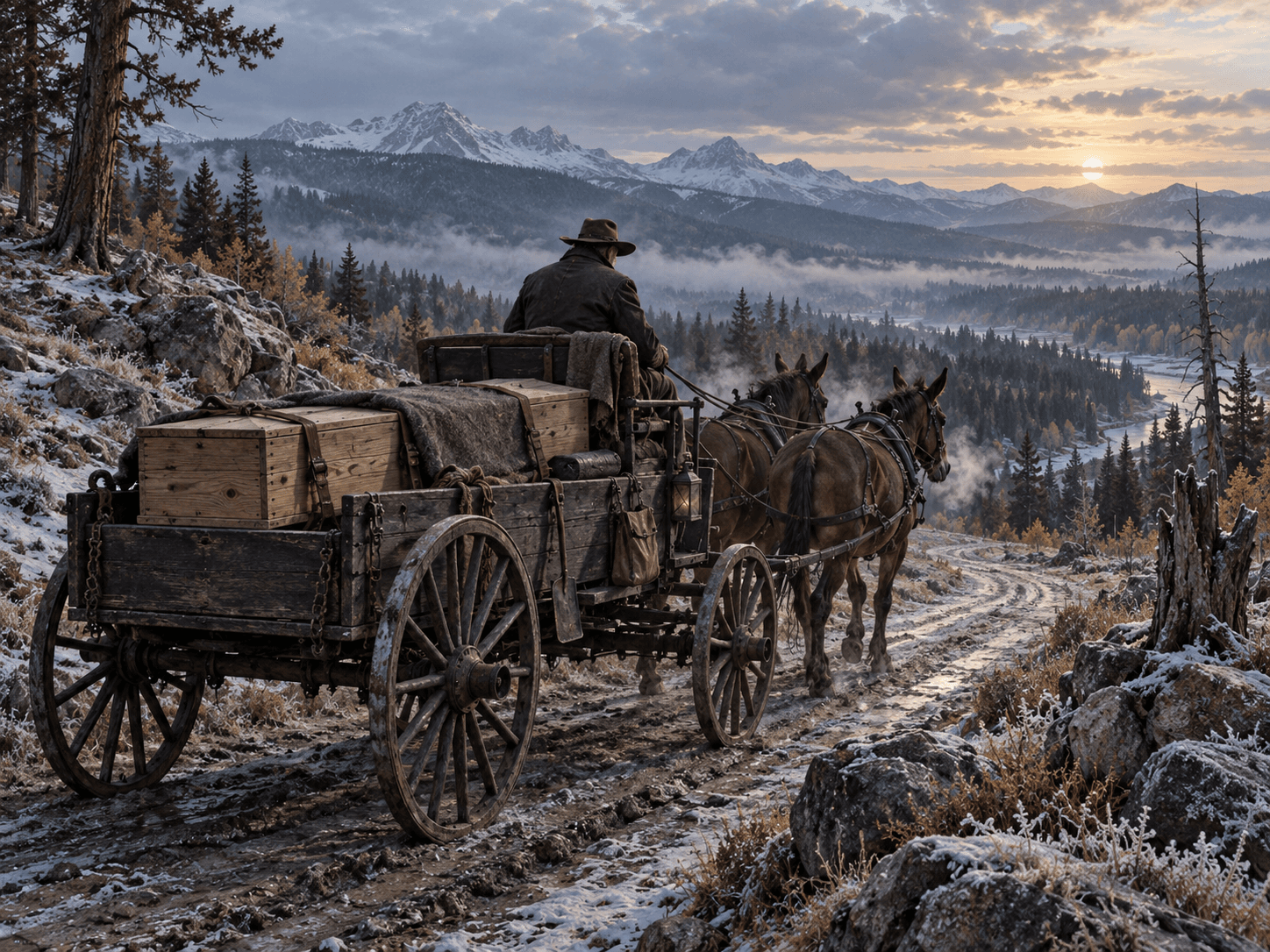
I. The Price of Pine
Ezra Combe knew the camp before he ever saw the body, by the way people looked at him — or rather, by the way they did not. Two lumbermen beside a stack of logs turned back to work that was not there. A boy with a bucket stopped in midstep. That was usually what a place looked like when someone lay there who had to be taken away; the living kept their hands busy with anything at all so they would not have to stand idle beside death.
He stopped the mules by the bunkhouse and climbed down from the box. It was cold, late October, and the air smelled of resin, smoke, and wet sawdust. Pine Country lay high up, on the western edge of Greycap, where the slope fell in terraces of felled ridges toward the valley, and logs rode down the incline to the mill below. Ezra had heard it already from the road — that distant, measured thunder of timber descending the chute — and he had heard, too, that today the thunder came less often than it should.
He straightened his back. The road from his workshop had taken a day and a half, and the last stretch uphill the mules had gone heavy, because the wagon, though empty, was not light — it carried his tools, spare boards, a saw, and that knowledge one carries to every job of this kind and which cannot be seen on the wagon. He would be going back with a load, and across half the country at that, because this man from Pine had family somewhere near Dusthaven, far away, and he had to be taken there. It was not the nearest commission Ezra had ever accepted; but in this trade one did not choose the nearest commissions. People die where they die, and want burial where they came from, and between one and the other there is a road, and that is what a man with a wagon is for. The camp was like every logging camp he had seen: bunkhouses knocked together from unplaned boards, hills of sawdust, heaps of bark, the incline track running up the slope and vanishing among the trunks. Resin bit at the nose. A horse blanket and a pair of trousers hung from a pole by the bunkhouse, stiffened by frost. Crosscut saws leaned against the wall, long, with teeth like a fish’s.
There were fewer men in sight than there ought to have been in a camp at that hour, and Ezra knew what that meant. Death in a camp drives men either to work or out from under the roof; no one wants to sit idle where someone recently living lies. He counted in his head, as he always counted everything: five, six men within sight, none looking straight either at him or at the shed. That too was information. Everything was information.
He had been doing this for thirty years, and in a certain sense he had done nothing else. His wagon was known on the roads from Cedar Flats to Greycap; his name was known to those who had someone at home to bury, and to those who expected they would, which meant everyone. He traveled alone. Once he had had a helper, then another, then he stopped taking them on, because a helper was someone things had to be explained to, and Ezra preferred work that needed no explaining — work in which body, wood, and road spoke directly to the hands, without an intermediary. People sometimes thought a man who spent his life among the dead must be gloomy or devout, or both. Ezra was neither. He was only exact. Exactness was the only piety this trade required, and the only one it allowed.
A man in a heavy jacket came out to him, with the face of someone calculating in his head how much all this was costing him — not because he was stingy, but because running a camp meant counting, without cease, timber, men, days, dollars, and a man who had done it long enough went on counting even when he looked at a coffin maker at the gate. He introduced himself as Pruitt. He was the owner of the operation, or close enough to the owner to speak like him, and he had that mixture of solemnity and haste found in men who have just had someone die on the job and who must at once honor the dead man and set the work moving again before it stops for good.
“Combe?” he asked. “You got here quick.”
“The messenger rode quick,” Ezra said. “I came as usual.”
Pruitt nodded toward the shed by the clearing. “We’ve got him there. Gant. Lewis Gant.” He swallowed, as if the name had weight. “A good man. Held the brake so the boys could get off the track. Stayed at his post to the end.”
Ezra said nothing to that. He had heard such sentences hundreds of times, over different bodies, and had learned that a sentence that came out so smoothly on the first day had usually already been smoothed by someone’s hands. He set it aside, the way one sets aside a tool not yet needed.
Pruitt looked at him as if waiting for Ezra to add something — praise the dead man, say what a shame it was, do what people do when they hear someone died like a hero. Ezra did not do that. Not because he did not care; because it was not his work, and praise for the dead, spoken by a man who had not known him, cost less than nothing and was worth as much. His work was the body and the box and the road. The rest belonged to those who stayed behind.
“I’m to prepare him and take him,” he said. “Where?”
“To his sister. Nora Gant, farm south of Dusthaven. He kept her. Supported her.” Pruitt rubbed the back of his neck. “You’ll make him a decent box?”
“I’ll make him a box that will get him there,” Ezra said. “What wood are you counting on?”
That was the proper question, and Pruitt heard it at once, because he looked aside, toward the stacks of boards under the lean-to.
“A man like Gant deserves better than pine,” he said. “Walnut would be right. Or ash, at least.”
“There’s walnut,” Ezra allowed. “Walnut costs.” He gave the price for walnut and the price for pine, one after the other, in the same tone in which he gave hours and miles. “Walnut has to be brought up from the valley. Two days, maybe three, before I begin. And he cannot wait three days, not this time of year, unless we leave him in the cold and do not move him. Pine is here. I can cut pine this afternoon.”
Pruitt thought about that the way men think about money.
“And if it were pine, but... properly finished?”
“Pine looks like pine,” Ezra said. “I can plane it smooth. I can put good fittings on it. It will look like what it is: an honest box of pine. I will not make walnut out of it for the price of pine, and I will not make walnut out of it for the price of walnut in two days.”
“A hero is owed walnut,” Pruitt said, more quietly now, already to himself.
“A hero is owed getting to his sister before it grows warmer,” Ezra said. “The rest is owed by those who pay. Who is paying?”
And that, as always, ended the conversation about walnut. Money ended conversations about wood faster than anything else; Ezra had learned that in his first year in the trade, and in thirty years had found no exception. The man who wanted walnut for a hero wanted it only so long as someone else was to pay for the walnut.
Pruitt said the operation would cover the box and preparation, and transport would be added separately, and that the sister would receive what was due her when everything was settled. Ezra remembered that last phrase — when everything was settled — because sentences that pushed money into an undefined future usually meant something. He did not ask what needed settling. He would find out on the road, or he would not; both were part of the work.
Pruitt had in him what men who run a camp or a works have: the need for the thing that had broken to be told somehow in a way that allowed them to go on living with it. A man had died, the incline had stopped, and Pruitt was already arranging it into something the camp could carry — a hero, a death with meaning, a reason for pride instead of a reason for questions. Ezra did not hold it against him. He had seen it in many men and understood it: a man responsible for others must give them something they can bear, otherwise they will go away carrying what cannot be borne.
“What was he like?” he asked instead, because he already knew the measurements of the box by eye, and a man had to be known at least a little in order to be laid out well. “At work.”
“Trusted,” Pruitt said without hesitation, and it was the first sentence about Lewis that sounded as if Pruitt truly believed it, and was not merely repeating it. “Held the brake at the upper station. You don’t give that to just anyone. When you send a cart of logs down the track, one man at the brake has the lives of everyone below in his hand. Gant did it well. And he counted. Paid the men on Fridays, carried the cash tin, and nobody ever said so much as a penny was short. That’s a man you trust.”
Ezra took that in and set it aside. A trusted man with the brake and with other men’s wages in a tin. He remembered it not because he was looking for anything — he was not — but because it was concrete, and concrete things he remembered by reflex, just as he remembered length and shoulder by reflex. Only later, when an envelope slid out from under the vest at the side, would those two things — the trusted man with the tin and the envelope by the crushed side — stand together in his mind and refuse to be separated. But that was later. For now it was only one of many things Ezra knew about the man he was to lay out, and he knew it as he knew everything: without weight, for the time being.
He went to look at the place for the box and the place for the body. He would make the box under the lean-to, where the boards lay and where there was light; the body lay in the shed, separate, set back from the bunkhouses, because that is how the dead are kept in a camp — apart, so they do not mingle with the living in eating and sleeping. It lay on boards set across trestles, covered with a horse blanket that was not long enough, so that the boots showed from beneath it. One boot was worn at the toe down to bare leather — not from the accident, from work, from years of walking the track and the cutting ground. Ezra noted it without thought, as one notes everything visible: boot worn by labor, blanket too short, the cold in the shed, which was good, and the smell already beginning despite the cold, faint but present, like a promise that time, though cold slowed it, was moving all the same, and that they would have to travel, not delay.
He did not uncover the body yet. He measured it through the blanket — length, shoulder, because shoulder determines the width of a box more than anything else — and wrote the measurements in pencil on the inside of his hand, as always, so he would not have to look for paper at the board. He did it with fingers and eye alone, after so many years that he no longer needed a measure for simple dimensions; the measure served only to confirm what the hand already knew. He drew the blanket aside only at the feet and the head, to check how the body lay and how it was stiffening, because stiffness tells how much time has passed, and how much remains before one must lay it out while it can still be laid out. The face was younger than he expected. Thirty-six years old, they said. He looked both less and more at once, as the dead do — less, because death takes from a face what the years have added to it, and more, because it also takes away what had kept it young. Ezra had long ago stopped guessing the ages of the dead from their faces. The faces of the dead have no age; they have only what the last hour made of them, and then what his hands will make of them.
He noted one more thing he had not been looking for: beneath the blanket, at the right side, the shape of the body was not as it ought to be. The side caved in where the ribs should have held it. A man who holds the brake and stays at his post may die in many ways — from a falling cable, from a splinter, from a fall — but that sunken side spoke of something that had lain on a man with its whole weight and stayed there, not of something that had caught him in passing. Ezra did not uncover the blanket any further. That was work for later, in the light, when he would have water, cloth, and time, and when no one would be standing at his back with a ready sentence on his lips. Sentences have this about them: when they are heard over a body, one begins to see what the sentence tells one to see; and Ezra preferred to see the body first, and the sentence only afterward, separately.
He began with the boards. He chose pine, straight, without knots along the sides, because a knot in the side of a box works in heat and cold and can split in the worst place. He sorted through the boards longer than he had to — rejected two with knots near the edge, one warped, one with a streak of resin that would bleed for years. What remained was clean pine, and it was good; the operation did not skimp on boards, even if it skimped on everything else.
He laid his tools out on a trestle: saw, plane, chisel, auger, pincers, a coil of wire, coffin nails in a tin box. He arranged them as he always did, from largest to smallest, not because it changed anything, but because when the tools lay in order, the hands knew where to reach and the head could be elsewhere.
Pruitt hovered a while longer, then went off to the office. The lumbermen returned to work that once again was not there. The thunder on the incline fell completely silent; no logs were being sent down today, and the silence on the track hung over the camp like a second cold. Ezra noticed that every so often the men glanced toward the upper station, where the brake shack stood, then looked away. They did not look at the shed in just the same way. The camp now had two places at which no one looked.
Ezra measured the first board, marked it with the pencil, set the saw to the line. The wood was fresh, smelled of resin, and the saw went through it cleanly. He cut evenly, along the line, and listened to the saw — because a saw speaks when it finds something invisible, and an honest board sings beneath the teeth in a single tone. This one sang. He planed the edges, checked the angles with a square, dry-fitted the sides before he nailed them together to see whether they would sit. They sat. He worked without haste, because haste in a box can be seen for years afterward, when no one remembers who lies inside it, and a box made in haste comes apart in the ground sooner than it should.
He made it a little longer than Lewis required, and a little wider at the shoulders, because he preferred a box into which a body went with room to spare over one into which it had to be forced. Forcing shows. Spare room is not wasted.
Toward evening, when the light began to settle, several lumbermen gathered by the lean-to — supposedly for tools, supposedly for nothing, really to watch a box being made for someone with whom, only a week earlier, they had eaten from the same pot. They stood to the side and spoke in low voices, and Ezra heard the same things return again and again: that Gant had been a good fellow, that it was a shame, that he had stayed by the brake. He did not join in. He planed a board, checked an angle, set the plane aside. One of the lumbermen finally asked whether the box would be ready by tomorrow, because they would like to see him off before he went. Ezra said it would be, by morning. The lumberman nodded and stayed a while longer, watching the shaving come smoothly from under the plane, and in that watching there was something people look for around such work: the certainty that at least this one thing will be done properly, when everything else can no longer be repaired.
He finished the sides before dusk and left the bottom and lid for morning. He washed his hands in a bucket, though they were not yet dirty from the body, only from the wood. Then he went once more to the shed, lit the lantern, and stood over the blanket.
Pruitt’s sentence returned of its own accord, as sentences do when they have fallen too smoothly into the ear: stayed at his post to the end. Ezra set it back on that shelf in his mind where he kept things not yet ready for use. Tomorrow he would have light and water, and then the body would tell him what bodies tell, and only that — not because the body was wiser than people, but because the body had no reason to lie, and people almost always had some reason, even if they did not know they had one. The rest — what people said — belonged to people, and he did not touch it, just as he did not touch another man’s tools without asking.
He covered the boots with the blanket more evenly than before, because boots sticking out from under a blanket are the kind of sight that enters the dreams of the living in a camp, and a blanket laid straight is a small decency that costs nothing. He put out the lantern and went into the cold.
II. What the Body Says
Morning was brighter and colder. Ezra carried into the shed a bucket of water, a second bucket empty, clean linen, scissors, a razor, and set the lantern on a crate so the light fell from the side, not from above; light from above lies, smooths things over, and he did not need anything smoothed over.
He took off the blanket.
Lewis Gant was dressed as he had been pulled out: in a work shirt, waistcoat, and trousers of heavy wool, everything stiff with dried blood and mud that had soaked in and dried together. The shirt was cut along the side, a long cut, from the armpit down, not torn, cut with a knife, evenly, hastily, by someone trying to get at what was underneath. Ezra knew cuts like that. They were made by the men who pulled people out, while they still had hope there was some reason to hurry.
He unfastened what could be unfastened, and cut the rest along the old cuts so he would not have to tug. Undressing a stiffened body is slow work; you have to know the joints, know where cloth holds and where it will give. Ezra did it the way he had done it for thirty years, talking to the body in his head, not with words, but with movements: now the arm, not now, now I will put my hand under.
The wool came away hard. Blood that had soaked in and dried glued it to the skin in places, and Ezra soaked those places with water from the linen, patiently, because tearing it off dry strips away what is underneath, and he did not strip anything from bodies that could be soaked loose. The water in the bucket turned pink, then brown. He changed it once, went out to the well for fresh, came back; the well was frozen over at the top and he had to break the ice, and the water he drew burned his hands with cold, but he preferred it that way, cold, because cold was good. It was cold in the shed, cold enough that steam came from his mouth and from above the bucket, and that cold was good, because it held the body and held the smell, which in warmth would already have been unendurable, and like this was only present, at the bottom of every breath, faint, steady, that one thing an undertaker never gets out of his head or his clothes, and to which he grows so accustomed that his wife, if he had a wife, would know from him which job he was coming back from before he had taken off his hat.
The right side spoke first and said the most. The chest was caved in, not broken in one place, as from a blow, but pressed inward, as if something heavy had lain down on it and stayed. The ribs had given underneath. The skin over them was blue and stretched, torn in one place, but not the way a blade tears, the way something taut bursts. Ezra washed the place with water and linen, slowly, and did not allow himself to look away, because looking away is a habit that spoils the work; once you begin looking beside the thing, you begin working beside it too.
The right hand was crushed. Not all the fingers, two middle ones, and the back of the hand above them, where bone had yielded under something hard and heavy. The fingers lay wrong, at an angle no living hand will take, and stiffening had fixed them in that angle. Ezra worked on it a long time, straightening what he could without breaking, because you do not break the fingers of the dead unless they will not fit in the box otherwise or will not arrange themselves into a decent sight. These would arrange themselves, if given time and the warmth of a hand. He held Lewis's hand in his own longer than he had to, until the stiffened joint gave a little, and arranged the fingers so that later, when he folded both hands on the chest, the right would be covered by the left and no one would see what had happened to it. That was the commonest thing in this work: arranging the body so that the worst of it was underneath, covered, against the board, not on top, not for the eye.
He did not think, while doing it, what had crushed that hand or how. The body said that something heavy had come down on the man from the right side, and that the hand had been near that weight or under it. It did not say whether Lewis had stretched it out to shield himself, or was reaching for something, or held something when it gave way. Ezra did not force the hand to say more than it was saying. The hands of the dead say little, and Ezra had long ago stopped asking them about things they do not know.
The jaw was clenched crooked. He bound it with linen, passing the band under the chin and over the crown of the head, and tied it at the top, where the knot would not show, and tucked a rolled piece of wool under the jaw so it would hold straight when the band came off. He pressed the eyelids down and held them with a coin from his own pocket on each one until they stayed; it was an old method and Ezra knew newer ones, but the old ones held best. It was ordinary work. Ordinary work was good; it gave the hands something to do when the rest of a man might not want that. Ezra thought of nothing while doing it except what he was doing, where the band went, where the coin went, where the wool went, and that was the best of this work: that for those hours the head had its hands full and did not go where it had no business going. Only afterward, when the hands were finishing, did the head return to the things it had set aside. It was always like that. That was how he had learned this work: hands first, and so long as the hands have something to do, everything is only work.
There were things the body did not tell him, and Ezra knew it would not tell him. It would not say at what moment Lewis stopped feeling. It would not say how long it lasted before he stopped, though certain things, the exhaustion in the face, the position of the hands, allowed one to think it had lasted. It would not say what Lewis had been doing under that weight or why he had found himself there. The body said only this: that something heavy had lain down on him from the right side; that someone had cut the shirt to get at him; and that he had not got to him in time.
Ezra was not a doctor and did not pretend to be one. He could not say which rib had pierced what inside or exactly how long the heart had beaten, an hour, half an hour, a few minutes. He did not have that knowledge and did not tell himself he did. He knew as much as a man knows who has spent thirty years looking at what death does to a body: that it had not been a quick death, that it had not come at once, and that between the moment the weight came down and the moment Lewis stopped, there had been time. How much, he did not know. Enough for him to be heard. That he knew from those who had heard, not from the body; the body only did not contradict it.
Once during that work the lumberman looked into the shed, the one who had asked about the box for tomorrow, and stopped in the doorway, and Ezra, without lifting his eyes, said only, “Not yet.” The lumberman understood; he stepped back. People want to see the dead man when he is ready, when he looks like a dead man and not like death; halfway through the work there is nothing there for the living, only for the undertaker. Ezra shut the shed door on the peg. Not out of secrecy, out of decency. There are things a man does alone, not because he is hiding them, but because looking at them serves no one, and the dead man is owed having his worst hour remain between him and that one man whose work it is.
This was the part of the work he handed over to no one and told no one about. The family would see a clean face, folded hands, a shirt buttoned to the throat. They would not see the bucket that turned brown three times, or what the side looked like after what had passed over it had passed over it. That was good. That was how Ezra had always understood his work: that he stood between what had happened to the body and what those who remained would see, and that his business was to know one thing and show another. Today, for the first time in a long while, that thought, usually comfortable, sat in him not entirely comfortably, and Ezra did not linger over it, but reached for the razor, because the razor was the next thing to be done.
When he had washed the body and taken from it the last stiffened piece of clothing, something slipped out of the inner pocket of the waistcoat and fell onto the boards with a quiet, hard sound. Ezra went still with the linen in his hand. With bodies that had been through what this one had been through, things seldom remained in the pockets; they were taken by those who pulled them out, or lost on the way, or put away by the family. But this had remained, close against the side, under the waistcoat, on the side that had been crushed.
An envelope, thick, folded, browned with dried blood on one side, so it was glued to the wool and Ezra had to peel it free with his fingers, slowly, so as not to tear it. Inside, when he bent back the edge, he saw the edges of banknotes and coins. Nothing else. No note. No word. Only some numbers and marks on the fold that looked like an account, not a message. He weighed the envelope in his hand, heavy, heavier than one man's weekly pay usually was, and set it on the crate beside the lantern, apart, so he would not dirty it further, and so he would know where it was. He went on working over the body, but out of the corner of his eye he kept returning to the envelope, not because he wanted anything from it, but because it was a thing out of place, and a thing out of place draws the eye like a knot in a smooth plank.
He did not open it all the way. That was not the work now. The work was the body.
He washed Lewis entire, with water and linen, from the face downward, washing away the mud soaked into the skin, the blood dried in the bends, the dust of the skidway from the hair and from under the nails of the hand that was still whole. The water cooled quickly in the cold and he had to warm it over a small fire he lit in the corner of the shed in a tin vessel, because warm water comes away from a body more easily than ice water, and he did not wrench anything from a body that could be washed away with warm water and time. He shaved him, because the beard grows after death only in appearance, but people like to see a smooth face, and shaving a dead man is work in which the razor must go surely, because the skin does not tighten as it does on the living, and it is easy to nick it, and the nicks of the dead do not heal and show later at an open coffin like an accusation against the man who shaved him. Ezra shaved surely, downward from the ear, tightening the skin with the fingers of his left hand. He combed his hair with his fingers, because a comb pulls, and parted it the way, judging by the turn of it, Lewis had worn it.
The clothes for the road were clean, brought by someone from the camp, Lewis's Sunday shirt, a little too loose now, because death takes from the body what cannot be seen in life, and a waistcoat, and trousers not the cut ones but another pair someone had found among his things. Ezra dressed him alone, because that too was his work and he handed it over to no one. Dressing a dead man is like dressing a sleeper who does not help; you have to lift, turn, slide an arm under the neck, draw a sleeve over a limp arm, and all of it slowly, so nothing is tugged, nothing half broken. He buttoned the shirt to the throat. He buttoned the waistcoat so it lay evenly over the side that did not lie evenly beneath it. Trousers, belt. He left the boots, only cleaned the mud from the scuffed toe. When he finished, Lewis Gant looked like a man dressed for church, not like a man taken out from under logs, and that was all the difference Ezra knew how to make, and all that was expected of him. In dressing him he had to lift, turn, slide an arm under the neck; Lewis's body was heavy with that dead weight, which is different from the weight of a sleeper, and Ezra felt that weight in his lower back and shoulders, as he always felt it, and as always he did not think that this had once been a man, because thinking that halfway through the work spoils the work. He thought of it only when he put down the last linen and washed his hands, which this time were truly dirty now, and stood for a moment over the finished body, doing nothing.
Lewis Gant now lay clean, straight, with his hands folded so that what had happened to the right one could not be seen, with a face smooth and peaceful in a way death does not grant by itself, but only the hand of an undertaker grants. He looked like a man about whom one could say a smooth sentence. And that, Ezra thought, not wanting to think it, was exactly it: that he, Ezra, by his work made from a shattered body something on which the eye could rest and a sentence could be built. That legend begins not with the rider on the road nor in the saloon in Eagle Flat, but here, beside these boards, in his own hands, which cover the crushed hand with the left hand and shave the face so it is the face of a man, not the face of what happened. Not in order to lie, but so the living would have something on which to rest their eyes. For thirty years he had seen nothing in that but decency. He set that thought aside too, but he set it aside more slowly than the others, and it came back to him more than once on the way.
There remained one thing the body did not explain and that he could not explain to himself: why a man whose chest had been crushed by what had crushed it had that envelope on him, close against his side, under his waistcoat, when they pulled him out. The envelope said it had been with him. It did not say whether he had gone back for it, or carried it the whole time, or pulled it out at the last moment, and why. That was not a question for the body; the body answered only the questions it could answer, how he died and how long and what came down, and to why was he here with this on him it was silent, as all bodies are silent to every why. That was a question for the living, and the living already had an answer ready, only their answer explained not the envelope, but the brake. They spoke of the brake, not of the envelope. The envelope seemed not to exist in their story, though it was in his hand, heavy, real, heavier than the whole story.
He stood over him a moment longer. The work was finished, the body clean, arranged, dressed, ready for the box he would knock together tomorrow from bottom and lid. Usually at this moment Ezra felt what a craftsman feels over a finished thing: that it is as it should be, and one can go on. Today he felt that too, but underneath it something else, the envelope on the crate, the sunken side now covered, the fact that the man had still been alive when they heard him. He could not name it and did not try. He knew only that to set it aside he would have to learn the rest, because not knowing walks around inside the head worse than knowing, even if the knowing is heavier.
Ezra wiped his hands on his apron, though they were already wiped, and went to find someone who would tell him how it had happened.
III. The Machine Is Already Moving
They were glad to talk. They were always glad to talk, because talking keeps the mouth busy the way work keeps the hands busy, and in a camp where an incline had been built, mouths and hands went looking for occupation.
Ezra did not ask questions. He had learned long ago that asking questions shuts people up, while silence at a table opens them, because someone has to fill silence. He sat with them in the barracks, at a long table stained with grease and tea, a mug of something hot in his hands, and listened, piecing together from what three or four men said one sequence of events, because each man told his own piece, and the pieces, when set beside one another, fit better than they wanted them to. They also said things that fit nowhere: that Gant owed one of them a dollar for tobacco, that this winter would be hard without him at the upper station, because no one else held the brake so steady. Ezra took it all in. In this trade you never know beforehand what will prove useful for what.
The incline had a brake at the upper station, by the shed where a man sat and held the heavy wagons loaded with logs, letting them down the track one at a time, on the cable and on the brake. That day the brake did not catch as it should have. It did not give way at once. It jammed halfway, held, but not in any way a man could trust. The loaded log wagon stood on the track, held by that jammed brake and by chocks wedged beneath it, and everyone knew it, and everyone got off the track, because that is what you do when a brake is holding on its word of honor.
— We all got off — said one, a thin man with a bandage on his hand. That was Ned Acker; Ezra remembered the name, because Ned had said it himself, as if it mattered that he had been there too. — We were already off to the side, down below, by the pileup. No one was in danger right then. The wagon was standing.
— And Gant went back — said another.
— Went back — Ned agreed. — Why, I don’t know. He was by the shed, at the station. He went back there.
— And then it let go — the first one finished. — What was holding it. Let go by itself, because it was only pretending to hold. The wagon started, the logs shifted, and Gant was under it.
Ezra listened and did not interrupt. He remembered the order, because order was what mattered, and because the truth of an accident lives in the order, not in the words: the brake did not catch as it should have; it jammed, held in pretense, by force, not in any way a man could trust; the men got off the track, because that is what you do when a brake is holding on its word; something had been left by the shed, in the zone where the logs came down, and that something was an envelope; Lewis went back to where the envelope was; what had been holding in pretense gave way, by itself, not by anyone’s hand, because a thing jammed by force gives way sooner or later by itself; the logs moved; Lewis was crushed. One chain, one break. There was nothing hidden in it, no second hand, no toothed wheel spoiled in advance. Simply a thing that was holding badly letting go when someone was beneath it.
— And why didn’t the brake catch? — Ezra asked, because it was the question anyone would have asked, and he preferred to ask it himself rather than leave it hanging.
They shrugged, one after another, and there was no evasion in those shrugs, only the ordinary fact that a machine, every now and then, does not do what it is meant to do, and no one knows why, and no one is to blame. It had worn out. It had frozen. It had gone in crooked. One man said the lever had been stiff lately and that they had talked about it, but talked about it the way men talk about everything that runs stiff and keeps running. There was no culprit in it. Ezra was not looking for one, and he was glad not to find one, because a culprit would have been a different story, and he was not carrying a different story. He was carrying a man who had been crushed because a thing that held badly had let go.
— We heard him — Ned said, and he said it more quietly, and the rest at the table fell silent, because this was the part no one liked telling, and the part truer than all the rest. — After. He was still alive. Calling out. But there was no way to go under it, because it was still moving, the logs were still coming down, and if someone had gone in, there would’ve been two instead of one. We waited for it to settle. — He stopped, and no one finished for him. — It took time.
Ezra nodded. The body said the same thing, that it had taken time, that the heart had gone on beating long afterward. It is good when the body and the living say the same thing; rarer than people think. And he noticed, because he noticed everything, that of this one thing, that Lewis had called out and that they had not gone in, they spoke quietly and briefly, while of his being a hero they spoke loudly and willingly. The first was true and it weighed. The second was comfort and it carried. A man chooses what he repeats, and repeats what is lighter to carry, until at last he forgets he chose.
— And this about him staying by the brake so you could get off? — Ezra asked, without pressing, in the same tone he used when asking dimensions.
The table went quieter for a moment. Then the first man said:
— Well, that’s how it came out. He held the brake, we got off, he stayed. That’s how it looks.
— Stood his post — added a third, who had been silent until then, and he said it as if quoting something he had already heard said better.
Ezra did not correct it. There was nothing to correct in what they said about themselves, that they got off, that he stayed. The correction would have had to come only with the sentence they made out of it: so you could get off. But that sentence was not lying on the table between them; it was already lying somewhere farther off, beyond the camp, where the messenger was going.
Someone at the table said they were already repairing the incline, that new brake fittings had come in, that tomorrow or the day after they would be sending timber down again, because winter does not wait and the contract does not wait. He said it without bitterness. That is simply how it happens: a man dies, and the timber still has to be sent down. No one at the table considered it heartless, because it was not heartless, only true. Ezra thought that the same brake, the same track, the same work that had killed Lewis would swallow up other men starting tomorrow and for years on end, and that none of them would think about it while standing by the shed, because a man cannot work an incline and think about everyone who has died on it. He put that aside too. It was not his work, the incline, the winter, the contract. His work was one man in one box.
They went on talking, and from what they went on saying, Ezra understood that the sentence had already begun to work.
The mill, Pruitt, had promised aid for the family. Had not paid it yet. Promised it. “The company won’t leave this be,” one of them said, evidently repeating Pruitt’s words, and said it with pride, as if a promise were already money. The men on the shift had taken up a collection, each giving what he could. Someone named how much they had gathered so far, and it was no small sum for a camp, but it had not been counted to the end either, and it lay in a tin in the office. And the merchant in Dusthaven, a man named Roe, through whom Lewis sent money to his sister and with whom the sister had debt on account, had put off pressing for that debt, for now, until after the funeral, out of respect for the dead.
Ezra listened to this and saw how all of it held together. Aid, collection, deferred debt: three things, and beneath them one sentence, the same sentence Pruitt had said to him in the yard on the first day, that Gant had stayed by the brake so the others could get down. The sentence held those three things the way the jammed brake had held the wagon loaded with logs: in pretense, on its word of honor, so long as no one touched it.
He saw, too, what the men at the table were not saying, and what lay beneath their speech: that the sentence was needed not only by Gant’s sister. It was needed by them as well. A man who got off the track and heard another man calling from under the weight, and did not go in, because there was no way to go in, sleeps better if that other man stayed for him. He stayed so we could get off sounds different from we got off, and then he went back alone and died, and we listened. The first makes a gift of their survival. The second leaves them alone with the fact that they are alive. The sentence about the brake fed the sister with fuel, and them with peace, and both were real hungers, and both were satisfied by the same lie.
Ezra did not think it in those words. He only thought that a great deal was hanging on that sentence like on one nail, and that the nail was not driven all the way in. But that was not his work, the nails of other people’s stories. He put it aside.
— Good the men took up a collection — Ezra said, because it was true, and because he wanted them to keep talking.
They kept talking, and they talked about everything at once, like people at a table after a funeral that had not yet taken place: about the aid, the collection, who would come from the neighboring camps, the winter, the fact that the incline had stopped and that it cost money. Ezra listened and assembled from it a picture of a camp that had lost a man and was trying to make something out of the loss that it could go on living with.
He returned to the shed and to the envelope. He laid its contents out on clean canvas, under the lantern, and counted. Bills and coins, and nothing else, no note, no word, nothing that explained anything. He counted slowly, twice, because with money one counts twice, not out of mistrust, but out of habit. He saw at once that this was not one man’s money for one week: too much, and folded not the way a man folds his own pay, but in several parts, in separate stacks, with pencil marks on the creases, initials, a line. That is how money is folded by someone who keeps other people’s money beside his own and has to know what belongs to whom. Pruitt had told the truth: Gant carried the tin, Gant was trusted down to the cent.
Part of it was Lewis’s pay, one full stack, weekly, like the others. The rest belonged to the men on the shift. Ezra did not truly separate it yet; he only remembered which stack was which, and put everything back the way it had been, and slid the envelope into his tool chest, underneath, beneath the chisels, where he kept things he did not want to lose.
He could have left the envelope in the camp, given it to Pruitt, said: this is yours, divide it. It would have been simplest. But Pruitt would have mixed it with the aid, with the collection, with all the rest that already hung on the sentence about the brake, and other men’s wages would have dissolved into something Ezra could not name and did not like. The envelope was a clean thing, money that had owners, and Ezra preferred to see for himself that it reached its owners rather than leave it to dissolve into someone else’s generosity and someone else’s debt. He did not say this to Pruitt. He took the envelope with him. He thought that something would have to be done with this money, and that whatever it was would have to be done cleanly, because other people’s money beside a dead man is a thing that soils easily. But that was for later. Now there was the box and the road.
Ned’s name came up at the table too, in another matter. Ned Acker, the thin one with the bandaged hand, was to be moved after the accident to lighter work in the yard, because with a hand like that he could not manage on the incline, and winter was coming, and a man without work in winter was a man in trouble. Someone said that would require a paper, and that Pruitt was already writing it. Ned sat at the end of the table and did not put in a word, but he listened the way a man listens when something concerns him.
Pruitt came to the shed once more before evening, with that paper in his hand. Ezra was at the lid of the box just then and had his hands in the work.
— Combe — Pruitt began. — When you’re done, I’d like you to look this over. Statement about the accident. For management, for Acker, so they’ll move him to lighter work. Someone from outside has to sign it, beside me. Independent. And you prepared him, so...
Ezra did not put down the plane. He ran it along the edge of the lid, once, then again, evening a bevel that was already even.
— When I’m done — he said, without lifting his eyes.
Pruitt waited a moment, and when Ezra did not put down the plane and did not reach for the paper, he put it back in his pocket and said only that he would talk about it in the morning. Ezra planed the lid longer than the lid required.
He had not told Pruitt no. But he had not said yes either, and he knew, feeling it in the way he had planed that lid too long, that not saying yes was not ordinary for him. Usually he told the living what they wanted to hear, or said nothing, which allowed them to hear what they wanted. This was neither one nor the other. He had not even looked at the paper. But he knew, because he had heard it at the table, what stood in the paper: that Gant had stayed by the brake so Acker and the two others could get off. And he knew he had not seen that, and that a man who had not seen it puts his signature either beneath what he has seen or nowhere.
His own hesitation felt strange to him. For thirty years he had signed what needed signing, said what brought relief, smoothed what could be smoothed, and called it doing right by the living. He did not remember the plane ever before moving in his hand longer than the board required, over someone else’s sentence. And now it moved, and Ezra could not tell himself why this sentence, this paper, when he had signed so many others without a tremor. Maybe because he had seen that side. Because he had washed that hand. Because he knew how long the heart had beaten after what fell had fallen. A man who has washed a body knows something about death that a man writing about it on official paper in official script does not know, and those two kinds of knowledge cannot always be reconciled in one signature. He put the plane down only when the lid was ready, and not before.
In the morning the box was ready. He put Lewis Gant inside, set canvas beneath the head and under the side, covered him and nailed the lid down with six nails, three to each side, as always. The envelope lay under the tools. The body lay in the box. The sentence about the brake was already somewhere ahead of him on the road south.
He carried the box out to the wagon with the help of two lumbermen, who bore it with their faces turned away.
IV. The Long Box on the Wagon
Loading a coffin is work a man has to know, because a long box with weight inside it behaves on a wagon differently from sacks or barrels. The weight is gathered in one place, and at the start and on turns it carries itself all at once to one side. Ezra set the box lengthwise, a little forward, so the rear axle would not take all of it, and tied it with four straps to the sideboards, two crossed and two lengthwise, and checked every knot with his hand, and then checked them a second time, because the first time you check the knot, and the second time you check yourself.
He laid a folded blanket under the bottom of the box, so the wood would not knock against the wagon boards on the ruts. Under the front edge he slid a wooden wedge, so the box would not creep backward on the descents; he drove the wedge in with the poll of the axe until it seated. He tested the balance of the load, walked around the wagon, shoved the box from the side with his shoulder to see how much it moved in the straps. It moved as much as it ought to, which was almost not at all.
It was work he liked — work with things that did what they were told. A tightened strap holds. A driven wedge sits. A balanced axle carries evenly. There was nothing in it to decide, nothing hanging on a nail not driven all the way in. There was only weight, wood, hemp, and knot, and Ezra knew them all, and they listened to him.
One of the lumbermen, the one with the bandage — no, it was another, older one — stood by the camp gate and watched Ezra finish.
“And that one in back,” he said, nodding toward the box, “does he pay full fare or half?”
“Full,” Ezra said, without lifting his eyes from the strap. “Takes up the whole length and doesn’t change seats at stops.”
The lumberman gave a short laugh, the kind of laugh men use around death to make a little room inside themselves. “And doesn’t complain about the price.”
“He didn’t complain,” Ezra agreed.
He did not say it as a joke, and the lumberman knew that, and maybe that was why it eased him. Ezra always answered such things seriously, as if they were questions about freight, because that was the only way one was allowed to joke about it — not by laughing at the corpse, but by taking the absurdity in earnest. A man asks something foolish because he does not know what to say beside a coffin; the undertaker answers the foolishness as if it were a sensible thing, and in that way gives the man ground under his feet without taking dignity from the dead. It was an art Ezra had learned long ago and could not have explained to anyone, because explaining it would spoil it.
One of the lumbermen, the same ones who had carried the box, patted the lid with his palm before he went away — briefly, the way a man pats the shoulder of someone he has nothing to say to — and walked off quickly, because nobody wants to stand long beside a companion’s coffin. The camp was going back that morning to the work death had taken from it for a few days; the skidway had to be repaired and put running, winter did not wait, and timber would not come down by itself.
Pruitt walked him to the gate. He did not take the paper out again — he understood, Ezra saw it, that there would be no signature today, and he put the matter aside the way one puts aside a thing that will be settled differently or somewhere else. At the gate he only said that the management had its office in Dusthaven, and that the paper would make its way there anyway, and that perhaps it might still be arranged there. Ezra accepted this without a word. He remembered, because he remembered everything: that the paper too was going south, like the sentence, like him, only by a different road and in different hands.
He climbed onto the box seat. The mules started unwillingly, because the load was heavier than usual and they felt it in the collars from the first step. The wagon rolled out beyond the camp gate, onto the road descending toward Greycap, and the camp was left behind them — the lumbermen, the bunkhouse, the silence on the skidway, Pruitt with the paper in his pocket, Ned Acker with his bandaged hand standing by the bunkhouse and watching the wagon the way a man watches when he knows that part of his case is just leaving in another man’s toolbox.
Ahead of Ezra, far ahead of him already, a messenger on a light horse was riding south that morning — a man carrying some mill business to the valley and who, Ezra knew it though he did not see him, was also carrying along, for free, weightless, the sentence about the brake. A horse without a load made two, three miles to his one. By the time Ezra came down off the ridge, the messenger would be in Eagle Flat. By the time Ezra reached Eagle Flat, the messenger would be in Dusthaven. That was the arithmetic of a wagon with a coffin: anything with legs that is not carrying the dead is faster.
Ezra did not hurry the mules. Hurrying mules under a load on a descent is a way to end in a ditch. He drove slowly, feeling the box behind his back — its weight in the way the wagon sat back on the rear when he braked, its presence in the way the mules pricked their ears when the road grew steep and the load pressed against the collars. From time to time he heard the wood of the box creak softly in the straps when a wheel dropped into a rut. That was now his background for all the days ahead of him: the creak of wood, the crunch of wheels, the mules’ breath, and behind his back that one weight that had to be delivered whole. A driver with a coffin drives differently from a driver with sacks — he knows that behind him there is not cargo, but a man, and that the man, though dead, still belongs to someone at the end of the road, and that the whole job is to hand him over in such condition that he can be looked at. Ezra knew it in his hands, in his shoulders, in the way he held the reins, and he did not have to think it in words.
The road went down through forest, then through thinner forest, then through brush where the pines gave way to scrub oaks and junipers. It was narrow and winding higher up, marked with ruts the frost had hardened into treacherous ridges, and Ezra guided the mules so the wheels ran along the bottoms of the ruts, not the crests, because a crest overturns a wagon faster than a hole. The cold held all day; that was good — cold was now his ally, the only one he had in this work, because it kept the box in order longer than warmth would have. So he drove in shade where the road offered shade, and did not begrudge the mules their stops in the chill, and did not seek the sun on the southern slopes, though it would have been warmer there for him.
Ezra counted in his head the days to Dusthaven and from Dusthaven to Nora’s farm, and counted them against the cold, and it came out that he would make it if nothing stopped him. Something always stopped a man. But he counted as if it would not. And he counted one thing more, which he did not count on his fingers, only felt: that somewhere ahead of him a light horse was going, a horse that would make three miles to his one, and that horse was carrying for free, weightless, that sentence about the brake, and the more slowly he, Ezra, traveled with the body, the farther the sentence would get. He did not put it into words. He felt it only as a faint unease at the back of his head, the kind a man feels when he has left something not quite fastened, and he adjusted the strap on the box by reflex, though the strap was fastened.
On the way a wagon going up toward the camp passed him — two men with supplies, probably the very things that would repair the skidway, iron fittings and boards, because the life of the camp was going up the same road death was taking down. They drew in the reins when they saw the box, and touched their hats, and one of them asked whether that was the one from Pine, and Ezra said yes, and they nodded and drove on, and Ezra still heard one say the word hero to the other before the rattle of their wagon took the rest. He thought those two would now carry that word to the camp that had sent it out yesterday, and that it would return there rounder than it had left, and the camp would accept it back as confirmation from outside, not recognizing its own voice. That was how those sentences traveled — once released, they came back strengthened, and no one remembered anymore that he himself had let them go. That was how it went. He did not have to tell anyone anything; the box said someone had died, and the rest was already hanging in the air of those roads, brought earlier by someone lighter and faster.
Toward evening he found a place to camp where the road widened by a dry wash and there was a stone a man could lean his back against, and a little dry wood. He set the wagon so the box stood in the shadow of the stone, not out in the open, and with the tongue toward the road, so he could start in the morning without turning around. He unharnessed the mules, watered them from the water skin poured into a canvas bucket, hobbled them, gave them oats from a small sack. He checked the straps on the box — once, and a second time. He lit a small fire, more for light than warmth, because he did not want too much warmth near the wagon; he laid it on the leeward side, so the smoke and heat would go toward the road, not toward the box.
He sat by the fire and ate what he had — bread, cold fatback, a drink from the water skin — and behind him he had the wagon, and on the wagon the box, and in the box Lewis Gant. For the first time since the camp there were only the two of them, him and what he was carrying, and the silence of the road was such that he could hear his own thoughts, which he did not like, because thoughts at work are good, and thoughts without work go where they have no business going.
They went to the envelope under the chisels. To the paper in Pruitt’s pocket, traveling by another road. To Ned by the bunkhouse, watching the wagon go. To the sunken side under the shirt, which he had washed and covered, and which no one would see again. Ezra scolded them the way one scolds a dog that has gone where it is not allowed, and occupied them with a simple thing: he stood, checked the straps on the box once more, fed the fire, looked over the mules’ hobbles, walked around the wagon in the dark with a lantern, for no reason, for the walking itself. Simple things drove thoughts off better than any resolve not to think. Thirty years ago he had not known that, and had lain sleepless over more than one body, turning over things that turning over did not change. Now he knew: hands first, head after, and when the hands have done enough, the head leaves a man be. That was probably the only wisdom the trade had given him, and it was enough for most nights. For this one it was barely enough.
He lay down by the fire, his head on the rolled blanket, and looked into the black branches above him, and listened to the mules, and the box, and the road. Somewhere far below, to the south, there was a settlement with a roof and warmth, and in it people who tomorrow or the day after would hear about the man he was carrying before they saw him. He fell asleep before he had time to count how many.
V. Three Men
The night was bright with stars and moonless, and a cold came down such that Ezra slept in his coat, under a blanket, close to the dying fire, and woke again and again to feed it, and fell back into shallow sleep. The road was empty in both directions; no one travels by night with a load unless he has to. The silence was complete, that silence of wasteland in which your own breath and the shifting of the mules sound loud, and every other sound sounds like an event.
A knocking woke him — not the mules, not the fire. From behind him. From the box or from the wagon, Ezra could not tell at once, because sound comes at night without direction. One knock, then, after a while, another.
He lay motionless and listened. His heart was going a little faster, not from fear — from that sudden waking, when the body gets to its feet before the head has time to calm it. The fire had long since sunk to embers. The cold had tightened, as it tightens toward morning, and that cold was the answer before Ezra stood up to check it. Wood contracts in the cold; board presses against board, a strap draws taut over an edge, the wedge Ezra had set under the box settles deeper under its own weight and the weight of what is on it. All of it makes sound. All of it had made sound a thousand times, with a thousand boxes, on a thousand night stops. Ezra knew this lying there, just as he knew the sun would rise in the morning. And still his heart went faster, because the body has its own mind and the body’s own mind never read at night as cleanly as the head by day.
He got up all the same, because not checking is a worse habit than checking. He blew the ember in the lantern to life, rose with joints stiff from the cold, and went over to the wagon. He looked at the straps — taut, as they ought to be, perhaps a little more, because cold tightens hemp, and it is just that tightening of hemp on edges that sometimes makes a quiet, creeping sound at night, which to a man unused to it sounds like something alive. He laid his hand on the lid of the box. The wood was cold and still, as still as only wood can be, dead, breathless. He pried at the wedge underneath with a finger; it sat deeper than it had in the evening, because the cold had shrunk everything around it and the wedge had settled. He adjusted it, drove it in with the back of the axe, and the knock it made — dull, hard, wood on wood — was the same knock that had woken him. Nothing more. That much.
He went back to the embers. Nothing had moved that ought not to move. He only remembered, as usual, that if you have a box behind your back, you have sounds behind your back, and that sounds have causes, and that finding the cause is work, and the rest is what people do who do not know wood. He lay a while longer, until his heart returned to its usual gait, and thought, without resentment, that in thirty years he had not come across a box that knocked without reason, and that he did not expect to, and that all the same he always got up to check. That was honest. A man who stops checking because he already knows all the causes will sooner or later miss the one that has no cause — and then he had better be on his feet than on the ground.
He set out at dawn. The road that day ran through country lower and drier by the mile, the pines left up behind him, and here there were only thickets and grass reddened by the first frosts, and a far view of the flatland that stretched south without end. He drove slowly, counting the mules, sparing them on the descents, letting them rest in shade where there was shade. Sometimes someone passed him — a herder, a boy on a mule, a wagon with hay — and each looked at the box, and each in his own way tipped his hat or turned his eyes away, and Ezra nodded to each of them, because that is how one travels with a coffin: you greet the living with a nod, because they need it, not the dead man.
Before noon a rider caught up with him — or rather Ezra caught up with him, because he had been riding faster in the opposite direction and turned back beside him for a while — a rider with a packhorse, a freight man who had carried something north and was returning. He was perhaps middle-aged, with a scarf tied under his hat, his face red from cold and road. He slowed, drew level with the wagon, stopped out of that ordinary courtesy with which people on empty roads stop by one another to exchange a word, because there are few words on an empty road. He looked at the box, then at the mules, judging both, as everything on the road is judged — how much, where to, whether all is in order.
“Taking him far?” he asked.
“Outside Dusthaven,” Ezra said.
The rider nodded, and then something arranged itself in his head and he looked again, differently now.
“That Gant?” he asked. “The one who saved three?”
Ezra held the reins and looked at the road ahead. A moment passed — not a long one, but it passed — in which he could have said various things. He could have said he did not know whom he was carrying, which would have been a lie. He could have said who lay in the box, and nothing more, and left it there. He could have said: he saved no one. That followed from what the men at the table had said — they were all already outside the zone. He could have said that Lewis went back for the envelope. That much he knew too. He only did not know why.
He said:
“That’s Gant.”
He said it and heard how it sounded — like confirmation. He had said nothing beyond the name. The name was true. But the rider had not asked about the name; the rider had asked about the man who saved three, and Ezra, giving him the name in answer to that question, gave him the man who saved three, though he had not said a single word that was such a word.
The rider nodded gravely, as if he had heard confirmation of something more.
“Heard about it at the station yesterday,” he said. “Saved three boys on the incline. Stayed at the brake, let them go, and didn’t make it himself.” He shook his head. “Not many like that left.” He touched the brim of his hat toward the box, not toward Ezra; that is how it is done, you pay respect to the burden, not the driver. “A good death. Go with God.”
Ezra noticed how the sentence had grown since the camp: there it had been stayed at the brake, and now, in the mouth of a man who had heard it from someone who had heard it from someone — stayed at the brake, let them go. The word let had been added, which had not been in the camp, because in the camp they knew the brake had let go by itself. Now Lewis was letting them go, deliberately, like a man holding a gate. No one had invented it out of malice. The sentence, simply by traveling, was furnishing itself with what it needed to sit better in the ear.
“A good death,” the rider repeated, already moving, as if he wanted it said aloud, because said aloud it became truer.
He spurred his horse and rode north, and was around the bend before Ezra had time to decide whether he would have liked to say anything more. He said nothing. He had not lied. He had only said the name, which was true. And yet he sat for a good while afterward with the fact that the man had ridden north more certain than he had arrived, and that Ezra, by not denying it, had sealed that certainty for him.
He had always done that. For thirty years silence had been his way with the living: when someone over a coffin said a thing that was not quite true, but gave comfort, Ezra did not correct it, because correction does not raise the dead and it wounds the living. He considered it decent. He sat now on the box seat and for the first time in a long while silence did not seem entirely empty to him — not because he thought of it in those terms, for he did not think of himself in words like decency or silence, but because he felt something small and uncomfortable, like a splinter under a fingernail, and because that splinter remained after the rider had long since vanished. He adjusted the reins, which did not need adjusting, and clicked at the mules, and went on south, carrying ahead of him, not knowing it in that way, his own sentence, which he had just let loose on a light horse before him.
The wagon went on south, slowly. Somewhere ahead of it, faster, went the sentence — no longer stayed at the brake, but saved three — and Ezra knew, though he would not have put it this way, that the slower he traveled, the farther that sentence would get ahead of him, and the more people would already know it by the time he arrived with what he knew.
The staging station the rider had spoken of lay half a day farther on. Ezra set his mind on it, because the mules needed rest under a roof and so did he, and the box needed the shade and cool of a stable more than the open road in the sun, which at noon, even in October, could heat hard in exposed country. He drove and counted in his head: a day to the station, then the descent from the ridge, then Eagle Flat, then Dusthaven, then Nora. Four, five days, if nothing stood in the road. He counted that against the cold and against what the cold held in, and it came out that he would make it — but it also came out, and this he did not count on his fingers, that for those four, five days his box would be moving south at the pace of mules, while the sentence about Lewis moved at the pace of every horse, every wagon, every man who heard it and repeated it onward. One crept. The other flew.
He drove toward the station, and the sentence was already there.
VI. The Earth Disputes
The way station stood alone by the road, where two ruts came down into one: a house of stone and timber, a stable, a pen, a well, and behind the house, on a slight rise, several graves behind a low rail fence — the family’s piece of ground, belonging to those who lived and died there, because the station had stood in that place a long time and had long been burying its own.
It was run by a man named Odell, gray-haired, one leg stiffer than the other, with a hired boy helping him, maybe fifteen, thin, with that look boys have when they have been sent far from home to work. The way station lived off what passed through — a horse to be changed, a wagon to be fed, a man to be put up for the night — and Odell knew the road the way a man knows a thing he has sat beside all his life: he knew who had passed, when, what he carried, and what he said before going on.
Odell came out into the yard, saw the box on the wagon, and nodded before Ezra had time to speak.
— Gant — Odell said. He was not asking. — Heard yesterday. Saved three on the incline at Pine. — He spat aside, not from contempt, only habit. — Taking him to his sister?
— I am — Ezra said, and climbed down, and added nothing to what Odell already knew, because Odell knew it not from him, but from a horse that had passed this way earlier.
He saw to the mules, because mules come first — tired, hungry, their necks rubbed raw by collars after a day on the road — and only then the man and the box. That is how it is done in this trade, and in any trade with horses: the animal that carries you is tended before yourself, because an animal will not say it is in trouble until it drops. Odell showed him a place in the stable, cool, on the north side, where the wagon could be rolled under cover and the box could stand in the cold. When Ezra was leading the mules into the pen, one of them — usually calm, the left one — balked at the rear of the wagon. He set his ears, backed away, refused to pass close to the box, and stepped sideways so hard he nearly caught himself on a post.
Ezra did not jerk the lead. He went to the back of the wagon and looked for the cause, because an animal that shies usually senses something a man does not sense at once. He found it. By the tailboard, where the box met the planks, the blanket beneath had soaked through — not with fresh blood, because nothing was running, but with what the body gives off despite the cold, that damp and that faint smell, which the mule caught more strongly than he did. Ezra turned the blanket dry side up, wiped the planks, checked the seams of the box — the lid held, the nails held, nothing was open. It was only the smell, and only the mule, and now the mule passed calmly, because the smell had gone another way.
Odell watched from the stable doorway.
— They feel it — he said. — Always do. Had a horse once would not stand by a hearse, even empty. Sensed death, I tell you. Or what’s left of it in the wood.
— They smell it — Ezra said. — Blood, damp. The thing, not the hearse. That same mule would pass an empty box easy enough. — He turned the blanket dry side up and weighted it with a stone so it would not slip in the night. — Horses know less than people think. They only sense more.
Odell shrugged, as if that were the same thing, and went to see about supper. Ezra stayed a while longer by the wagon, by the mule, and patted his neck until the animal loosened and stood. The smell would go out overnight in the cold; by morning the mule would forget. Horses did not carry things long. In that they were wiser than people, and Ezra sometimes envied them for it, without calling it envy.
That evening Odell complained, because people who live alone by the road complain to a guest as soon as one comes along — not from anger, only because complaining to a stranger is like conversation, and they have little of conversation. He complained about the boy, that he was lazy and ate for two. He complained about the merchant in Dusthaven, that he was dear, and that salt would not be had this year at an honest price. He complained about the road, the frost, the freight running less often since the railroad took the loads for itself. Ezra listened with half an ear and ate, because Odell’s complaining wanted nothing from him, and that was a relief after all those who wanted something.
Most of all Odell complained about the work he had for the next day: his wife’s brother had died in a settlement two days’ road from there, and they were to bring him tomorrow or the day after, to bury him here in the family ground, and Odell and the boy had already dug the hole, that afternoon, because the earth hardens in the night and it is better to have the hole ready than to hack at frozen ground in front of people. — Work for nothing, family — Odell muttered. — They’ll bring him, lay him in, go off, and I dug the hole. And I’ll be the one filling it in. Family.
— Dug it, and now wait — he went on. — Hole standing open, and I am supposed to watch over it, because that is not done, leaving an open hole at night. Old rule. But who’s going to watch it. Cold.
— Old rule — Ezra repeated, because he had heard it many times in many places, in different versions, and had learned not to dispute it, because disputing another man’s rules beside a grave brings nothing but an argument.
They ate in the room by the stove, the three of them — Odell, his wife, and Ezra, because the boy ate separately by the door — and the talk kept returning to Gant, because Gant was news, and news reached the station rarely and was kept a long time. Odell wanted details Ezra did not give: what he had looked like, whether he had suffered much, whether it was true he had held the brake to the end. Ezra answered as he always answered — that he had prepared him properly, that he would look well for his family, that the road was treating him kindly in this cold — and said nothing of the side or the hand, or of what the body had said that the sentence had not. That was not a thing for the supper table. It was not a thing for anyone but him and Nora at all, and he would tell Nora only when the time came.
He ate, thanked them, and went to sleep on the hay in the stable, nearer the wagon than Odell would have liked, but Ezra preferred to be close to the box when he could. He slept lightly, as he always did in a strange place, and once the wind pulling at a shutter woke him, and he went to check, and it was the wind, and the shutter, and nothing more, and he went back to the hay.
In the morning Ezra rose before dawn, as usual, tended the mules, rolled the wagon out of the stable into the yard so he could hitch up in the light, and was just checking the straps on the box when the boy’s cry came from the graves. Not terrified — startled, foolish, the kind of cry a person gives when he does not understand something, when the world has done a thing he had not foreseen. Ezra set down the strap he was holding and went out of the stable with Odell, who came limping from the house faster than Ezra would have expected from his stiff leg, and they went behind the house, up the rise, to the low rail fence, over the same frost that lay thick and gray and untouched across all the grass except for the boy’s tracks.
The hole was filled in.
Not partly, not as if a side had caved in or an animal had pawed at the edge. Filled evenly, to the top, the earth tamped down and rounded into a low mound, as a fresh grave is tamped. And all around it lay frost, thick, gray, untouched — any step would have shown in it, and the boy’s tracks showed, running up from the house, black in the gray, and the place where Ezra and Odell now stood, and no others. On the mound itself there was a thin frost too, as if the earth had been tamped long ago in the night, not just now.
Odell stood and stared, and his face was going gray.
— I didn’t do that — the boy said. — I swear, I didn’t. Why would I.
— Nobody says you did — Odell said, but he said it as if he would rather it had been the boy after all, because the boy would have been an explanation.
Ezra looked at the mound, at the frost, at the absence of tracks. There were no shovel marks, no earth thrown aside, no traces except those he knew how to name. He had nothing for it.
— The earth disputes sometimes — Odell’s wife said; she had come out of the house and stood behind them, and Ezra had not heard her approach. — My mother used to say so. That it does not want an empty hole left open overnight.
Odell muttered that it was an old tale, but he muttered uncertainly, looking at the untouched frost. Ezra said neither yes nor no. He had heard hundreds of such sayings in his life and believed none of them; this time he simply had nothing better to put in its place.
— Dig it again — he said. — They will be bringing the brother, and the hole needs to be ready.
He went to the stable, hitched the mules, checked the straps on the box — once, and then again. Odell and the boy stayed on the rise, above the filled-in hole, and watched him as he drove out onto the road. Ezra did not look back. He had the descent from Greycap ahead of him and the box behind his back, and he knew how to set about both.
He did not return to it in his thoughts that day or later. There were things one carried, and things one left behind, and in thirty years he had learned which were which. This was one to leave. He left it.
VII. The Washed-Out Ridge
Toward morning the sky clouded over from the west and the air softened, lost that dry sharpness of frost, and Ezra, who read weather the way he read everything, knew a change was coming — not snow yet, but damp, a thaw that would soften the roads and take away his ally, the cold. He hurried as much as a man could hurry without jerking the mules about, because he wanted to get down off the ridge before the weather spoiled for good. He did not make it before what the weather had spoiled earlier.
The descent from Greycap began gently, then dropped away — the road cut into the slope, wall on one side, on the other a drop that was not a precipice, but deep enough that a loaded wagon, once let go, would not stop soon. Ezra knew that road from old years and did not like it even dry, and liked it wet twice as little. The storm that had passed through here a few days earlier — the same one that had sent the cold — had washed out a piece of the ridge halfway down the descent, where the road turned, and what was left of the shoulder was a sodden shelf, undercut beneath, with one rut hanging over nothing.
Ezra saw it from above and stopped the mules, and climbed down to look before he drove in. That is how it is done: first with feet, then with wheels. The edge was soft for the breadth of a hand, harder beyond, but there was no judging with the naked eye how far the undercut ran underneath. The passage was narrow — the wagon would fit, but the left wheels would go close to the soft edge, and the right ones against the wall, where stones had come down from above.
He stood over that piece of road longer than he would have stood many years ago. A younger man would have driven in, counting on luck and on the mules; an older one knew that luck and mules are not enough when there is nothing on the left. In thirty years he had seen what is left of a wagon that went down off a ridge — and once, long ago, he had seen what is left of a man who went with it — and that sight stood beside him now like a second driver and said: slow, on foot, at their mouths.
He could wait for the ground to dry, but ground at this time of year did not dry, it froze, and frozen it would be more treacherous, because the top would be hard and underneath ice and mud. He could turn back and look for a way around, but a way around Greycap was a day, maybe two, and days were playing against him and against the box. What remained was work.
He stood a while over the soft edge and read the road the way he read a body: not all at once, but piece by piece, from what could be seen to what had to be done. The shelf was some twenty paces. The left wheels would run close to the soft all that length; the right over stones, which would throw the wagon in their own right, but throw it toward the wall, not toward the drop, so today the stones were his ally, same as the cold. The worst place was halfway across, where the rut hung over nothing and where the edge was undercut deepest. There the wagon would have to pass slowest, and the mules would want most of all to quicken there, because an animal on bad ground wants bad ground behind it as soon as may be. He would have to keep them from it.
He took the box off the straps — not entirely, he loosened them and shifted them, drawing one strap underneath and fastening it to the ring at the front board so that if the wagon tilted, the box would not go down outward, but be pulled inward, toward the wall. He took off the wagon what was heavy and movable — the tool chest, the waterskin, the second spare wheel — and carried it onto firm ground beyond the bend, so the wagon would be lighter and so that, if it went badly, everything would not go down at once. The envelope, under the tools, he took separately and put inside his jacket, against his chest, and did not consider why that one in particular he was carrying on himself, only carried it.
Then he took the mules by the bridles, at their mouths, and led them on foot, step by step, letting them neither hurry nor stop, because both one and the other were bad. The wagon rolled onto the shelf. The right wheels went over the stones by the wall, grinding. The left went by the soft.
Halfway across, the left rear wheel slipped. It did not fall — it slipped, bit into the soft edge, and the wagon tilted left, toward the drop, suddenly, by as much as the earth gave way. The earth from under the wheel went down, quiet, long, sifting down the slope, and that quiet, long whisper of falling earth was worse than any crash, because it said how deep it was where the wagon might go. The mules jerked. Ezra held them at their mouths, with his whole weight, both hands, heels braced in the hard ground by the wall, not letting them leap forward, because a leap forward would drag the rear still farther. The animals tossed their heads, snorted, the whites of their eyes showing. He spoke to them — not words, only tone, low, even, the same one with which for thirty years he had quieted horses beside hearses — and held, and waited until they felt his weight as a thing more certain than fear.
And in that same instant the box behind his back moved in the straps and struck once, hard, wood against the left sideboard — one dull, heavy knock that Ezra felt in the planks, in the ground, in his teeth. For one heartbeat he thought three things at once, not in words, but with his whole body: that the wagon was going down; that the box would go over the side; that the lid would give and Lewis Gant would spill out onto the slope halfway to his sister. Three things that must not be allowed, in the order in which they must not be allowed.
Then silence. The wagon did not go down. The box stood. The strap he had passed underneath held it against the wagon wall — stretched to its limit, bitten into the wood, but whole. The lid held. None of the three things had happened.
Ezra did not let go of the mules. He stood holding them, feeling them pant, feeling his own heart, and waited until everything — wagon, earth, animals, himself — stopped moving. Only when it had stopped did he begin to act, and he acted in the order he had learned not to think but to perform: first the load, then the wagon.
He tied the mules to a rock outcrop by the wall, short, so they could not jerk. He went to the box and checked the strap underneath — taut, bitten into the wood, but whole. He tightened it. He passed a second strap across it, so that now the box was held from two sides toward the wall, and only then, when he was certain that whatever he did with the wagon, the box would not go down, did he attend to the wagon.
The slipped wheel hung over the soft, the hub resting on the edge, and beneath it now was only what had already fallen away. Ezra examined it, not touching yet — a man must know what a thing is standing on before he moves it, because the first wrong move is often the last. Then he started from above: he unhitched the mules, because a mule beside a wagon that might still go down is a second misfortune waiting for the first, and tied them farther on, by the wall, to a rock outcrop, short. Without the mules the wagon stood steadier, lighter at the front.
He went lower down, to firmer ground below the shelf, and looked for stones — flat ones, broad ones, the sort that bear, not the sort that turn under weight. He carried them two at a time, three at a time, uphill, and laid them under the slipped wheel, building it support from below, driving each one into the mud with the poll of the axe, testing with his hand whether it rocked, until he felt them settle on hard. It was slow, laborious work, and Ezra did it as he did everything laborious: not thinking how much was left, only about the stone he held in his hands. He brought two oak poles from the brush, thick as an arm, stripped them of twigs. One he slid under the axle as a lever, setting a stone under it for a fulcrum, the other he set as a prop to be pushed in when the wheel lifted. He threw his whole weight onto the end of the lever. The oak bent, creaked, and the wheel rose an inch, two. Ezra held it with his weight and with his free hand shoved the prop and stones under the hub, and slowly took the weight off the lever until the wheel settled onto what he had put beneath it. Then again: lever, pressure, an inch, support. Step by step, inch by inch, not with force all at once, because force all at once breaks the pole or the back, but with force many times over, he brought the wheel out of the soft and onto the laid support, until the wagon came back upright — not entirely, but enough to stand on its own.
Sweat poured down his back under his jacket despite the frost, and steam went off him like from a horse. His hands were scraped raw from the stones and the bark of the poles, and one hand bled across the knuckles, where he had skinned it on a sharp edge. He bound it with a rag and worked on, because the work was not finished, and finished work and unfinished work are two different things in that trade, and only one of them counts.
It took half a day. The sun, when he finished, was already low, and he was wet with sweat under his jacket despite the cold, and his hands were abraded from stones and poles. Then once more he took the mules by their mouths and led the wagon across the rest of the shelf — slowest at that worst place halfway across, where the animals wanted to quicken and he did not let them, holding them short, step by step, speaking to them in that low tone of his, until the soft edge and the hanging rut were behind them. Only beyond the bend, on sure, hard ground, did he stop the wagon, and stand, and lean against the sideboard, and allow himself to pant, and allow the mules to pant. His heart was still pounding from the effort and from what might have happened and had not. He put his hand on the box, on the lid, not out of tenderness — to check, as he checked everything — and the wood was cold and whole under his hand, and that was enough for him.
Then he carried back the tools, the spare wheel, the waterskin, and set everything on the wagon, each thing in its place. He took the envelope from under his jacket — it had lain against his chest through all the work, warm from him, strangely light for how much hung on it — and put it back in the bottom of the tool chest, under the chisels. He unloaded the straps with which he had drawn the box toward the wagon wall for the crossing, and tied it back as it should be, for the road: two straps crossed, two lengthwise, a wedge under the front edge. He checked the knots once, and a second time. He walked around the box and looked at the place where it had struck the sideboard — in the wood there was a dented score, pale, fresh, but the wood held, the lid held, nothing had opened. He ran his thumb over the score once, as one runs a thumb over a scar. At Nora's he would rub it with wax. For now it was enough that it held.
His passenger would arrive whole. That was all Ezra wanted from that day, and that he had.
Half a day lost. Ezra knew, without shaping it into a sentence, what half a day meant: that everything traveling faster than him — and everything was traveling faster, a light horse, a rider, a wagon without a load — now had half a day more. That in Eagle Flat, when he arrived, they would know half a day more than they would have known if the ridge had not been washed out. The work he had just done — hard, honest, good work with hands and pole — had brought him closer to Nora and farther from his own version of what had happened, because it had given the sentence about the brake another half day of road ahead of it. He did not think of it that way. He only felt, tired, the reins held in his bound hand, that the harder he worked to deliver Lewis whole, the farther ahead of Lewis someone else was traveling, lighter, carrying no Lewis at all, only his name.
He made camp just beyond the crossing, because he had no more road left in him that day. He ate little, because his hands hurt so much he held the bread unsteadily. He slept hard, for the first time since the camp, with the sleep of a man who has done enough with his body for the head to leave him alone, and he heard no knocks, and if there were any, he did not hear them.
VIII. The Man Before the Monument
Eagle Flat lay on the flat, as the name said — a few streets that were not quite streets, a stable, a store, two saloons, a church without a steeple. After the descent from Greycap the road widened and straightened, and the mules went on more briskly, sensing hay and water close by.
Ezra rolled the wagon into the stable yard and asked about stopping. The stable owner came out, wiped his hands on his apron — an apron worse than Ezra’s, but of the same kind — and looked at the box with the look horsemen give coffins: without fear, with a professional estimate of weight.
— Far?
— Near Dusthaven. To his sister.
— Who is it?
— Gant — Ezra said, and waited to see whether the name had already got this far.
It had, but differently. The stableman frowned, thought, and said:
— Gant. Lewis Gant? From Pine? — And he laughed shortly, not merrily, only with the laugh of recognition. — Well, I’ll be. I knew him.
His name was Dow. He had run the stable in Eagle Flat for years, and before that he had worked in Pine, by the incline, and that was how he knew Lewis — not closely, only as men know each other when they have worked in the same place and sometimes drunk in the same corner. He was at the age when a man remembers more dead than living acquaintances, and he spoke of Lewis in the tone old men use for younger men dead: with something that is not quite grief, rather amazement that it had fallen to them to bury those men and not themselves.
— I heard what they’re saying — Dow said, helping Ezra unhitch, because he had in his hands that professional helpfulness of horse people, who cannot stand by when someone is working at harness. — That he was a hero, that he saved the boys, that he stayed when the others ran. — He shook his head, not denying it, only as if it did not fit something he remembered, the way a new saddle does not fit an old horse. — Lewis Gant. Well, well. A hero. — He said the word as if he were turning it in his fingers and looking at it from the other side.
— What was he like? — Ezra asked. Not because he was searching for something. Because Dow wanted to say it, and Ezra had learned over thirty years that when someone wants to say something true about a dead man, it is worth listening, because true things about the dead are rarer than smooth ones.
Dow leaned against a post and had the look of a man about to say something true about the dead, and true things about the dead are sometimes small and crooked, not like the things said over the grave.
— He borrowed a tap-and-die set from me once — he said. — And never gave it back. I went after him for half a year. Every time: “Tomorrow, Dow, I’ll bring it tomorrow.” He didn’t. I found it later in his box, after he moved higher up, and took it back myself, and he did not even thank me, only took offense that I’d taken it without asking. — Dow laughed again. — That was how he was. Took offense over taps. A man who now supposedly gave his life for three fellows, and could not give back another man’s taps for half a year.
Ezra listened and did not smile, but something in him accepted it with a relief he would not have expected of himself — because the taps were truer than the brake, and a man who does not return taps was closer to a man than the hero he had hauled across half the country. Through all those days Lewis Gant had been growing smoother and smoother in his head, more and more like the sentence that traveled ahead, until he had almost stopped being anyone at all. With one tap, Dow gave him back his edges. It was strange and good at once: that the most of a man remains not in what they say over his grave, but in what someone remembers with anger after half a year — in a borrowed tool not returned, in the insult he made of cards.
— Did he help anyone? — Ezra asked, because in what Dow had said there was only half a man, and the other half Dow was holding, plainly, for the end.
Dow scratched the back of his neck.
— When the Satterlee boy broke his leg and couldn’t work — he said — Lewis added to his pay out of his own every week. Quietly. Told no one. I found out by accident, because I was by the tin when he put it in. Told me to shut my mouth. — He shrugged. — So yes. He didn’t return taps, and he added to a stranger’s pay and was ashamed for anyone to see. Both things, same man.
— Did he play cards? — Ezra asked.
— Terribly — Dow said with satisfaction. — Worst I ever saw. And stubbornly. He’d lose and sit down again. Once he lost a whole week’s wages and walked around afterward for a week gloomy as a cloud, and still on Saturday he sat down. — He shook his head. — A saint, my foot. I’m sorry he’s dead. He was a good man. But not a saint. Nobody I knew ever was.
He filled the mules’ manger without being asked and went on speaking, more quietly now. — When he was alive, half of Pine cursed him for those little things he borrowed, for the cards, for being close-mouthed. And now listen to what they say. — He nodded toward the saloon, from which voices were coming. — Die, and they’ll make you into whoever they need.
Ezra did not answer.
He left the wagon in the shade, against the north wall, looked over the box — lid, straps, the scrape from the ridge — and moved it once with the shade, the way one follows the shade with a thing heat damages. He went to the store to buy more oats, bread, salt; and there he heard Gant’s name, because a store is the place where names meet. The shopkeeper’s wife asked whether he was the one hauling that hero from Pine, and when he said he was hauling Gant, she added a handful of dried apples to the parcel without counting them, because that is what one does for a man hauling a hero.
By the stable some man accosted him yet again, asking whether, since the wagon was going near Dusthaven anyway, he might not take along a box of parts for his brother-in-law on the way. Ezra looked at him, then at the long pine box on the wagon, then back at him.
— I already have a passenger — he said. — Takes up the whole bed and does not care for company.
The man understood, reddened, and backed away. Nothing Dow had said explained how Lewis died or why he went back for the envelope. It only showed what Ezra already suspected: that Lewis Gant had been a man, and a man does not fit inside either the word hero or the word cheat. Dow remembered the man — the taps, Satterlee’s wages, bad cards — and that man would stay in Eagle Flat and not go on.
The sentence that traveled on changed again. In the camp it had been: he stayed at the brake. On the road it became: he saved three men. Here, in Eagle Flat, Ezra heard it in yet another form, from the men in the saloon, through the wall, while he ate supper: he stayed when everyone else ran. No longer about the brake, no longer about the number — about what kind of man he was. He stayed when others ran. A fact had become a reason; the reason was becoming character.
He heard them telling it — not the ones who had known Lewis, because they, like Dow, remembered the taps, but those who had not known him, and who needed him not as a man but as a thing to tell over beer, so the world would make sense for a moment. One told another, and the second told a third, and with each passing through another mouth the sentence lost some edge and gained some roundness. Someone added that Lewis shouted to the boys to run. Someone that they warned him, and he stayed. None of them had been there. Each spoke in good faith, repeating what he had heard, only a man never repeats anything entirely faithfully — he adds what, in his opinion, the story needs in order to be good. And a good story needs the hero to say something before he dies, so soon Lewis would say something, though no one had heard him say anything except what a man shouts from under weight.
One voice through the wall said he would gladly have shaken such a man’s hand, had he lived. Another said there were no men like that anymore. A third told a story about an entirely different man from an entirely different accident, because one good death draws another, and by one hero people remember all the heroes they have ever heard of, until it all melts into one warm feeling that has little enough left to do with Lewis Gant. In their mouths Lewis was becoming cleaner and less and less like the fellow who grew angry over cards. Ezra listened through the wall and ate, and did not go in, because he had nothing to say there that would not spoil something. He only thought — briefly, setting down his spoon — that he was hauling on his wagon a man whom no one on this road wanted anymore, and hauling him to the only place where they still knew him as a man: home. Everything in between preferred a monument. A monument is lighter than a man. With a monument one need not remember taps or bad cards or the thin wood in someone’s basket. A monument needs nothing and throws nothing back at the conscience. That was why people on the road preferred the monument, and why the monument traveled faster than the man in the box.
That evening in Eagle Flat he heard the sentence about Lewis from a third or fourth hand, already so altered that if one set it beside what they had said in the camp, it would have been hard to believe it concerned the same man and the same day. He no longer counted the versions. There were as many as there were people carrying them, and each was a little different, and all of them were headed in the same direction — toward something clean, simple, worthy of being carved. He slept that night in the stable, beside the wagon, on hay, and slept better than on the road, because a roof over one’s head makes a difference, even a stable roof. In the morning he rose before dawn, tended the mules, checked the box — lid, straps, the scrape from the ridge that would have to be rubbed with wax at Nora’s. Everything held. He paid Dow for the stop and the hay, and Dow did not want to take money for the hay, saying it was for the horse hauling Lewis, and Ezra paid anyway, because he did not like anyone quietly adding to a funeral things for which he himself took money; it made a muddle in the account, and he did not like a muddle in the account.
As he was hitching up, a supply wagon rolled into the stable yard from the north, from Pine — Ezra knew it by the load, by the brake fittings wrapped in oakum, by the crates of provisions. New brake fittings; someone in the camp was already repairing what had given way, because the incline had to run, because winter, because the timber had to be sent down, whatever had happened. The driver jumped down, and with him jumped another man, thin, with a bandaged hand, and Ezra knew him before he turned around.
Ned Acker.
IX. What He Will Not Sign
Ned had not come after Ezra. Ezra saw that at once and was glad of it, because if Ned had been following him, chasing him across half the country for a signature, it would have been a different conversation and a worse one: a conversation between a man pursued and the man pursuing him. As it was, it was ordinary, almost accidental, and that was the only thing in the whole scene that had any mercy in it at all: that they had met not because Ned had come after Ezra, but because both matters, the body and the paper, were moving by the same road south, because everything from Pine moved by the same road south. Ned was traveling with the supply wagon that was going to Dusthaven anyway, carrying replacement fittings for the incline, stores, and the accident papers that had to be delivered to management, and Ned had come along because his hand would not let him work at the incline now, and he had business in Dusthaven anyway, and that business was himself, his hand, his winter.
They greeted each other like men who had sat at the same table over a fresh dead man: without warmth, with that careful courtesy death leaves behind. Ned looked worse than he had in camp; the road did not serve him, and his bandaged hand hung at his side the way a hand hangs when it is not being used and reminds you of that with every movement. Ezra looked at the hand once, professionally, and saw that it was no small thing: that at the incline, in winter, such a hand was no hand at all.
The matter was the paper. Ned had it with him in an oilcloth folder, and he took it out in the stable yard once they had greeted each other, and spread it on the wagon board as carefully as if the paper might fall apart.
“They said I’d catch up with you or pass you somewhere on the road,” Ned said. “Good it’s here. Pruitt said you could sign.”
“Sign what,” Ezra said. He was not asking. He knew already, felt it in himself, in the fact that he had set down the harness he did not need to set down.
“This.” Ned turned the paper toward him. An accident report, a writing on the accident, with boxes and space for two signatures. At the top, the cause and circumstances had been entered by another hand, in official script, the same hand used for things meant to sound certain. Ezra read it slowly, twice, as he read everything beneath which he was to be asked for a signature. It said, more or less, that Lewis Gant had remained at the braking post during the accident on the incline, in which Ned Acker and two other workers had managed to leave the danger zone, and that their escape had happened thanks to his conduct. A smooth sentence, official, and no longer the same as the one Ezra had heard from the men themselves at the table in camp, because at the table they had said we got down, and he stayed, and here someone had written, between we got down and he stayed, the little word thanks, and that word changed everything, and Ezra had not seen that word on the body, and no one had seen it, because there had been nothing to see.
“They’ll move me to lighter work, to the yard,” Ned said. “With this hand I can’t manage at the incline, but at the yard I can. At the incline you need two sure hands, and I’ve got one, and even that one isn’t sure.” He raised the bandaged hand, as if in proof, then lowered it. “But for the transfer they need this paper, signed. Pruitt signs for the works. And beside him somebody from outside has to sign. Independent. Pruitt said you’re from outside and you prepared him, so you can.”
He said it plainly, without begging, like a man laying out a matter, not pleading for mercy. Ezra respected that. Ned was not one of those who beg, and he was no coward: Ezra saw that in him, in the way he stood straight with that hand of his, in the fact that he had come for the paper himself instead of waiting for the matter to somehow arrange itself. He had stepped off the track when he ought to have stepped off. Anyone would have. Sense was on his side, all of it. If he had gone back under that swaying load after Lewis, there would have been two crushed men instead of one, and it would have helped no one, and Ned knew that. But Ezra also saw in him what Ned would not say: that a man can make every single move rightly and still be left with the fact that he is alive and the other man is not, and that no amount of sense can talk away that still.
Ezra read it again. He held the paper by one corner, lightly, the way one holds a thing one does not want to soil.
“I can sign that Lewis Gant died by crushing in an accident on the timber incline,” he said. “That much I know. I saw that on the body. I’ll sign that.”
“Then sign,” Ned said.
“That isn’t what’s written here,” Ezra said. “Here it says he stayed at the brake so you could get down. That you got down thanks to him. I don’t know that. And from what I know, that isn’t so.”
Ned looked at him, and slowly something in his face changed; not into anger, not yet, into something worse, into understanding.
“We got down before he went back,” Ned said quietly, as if that explained things in his favor, though it explained them against him, and he must have heard, as he said it, that it explained them against him, because he said it more and more quietly, until the last words were barely audible. “We were already off to the side. He went back after. Not for us. I know that better than you, I was there.” He swallowed. “But that’s how they wrote it. And if that’s how it’s written and signed, I go to the yard, and I have work for the winter, and my hand mends doing light labor, and things somehow hold. And if not, I go back to the incline with this hand, and either I smash it to pieces for good, or they dismiss me from it, because a one-handed man at the brake isn’t a worker, he’s a disaster waiting for the next Gant.”
“I know,” Ezra said.
“Then sign what they wrote.” Ned did not raise his voice. “What harm does it do you? It can’t harm him anymore, and it helps me. It’s all the same to him what’s written there. It isn’t to me.”
Ezra stood with the paper in his hand. There was a moment, longer than the one on the road with the rider, in which he could have signed it. The pen was in Ned’s folder, Ned was already taking it out, already unscrewing it, certain it was a matter of a moment, because why would it not be. The signature would cost Ezra one movement of the hand, one line of ink, and everything would arrange itself smoothly: Ned goes to the yard, the works has its paper, management has its paper, no one ever checks, because there is no one to check with, because everyone who had been there wants the same version, and everyone who had not been there already believes it. For Lewis, it was true, the signature would do no harm at all; Lewis lay in the box two paces away and nothing could harm him or help him anymore, nor did he care what stood on some paper. And it would help Ned: concretely, with a hand at the incline, in winter, with work a man lives by or does not.
For thirty years Ezra had signed for the living what helped them when it did not harm the dead. That was what he did. That was how he believed it was done. That the dead needed work, and the living needed peace, and that if he could give the living peace at the cost of a word indifferent to the dead, he gave it. His hand went of itself toward the folder, toward Ned’s pen, and Ezra felt how easy it would be: a turn of the wrist, and Ned goes to the yard, and no one ever checks whether Lewis stayed at the brake for them or not, because there is no one left to check with, because everyone who had been there wants the same version.
And yet his hand stopped. It stopped at the thing Ezra could not get around: that what had been written on the paper was not what he had seen. He had not seen Lewis stay for anyone. He had seen a crushed chest, a mangled hand, an envelope glued by blood to a vest. The rest was someone else’s sentence, and he put his signature under what he had seen or nowhere at all, and for thirty years he had not noticed that until now those two things, what he had seen and what helped the living, had never yet stood against each other in a single paper. Now they did.
He laid the paper on the wagon board. He took his own pencil from his pocket. In the cause box, beneath what had been written, he added in even block letters: Death due to crushing in an accident on the timber incline. And where there was space for his signature beside the sentence about the brake, he did not sign. He slid the paper back toward Ned.
“I’ll sign that,” he said, pointing to his addition. “Not the rest.”
Ned looked at the paper, at the addition, at the empty place where there was no signature. He looked a long time, as if waiting for the empty place to fill itself in, or for Ezra to change his mind, or for the world to arrange itself otherwise than it had.
“Then they won’t transfer me,” he said at last, quietly.
“I don’t know,” Ezra said. “Maybe they’ll find someone else to sign.”
“They won’t.” Ned did not raise his voice; he spoke like a man doing sums and not coming out right. “Who was from outside and saw him? You. There was no doctor, the doctor is a day’s road away and didn’t come for a corpse. Management wants the signature of someone who isn’t from the works. There’s you. There’s no one else.” He said, “I’m going back to the incline.”
“I’m sorry,” Ezra said, and it was true, and it was too little, and they both knew it.
“I was there,” Ned said quietly. “You weren’t. You only washed him.”
“I was with him longer than you were,” Ezra said, and he said it without sharpness, as a fact, not as a blow. “And I don’t know whether he stayed for you. You know he didn’t. You’re asking me to sign that he did.”
Ned did not answer that at once. He turned his eyes away, to the box on the wagon, to that long pine box in which lay the man he, Ned, had outlived, and Ezra saw on his face what Ned did not say and would not say: that between he stayed for us and he went back alone for something and died, while we stood safely aside there was a difference that did not let Ned sleep, and that the first version was the only one in which Ned was not a man who had stood aside, hearing. Ned had not run like a coward. He had stepped off the track when he ought to have stepped off, and he was right not to go back, because going back might have killed the next man. Sense was on his side. But sense does not warm a man at night, when in memory he hears another man under weight.
Ned put the paper back into the oilcloth folder. His bandaged hand would not obey him as he folded it, and the folder slipped once, and Ezra instinctively reached out to steady it, then drew back, because this was no moment to help Ned with anything. He did not shout. He did not shake. He did not say of Lewis that Ezra had left him to die. He said only, as he climbed onto the wagon, without looking at Ezra:
“You could have signed it.”
Ezra did not answer.
The supply wagon set off south, Ned on it, and it went faster than Ezra would go. Ezra remained in the stable yard. After a while he took the pencil from his pocket, examined the point, which had not worn down at all when he wrote in Ned’s document, and sharpened it with his knife, shaving away a thin, even curl until the graphite was as sharp as it ought to be. The tool did not need sharpening. He put it away only once it was sharp, and then turned to the mules.
He harnessed them. His hands did it by themselves. The rest of him stood beside what he had just done, and did not leave it all the way south. He did not regret it; if he could go back, he would do the same, because it was not possible to sign under what he had not seen. But I do not regret it and I feel good about it are two different things, and Ezra, who for thirty years had known how to settle the living so that he felt good about it afterward, this time had only the first. That was all his rightness left him: that he did not regret it. It did not warm him at night, any more than it warmed Ned.
X. The Price of a True Word
Dusthaven was larger than anything he had passed since Pine — a real town at a crossroads, a knot of roads and freight, with a street long enough to have two sides, with signs, with people who did not know one another. Ezra did not like larger towns with a coffin on the wagon, because in a larger town more people turn to look after the box, and at the same time fewer make room for it. In a small settlement the coffin belonged to someone; here it belonged to a stranger, and people looked at it the way they looked at anything that did not concern them — for a moment, with curiosity, and then went on.
And yet it did concern them, more than the box did, because it had arrived before it. Ezra understood that before he had time to climb down from the driver’s bench. At the first saloon he passed, two men at the entrance looked at the wagon, and one said something to the other in which Ezra caught the name — Gant — and the word incline, and there was no question in it, only statement, as if they were talking about someone from town, someone of their own, though Lewis had never in his life been in Dusthaven except as money passing through Roe’s exchange. The sentence had been here ahead of him by a day, maybe two. It had had time to settle in, find itself mouths, spread through town like a coin that had passed through many hands and no longer remembered whose it had been first. That was what Ezra knew about the road with a coffin and could not have said in one sentence: that he carries the body at the pace of mules, while what people have made of that body runs ahead and is everywhere before he gets there, as if the dead man really did reach home before his own box, the way they say along the roads that he does. He did not. The sentence did. But it sounded almost the same, and raised gooseflesh almost the same way.
He rolled the wagon into a side street by the freight depot and went first to the merchant, because the merchant was on his list of things to do in Dusthaven, right after shade for the box and water for the mules.
The merchant’s name was Roe, and he ran both a store and an exchange — trade and accounts, goods and credit, all under one roof, as happens at a crossroads, where the man who holds goods also holds other people’s debts and other people’s money on the way. It was through Roe that Lewis Gant sent money to his sister — he left it with him, and Roe entered it to Nora’s account or issued her goods against it — and it was with Roe that the sister had debt on the books. Such an arrangement was ordinary on these roads: the merchant was store, post office, poor man’s bank, and memory of who owed whom.
Ezra introduced himself and said whom he was carrying, and Roe immediately grew sad with that professional sad face merchants assume over dead debtors, because a dead debtor is both a loss and a trouble, and at the same time a dead hero is something one ought to look properly sorrowful over, because people are watching. Roe knew how to do both at once; his face was trained like a preacher’s.
“Gant,” Roe said. “We heard. The whole town heard. Held the line long enough for three men to get off the track.” He shook his head. “Some are already saying five. A good death. Hard on his sister.”
Held the line long enough for three men to get off. Ezra noted another form of the sentence — no longer about character, as in Eagle Flat, but back to the deed, only the deed smoothed into something almost military, held the line, as if Lewis had stood guard, and not gone back into the zone the others had left for an envelope in the brake shack. Now it was three, and Roe added that some were already talking about five.
“Hard on his sister,” Ezra repeated. “How hard?”
Roe spread his hands, and that was the merchant’s answer, the one that said everything.
“Lewis sent her money through me every month,” he said. “Left it with me, and I put it to her account or issued her goods when she came in. It was, truth be told, most of what that household lived on. She has a small holding, goats, a little field, chickens — enough not to starve in summer, too little to get four people through winter. She has two children and herself, and what comes from the field, and at this time of year the field has already given what it had to give.” He drew the ledger closer, without opening it, only laying his hand on it. “She has debt with me. Not much, but it is there. I have let it stand since this happened — I will not press her until after the funeral, out of respect. But debt does not vanish from respect. Winter is coming. She will need fuel, flour, and what children need. The works promised relief. The men on the shift took up a collection.” He tapped a finger on the ledger. “Promised. Took up. Only a promise is not the same thing as money in the hand, and the collection has not come yet. So long as everyone remembers she is the widow of a hero—” He stopped. “The sister of a hero. So long as they remember, it will be all right. People are generous when they remember. They remember briefly.”
Ezra listened, and what he heard arranged itself in his head not like a thought, but like an account — because that was how he thought, in numbers and things. Nora Gant would not lose her house tomorrow if the sentence about the brake fell apart. There was no mechanism by which she would lose the house tomorrow; no one would throw her out, there was no bailiff who would come the day after the funeral. That was not how it worked, and Ezra did not pretend to himself that it did. But between she will not lose the house tomorrow and she will get through winter with four people under one roof lay everything that matters in November, December, January: fuel or cold, a full flour bin or endlessly stretched credit for flour, bacon or the lack of it, the children together or the older one sent to relatives for the winter, to work, because that is what is done when there is not enough, and no one calls it a misfortune, only that is what is done, and the child comes back in spring older by something it should not have had to learn that winter.
“And the relief from the works?” Ezra asked. “They said at the camp it was promised.”
“Promised,” Roe repeated, and into that one word he fit everything a merchant knows about promises. “Pruitt is a decent man, I am not saying otherwise. But the works have their accounts, and winter has its own, and a promise made over a fresh grave is not the same as money paid in February, when no one remembers the funeral anymore and fuel has to be bought today. We will see. Maybe he pays the whole of it. Maybe part. I do not know, and he likely does not know yet either.” Roe shrugged. “Same with the shift collection. They will gather it while the boys remember Gant was a hero. The boys have short memories and a long winter ahead of them, and their own wages to keep their own families on.”
Relief, collection, deferred debt — all of it held as long as the sentence held. And the sentence held as long as no one undermined it. Ezra saw it clearly now, more clearly than at the camp: that he was carrying not only a body and an envelope, but this one thing which, if he touched it aloud in Dusthaven, in front of Roe, in front of the people in the saloon — Nora’s fuel would grow thinner, and her older child would go to relatives for the winter. He did not mean to touch it. But the fact that he now knew how much it weighed was itself a weight he had not had before, and Ezra carried it from that conversation on as he carried the box — feeling it at every turn. At the camp the sentence about the brake had been, to him, a falsehood needlessly burdening someone; now it was a roof over two children. That did not change the fact that it was false. It changed only how much a falsehood weighed, and in which direction.
Ezra had no intention of undermining it. But under his coat — no, in the tool chest, at the bottom — he carried an envelope in which part of the money was not Lewis’s, and he already knew he had to do something with that envelope, and that the something had to be done before he reached Nora, because with Nora it would already be too late for things that needed doing cleanly.
He thanked Roe and went out into the street, into that town clamor which, after days on the road, sounded too loud — wheels, voices, a blacksmith somewhere striking iron, a dog. He saw to the box, because by the box there was quiet, even if it was loud all around. That was a kind of shelter in this trade: that when people, sentences, and accounts became unbearable, there was always the box, the strap, the lid, the wood — things that wanted nothing from a man except that he do them properly, and that repaid him by holding when done properly. He rolled the wagon under the freight depot awning, into shade, and inspected everything again, as he did at every longer stop: the lid — whether the nails held, whether the board had not warped from the ridge’s damp; the straps — whether they had frayed on the edge; the crack from the blow — whether it had gone deeper. It held. Lewis Gant had crossed the ridge, passed through Eagle Flat, crossed half the country and remained whole, and he would arrive whole, and that was one thing about which Ezra had no doubts, and he held to it, because doubts were accumulating around it, while this one thing stood firm as a driven wedge. He bought what was missing for the rest of the road, hay and oats for the mules, bread and bacon for himself. And at the freight depot he asked, slowly, as if asking for directions, about the thing he truly needed: whether regular freight went from here north, to Pine Country, and when, and through whose hands. He asked not out of curiosity and not for himself — he asked because he already knew that this would be the road by which other men’s money would return to its own, and he wanted to know whether that road was sound before entrusting to it something that was not his. Freight that loses a sack of oats is a nuisance; freight that loses other men’s wages entrusted by an undertaker is a thing that cannot be repaired, because there is nowhere left to get a second set. So he asked carefully, and listened carefully, and remembered what he heard.
It went. Every week, through an agent named Vance, who had run that line for years and whom they knew at the depot, and vouched for the way people vouch for someone with whom they have done business long and without loss. He took supplies, fittings, sometimes mail to Pine, and came back with planks; a known road, sure hands, the company stamp on receipts. Ezra remembered the name and remembered that Vance would be at the depot tomorrow morning, before leaving north, and that this was exactly the thing he needed — not for himself, but for the envelope.
Because the envelope had to be divided, and divided cleanly, and what belonged to others sent back where it had come from before he reached Nora. If other men’s money reached Nora, it would be mixed — not in her hands, because Nora would not take it, but in the thing itself, in the fact that a man had brought the dead man’s sister a full envelope after a hero. And part of that envelope was not after a hero and was not Nora’s; it was the wages of men who were alive and waiting for their own. It was the one thing in this whole affair that could be done cleanly to the end, and Ezra held to it because it was the only one.
That was what he needed. The rest — the sentence growing in the town’s mouths, Nora and her two children, fuel and flour, Ned returning to the incline with a hand that would not fold paper — the rest was not a thing that could be settled at the depot, or anywhere, by anyone in his position; the rest were things that would resolve themselves or not, slowly, among people, long after Ezra had vanished from their roads, and on which his wagon, his hands, his signature had no influence. But the envelope was different. The envelope was a finished thing, closed, with owners and with weight, and it could be carried where it belonged, and there could be paper for it with a stamp. Ezra held to this one thing that could be done properly the way a drowning man holds to one plank — not because the plank saves everything, only because it is the only one, and because it is better to hold one than none.
In town the sentence about Lewis was now everywhere Ezra turned, and it sounded different than it had at the camp, different than in Eagle Flat — it sounded like a thing no one checks anymore because everyone knows it, like a date or a name. At the camp they still knew the brake had let go by itself; here no one knew that, because no one here had been there, and the sentence, cut off from those who had seen, could grow without hindrance now, like a weed in no one’s field. He heard it at the blacksmith’s, when one of the mules was being shod after a shoe had worked loose on the ridge; he heard it at the inn, where he ate a hot meal for the first time since the camp; he heard it from the boy who held his mules for a cent and repeated to him, full of feeling, that the one in the box was the one who had saved five men on the incline, holding back falling timber with his bare hands. Five now, and with his bare hands. Ezra gave the boy a cent and did not correct him. Correcting a child would not raise Lewis from the dead or add fuel to Nora’s stack; it would only take a good story from the boy, and children have more right to good stories than to precision. That was what he told himself, and it was true, and it was also convenient, and for the first time since the camp Ezra noticed that those two things — that something is true and that it is convenient — would not always be as easy for him to separate cleanly as before.
He spent the night in Dusthaven, by the wagon, in the shade of the depot, because even here, in a town with inns and beds, he preferred to be close to the box rather than under a strange roof; it had been that way the whole road, and so it remained. He lay under his blanket, listening to the town, which quieted at night differently than the wilderness did — not entirely, always a dog somewhere, a late wagon somewhere, a voice somewhere — and thought about tomorrow, about the envelope, about what could be done cleanly, because thinking about what could be done cleanly was a rest from thinking about what could not. In the morning he had work to do before he turned south, to Nora, and he held to that one piece of work like a signpost.
XI. The Receipt
In the morning, by the light, Ezra took the envelope out of the toolbox and spread its contents on the blanket, on his knees, with his back turned to the street so no one would see that a man with a coffin was counting money on a wagon.
He counted it all once more, slowly, and separated it. He knew how to separate it, because the money in the envelope did not lie there like one thing; it lay there like several things put together by a man who knew what belonged to whom. Lewis’s pay was separate, in one bundle, and Ezra recognized it because it was whole, a week’s wages, like the others’. And the rest — smaller bundles, different ones, with names written here and there in pencil on the folds, initials, marks — was other men’s money from the shift, wages Lewis had been keeping because he was the one they gave them to for keeping.
There was nothing else in the envelope. Ezra checked again, opening every fold, bending back every corner, running his finger along the inside of the envelope, not because he expected a note, but because he wanted to be able to tell himself he had checked, and to say it with a clean conscience if anyone ever asked. There was no note. There was no word. There was no please give this back to Nora, no this is for the children, no forgive me, nothing that would explain why this money had been worth going back for into a zone others had come down out of. There was only money, wrapped by the hand of a man who knew what belonged to whom.
Whose was whose — that Ezra knew from the very way it was folded. Why Lewis had gone back — the envelope did not say, and Ezra did not force it to. A reason could be invented; anyone would invent one, and each man would invent a different one, and each would be certain his was the right one. In thirty years Ezra had learned not to invent reasons for the dead. The dead will not correct you when you assign them the wrong reason, and an assigned reason clings to a man harder afterward than the truth, because it is smoother. The envelope said: he went back for this. It did not say: because. Ezra left it as the envelope had left it.
He slid the other men’s money back together and wrapped it separately, in clean paper, and tied it crosswise with string, and wrote on the outside what was inside: wages of the shift from Pine, to be returned, and the amount he had counted, in figures, and the date. He did it the way he did everything that had to pass through other hands: legibly, so there would be no dispute, so that anyone who took the parcel would know what he was holding, and so that if something went missing, there would be something to settle accounts from. He set Lewis’s pay aside separately, into the envelope, for Nora, and kept the envelope on him, not in the toolbox — because this was now a thing he was carrying to hands, not a thing to send off.
It was strange, he thought, holding both — the wrapped parcel and the envelope — that the same money Lewis had kept together in one envelope, because it had been entrusted to him together, now had to be separated so each part would go where it belonged. Lewis had gathered it into one. Lewis’s death made it be separated again. Ezra drew nothing from that; it was only work with money, and money, unlike people, could always be separated cleanly if you knew what belonged to whom. He knew.
He went to the freight depot in the gray morning light, when the town was only just waking and there were more dogs than people in the street. The depot was already open — freight rises early — and he waited for Vance by the gates, watching them load the wagon north: barrels, crates, coils of wire, everything weighed, written down, hauled up onto the bed. He liked watching work done well, and here they did it well; every thing had its place and its entry, and nothing went onto the wagon without a number beside it. It was a world he understood — a world in which things have weight, place, and receipt, and nothing hangs on the unspoken.
Vance came, as they had said he would — a short, lively man with a list in his hand and a pencil behind his ear, with a wagon ready for the north. Ezra introduced himself, said what he was carrying and from where, and Vance grew sad with the same expression as everyone else, because everyone already knew, and said he had heard, and that he was a good man, and Ezra accepted it with a nod, not adding that he did not know whether he was good; good was now in the mouth of the whole country, and it too was going north on every wagon, maybe on this one.
— I have a parcel for the north — Ezra said. — To Pine Country, to the works, into Pruitt’s hands, or whoever pays the men there now. Money. Shift wages that were traveling with Gant, and belong to the living. They are to go back to their own.
Vance weighed the parcel in his hand without asking what exactly was inside; freight men do not ask what is in a parcel, because the less they know, the cleaner they carry, and the cleaner they carry, the longer their line stays on its feet. But money is money and Vance knew it by the weight and by the way Ezra held it — the way a man holds something belonging to someone else, something he must hand over, not something of his own he means to hide away. He looked at Ezra once, briefly, with the look of a man who carries all sorts of things and has learned not to ask, but not to miss things either, and evidently judged that this was in order, because he nodded and took the parcel.
— It’ll get there — Vance said. — In a week, maybe ten days. Want a receipt?
— I do — Ezra said.
Vance took out a receipt book, moistened the pencil with his mouth, and wrote on a piece of paper printed with the name of his line: that he had received from Combe a parcel weighing so much, bound for Pine Country, into the hands of the works, on such and such a day. He asked what to enter as the contents, and Ezra said: shift wages, return — because that was what it was, and because he wanted the paper to state what it was, in case the parcel went missing somewhere and someone had to pursue whose it was and why. Vance wrote it down, signed his name, and stamped it with the line’s seal, round, blurred at the edge, which was worth more than the signature, because the stamp meant there was a company behind it, not a man, and a company does not disappear from town in the night.
Ezra folded the receipt in two, and then once again, and put it where he kept things he did not want to lose — at the bottom of the toolbox, under the chisels, in the very place where the envelope had lain all the way from the camp. Now the receipt lay there instead of the envelope, and that was a good exchange: paper saying a thing had been done, in place of the thing that had needed doing.
That was all. A small paper, a small weight, a small moment beside the freight wagon at the depot in Dusthaven. There was nothing of heroism in it and nothing of proclamation. Ezra told no one what he was doing, and no one asked. But from that moment the other men’s money was no longer in Lewis’s envelope, or in Ezra’s hands, or on the road to Lewis’s sister, where it would have mingled with relief money and the collection and become part of what Nora’s house took as its own. It was going north, to those it belonged to. That could no longer be undone, and Ezra was — not pleased, because pleased was not a word he used — but certain of it. It was one thing that could be done properly, and he had done it.
There remained the envelope with Lewis’s pay, lighter now, and there remained the road south, and there remained the house that needed him, though it did not yet know that this was what Ezra was bringing.
Walking back from the depot to the wagon, Ezra passed the same people in the street, the same signs, the same clamor, and now, when he had dealt with the one thing that could be dealt with cleanly, the town became quieter to him, though it was just as loud. That was what finished work did to him: it did not bring joy, because joy was not a word in his vocabulary, but it gave a kind of quiet inside, like after a well-built crate or a coffin well lowered — the quiet of done, and done properly. Not much on this whole road could be closed with that quiet. The other men’s money could. The rest — the sentence, Ned, Nora’s winter — remained open, and would remain so, and Ezra knew he would carry that onward.
He hitched the mules and drove out of Dusthaven south, along the road toward Nora Gant’s farm, with the receipt at the bottom of the toolbox and Lewis behind his back, and the envelope, lighter, against his breast.
XII. The House That Needs Him
Nora Gant’s farm lay south of Dusthaven, a good hour by road through low, rust-browned fields, where the land was already flat and dry, with no ridge and no woods, and where the house stood alone in plain sight, smoke from the chimney going straight up into the cold, windless air. The house was small, with a lean-to, the barn smaller than the house, a pen, a well with a sweep. In the yard, as Ezra drove in, two children were playing, the girl older, maybe eleven, the boy younger, and they stopped their game and looked at the wagon, and at the box, because they knew what kind of wagon it was and what was on it.
The road to the house ran through fields where there was nothing left to gather: stubble, leavings, a couple of goats by the fence. Everything said this was a small holding, kept by hands that did not let go, but small. There was no hired man in the yard, no second smoke from a second chimney. One house, one woman, two children, and whatever came each month from Pine. Ezra read all of it as he drove, the way he read road and body: by the things that could be seen.
The woman came out of the house before Ezra had time to halt the mules. She wiped her hands on her apron. That day, and all those days, Ezra had already seen many aprons, his own, Dow’s, the shopwoman’s in Eagle Flat, and hers was the cleanest and the most worked in all at once. She stood on the threshold and did not come down at once, only watched him draw up with the same assessment he used on wood: how much, how heavy, what would have to be done with it.
“Mrs. Gant?” Ezra asked, climbing down.
“Nora Gant,” she said. “Lewis’s sister.” She looked once at the box, briefly, and turned her eyes away, not because she could not look, but because she had already seen what there was to see, and there was no sense in looking longer. “Combe?”
“Ezra Combe.”
“You made it,” she said, and that was all she said about the road, and Ezra was grateful to her for it. She did not ask whether the road had been hard, whether Lewis had stood the journey well, whether everything was all right, the questions people asked to fill the air, and to which for thirty years he had answered the same gentle nothing. Nora did not fill the air. He looked at her and saw a woman who knew the air did not need filling, because there was work, and work filled it by itself.
She sent the children to the barn so they would not stand by while the box was carried in. The girl went, pulling the boy by the hand, and looked back once, and the boy looked back three times, and Ezra heard the boy say to his sister, not lowering his voice as much as he thought he was lowering it, that it was Uncle Lewis, and that Uncle Lewis had saved people, and that now they had brought him. The girl hushed him with the sharp whisper of an older one who knows certain things are not said aloud in front of a stranger. Uncle Lewis. Not father. The children were Nora’s; Lewis was their uncle, their mother’s brother, the one who sent money and sometimes came, likely with something in his pocket for them, because that kind of uncle came with something in his pocket, and who was now returning in a box as the one who saved people. Ezra thought the boy might be seven, and that for the rest of his life, a long life if fate gave it to him, he would carry inside him an uncle who saved people on the incline. That the sentence he had hauled behind him from Pine had reached here, reached this boy, and would take up residence in him for good, unless somebody someday gave him another. And Ezra already knew whose decision that would be, whether to give it to him. Not his.
Ezra carried the box in with Nora’s help, because there was no one else, and Nora was not the sort to stand aside. She took one end, he the other, and she carried evenly, not pretending it was light, but not letting on that it was heavy either. They went through the doorway sideways, tilting the box, because the door was narrow, like all doors in such houses, not made with coffins in mind, though sooner or later a coffin is carried through every such door. They brought it into the room, onto two trestles already set up, because Nora had known he would come, and had prepared the trestles, and covered them with clean linen, and pushed the table against the wall to make room for the people who would come. Ezra noted that too: that this house did what needed doing before it needed doing, because there was no other way to manage, and that Nora must have been doing all this through the days of waiting for her brother’s body, the trestles, the linen, the space, the grave ordered from a neighbor, doing it with her hands, thing after thing, because hands, here and in his trade and everywhere, are what carry a person through such days.
The room said more about the house than Nora would have said. Ezra read it as he read everything, by things. By the stove stood a basket of firewood, and the wood in it was thin, split sparingly into kindling, not the thick billets you lay on when you have enough; that is how someone splits wood who is counting how long it will last, and whose count comes out short. On the shelf stood a row of jars, more empty than full, and the empty ones stood there with the full ones, not hidden away, because an empty jar is a promise it will be filled again, and a hidden one is an admission it will not. The children’s boots by the door were resoled, not new, and one pair too big, worn after someone else, plainly, an older cousin, someone who had outgrown them. On the wall hung last year’s calendar, because a new one had not been bought. Nothing in that room was wretched. Everything was clean, patched, kept by hands that did not let go. But everything was just enough, measured out, with no margin, counted. Ezra knew houses like that; he had entered many of them over thirty years, always for the same reason, because it is to such houses that a man of his trade is most often called, because in such houses the death of one adult pair of hands is not only mourning, but arithmetic. They held on as long as that one coin held on, the one that came each month from outside; and that coin came from Pine, from the brother, and the brother now lay in the box on two trestles in the middle of the room, and the coin had stopped coming.
He did not open the box at once. That was work for evening, for after: when the neighbors came and the body would have to be shown, and before that looked over again, whatever the road had spoiled put right. He would open it in the cool, in the light, alone, just as he had closed it; and now, in daylight, in the warmth of the room, it was better for it to stay shut. He told Nora that, that he would open it in the evening, that then he would look and prepare him for viewing, and Nora nodded, not asking how he looked, because either she knew that was not something to ask, or she did not want to know. Ezra did not distinguish between the two, and it was not his to distinguish.
He first saw to the usual things, because the usual things bring order to a house with a dead man in it better than words do: setting the box on the trestles so it stood level and could be walked around; the light; the place where people would stand; questions about tomorrow, the hour of the burial, who was digging the grave and where, whether a preacher would come, whether there was somewhere for the old people to sit. Nora answered everything practically, without hesitation, because she had already thought everything through before Ezra arrived; this house had prepared the funeral before the body came, as it had prepared the trestles, because there was no other way to manage.
Behind the house, on a small rise, a neighbor was digging the grave. Ezra had heard the shovel, the even rhythm of bite and toss, since he stepped into the yard, and knew from the sound that the soil here was lighter than on the ridge, sandy, good for digging, and that the man digging had done it more than once and knew how. It was one of the things Ezra checked by reflex, without thinking: whether the grave would be good. It would. The ground held, the walls stayed, no water came up. A good place to lie, if there is such a thing as a good place.
The neighbors began coming in the afternoon, because word that the body had arrived spread through the country as quickly as the sentence about the brake had spread before it: people faster than a wagon. They came with food, with wood, with the things one brings to a house where there is a dead man: someone a pot, someone a side of bacon, someone an armful of thick logs, the kind Nora’s basket did not have. Ezra watched the wood travel into the basket by the stove and understood this was not only mourning. It was help for the winter too, given in a way that did not look like charity, under the cover of a funeral. People were generous when they remembered. Roe was right. Today they remembered, and the wood grew in the basket, because Lewis was a hero, and a hero deserved that his sister have something to burn. Ezra did not tell himself what would have happened to that wood if they had remembered differently. He knew and did not say.
One old woman, a neighbor from always, remembered Lewis and Nora as children. She told Ezra, unasked, that of the two of them Lewis had always been the one hiding things in corners, nuts, strings, coins, that already as a boy he gathered and hid, and that their mother used to slap his hands for it, and he hid things anyway. She said it with the tenderness old people have for the faults of the dead whom they had known small. Ezra took it and set it aside, as he set everything aside, but he set this one aside more carefully, because it fit: the envelope, the tin, the man who had gone back for money. It fit, and yet it explained nothing, because hiding pennies in corners as a boy is not the same as going back for them into fire, and between one and the other there was still a gulf no one would cross for him.
And then, as people do, they began having opinions.
They had opinions about everything. One old woman insisted the coffin must be carried out feet first, because otherwise the dead man “looks back” and returns; another, just as old, insisted that in these parts it was carried out head first, and that the first woman was confusing customs from another parish. A man by the door declared with conviction that the coffin in the room should stand with its feet toward the door, and another said toward the window. Someone asked whether Lewis had been given shoes, because it was not proper without shoes, and someone else said shoes were taken off, because they were heavy. They argued with the solemnity people use to argue about things that cannot be checked, over someone who could not interrupt.
Ezra answered every question as he always answered: as a question of work. Feet or head, as you prefer, the door is wide enough for either, I’ll carry him the way you say. Shoes, he has shoes, I’ll leave the shoes, if they need taking off, I’ll take them off, but then the feet will have to be covered, because without shoes you see they are a dead man’s feet, and with shoes you see a dressed man. Toward the door or toward the window, wherever there is the most room for those who come, that is where I’ll put him, because they will be standing here tomorrow, and Lewis will not object to either.
The hat was a separate dispute. One woman claimed the hat had to go in the box, in his hands, because it was not proper to bury a man without a hat. Another said the hat should be left to the family, because wasting a good hat in the ground was a sin. They argued about it over Lewis with fervor, as though he were going to decide.
“I’ll lay the hat beside him while people are coming,” Ezra said. “And before closing, I’ll take it off and give it back to the family. That way it is proper, and it is not wasted.”
Then there was the matter of the boots, the same as in every house. An older man claimed a man should be buried in boots, because a man without boots was no man. The woman from the hat, emboldened now by victory, said boots were taken off and left to the living, because good boots in the ground were waste, and Gant had decent boots, though one was worn.
“I’ll leave the boots,” Ezra said. “He has them on, he came in them, let him stay in them. And if someone needs them more than he does,” he looked, not at the quarrel, but briefly toward the worn children’s boots by the door, “then that is the family’s matter, not mine or yours.”
No one found an answer to that, because it was truth dressed as logistics, and there is no arguing with logistics. The solutions satisfied everyone, because each of them heard in them that they had been right. Ezra said all of it without a trace of mockery, entirely serious, as logistics, because that was what it was: the width of the door, room for the standing, the fate of the hat, the fate of the boots. Maybe that was why the disputants quieted one by one, because it is hard to argue custom with a man who treats custom as a matter of door width and the fate of a hat. He did not laugh at them and did not allow himself to think they were stupid. They were not stupid. They were doing what people had done around death since they had been people: keeping their hands and mouths occupied with things that could be decided, because that one thing lying on the trestles in the middle of the room could not be decided.
Nora moved through all of it as through work. She did not cry in front of the neighbors. Ezra saw well enough that grief was in her, but it was in the things she did: in the way she cut bread too sharply, in the way she moved the same log twice in the stove, in the way she answered the neighbors shortly and went back to the kitchen, where she had something for her hands to do. Once, when she thought no one was looking, she stood by the box on the trestles and laid her hand flat on the lid, for a moment, no longer than one lays a hand on a child’s forehead to check for fever. Then she took it away and went back to the bread. Ezra, who was looking because looking was his work, turned his eyes aside, because not everything seen is meant to be looked at. In the evening, when he opened the box so people could see the face, because that is how it must be, people must see, otherwise death stays unreal to them and comes back to them later by strange roads, Nora stood over her brother first, and looked for a long time, and said nothing, and nothing moved in her face except that it grew stiller. Then she nodded to Ezra once, and that was thanks: for her brother looking like her brother, and not like what had happened. Ezra accepted that nod, because it was payment this trade does not enter on a bill, and the only payment in it that truly counts.
She asked Ezra for nothing. She did not say a word about the sentence he had brought before him across the whole country, about the hero, about the incline. Nor did she say thank you for bringing him whole, or what a loss, or any of those things. She spoke of things that could be done: how many people tomorrow, whether there would be enough places, whether it was good that they were digging the grave from the east, the neighbor was already digging it behind the house, Ezra could hear the shovel, whether Ezra would stay the night, because he would stay, there was a pallet in the lean-to and blankets. Ezra answered just as practically, because it was the only language in which they both spoke truth: the language of things that had to be done. In that language they were at home.
The children came back from the barn when the neighbors began arriving, and stood to one side, washed and quieted, with that stiff silence children put on in a house where something has happened, not quite understanding what. The boy would now and then come closer to the box and retreat, as if testing it, as if wanting to make sure it was really a box and that his uncle was really inside it, because at that age death is still something to be checked, not believed. The girl held his hand and did not come closer, and had on her face what older children have in such houses: that they are older than they are, because they have to be, because someone has to hold the younger one by the hand when the mother’s hands are full of bread, wood, and funeral. Once Ezra heard the boy whisper to his sister, asking whether Uncle Lewis was in heaven now, because he saved people, and the girl said yes, and said it in the tone of an older child who does not quite know herself, but knows that this is how one answers the younger. Ezra remembered it, because he remembered everything, and because in that one sentence of a child he heard the whole road of the sentence about the brake: from the shack on the incline, through the rider, Odell, the tavern in Eagle Flat, Roe, all the way here, to this kitchen, into the mouth of a child who would repeat it as the truth about his uncle for his whole life, if no one gave him another.
Ezra did his work until evening. He set the box where it was to stand, looked it over once more in the light, corrected the arrangement the road had managed to disturb, rubbed wax into a scratch on the lid until it disappeared into the wood. In the evening the last neighbors came, sat a while, left what they had brought, and went away, because of the frost and the road home. The children lay down in the lean-to. Ezra helped Nora with this and that, not because she asked him, but because he was standing there, and around death it is better to do something than stand. He brought wood, poured water, took from the wagon what had to be taken off for the night. He did it in silence and Nora accepted it in silence, and in that there was the understanding of two people who both know that around death hands do what mouths cannot.
He waited, without calling it waiting, until the house had emptied of strangers. Because he knew there was still one thing to say, and that it would be said only when they were alone, and that it had to be said that night, because tomorrow would be the burial, and after the burial he would leave, and if he did not say it now, no one would ever say it, and Nora would be left with the smooth sentence of the whole country alone, without that one angular truth only he could give her.
XIII. One True Thing
The house quieted slowly. The neighbors dispersed after dark, each having left something behind: a cake, a handful of flour, a log, a word. They left reluctantly, the way one leaves a house where there is a dead man, because leaving a family alone with a coffin for the night feels like cruelty, and there is no point in staying longer; so they stood in the doorway, and said the same things twice, and at last went, because of the frost and the road. The children lay down in the lean-to and Nora sat with them until they fell asleep; Ezra heard through the wall how she spoke to them, softly, not words, just the tone, the same low tone with which he calmed mules on the ridge, and he thought it must be the same tone in all people who have someone frightened in their care: a horse, a child, a dying man. A tone that says nothing except that someone is beside you and you can sleep. Then she came out, and only the two of them were left in the room, and the box on the trestles, and the stove burning down, and that silence that falls in a house when the children are already asleep and the adults have something to say to each other that they do not want to say.
She ladled two bowls of what was left in the pot, set one before Ezra, and sat down across from him at the table. Ezra understood that now would come the conversation he had ridden across the whole country toward, and for which he had no ready sentence, because only the country had a ready sentence, not him.
They ate for a while in silence. Nora ate the way she did everything: without delay, without theater, because eating was a thing that had to be done so the next things could be done. Ezra ate too, because he was hungry from the road, and because eating gave his hands and mouth something to do, and he needed his hands and mouth to have something to do for a little while longer. The room was warm. For the first time since the camp he sat in warmth in which he did not have to think about the box, because the box now stood in the cool part of the room, against the north wall. It had arrived. It was in its place. It was a strange relief: that he had hauled this so many days, and now it had arrived, and tomorrow it would go into the ground, and his work with Lewis Gant would end the way it was going to end. Only this one conversation remained, and Ezra would rather not have had it, and knew that he would, because it was the last thing he owed this woman, and the only thing no one else would say for him.
“Say what you have to say,” Nora said at last, not raising her eyes from the bowl. “I can see you have something. You rode with it the whole way, plain enough.”
Ezra put down his spoon. Then he picked it up again, because he did not know what to do with his hand, and this was the moment when other people had gestures, while he had tools; he had no tools here, only a spoon, so he took the spoon and laid it evenly beside the bowl, and that had to serve for the whole gesture. He had behind him as many conversations like this as he had funerals. There was always a moment when the family wanted to know, and he always said as much as he thought would help them, no more, and smoothed the rest. Today he knew it would be different, and not because he had decided to be a different man. He decided nothing about himself. Only because this time, between what would help her to hear and what was true, there lay a chasm that could not be filled in with a smooth sentence without burying the truth itself. And the truth was not his to bury. It belonged to Lewis, and then to her.
“They brought him in with an envelope,” he said. “With the pay. It was on him, at his side, under his vest, when they pulled him out. I found it when I was preparing him.”
Nora raised her eyes.
“He went back for it,” Ezra said. “For the envelope. They had all got off the track, the brake was holding in play only, and he went back to where the envelope was. That was when it let go.” He spoke slowly, laying each thing down separately, because every thing he said was a thing he was sure of, and between them were chasms of things he was not sure of, and he did not step into those chasms. “That I know. He went back for the pay. It was with him when they pulled him out.”
Nora did not answer at once. She sat looking not at him, but at the spoon in her bowl, and Ezra saw that she was taking it in the way one takes in a heavy thing: not pushing it away, not denying it, only making room for it inside herself, slowly, the way one makes room for something that will remain from now on. She did not ask if he was sure. She did not ask how he knew. She was one of those who understand at once the difference between what someone has seen and what someone repeats, and she heard in his voice that he was saying only the first. He waited for her to say something, but she did not, so he went on, because there was still one more thing he owed her to say.
“Some of that money was not his,” he said. “He was holding the wages of other men from the shift, because he was the one people gave things to for safekeeping. I sent those back north from Dusthaven, to the works, to their people.” He took Vance’s receipt from his pocket, unfolded it, and laid it before her, stamp upward. “I have the receipt for that. I’ll leave it with you, so there is paper if anyone ever asks what happened to that money. It is on its way to its own. It did not get mixed in with yours.”
Nora looked at the receipt, at the line’s stamp, at the sum, but she did not take it right away; first she understood what it meant, and it meant that Ezra had not brought her a full envelope after a hero brother, only what had been her brother’s, separated from what belonged to others. That someone had watched the whole way to make sure another man’s stayed another man’s. Not many would have watched.
“I brought his pay,” Ezra said. “That is yours.” He took the envelope from his pocket, lighter now, and laid it on the table between them, by the bowl, not pushing it toward her, only setting it down, the way one sets down a thing one is not forcing on anyone. “That much.”
Nora looked at the envelope. She did not reach for it right away.
“He went back for the pay,” she repeated, quietly, not like a question, but like a thing one sets aside inside oneself to look at later.
“For the envelope,” Ezra said. “That I know. Why, I do not know.” And that was the most important sentence of the whole conversation, and Ezra said it as plainly as he could, so it would not sound like an evasion, because it was not an evasion, only the truth, and the only honest thing he had. “I will not tell you whether he was afraid or not. I will not tell you whether he was thinking of you, of the children, or of nothing. I will not say he did well or did badly. I do not know. The envelope said nothing. There was no note in it. There was only him and that money, and the fact that he went back for it. The rest you must think for yourself, or not think. That is yours now.”
He could have given her a reason. He saw how easy it would have been to give one: he went back for you, for the children; and how greatly it would relieve her. For thirty years he had given the living reasons like that and called it mercy. That night he did not give one, because that reason was not his to give nor hers to take, but Lewis’s, and Lewis had not left it.
Nora sat a long time. The stove snapped. Somewhere in the lean-to a child turned over in sleep and then was quiet again.
“They say he saved people,” she said at last. “All of Dusthaven. The storekeeper. The relief, the collection, all of it stands on that.” She did not say it as a complaint or a plea. She said it the way she spoke of fuel and flour: as a thing that exists, and must be dealt with. “If that comes apart before the funeral, it will be colder and thinner here for me this winter, and I may have to send Sal to my sister in town for a few months, so there is one less mouth here to feed.” She looked at Ezra. “Will you tear it apart?”
“No,” Ezra said. “It is not my business to walk around Dusthaven setting straight what people say. I will not do that. In the papers I will write only what I know: that he died crushed in an accident on the incline. Nothing about saving, nothing about the envelope. As much as I know, and not one word more. Let the rest go as it goes. I did not set it loose, and I will not be the one to stop it.”
Nora nodded, slowly, and then she reached out and took the envelope from the table, and weighed it in her hand the same way Ezra had weighed it in the shed on the first day, with the same motion, as if knowledge of the weight of money were something the Gant family had in the blood. For a moment she held it without opening it, and Ezra saw that for her it was not only money. It was the last thing her brother had held in his hands, and she knew that, and taking it meant taking together what Ezra had told her and what he had not. She tucked it into her apron. She did not count it. She would count it later, alone, after he was gone; to count it now would be out of place, and Nora knew what was in place better than anyone Ezra had met on this road. There was so much of Lewis in her: that knowledge of the weight of money, that one does not count another man’s money in front of a stranger. He saw the brother in her for a moment, and that was the only place on this whole road where Lewis Gant flashed before him as someone living: not in the legend, not in the body, but in the gesture of his sister putting away the envelope without counting it.
She sat a while longer with her hands flat on the table, and Ezra saw how it worked in her, not on her face, because she held her face, but in the way she had gone still, with the stillness of a person carrying something invisible. She did not cry. She did not say it was unjust, or that she did not understand, or that she would rather not know.
“He was always secretive with money,” she said at last, quietly, more to herself than to him. “Since he was a child. Hid it in tins, counted it at night. I don’t know whether he went back for it for us, or because a man like him does not leave money behind, even if the place is burning. Maybe one, maybe the other.” She looked at Ezra, and it was the only question she asked him directly: “You truly do not know?”
“I do not know,” Ezra said.
She nodded, as if that answer, though it gave nothing, was better than an answer that would have given something and been made up. Nora did not reach out for a reason. She sat with what was there, and with what was not, and held both without trembling.
“It is good you told me,” she said. “And good you sent that other money back.” She stood, gathered the bowls. “I don’t know yet what I’ll tell the children when they grow. For now let it be as it is. Uncle Lewis saved people. They are young.” She set the bowls by the sink. “Someday, maybe, I will tell them he went back for the pay. Let them think what they want of that. Like you say. Or maybe I won’t tell them. I don’t know yet.” She turned from the sink. “But that is my business now, not yours.”
“Your business,” Ezra agreed, and for the first time since the camp, it did not feel light to him, but clean: the way it is clean when one has handed a thing into the hands it belongs to. All the way from Pine he had carried it alone, and he was neither family, nor judge, nor priest, only a man who had brought the body. Now the knowledge was where it should be: with the one who had to live in it.
They sat a while longer in a silence that was no longer heavy as before. The stove was burning down. Nora rose at last and added one of those thick logs the neighbors had brought, thick because it was for a hero’s funeral, not for January. Ezra looked at it in her hand and said nothing. It was not his to say.
Lying down that night in the lean-to, he thought only that tomorrow they would have to open the box at dawn, while it was still cold, and fix the arrangement after the road before people came, and that the blurred ridge had left a scratch on the lid that would have to be rubbed with wax so it would not catch the eye. Things like that. On things like that he fell asleep.
XIV. The Empty Wagon
They buried Lewis Gant in the morning, because morning was cold and clean, and because funerals are held in the morning so the day is left alive for whatever the day requires. Winter was already in the air that morning, not snow yet, but that hardness in the air that promises snow, and Ezra, going out before dawn to the coffin, saw frost on the fence and on the grass, and his own breath, and the breath of the mules in the stable. He thought, not wanting to think it just then, that the same cold that had been his ally the whole way, that had kept Lewis in order from Pine all the way here, was the same cold that would soon look into Nora’s room and count the wood in the basket. Cold made no distinctions. It helped him carry the dead man and threatened the living kin of that same dead man. He set that aside and saw to the coffin.
Ezra opened the coffin at dawn, alone, in the cold, before anyone was up. It was the last piece of work he had to do for Lewis face to face, and he did it carefully: he corrected the position of the hands, which had slipped on the blurred ridge, so that the right one, the crushed one, lay again beneath the left, covered; he smoothed a fold of the shirt; he adjusted the band beneath the jaw, though it could not be seen anyway. He rubbed wax into the pale scratch on the lid, the one from the blow against the wagon side, until it sank into the rest of the wood and you had to know it was there to find it. Then he closed the lid for the last time and nailed it down, and then there was only a man in a pine box, ready to be lowered into the earth.
People began coming from morning on, on foot and in wagons, from neighboring farms and farther ones too, more than Ezra had expected for a house so far out, because a hero draws people, and a death with sense to it draws them more than a death without sense. Even someone from Dusthaven came, someone who had not known Lewis, because the whole town was already talking about the hero from the incline, and a man ought to go to a hero’s funeral, even if he never knew him. They stood in the frost, stamping their feet, their faces solemn, and Ezra, who had seen enough mornings like this to count them like rings in a board, recognized among them every kind of mourner: those who were truly weeping, those who had come because it was proper, and those who had come for that relief another man’s funeral gives, the relief that it is not them, not them yet.
Then Nora came out in a black shawl, and the two children, washed and quieted, and the preacher came from Dusthaven, having ridden out for this one funeral, a short man with cold hands he kept rubbing together, and over the grave he said of Lewis Gant what the whole town was already saying: that he had died saving men on the incline, that he had stayed when others left, that he had given his life for his fellows. He said it prettily, in a voice trained for such mornings, and wove verses through it, and twice repeated the word sacrifice, because that word sat well in people’s ears. He spoke of a man who had shown greater love by laying down his life for his friends, and Ezra, listening, thought Lewis Gant had probably never in his life heard the word love said of him, and that now, when he was gone, he was hearing it over his own grave, and that this too was part of what is done with the dead: things are put into their mouths and onto their shoulders that in life they would have denied or would not have understood. People listened and nodded, and more than one pair of eyes grew glassy, because it was a good death to mourn, clean, with sense to it, the kind a man can weep over more lightly, the kind at which his own death, someday, seems for a moment less senseless, because if this one had meaning, then perhaps every one does. And so the sentence Ezra had carried before him across the whole country, from he stayed at the brake through he saved three, he stayed when the others ran, he held the line, ripened here over the grave into its last, smoothest form: Lewis Gant died saving men from doom on the incline. Full, round, without one jagged edge, ready to be repeated for years, growing rounder all the time, perhaps one day about five men, then about ten, until it stopped being about Lewis and became only a story told in these parts about a man who once died as he ought.
Four men carried the coffin out of the room, neighbors, and Ezra walked at the side and made sure it passed through the door as it should, because the door was narrow and they had to tilt it, and Ezra gave the sign when and how, so it would not catch and jar what was inside. An old woman by the threshold said something about taking him out feet first, and they took him out feet first, because it was easier to yield to an old woman than to argue with her on a morning like that, and it did nobody any harm. They carried the coffin on their shoulders across the yard, over the frozen ground, up the rise behind the house where the grave was waiting, and they went slowly, and their breaths went in steam into the cold air, and the whole mourning party followed behind in a group, wordless, only the crunch of frost under their boots. Ezra walked at the side, not carrying, because family and neighbors carry, not the coffin maker; the coffin maker does everything before and after, and at the carrying itself he gets out of the way. But he walked close, watching the step of the men who bore it, ready to steady them if one tripped on a frozen clod, because a stumble while carrying is a thing that stays in mourners’ memories for years, and he preferred to remain in memory as no one, as the man who had not been seen, because that was how it ought to be: his work well done was work no one noticed.
Ezra stood off to the side, by the grave dug from the east, hat in his hands, and said nothing. He did not correct the preacher. He did not add his confirmation to the sentence, nor his denial. He could have. If he had wanted, one sentence would have been enough, once, aloud, and the sentence about the brake would have cracked like a jammed brake under weight; but after the cracking there would be cold in Nora’s house, a child sent off to kin, and nothing more, because the cracking would give Lewis nothing, and would take from the people at the grave the death they knew how to mourn. He did not say that sentence. And he did not say the other one either, yes, he saved them, rest in peace, hero, which the preacher almost expected from him, having glanced once his way as at the man who had brought the body and must know. Ezra did not even nod. He stood there as the man who had brought the body, and did what belonged to him: he watched whether the grave was well dug, whether there was water in it, whether the ropes were long enough and of even thickness, whether the earth had been laid on the proper side, so it could be shoveled back well and no one would have to walk around with a spade in front of people.
When the time came, he passed the ropes under the coffin, two of them, thick and of even thickness, which he had checked that morning, because a rope that gives way during the lowering is a thing no one forgives, and with two neighbors to help he lowered the coffin, slowly, paying the rope out hand by hand, evenly from both sides, so it would not tip or strike the wall. Lowering the coffin is the last work done for the dead, and the only part everyone sees, and Ezra had never known a man who would botch that work, even if he knew no other, because it is botched before the eyes of the whole mourning party, and no one excuses himself for that. He placed the neighbors, one with him at the rope on this side, two on the other, and told them under his breath how to let it out, evenly, waiting for his nod, because a rope paid out with a jerk tilts the coffin, and a tilted coffin over a grave is a sight that stays in mourners’ memories longer than the whole sermon. He nodded. The rope went through their hands hand by hand. The coffin went down straight and settled on the bottom straight, without a knock, without a tilt. Ezra pulled the ropes out from underneath, one, then the other, drawing them lengthwise so as not to jerk, coiled them, and laid them on the heaped earth.
They threw earth, Nora first, a handful that fell on the lid with that dry, scattering sound no one who has heard it once ever mistakes for any other, then the children, the girl steadily, the boy uncertainly, glancing at his mother to see if he was doing it right, then the neighbors, and Ezra last, a handful, as was proper. The preacher said the final words, again about saving, again about sacrifice, and the people answered what people answer, and their voices went in steam into the cold air and dissolved above the flat field. The girl did not cry; the boy did, briefly, more perhaps because his mother stood so stiffly than because he understood what was happening, for at his age one cries more from the faces of the adults around him than from his own grief. Nora put her hand on his head, once, and the boy fell quiet.
Then they filled the grave, and Ezra helped fill it, because he did not stand idle when there was a shovel to take, and besides, filling was work, and at work he was best. The earth went back into the hole lightly, sandy, and arranged itself into a low mound, and Ezra smoothed it at the end with the back of the shovel, the way it is smoothed.
Nora stood over the mound with the children on either side, holding their hands, and she did not cry even now, even over her buried brother. She stood straight, as she had all along, and Ezra understood that she would not cry in front of people at all, that she would cry, if she cried at all, later, alone, at night, beside a dead stove, when no one was looking anymore and when crying would be no one’s business but her own. The boy looked at the mound with that solemnity children learn in one day and never unlearn. The girl looked at her mother, not at the grave, because at a girl’s age death is learned not from the grave but from the faces of adults over the grave, and what she learned today from Nora’s face would stay in her: that you stand straight, that you hold the younger ones by the hand, that you cry later. Ezra looked away. That was not a thing to look at, and he had looked enough already.
There was one more thing, and he did it before he left, by the wagon, with a board across his knees in place of a table, in the same cold and the same morning light in which, a few days earlier, he had read Ned’s paper and not signed it. The hand that had not written another man’s sentence then had to write its own now, short, dry, true. He took out his book, the record a coffin maker keeps for himself and leaves a copy of with the family, so there will be a paper when a paper is needed. He wrote the name: Lewis Gant. He wrote the age: thirty-six. He wrote the date and place. And in the line for cause, he held the pencil for a moment above the paper, not because he did not know what to write, but because he did. He wrote in even block letters: Death by crushing in an accident on the timber incline.
He did not write that Lewis had saved men. He did not write that he had gone back for money. He did not write that he had been trusted, or that he played cards, or that he did not return taps, or that he gave in secret. He did not write a word about what sort of man Lewis had been, nor why he had been there, because Ezra did not know that, and a man writes what he knows. The sentence he wrote was short and ugly and true, and it would ease no one who read it, and it was not there to ease. It was there so that somewhere, if only on one sheet no one might ever look at, it would stand what had truly happened to the body of Lewis Gant: that it had been crushed, and that he had died of it. Not heroically. Not basely. Crushed. That was what the body had told him, and that was what he wrote. He signed beneath that, and beneath that alone, with the same signature he had not put beneath another man’s sentence several days before in Eagle Flat. He tore off the copy and left it for Nora, under the envelope, on the shelf, saying nothing; she would find it when it was needed.
The relief money for Nora had not been paid when Ezra left, and he did not know whether it would be, or in what part. The collection lay uncounted in the tin in Pine, the debt at Roe’s had been set aside, not forgiven, and winter was coming. None of that was for a man carrying a coffin to solve. He left those things as they were, open, dependent on people’s memory and on how hard the winter came.
He did not look again under the envelope on the shelf, where he had left the copy of the death record. She would find it when it was needed, in a year, in ten years, or never. Paper would wait. Papers know how.
The people by the grave were dispersing slowly, in groups, returning to wagons and horses, and their voices, which had been subdued during the sermon, were rising little by little to their ordinary pitch, because life finds its voice again faster than we expect, and rightly, because it must. Ezra heard scraps as he walked away to his wagon, that it had been a good sermon, that poor Nora, that a hard winter was coming, that help would be needed, and that Gant, well, Gant, who would have thought it, such an ordinary-looking fellow, and he ended like a hero. The sentence was already living its own life, from mouth to mouth, over the fresh grave, and it would go on, through this winter and the next, smoother all the time. Ezra did not chase it. He had never set it loose himself, he had said only one name on the road, and it was not his now to stop it.
Ned Acker was somewhere north, going back to the incline with a hand that had not folded the paper, and that too remained as it was. Ezra had not signed what he did not know, and Ned had paid for it, and one thing did not balance the other and was not meant to.
A few stayed with Nora, with food and quiet words, and Ezra got out of their way, because this was their time now, not his; a hero’s funeral or no hero’s funeral ends the same way, people go back to firewood, to cattle, to their own accounts with winter, and the family is left with what is left. He gathered his things, the ropes, the shovel, the board, the tool box with the receipt lying at the bottom, and put them on the empty wagon, evenly, each thing in its place, because a wagon is packed the same whether it is carrying a coffin or coming back empty.
They settled accounts. The works in Pine had already paid for the coffin; the road was to be paid for by the works, and from her Ezra took nothing, and when she wanted to give something from what was in the envelope, he did not take it, because taking money from her now out of her brother’s envelope would be a thing he would not forgive himself for, even if it was owed him. He would settle with Pruitt when he got back, or not, he would see. He told her that shortly, and she did not press him, because she understood, and that too was an understanding between them.
Nora thanked him by the wagon, briefly, as she thanked him for everything, and gave him bread and salt pork wrapped in cloth for the road, and Ezra accepted, because refusing would have been refusing to let her do a thing she knew how to do, and there were few things she could do now for anyone, so this one had to be left to her. They said nothing more to each other. There was nothing to say that they had not already said at the table in the night, and they both knew it, and the fact that they knew it was a kind of understanding. The children watched from the threshold. The boy waved, uncertainly, as if he did not know whether you waved to a man who had brought your uncle in a box. Ezra nodded to them, to both of them, gravely, the way he nodded to adults, because children near death prefer to be treated like adults rather than like children.
He climbed onto the seat. The mules started.
Ezra drove north, back toward Dusthaven and beyond, toward his workshop and toward the next job, because there was always a next job. For the first quarter mile he noticed nothing, because a man’s attention does not immediately keep pace with what has changed.
For so many days that coffin had been with him like a second passenger who says nothing but is there: it weighed on the descents, pressed on the collars, shifted in the straps on turns, knocked wood against the wagon side over ruts, made him check it by hand at every stop, made him look for shade, made him count days against the cold. Ezra had learned it the way one learns a weight carried for a long time; one stops feeling it separately and begins feeling it as part of oneself, part of how one sits, how one holds the reins, how one takes a turn.
Only at the first bend, where the road turned behind a clump of rust-colored trees and the wagon leaned a little into the turn, just as it had leaned through all those days, when behind Ezra on every turn the coffin had moved in its straps, pressed, shifted its weight, knocked wood against the side, reminded him it was there, on that bend nothing behind him moved.
There was no weight to shift. There was no wood to knock. There was nothing to hold with straps, nothing to check by hand, nothing settling onto the rear axle, nothing whose smell the mule would catch. The wagon took the turn light and straight and quiet, and that silence and that lightness behind his back were, for a moment, stranger than anything Ezra had carried over the past days. He looked back once, instinct, not thought, and saw the empty boards of the wagon, the folded blanket, the coiled straps, the place where for so many days the long box had stood.
He turned back toward the road. The road was before him, and it was empty, and the wagon was empty, and Ezra drove on.