
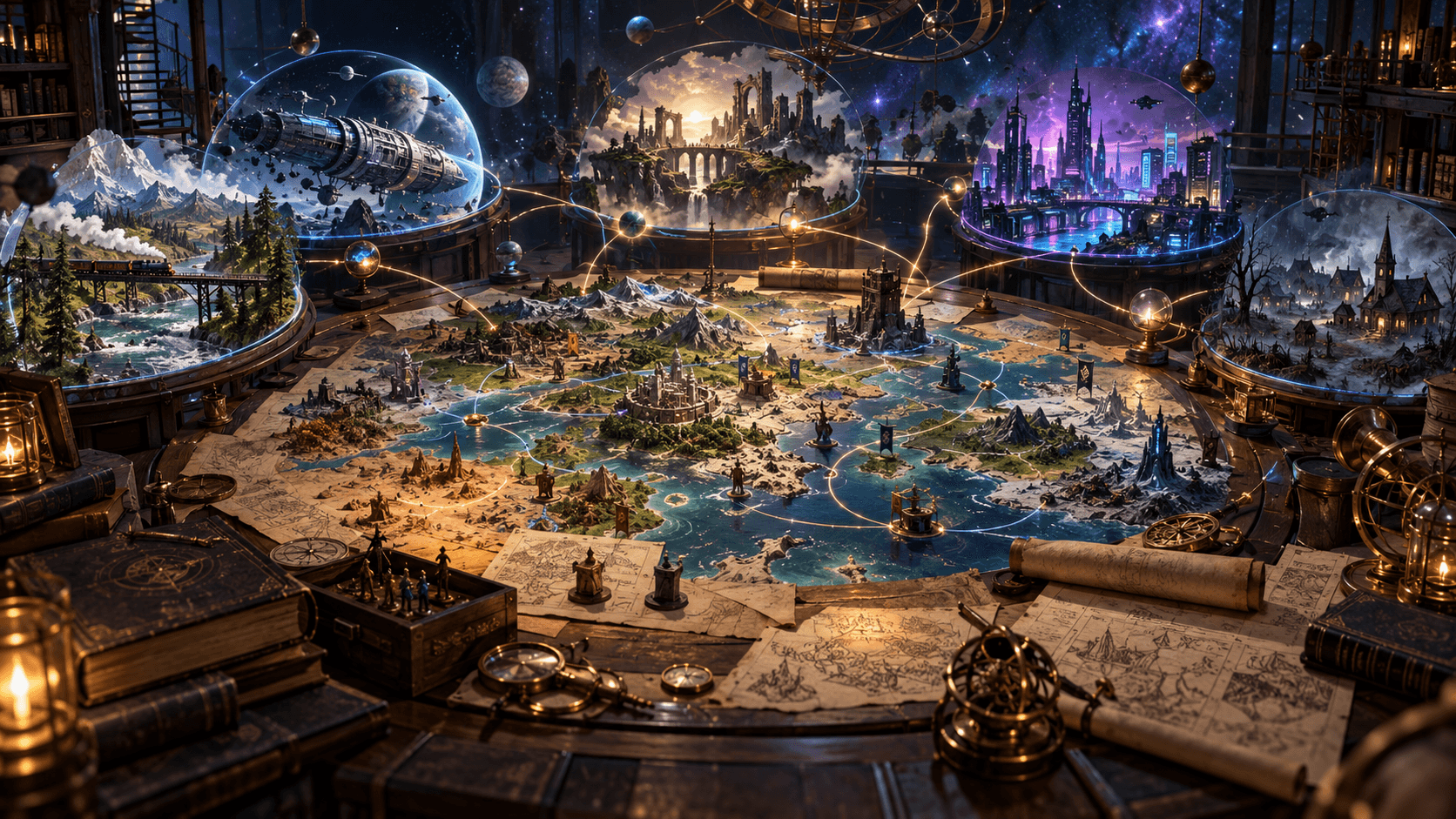
People often ask us the same thing: how can short stories, novellas, characters and playable games all come out of the same place and still fit together?
The answer is that we don't build stories side by side. We build a world that can produce them.
First there has to be a place that exists even when no particular plot is running inside it. It has geography, a past, an economy, institutions, conflicts, languages, local legends, trade routes, the powerful and the ordinary — and a timeline it actually remembers. Only then do we start telling stories in it.
A world is not a backdrop. It's a mechanism that generates stories.
A character's skills are the game's verbs
We don't write a character as name + job + mood. We write what they can actually do — because that is exactly what a player will be able to do when they step into them.
Ezra Combe, from The Long Box, isn't just "a grim gravedigger." He knows bodies, timber, transport, weight, documents and the practice of burial. He can prepare the dead, keep the record, negotiate transport — and say: this I know, this I don't, this I won't certify.
Those are the traits of a literary character and the verbs of a future game at the same time. That is where literature meets AnyVerse.
Stories don't reset the world
A story has an ending, and we don't undo it. What someone built stays built. What was torn down, the world remembers. A place closed in one story can't be pretended open in the next.
It's not "new session, clean slate." It's the same world, later.
So we guard the timeline. If the railway hasn't reached a town yet, the next author can't drop a character off a train there just because it would be convenient. If a decision was made, the world carries its consequences.
First you read. Then you walk in.
You can read a story to its ending — we don't change it. The world keeps existing after the last page. The character keeps existing. And then you can enter that same world and live a new story.
You don't pick A — good / B — bad. You make decisions inside a world that already has its own limits, and the ending is a consequence of what you actually did.
First the place. Then the people. Then their stories. And when the world is real enough, we do one more thing: we step inside — and stop only listening to the story, and start living in it.