
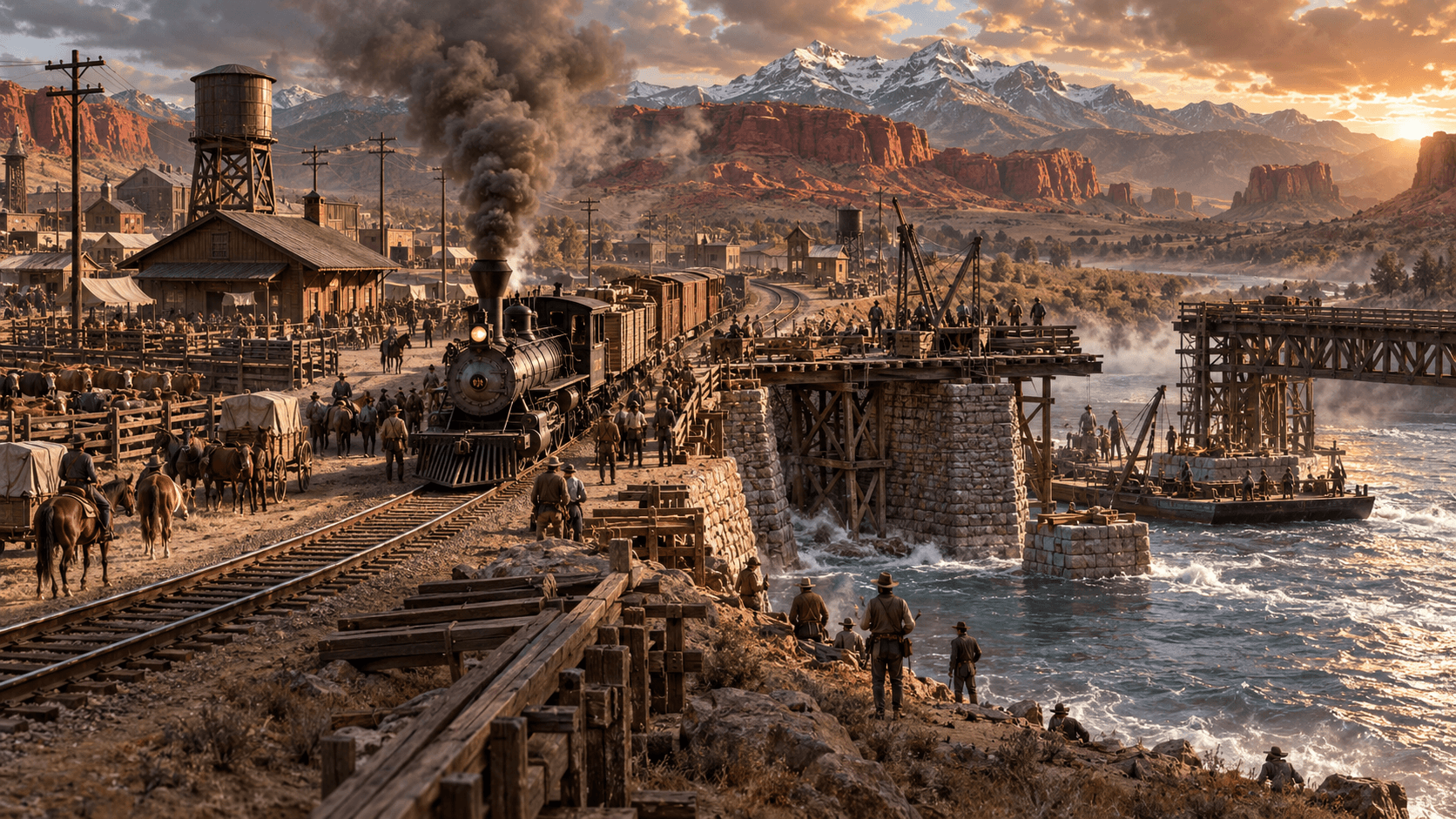
It isn't enough to say "a western in 1895." That's a costume, not a world.
To tell real stories here we have to know where the river runs. Which roads are passable. Where the railway ends. Which town lives off cattle, which off a mine, and which is just starting to lose to new infrastructure. Who has a telegraph. How long a journey takes. What happens to the ferry crossing when a bridge is finally built.
In Red Basin Country, Dusthaven has no railway yet. The current railhead is Red Junction. A crossing over the Cold River is under construction. Mercy Crossing lives off its ferry — so a new bridge isn't scenery to it. It can change the future of the whole settlement.
That's not decoration. It's a mechanism that generates stories.
The world has no single story of itself
This is the layer we care about most. People tell stories, believe in places and signs, and repeat things they can't explain. Fact, rumour, local legend and official record can be four completely different things — and not everyone knows the same version.
That gives us something unusually useful: the people living inside the world are also trying to work out what happened. The world doesn't hand you one tidy truth.
One place, many roles
A single location can be the backdrop of one story and the heart of the next. A minor character can become a protagonist months later. A bridge can be a single line in the background of one tale and the thing that destroys a town's economy in another.
A railway means progress to one character, the loss of a trade to another, and the chance to make a fortune to a third. We don't write stories next to each other — we write them inside the same system of cause and consequence.
And then we let a player in
That's the difference between ordinary worldbuilding and AnyVerse. We don't want an encyclopedia of a world. We want a world you can act inside.
So alongside geography and history we build the facts a player can discover, the facts a character can't know, the objects they can use, the relationships, the institutional limits, and the conditions for different endings. You decide inside a world that has its own physics, law and cost — and your ending follows from what you actually did.