
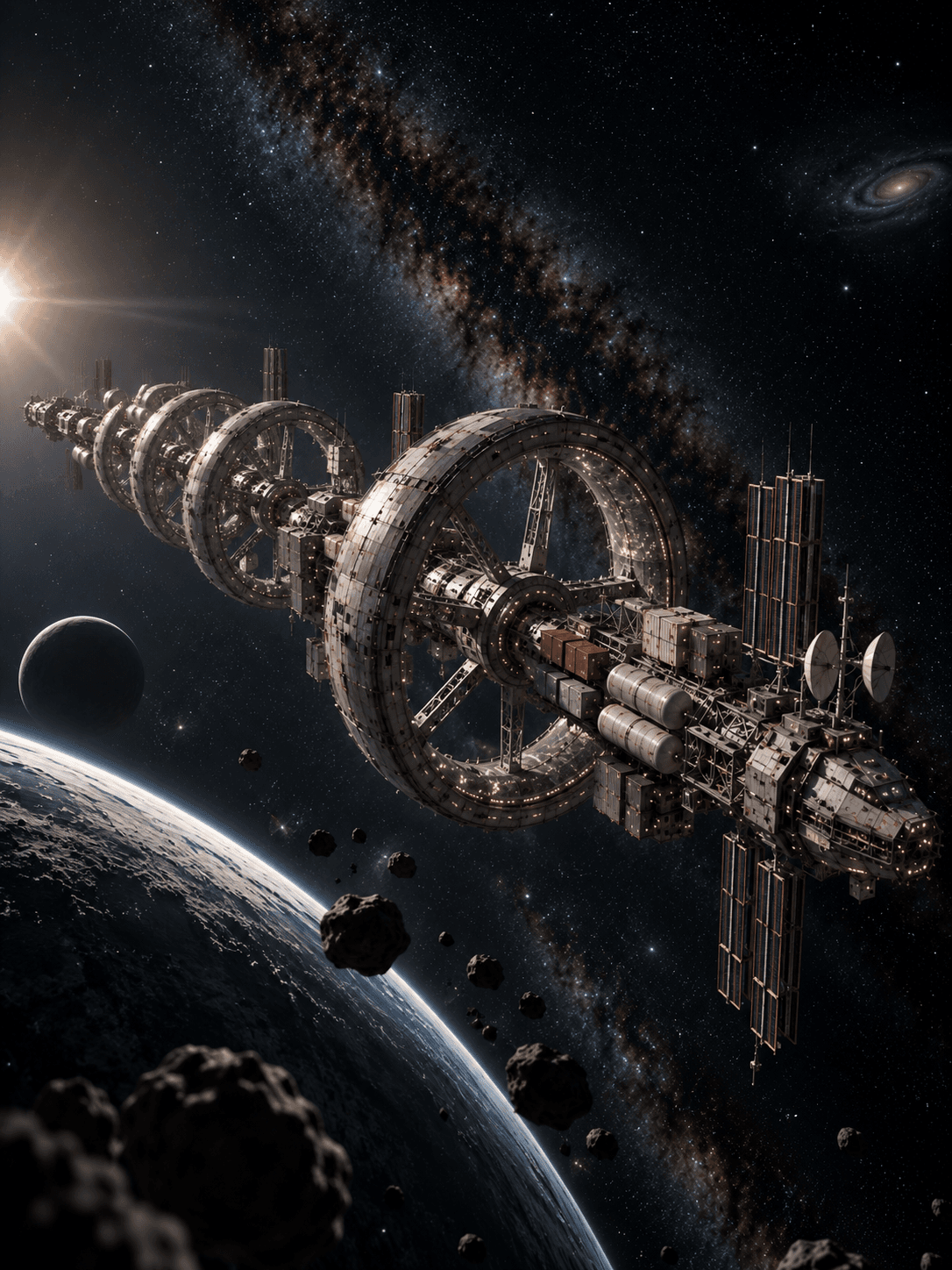
Look at The Long Wake and it's easy to see just a colony ship crossing space. That's not enough. We aren't telling the story of one ship. We're building a ship that can give birth to completely different stories across nearly two centuries.
Holdfast is a huge colony ark bound for a red-dwarf system. Tens of thousands of people spend most of the voyage in stasis; only a small part of the population is active at any time. People wake for Watches, work, build, repair — sometimes break something — and go back to sleep.
You know when your current Watch ends. You don't know when the next one begins.
You might sleep tonight and wake in a year, in thirty years, in a hundred — or never again during the voyage. For you, a night passes. For Holdfast, a generation.
The ship remembers every physical decision
The real protagonist of The Long Wake isn't a person. It's the same hull. People change, Watches change, sectors open and close — but the ship remembers every physical decision ever made to it. A workshop built in Ship Year 61 still has mass, cooling needs and upkeep costs seventy years later.
A corridor can still exist and not be available. A sector can still exist and sleep for seventy years. A map can still show something — and not show the truth you need right now.
Time stops working normally
Stasis changes more than a journey. It changes a family. A father can be biologically 28 while his son is 40 — no paradox: the father slept while the son lived through more Watches. One day the mission may wake both during the same Watch, not to reunite them, but because it needs their skills. The son might be the father's superior.
Wake scheduling is never family-driven.
So in this world you can be alive, close, and temporally unreachable. Your partner can sleep a few hundred metres away, and you may not see them for fifty ship-years. Sometimes the greatest cost isn't death. It's biological time you weren't meant to spend — the status we call STRANDED AWAKE.
The AI does not own people
Holdfast has a very advanced AI. It can model decades and coordinate automation. But it isn't the king of the ship. The human mission charter defines who is qualified, what roles exist, the limits of authority, and what rights a person keeps. The AI chooses who wakes and when — inside those rules. It cannot expand its own power.
And then we let a player in
The player doesn't replay Return Window or repeat Tessa Vale's decisions — those already happened; they're the world's history. Instead: you're someone else, on a different Watch. Or you're a character we've already met, years later for the ship and months later for them.
Tessa Vale, from The Cartographer's Correction, can measure a route, certify it, reject it, sign a change, grant an exception — or refuse to certify a promise the ship can't keep. Those are her traits and the verbs of a future game at once. You decide inside a world with its own physics, history, law and cost, and your ending follows from what you did when the world wouldn't bend to you.
Not "new session, clean ship." The same ship, later.