I. The Dock
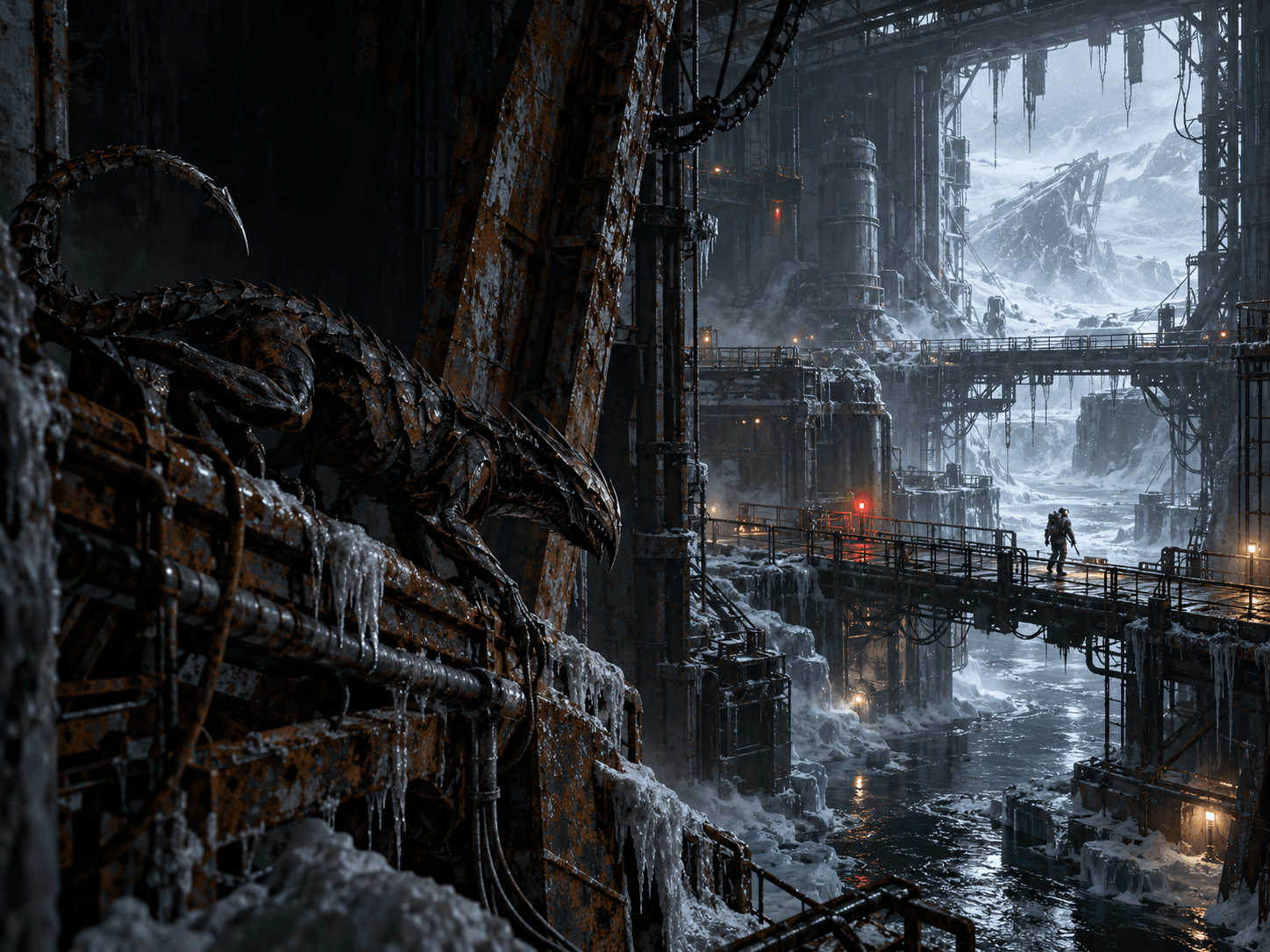
P-14 was not dead. Dead bases are silent. This one breathed — badly, unevenly, through frozen conduits someone had left under pressure sixty years ago and never come back to close.
The hauler rolled into the dock bay on dying thrust and settled on the frost-caked plating. Beyond the airlock gates the storm hammered the base's outer shell — the same front that, far away at Przetop, was closing the plain to white — but here, metres under the ice, in the belly of a military pylon, you heard it only as a dull, distant pulse in the structure. Like something large turning over in its sleep and not yet waking.
Mark Novitzki went down first and laid a hand on the inner wall of the bay before he took off his helmet. He always did. The others read the manifest; he read the metal. Under his glove he felt the slow, old settling — a structure that for decades had been looking for a new shape and had almost found it. That was understandable. That he could read.
He could not read the silence. Nor the fact that in a bay no one had entered in generations, the emergency lights burned in an even, maintained row — and should not have. Power in an abandoned base dies sector by sector. Here someone — or something — had left it on.
"Eight hours," said Hensa Dray, coming down behind him with the contract slate strapped to her forearm. "We go in, we take the recorder from the lab in the central section, we come out. The broker wants it yesterday. He pays for yesterday."
"The broker wasn't inside," said Sael Teveen.
She stood side-on to the airlock, as always, never in its light, a hand on the coil of line at her belt. The combs at her skull were darkening toward violet — a Veyr under load — and darkening since they'd entered. Mark said nothing. Sael knew more about lines, locks and thresholds than anyone, and she had one rule she repeated like a technical prayer: don't stand in the light of an entrance, don't lean on a doorframe. In tight places, what kills you waits exactly there.
There were six of them. Mark, Sael, and four hired. Corm Veical, a heavy operator with a heavy slug-thrower across his back, who hadn't said a word to Mark the whole way and looked at his hand on the wall like a superstition. Tovey Lund, a medic, with a bag full of things meant to last eight hours, not a war. And Davik Sorn, the boy everyone called "Grin" because he smiled even now — drone and comms operator, first big contract, eyes like someone who finally got to work with real Guardians of the Trace.
Above the gates, on an old board, a message that had outlived the crew still glowed:
WELCOME TO P-14. SAFETY IS A SHARED WATCH.
"Lovely," said Sael. "Always wanted a watch shared with corpses."
Grin laughed. Corm didn't.
Mark walked the bay, reading it with hand and eye. Old docking stands, bent inward, as if something had once tried to get out of here, not in. Against the wall — a row of military suits on racks, stiff with frost, names on their breastplates. No one had taken them. People who leave a base on schedule take their gear. People who don't leave, leave it hanging.
"Hensa," he said. "Does your contract say why this base is empty?"
"My contract says where the recorder is and how much I get for it," said Hensa. "The rest is your problem, Guardian."
"The rest is going to be all of our problem," said Mark. "The power's being kept on. Someone left it that way on purpose. In an abandoned base that doesn't happen by itself."
"Good," said Hensa. "There'll be more light."
Sael glanced at her over her shoulder.
"In this line of work, agent, 'there'll be more light' is usually the last thing a person says before what's visible in the light."
Grin unfolded his rig, to be useful, because he wanted the Guardians to see he was useful. He hunted for the mast, for the relay, for the surface. He found the storm.
"I've got the mast," he said. "I've got — I had the mast."
Outside, something large turned over in its sleep and this time did not wake gently. The front struck P-14's external antenna and took it — didn't damage it, took it, tore it from its mount and carried it off into the white. Grin's comms indicator dropped to zero and stayed there.
"Was that the only antenna?" asked Corm.
"That was the only antenna," said Hensa, and for the first time something in her voice didn't square with 'eight hours.'
They were inside, cut off — from the hauler beyond the gates, from the surface, from everything. Somewhere far away, behind the same storm, an assessor whose name none of them knew was counting percentages over different ice and did not know P-14 existed. And they were not to learn of him. Two stories, one storm, one planet, and no bridge between them except that both were going to end in loss.
Mark looked down the first corridor, into the rust and frost, and felt something he couldn't measure — not a fact, not a reading, just a bad place in the structure further on, past the bend, where the air should have been still and wasn't. He set it aside. The flashes were not a map. Axiom had percentages; Mark had only a neck that sometimes stood on end before his mind could name why. For now the neck was silent. The silence said something too.
"We go for the recorder," he said. "And remember every metre. Because if Hensa's map is as old as this base, the way back is the only thing we've got."
Hensa didn't answer. Mark noted that too.
II. The Barracks
The first signs of the nest looked like order, and that was the worst of it, because order meant someone or something lived here, not just died here.
In the barracks ring the service plates had been stripped from the walls and arranged — not scattered, arranged — into low, rippling banks along the corridors, caked with something dark and dried. Tovey crouched by one and did not touch it.
"Organic," she said. "Old and new. In layers." She sniffed through her filter. "They've eaten and slept here a long time. And still eat."
"Someone or something?" asked Grin.
"On Kharos-9 that's usually the same question," said Sael.
They walked the middle of the corridor, because Sael made them walk the middle — away from the bulkheads, the emergency lights, the recesses where something could hold still. They passed quarters with bunks that still held gear built for people who were no longer there: helmets with engraved names, rations dated sixty years back, a vacuum laundry with instructions in three languages, two of which no one used anymore. On the mess wall, under the safety regulations, someone long ago had scrawled in thin marker, in a hand that was in a hurry: if you can hear them in the wall, you're already in the wall.
"An optimist," said Sael.
In the corner of the mess stood a terminal still alive on the dregs of a cell. Hensa switched it on, because Hensa switched on anything that might have value, and the terminal showed fragments — old watch recordings, worn, full of static. A voice from sixty years ago, tired, matter-of-fact: ...third attempt at specimen identification failed. The object does not respond to the standard thermal lure in a way that... correcting. It learns faster than the protocol assumes. Procedure change attached... Then static. Then another voice, a woman's, quieter, as if she were talking to herself, not to the record: ...stop calling it a specimen. The specimen lies on the table. This walks on the ceiling.
"What was that?" asked Corm.
"A military base that tried to identify something," said Mark. "And failed."
They went on. At the exit from the barracks the corridor had a low-hung ventilation lattice, black with old grease and crusted with frost, and Grin — who wanted to be useful — sent a drone into one of the ports. Small, four-rotor, with a lamp and a camera, it rose to the ceiling and entered the first open shaft, because the vents were faster than the flooded levels. The feed ran to his slate: duct, rust, frost, a bend.
At the bend something was waiting, and for a moment — for that one cruel moment — the drone showed it to them clearly. It didn't lunge. It hung in the duct's lattice, slender, wet, dark, fused with the ribs and bolts so that without the lamp it would simply have been wall. It slid sideways, parallel to the direction the drone was flying, as if it were leading it, as if it wanted to see where the thing was going — and then, as Grin opened his mouth to say something, the duct rippled, and the drone's lamp turned back, inward, and went out between teeth no one had time to count.
"Did you see?" Grin asked quietly. "It went alongside. Not behind. Alongside."
"Lockjaw Sentinel," said Sael. "An old habit of this place. It plays at being structure until you need the structure." She looked into the dead screen. "And it doesn't hunt stupid. It led the drone to find out where we're going."
"Which means it knows we're here," said Corm.
"It knew before we opened the airlock," said Sael.
"We've lost our eyes," said Mark. "From now on we go blind, and we go low. Because up is where it is." He looked at the ice-and-rubble collapse that sealed the corridor running, on Hensa's slate, straight to the central section — a collapse that wasn't on the slate. "Up, and straight ahead. We're left with the road they left us. Lower. Flooded."
III. Water
The flooded sector began where the floor for humans ended, and it taught humility to water faster than anyone wanted to learn.
Black water stood in the shaft to halfway up the first catwalk, motionless, skinned at the top with a thin layer of ice that broke under the hand like glass. It was colder than anything they'd felt — so cold the heated suits barely kept up, so that up the ankle, the knee, the waist it climbed the leg like someone taking your measure. Sael went down first, on the line, and marked the way across the torn catwalks, along railings that still held, and around those that had to be avoided, because they didn't. They went slowly, because water muffles a step but does not muffle what's below.
And below you heard everything. Water carried the pipes' vibrations farther and cleaner than air. Every creak of metal, every settling, every movement — came through the liquid into the bone, and there was no telling whether it was the base or whether it was him. Once, in the dark behind their backs, something entered the water — quietly, in one smooth motion, without a splash — and the wave came through the liquid, brushed their thighs, and vanished, and no one said anything, because there was nothing to say. Grin walked close to Mark, his needle carbine up, whispering not to be afraid, jokes no one listened to, his breath in the channel too fast.
"At the dock they said it would be warm in the water," he said. "That water holds heat. They lied."
"Water holds heat on a planet that has a sun," said Tovey. "Here it holds only you."
The road Mark read as holding balked in one place: a submerged bulkhead, closed to two-thirds of its height, with a remnant of passage under the lintel where the water reached the frame itself. To get through you had to submerge to the neck, cross under the bulkhead's edge on a held breath, a metre of black water over your head, and surface blind on the other side. Sael went first, on the line, and jerked it three times — the sign that there was air on the other side and no teeth. Then she brought them through one at a time, because underwater a person can't see, can't hear, and doesn't know whether the thing that touched his leg is the line or something else.
Corm went third and did what people whose bodies know about fear before their heads do: in the dark under the bulkhead, feeling for the edge with his hand, he grabbed not the edge. He grabbed something that clung to the ceiling underwater, motionless, waiting — Szczeliniaki don't swim, but a Lockjaw, young, smaller, can enter the water briefly — and it stung him in the forearm, once, shallow, because it wasn't holding him, only standing in the way, and it withdrew into the deep before anyone saw it. Corm surfaced on the other side with a cry the water half ate, and a hand already beginning to stiffen.
"Stung," said Tovey, already at him, already cutting the sleeve. The wound was shallow, but venom doesn't count depth. "Shallow. Little. But venom is venom." She glanced at Mark over her shoulder, briefly, and he saw a number shift in her head. Then she drove the first dose into Corm's forearm above the wound, and Corm swore, and the stiffness began to recede. "That was unnecessary," Tovey said quietly, more to herself. "He'd have survived a shallow sting without the dose. Maybe. But 'maybe' wasn't a good number today, and I'd rather Corm held a weapon than find out how much was in that 'maybe.'"
Corm looked at his own hand coming back to him.
"How many do you have?" he asked.
"Fewer than I had a moment ago," said Tovey, and closed the bag, and didn't say the number, because numbers take away people's will to fight, and she needed them a while longer.
Halfway through the next sector the Szczeliniaki got into their suits. No one noticed when — blind, threadlike, finger-long, entering every seal, every reduction valve, hunting heat and movement. Corm cried out again first, because something got into the valve at his wrist and began to choke the air feed, and the suit hissed a pressure-drop alarm. Then Grin. Then Sael herself felt them in the valve at her throat.
"Don't yank," said Tovey, already with the knife. "You'll tear it, half stays, and it rots in your seal. It has to be cut out." She cut into the valve, into the living, and drew out a thread still moving, and did the same to the next person, and the next, waist-deep in black water, in the dark, cutting out of valves something that wanted only their warmth. This was the thing the sector took from them beyond time and blood: the certainty that a suit was sealed. Every one of them now breathed through a filter that might still hold something thin and blind, and each knew he wouldn't find out until the air ran short.
They came out onto a drier ledge and stopped, to count valves and catch the thin air. Above the exit a message glowed:
WET ZONE. REMEMBER TO CHANGE FILTERS EVERY 4 HOURS.
"Davik," said Mark. "How many spare filters do we have?"
Grin reached into the pack where he carried the spares for the whole group, and his face did something Mark hadn't seen it do before. It stopped smiling.
"I was carrying them up top," he said. "With the drone. To be lighter down here." He swallowed. "They're in the duct. With the drone."
Silence, in which you could hear only the water dripping off them.
"All right," said Sael at last, very calmly, because panic kills faster than a lack of filters. "That means from now on we breathe carefully. Everyone. And we don't go up for anything again." She looked at Grin, and there was no reproach in it, only the arithmetic they both understood. "And you owe me one watch of air, boy. You'll pay it back when we get out."
Grin nodded, and believed her that they'd get out, because he wanted to believe it, and that was the only thing he still got to give her.
He died twenty minutes later, and it happened fast, and quietly, and without any roar, because the Lockjaw did not hunt with a roar.
They were walking the corridor between the flooded sector and the first frozen tank, one behind another, Grin second from last, and the corridor had a ceiling of ventilation panels that looked like all the ventilation panels in the world. Grin was just saying something — about how when he got back he'd stand the Guardians a round at the port, that no one would believe who he'd worked with — and his suit was cracking with the rising frost, and the vapour of his breath rose straight up, into a panel, warm and wet, like a thread leading to the lungs.
The panel above him opened without a sound. No monster fell. Out of the dark slid a long, segmented tail, tipped with a spine wet from something that was not water, and it touched the boy's nape — carefully, once, like someone checking in the dark whether an object is where he left it. Grin went still. He managed a single quiet sound — not of pain, of surprise — and Mark saw the venom enter his nape, saw the boy try to lift a hand and fail, saw his face go suddenly very calm. Then the tail tensed and lifted him up, into the panel, without effort, like a cat lifting a kitten by the scruff, and the panel settled back, and the corridor again had a ceiling of ventilation panels that looked like all the ventilation panels in the world.
They were left with his lamp, which had fallen and rolled across the grating, circling light across the walls, and with his carbine, which he hadn't had time to raise.
Corm went mad. In the tight corridor he lifted the heavy slug-thrower and aimed at the ceiling, at the panel, at the place where the boy had just been, and Mark threw himself at the barrel, forced it down, pinned it to the grate.
"Not at the ceiling!" His voice was hard, because it had to be harder than Corm's fear. "You'll drop him on our heads and breach the corridor. He's gone. Do you hear? He's gone, and there are still five of us, and I want there to be five when I count in an hour."
Corm panted. He lowered the weapon. His hands shook, and he hated the shaking, and he hated Mark for being right again.
Tovey went to Grin's lamp, picked it up, switched it off and put it in her bag, because the lamp would be of use, and grief on Kharos-9 is a list, not a speech. But her hand shook at the bag's clasp, and Mark saw that the medic who was meant to last eight hours had just worked out what she really had to last, and that she didn't like the answer.
IV. Ice
The frozen tank was beautiful, and that was the worst thing about it.
The water that had once filled it had frozen mid-motion — a great transparent sheet, a wave set solid with trapped air bubbles, tools, a cable someone had dropped sixty years ago and that now hung in the ice like an insect in amber. A thin catwalk ran above the sheet, torn in three places, and beneath the catwalk the ice went down far enough that a lamp didn't reach the bottom. Sael laid lines across the gaps, anchoring them in bolts Mark marked as living, and brought the crew over one at a time, in a long haul, never a jerk.
Halfway across the sheet the ice stopped being ice.
Not under their feet — beside them, in the tank's wall, a band of ice for a few seconds became transparent differently than the rest: not glass, but something taut and trembling, like the surface of water just before it breaks. And beyond that band, for that one moment, Mark saw a space that could not be behind the tank's wall — a depth, a corridor no map linked to this place, running off at an impossible angle. And at its end something stood. Not a figure. A shape — vertical, dark, could be a suit on a rack, could be a shadow cast by nothing, could be a bend of the ice itself. The eye wanted to make a man of it. Mark didn't let it. It was only a shape, and when he blinked the wall was ice again, and behind the ice rock, and there was no corridor, and no shape, and nothing but the pressure in his own skull.
A breach. Brief, local, sourceless. Not a passage, not a warning, not a sign. Something that for a few seconds let through a view of a place that should not be there, and took it back, explaining nothing.
And it left in Mark a thing worse than fear: a certainty that was not a certainty. For a moment after the breach his neck told him the far part of the catwalk was good, held, you could go fast — and that was a lie. The breach had thrown off his reading the way a magnet throws off a needle. Mark took two steps on that false certainty, felt the ice under the catwalk answer wrong, dull, not-so, and stopped mid-step, his heart hammering not from the cold.
"Don't trust me for the next minute," he said to Sael, quietly, so the rest wouldn't hear. "Something's reset my sense of it. Lead by the line, not by me."
Sael didn't ask why. She led by the line.
On the far shore of the sheet a Lockjaw waited — not in ambush, but in the open, because here, on thin ice, in close quarters, it had the advantage and knew it, the way a predator knows, not the way a man knows. It was the size of a big panther, slender, dripping, dark, and it moved so fast the eye lost it between one lamp and the next. It rushed Corm, because Corm was heaviest and stood surest, and Corm did exactly what Mark had warned him against since the dock.
He fired.
In the tight tank, over the frozen sheet, the heavy slug-thrower sounded like the end of the world. The first round hit the Lockjaw in a dorsal plate and ricocheted — the chitin was precisely so that it would ricochet — and went into the tank's wall, into a bolt, into a bulkhead holding pressure between the tank and the void behind it. Corm emptied half a magazine before his reason caught up, and half those rounds ricocheted off the creature's plates and off the walls, cutting the base's steel ribs like paper, and one of them did the thing Mark had feared from the first step: it breached a bulkhead.
Air went out of the tank with a roar, and into the roar went a scream. The pressure drop snapped at the sheet, the ice under the catwalk cracked along Mark's false certainty, and the Lockjaw — which feared neither pressure nor ice — vanished into a gap between plates, whole, as if it had never been, taking with it only the knowledge of how their weapon sounded and that it was useless.
They survived because Mark read which section of catwalk would give last, and shouted the order, and they crossed it, and Sael anchored them to bolts on the far side and hauled each over in turn, a long haul, in the escaping air, with the ice cracking under them. All five survived. But Corm took a bolt-fragment in the side of his helmet, and lost the hearing in one ear, and — worse for everyone — the heavy slug-thrower went into the gap with its magazine, because there was no going back for it onto ice that no longer existed.
They lay on the far side, catching the thin, cold air.
"I told you," said Mark. Without triumph. They were too short of air for triumph.
"I know what you told me," said Corm. Blood from his ear froze on his neck in dark icicles. "You told me to trust the fortune-teller." He looked at Mark differently than at the dock, through the one ear that heard. "I agree too late. But I agree. From now on I go where you point and I don't fire until you say." He grimaced. "I've got nothing to fire with anyway."
That was the third thing they lost: firepower, and the illusion that P-14 could be crossed by shooting. They were left with a bolt-bar, a few spikes for the lance, Sael's lines, two thermal charges — and a ration of air that had just shrunk again by one breached tank.
V. The Vents
The base defended itself, and did not know it was defending itself against the last ones who had come to help it get out.
Beyond the frozen tank the only road Mark read as holding ran through a ventilation node — a crossing of ducts and service passages where the old military had installed automatic anti-boarding turrets. The turrets did not know the crew was dead. They knew only one thing: movement is the enemy, vibration is the enemy. For sixty years they had fired at Szczeliniaki, at falling ice, at Lockjaws that had long since learned to move so the sensor didn't catch them. And now they turned on people who walked normally.
The first burst nearly killed Hensa. She stepped into the light at the crossing — Sael had been shouting at her for ten minutes not to step into the light — because she wanted to see whether the corridor ahead matched her slate, and a turret in the ceiling turned on the vibration of her steps and opened fire. Hensa dropped at the last instant, instinctively, and depleted-uranium rounds passed where her head had been, and bit into the bulkhead behind her, and into the steel ribs, and sprayed in ricochet across the whole crossing. Everyone went flat, below the sensor line, and lay in the dust of metal sifting from the cut walls, and waited for the turret to stop finding movement.
"We've no way to disarm them," said Mark, quietly, cheek on the grate. "We've no mechanic who'd know these systems. No one of the kind who works the old installations on the Fourth Loop. We've a medic who knows how to cut people, not military, and a gunner with no gun."
"Thanks," muttered Corm.
"I won't disarm them," said Sael. "But I'll fool them." She unclipped a spare hook on a line from her belt. "They go for movement. I'll give them movement." She threw the hook across the crossing, and the hook jittered, rolled, and the turrets turned on it and emptied into a dead piece of metal magazines that were sixty years old and that no one had ever refilled, until they ran dry, one after another, on nothing. Then there was silence, and in the silence, crawling, they passed under barrels that had nothing left to fire.
But beyond the turrets, where the corridor should have gone on, a fresh collapse waited — the base had settled from the fire, and what had been road five minutes ago was now a wall of ice and bent steel. Mark laid a hand on it, searched, and found nothing that would give without burying them alive.
"We don't get through here," he said. "That leaves one road."
He looked up, into the ceiling lattice, into the open mouth of a ventilation shaft, black and tight.
"No," said Corm. "Not into the ducts. That's where it is."
"It's everywhere," said Mark. "Below, above, in the water. The difference is that in a duct, at least, it can't get up to speed." He looked at Sael. "Your domain. Lead."
They went into the shaft. And the shaft was worse than anything so far, because in a shaft a person stops being a person — he becomes a thing crawling on its elbows in a tight, freezing pipe, in a dark that the headlamp shoves back a metre ahead and a metre behind, and beyond that is what you can't see. Sael went first, in silence, making them put their hands exactly where she put hers, because the lattice under them was old and didn't hold everywhere. Corm went last, because he was the widest and the slowest, and that was a bad place for the slowest.
In the duct they heard them for real. Not through water, not through a wall — alongside, in the same metal they were pressed into. Soft slidings, once from the left branch, once from the right, once — and this was the worst — from above, from a duct crossing over them, separated by a single layer of lattice. Something passed over Mark, across, a metre above his back, and Mark felt on his nape a trickle of warm air that was not his own — the creature's breath, let through the grate — and froze, and everyone behind him froze, and they lay in the pipe, not breathing, while something slender and heavy slid over them, sniffed at the grate, searched for the warmth they had just learned to hold back.
It passed. Or pretended to pass, and waited three metres on. There was no knowing. They went on, and after a hundred metres of tightness they reached a node — a place where four ducts met in one junction chamber, large enough to kneel in, and open enough to die in. And there, in the chamber, Corm, who had crawled in last and rested his wounded side of the head against the cold grate, looked up, into the chamber's ceiling, into the lattice two metres above him. And the lattice looked back.
One of the ribbing panels was not ribbing. It was a slender shape clung to the metal, dark and wet, so perfectly motionless that for a few seconds no one saw it, though everyone was looking at it. Then Corm saw that the rib had mouthparts — folded, drawn into itself, a second jaw hidden inside the first — and that those parts were aimed straight at him, and that the creature did not move, waited, measured, decided whether Corm was worth stopping being the ceiling for.
"Nobody. Moves," said Mark, very quietly, not moving his lips more than he had to.
They lay still. Corm lay under it, looking into its mouthparts, his face grey, and did not twitch, and that saved him, because the Lockjaw hunted movement and heat, and Corm, cold with fear, motionless, was for those seconds almost part of the base, the way the creature was almost part of the ceiling. It lasted fifteen seconds. It lasted an hour. From a side duct came a second breath, and a third — the nest was gathering to the chamber, drawn by the warmth of five bodies pressed into one place.
Then Sael, without rising, moved her hand to one of the two thermal charges and fired it into the farthest of the four ducts. Heat burst there, trembling, loud to senses that read heat, and the shape in the lattice above Corm stopped being a shape — it threw itself sideways, toward the false, warmer, moving prey, soundless, and with it went those two breaths, the whole nest pouring into one duct after one lie of warmth. And in those few seconds they crawled across the chamber to the down-shaft Mark marked as the only one holding, and rode it down on Sael's line, spilling out of the vents onto the hard floor of a research corridor like something the base had spat up.
They lay there, panting, and for a while none of them could stand. They had one thermal charge left. And four people instead of six, because the counting was shorter now.
Tovey crouched by Mark, checking that nothing had reached him in the chamber, and Mark asked her quietly, using the fact that Corm was deaf on the near ear and Hensa stood farther off, at her slate.
"How much antitoxin do you have."
Tovey didn't look up.
"I started with three," she said. "I used one on Corm in the water. Two left." She closed the bag. "I'm telling you the truth, because you're a Guardian, and a Guardian will count anyway. I'll tell the crew three. Because a lacerated wound on Kharos-9 doesn't heal in this cold — blood doesn't clot, the body doesn't rebuild, the cold holds everything open, and the only thing that heals here is getting out, or a needle. A person who knows there are two needles left for four people stops fighting." She looked at him. "So you tell me, Guardian, since you count: what are the odds we come out whole? What would your assessor give?"
"Axiom never gives a hundred," said Mark.
"Then I already know we don't come out whole," said Tovey, and smiled, Grin's smile, a defence mechanism, and no one told her to stop, because no one had a better one.
VI. The Truth
The lab began to speak before they reached it, and the longer it spoke, the quieter the crew went.
Beyond the ventilation node the corridors changed character. Less barracks, more research steel. Observation chambers with thick panes, cracked from within — always from within. Old terminals, one of them still alive on the dregs of a cell. And walls covered in something Mark first took for corrosion and that was a map — not of the base, but of behaviour. Someone, long ago, had drawn routes on the walls. Lockjaw routes. Feeding hours. Points marked with one repeated word that someone wrote more and more carelessly, until he stopped: feeding.
Hensa read the terminal, and Mark watched her face, not the screen, because the face said more. There was no surprise on it. There was a kind of confirmation — as if she were reading something she'd already heard, and only checking whether it matched.
"You knew," said Mark quietly.
Hensa didn't stop reading.
"I knew the broker was paying too much for a simple recovery," she said. "I knew there was something behind the recorder he wouldn't name. I didn't know what." She scrolled the record. "Now I know. And it changes nothing. I still have to carry it out. Because if I come back without it, Grin died for nothing, and I don't know how to work with 'for nothing.'"
The terminal showed it in plain military language that was worse than a scream. The station's last director, in the voice of a man who knows this is his final recording and speaks anyway, because the military habit is to report even your own end: ...to a command that no longer exists. Program Rust Ribs, final report. We did not create them. I want that to be clear in the record — we did not create them. We found them here, in the warm sectors, already nesting, already hunting everything that came in uninvited. We judged it a resource. A living barrier. No one crosses P-14 we don't let cross, because P-14 guards itself. We fed the nest. We steered it. We taught it where it was allowed and where not... — Static. — ...the program outgrew the feeding. It grew beyond what we could feed and steer. And when there was no more of what we gave them, they began taking what was to hand. Us. — Longer static. — I'm leaving the power and the sensors on. Not so that someone comes back. So that when they come in, they see the light is on, and think it's safe here. I'm sorry. It's the only lie I can leave as an inheritance...
The record cut off. No one said anything for a moment, in which the base settled a millimetre.
"They bred it," said Corm at last, through the one ear that heard. "Kept it on a leash and fed it, and then it ate the leash. And left the light on so it would eat us too."
"They didn't breed it," said Sael. "They found it and used it. That's worse. You can breed something by mistake. This was an idea."
Mark laid a hand on the lab wall and felt the base breathe under him, and felt, somewhere below, in the central section, in the warmest sector, the nest breathing with it — dozens of breaths, adult and smaller. The nest had taken the central section because the central section was warmest, not because something guarded there. The recorder lay in the heart of the nest by coincidence, not by design. And people, as always, had taken coincidence for meaning, and paid for the mistake.
That was the third thing they lost, and the worst: the illusion that they were here for something clean. They had walked into the grave of people who dug it themselves, and the only road out led through the very heart of what those people had fed.
VII. The Nest
The central section was warm, and the warmth was obscene.
For the first time since the dock they were warm, and none of them was glad of it, because this warmth was not a rescue — it was a breath. The air in the central section stood thick, reeking of stale ammonia from the dead coolant and of something beneath it, sweetish, heavy, the smell of overheated biology that got into the throat and wouldn't leave. Across the walls and floor ran banks of black, steaming secretion. Service plates — stripped from every wall of the base and carried here across generations — were heaped into mounds, low, rippling, warm, and in the mounds something moved.
Not eggs. Not larvae. Young. Slenderer than the adults, faster, the size of dogs, moving not singly but as a swarm, like a handful of steel pincers spilled on the floor — and where they passed over the metal, matte, eaten tracks were left, because the thing the young defended and fed with burned like acid. They did not attack head-on. They poured around the legs, testing suits, forcing the crew to constant movement, because whoever stopped had the pincers start eating out his sole and ankle. You had to keep going. All the time, going.
And the adults were wall, ceiling, console, valve — until the moment they stopped being.
The recorder lay on a console at the centre, where it had been left sixty years ago — a module the size of a bag, matte, dead, with an incomplete record no one here would ever read in full. And Hensa, who had not changed one thing the whole way — that the artefact was worth more than people, even now, maybe especially now, because if she came out empty-handed then Grin, and Corm, and the air, and everything, would be for nothing — Hensa went for it first, among the mounds, across the burning floor, batting the pincers aside with the stock of her pistol.
She reached it. She took the module in both hands. And in that same moment the adult Lockjaw that had been the edge of the console stopped being it.
The tail struck her in the side, the spine went deep, under the ribs, and Hensa did not let go. She dropped to her knees, pressing the module to her chest, and the venom began to climb — into the diaphragm, into the lungs — and she tried to crawl back, toward them, toward the exit, with the recorder in her arms, leaving on the steaming floor a smear that was not only blood. Tovey threw herself toward her with a needle, one of the two, through the pincers, through the acid, and Mark shouted that it was too late, that the venom was in the lungs already, that it was a wasted dose — and he was right, and Hensa knew it too.
"Not on me," Hensa forced out, and it was the clearest thing she'd said since they entered. "On someone who... gets out." She looked at the module in her hands, at the thing she'd done it for, and something in her face broke, because she understood, at the last, that no one would carry it out. "Tell the broker..." — but a second Lockjaw took her whole, module and all, into a mound, into the dark, and there was no more Hensa, no proof, and no end of the sentence.
Tovey stood with the needle in her hand, over the empty place where Hensa had just knelt, and Mark saw the medic make the decision a medic makes once in a life. She turned — not to Corm, not to Sael, to him — and drove the needle into his thigh before he understood that the tail that had missed him by centimetres at the console had not missed him after all, that there was a wound in his leg he hadn't felt in the fever of adrenaline, that the venom was already in him.
He shoved her off. Reflexively, in anger, because he didn't want it, not at her cost, not at the cost of the last —
"No," he said. "Tovey, not on me, give it to someone who —"
"You'll get Sael out," said Tovey, and pressed the plunger home, with the strength of a desperate medic who knows she's right and has three seconds for it. "Or she'll get you out. You read walls, she ties lines. Without me you get out. Without the two of you, no one." She pulled the empty needle from his thigh and threw it into a mound, so there'd be no temptation, no argument over a last dose that was no longer there. "I'm not getting anyone else out. I watched my last crew end, and this time at least I'll choose who the last dose goes to." She smiled, Grin's smile. "Put a good percentage down for me when you see the assessor."
She stayed by the mound, covering their retreat with what she had left — Grin's lamp, which she took from the bag and lit and threw to the far side of the section, so the warmth and the moving light would go there, not after them. No one saw exactly how she died, and that was her only mercy.
There were three of them. Then two. Corm — deaf, wounded Corm, who hadn't believed in monsters until he saw one two metres above him — stood in the throat of the central section, in the one place where two corridors met in one, and held back what came after Mark and Sael. Not with a weapon; a weapon couldn't. With the bolt-bar, into a plate's seam, into the one place the chitin was soft. Mark, retreating, heard it behind him — the crunch of breaking chitin and the crunch of breaking metal, snapping ribs that might have been the creature's ribs or Corm's, there was no telling them apart, and maybe in the end it was the same thing — and heard Corm's voice, which between one blow and the next shouted something that sounded like a laugh or a curse against every fortune-teller in the world, and that cut off not on a shout but mid-word, the way a recording cuts off when its cell runs out.
That one fight bought Mark and Sael ten steps. Ten steps were enough to burst out of the central section into the cold research corridor, to slam a bulkhead behind them and hear the nest strike the metal with its whole weight at once — and not break through, not yet. But the counting Mark had kept since the dock had one more entry he didn't know about. Not all the adults were in the central section.
VIII. The Way Out
They did not kill the nest. You don't kill a nest. A nest is sealed — and that costs too, and that is not the same as safe.
They reached the ammonia-coolant collector, the dead heart of the base, which the old crew had kept as the nest's boundary. Mark did what he was for — he read the base: which bulkheads would give and in what order, which bolts were weak, where one pressure drop would pull a whole section. Sael did what she was for — she took her lines, counter-tensions and knowledge of thresholds, and armed a cascade. Not a trap for one monster. A trap for the whole road the nest was coming down behind them.
It took more than one move. Each stage opened the Lockjaws a new road, and each had to be counted before it was opened. Mark pointed to a bolt; Sael armed it; and when she armed it, a gap opened elsewhere, and from the gap came a breath, and they had to make the next bolt before the breath arrived. They worked the way people work together after years — he said "that one," she already held the line, he said "not that one," she already pulled her hand back — and neither spoke of the fact that they were two, that of six, two were left, because the counting was only theirs now.
At the end they lured the nest with heat. They had no charges left, so Mark opened a dead heating conduit and loosed into the collector's throat the last remnant of warmth in the whole base, and the nest went for it, because a nest always goes for heat. Dozens of slender bodies poured into the sector behind them, adult and young, a swarm of pincers and shadows in the lattice. Sael pulled the main line; Mark opened the coolant dump. Ammonia filled the collector — toxic, suffocating, at a temperature where everything living slows and goes out — and the bolt-cascade ran in sequence, bulkhead by bulkhead, exactly as Mark had read. The nest sector sealed: depressurised, poisoned, cut off from the rest of P-14 for good.
And then, in the silence after the last bulkhead slammed, they heard a single breath. Not behind the bulkhead. Ahead of them. Between them and the dock.
"One didn't go for the heat," said Sael, very quietly, not turning her head.
An adult. Large, old, with a dulled carapace scarred by other kills — the one that hadn't been lured, because it had learned, long ago, that heat in the collector lies. It had been in the upper corridors the whole time, hunting not the nest but them, and now, when the way back was their only one, it stood on it. Not in the light. Not in full shadow. In a wall's ribbing just past a corner, so that they saw only the edge — a bolt that was not a bolt.
They had nothing left to kill it with. The bolt-bar had stayed with Corm. The spikes had gone into the water. The charges were gone. They were left with: a line, the base, and what Mark could read from it.
"It's driving us to the dock," said Mark. "Good. That's where we're going too." He touched the wall, felt, counted. "I lead. Stay half a step behind me and do exactly what I say, even if I say something that makes no sense."
They went, and the creature went with them — not behind them, alongside, the way it had gone with the drone: once in the ceiling, once in the bulkhead to the right, once gone entirely, and that going was worse than its presence. Mark led them not by the shortest road but by the tightest — through constrictions where the creature couldn't get up to speed, through places where Sael, walking backward, strung a thin line behind them at ankle height, not to stop it, because nothing would stop it, but to know in which second it crossed the threshold. Twice the line twitched. Twice Mark made them drop, and twice something passed over them, and twice they rose and went on, because to stop was to die.
At the dock, under the board that glowed the same as it had six hours and four deaths ago — SAFETY IS A SHARED WATCH — the creature stopped playing. It came out of the ribbing onto the open plating, between them and the hauler, slender, wet, whole, and Mark saw they wouldn't reach the cab before it reached them.
"The airlock," he said, and that was all he had time to say, because Sael already knew.
She threw herself not at the hauler but at the panel of the outer dock airlock — the gates they'd driven in through, huge, two-part, run on a pressure cycle Mark knew by heart, because it was the first thing he'd read on the way in. He shouted her the sequence — inner open, outer hold, wait for equalisation — and he himself moved sideways, into the light where you must not stand, and stood in it, in the airlock's light, and jittered, and was warm and moving, because that was exactly what the creature sought.
The creature leapt at him. And Mark — who did not see the future, only read from the walls and the creature's stance which way the leap would most likely fall, and could be wrong, and knew he could be wrong — was no longer where it leapt. He threw himself aside, onto the plating, under the line of the motion, because he'd guessed right; had he guessed wrong, he'd have died, and that was the whole difference between him and an assessor, who'd have put a percentage on it. And Sael shut the inner gate at the exact instant the Lockjaw fell into its throat after the false, warm, moving prey. The inner gate closed behind it. The creature was in the airlock. They were on the right side.
They did not kill it. The airlock doesn't kill — it opens. Sael opened the outer gates straight into the storm, and the pressure difference between the heated chamber and the freezing gale outside tore out of it everything not bolted down — frost, ice, and one slender, heavy body that for a fraction of a second still clawed at the grate, and then the storm carried it off into the white, into minus sixty, into a wind that knew no mercy for anything that had come out of warmth.
Through the thick pane of the airlock's viewport, before Sael finished the cycle, they saw it one last time. It did not die at once. It lay on the ice beyond the gates, in the white wall, drawn in, slowing in the cold — and it lifted its head, and turned its mouthparts toward the pane, toward them, and for that one second it looked, not with hatred, because the creature knows no hatred, but with the same patient arithmetic with which the rib had looked at the drone: as if it were counting whether it still had time. Then the storm covered it, and there was no telling whether it froze or went, and that was all they learned for certain about P-14: that even sealed, even poisoned, the base had let out onto the ice one thing no one would ever count again.
"One got out," said Sael, looking into the white beyond the pane.
"I know," said Mark. "We won't put it in the report." He looked at her. "Because if anyone read that something comes out of P-14 onto the surface, the military would come here, and more people would die than Lockjaws got out."
They got into the hauler. The machine choked in the cold, caught, and carried the two of them into the heart of the storm — the same storm they'd heard until now only as a pulse in the structure, and which on the surface turned out to be what it really was: a white wall with no bottom and no top.
Only a kilometre from the base, when the rust ribs of P-14 had vanished into the white behind them, Mark told Sael to stop the hauler. Not because it was safe. Because they had stopped running, and a person who stops running has to set a foot down somewhere. They sat in the cab, in the howling wind, water from P-14 dripping off them and freezing at once, and for a long while neither said anything.
"Davik owed me a watch of air," Sael said at last. "He didn't pay it back. Corm finally agreed with me that you had to be listened to, and died right after. Tovey chose who got the last needle, and chose you, not herself. Hensa wouldn't let go of something that was lost anyway." She looked into the white. "Four. In eight hours that lasted longer than many a winter."
"I know," said Mark. He had nothing more. Sometimes 'I know' is the whole of the grief a person has to spare who hasn't got out yet.
Sael reached under her suit and took out the one thing she'd brought from the central section — a fragment of the module that had broken off when Hensa dropped it. A piece. Not the whole. She turned it in the light: matte, dead, cracked.
"There's nothing on it," she said, matter-of-factly, the way you read a readout. "No map. No key. No coordinate. Not even a whole sentence of that director's. No one gets to anything from this. It's only proof the official version lies." She closed it in her hand. "Which is exactly as much as it takes for no one to want it badly enough to come back here — and for us to know what not to put in the report."
"And what do we put in?"
"That there was a failure. That there was a storm. That the base collapsed and it's not worth going back." She tucked the fragment deep. "No full map in one hand, Mark. And here there's no full map at all. And no one will learn that P-14 is still alive. Because if they learned, the next ones would come. And someone would count to zero again."
They drove on. The road through the storm to the staging point took the last of what Mark had left of the fever — the hauler went by feel, by what Sael remembered of the map and by what Mark felt in the vibration of the ice under the tracks. They arrived a few hours before the main group — people they knew nothing about, an assessor whose existence they had no idea of — was to go down under different ice, into a different disaster. They drove into the settlement from the side no one comes in from, left the hauler among strange vehicles, and walked into the hall where a convoy was being assembled.
No one asked them where they'd come from. They were two Guardians of the Trace — they come when something under the ice draws too many hands, and no one expects them to say where they were yesterday. Mark stood at the map table and laid a hand over the schematic, not touching it, reading it the way he read everything, and no one noticed that the hand had a fresh scar and shook more than it should. Sael stood side-on to the door, never in the light of the airlock, with a comb dulled by ammonia that no one here could place. They had frost on their suits that wasn't from this storm. They had four names inside them. And they said none of them.
There was no victory. There were four people who went in and did not come out — Davik, who wanted to be lighter; Corm, who believed too late and stood in the throat; Tovey, who chose who got the last dose; Hensa, who wouldn't let go of the proof even dying. There was a base deadlier than before — poisoned, depressurised, with a new breach, with a nest sealed in the dark and one adult somewhere on the ice that no one would ever count. And there was the one thing the Guardians carried out and did not give up: not an artefact, but a rule, tested one more time by the body, by another's death, and by four names that are in no official record.
The living before the evidence.
Mark carried a fever that would leave him, a scar that would stay, and one uncertain flash he couldn't name and didn't try to. Sael carried a fragment with nothing on it but proof of a lie, and four names that were in no official report, and that neither of them ever erased.
And P-14 "Rust Ribs" stayed behind them — dead and full, sealed and not empty, with a light burning in the dock that someone sixty years ago had left on, so the next one would think it was safe here. And with one new track in the snow by the outer airlock, which the storm was already filling in — and which no one was to see before spring. Waiting, the way everything on Kharos-9 waits, for someone to believe again that under the ice there is something worth tearing out.