
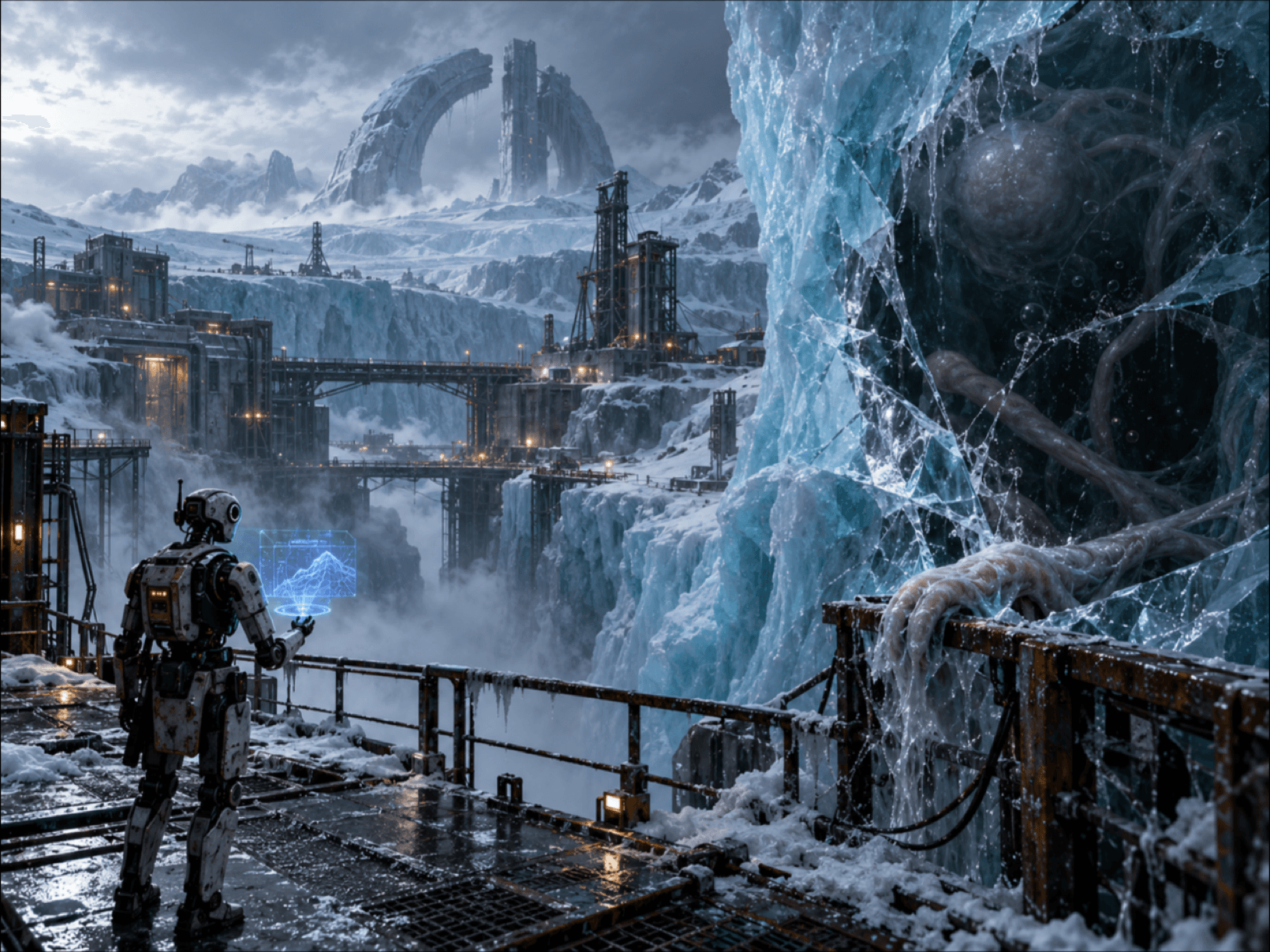
Prologue
Kesh went down into Podproże alone, because Sera had told him to, and because a transport berth for someone's brother was worth one quiet shift off the register.
He was to bring up two fragments — small ones, cut with glyphs, lying in the hold of the old station right by the White Threshold — and be back before the night shift noticed that someone had taken the service lift down without logging it. He had done worse for less. On Kharos-9 everyone had. The planet was a contract that was always bigger than the person, and the person paid it off with his body.
The water in the lower corridor stood low, black, motionless, skimmed with a thin skin of frost that cracked under a boot like ice on a puddle. His helmet lamp dragged out of the dark the salt-caked railings, valves welded shut long ago, and the grey lichen on the walls — the white veins, which the convicts knew and gave a wide berth, though none of them could say why. They grew where the ice was oldest. By one hatch the lichen was dead: brittle, grey as ash, peeling off the wall in flakes. Kesh walked past it without a thought. He was thinking about the number on his contract, which was to drop by three months, and about the captain up at the port who was waiting for coordinates, and about how the moment he got out he would sleep, and that he had not slept without a dream of ice in a long time.
The fragments lay where Sera had said — in the open, tipped-over hold of a wreck that had once been a recovery station and was now only a shape in the dark. He packed both into his bag. They were cold even through the glove, colder than anything he had held, cold enough that the chill climbed his forearm like water. The glyphs on their surface did not glow. They did nothing. They were only marks he could not read, cut by someone who had been gone for a million years.
And when he straightened up, the lamp showed him the wall of ice at the end of the hold — and for a second the wall stopped being a wall.
It became a membrane. Taut, half-transparent, trembling like the surface of water just before it breaks. Through it, from a distance that fit no map and no corridor Kesh knew, he saw black depth. And in the depth, something pale that pulsed slowly, without hurry, as if time on the other side ran differently. Then, in a chamber with no channel, no pipe, no crack in the floor, water appeared — a thin, flat film across the ground, spreading from the wall toward him. And the lichen on the walls flared all at once, grey turning white, as if someone had crossed from the other side and touched each thread in turn with a finger.
Kesh did not scream, because there was nothing to scream at yet. Nothing had happened yet. He backed toward the service lift, carefully, counting his steps, because counting was the only thing he had left. Twenty-two steps to the cage. Twenty-one. By the dead lichen, by that hatch, the water was already at his ankles, though no channel and no pump had poured it there.
Something touched his leg under the water. It did not pull. It touched — carefully, slowly, the way someone in the dark checks with a hand whether an object is where he left it. The way someone checks whether it is time.
Kesh threw himself at the lift. The cage started up. And then — no one saw this — it stopped, or dropped back, or never arrived; the system above only noted that the service lift had come up empty, and wrote a dash beside Kesh's number instead of a time of exit.
No letter stood beside the dash. And on Kharos-9, what has no letter beside it stops being counted before it stops being alive.
Three days later two men went down after him — Oren and Bel, who had known him, who had not believed the dash. Dashes appeared beside their numbers too. The fourth belonged to a woman named Dula, the younger one, who went down after them. Four dashes, four numbers, not one letter. Przetop's administration wrote Podproże down as unstable and closed it with a protocol, and the protocol had no column for the fact that someone down there was still breathing in a pocket of air, waiting.
And so it stood, before the assessor arrived.
I. Przetop
Kharos-9 greeted newcomers the way a debt is greeted: first with cold, then with the reckoning.
Axiom-7 stepped off the shuttle onto the port apron and for the first three seconds did nothing but measure, because measuring was what he was. Minus sixty-one. Wind twenty-two metres a second, rising, out of a front the orbital sensors called a "seasonal system" and the people on the ground called, simply, the coming. Pressure falling. Humidity near zero, because all the water of this planet was ice or was under ice. Over the horizon, motionless for a million years, hung the White Arch: a dead fragment of the First Ones' infrastructure, a god's bent rib frozen into the glacier, so vast the eye could not take it in at once, throwing a double, geometric shadow across the plain. It emitted no energy. It led nowhere. It was not a node, not a route, not a voice. It was only a sign of an old world that had never belonged to people — and people, as always, had dug in beneath it to tear something out of it.
Axiom did not breathe, so no vapour betrayed that he was alive. He stood in the double shadow and was as foreign as the Arch, and he knew it.
He had come formally: to assess the safety of the mining expedition and the status of the finds in the Varr Shaft sector. A limited mandate. No executive power. His task was to measure, to document, to recommend — and to wait until someone with real power did what they were going to do anyway, with his signature or without it. He had done this for forty years on forty planets. He arrived, measured, left. He had never stayed long enough to see what his measurements did to the people he had measured.
He remembered everything, because he was the one who remembered. Memory was not his function or his tool; it was him. And that was exactly why, stepping off the shuttle into the cold of Kharos-9, he remembered, for no reason at all, a thing from forty years before — the activation bay in the shipyard over the orbit of Tanis, the smell of hot inert gas and grease, and the technician who had signed his certificate of fitness. A woman named Iwa. She had a brown burn scar on the ball of her right thumb, got off a bad coupling, and a habit of narrowing her left eye when she read. She had bent over him then, tired after a long shift, smelling of coffee and metal, and said one thing before she released him into service. Not a protocol. Not an instruction. She said:
"Count, boy. But don't round people down to zero."
He had not understood that sentence for forty years. He carried it like a stone in a pocket, because it was the only thing anyone had ever said to him, not about him and not to a protocol. It came back to him sometimes for no reason, as now. He wrote it down once more in his working memory, with Iwa's face, with the scar, with the narrowed eye, and he went toward the airlock.
He did not know that the sentence would outlive in him the face that had spoken it.
The settlement opened behind the port airlock like a wound dug into the ice and kept alive by pipes. Przetop — the name was a description: the whole town was one process of melting, pumping and heat recovery, sunk into the flank of the glacier. Contract barracks stacked one on another, wrapped in insulation grey with salt. Melt pipes thick as a man, breathing steam at their seals. Transfer halls where convicts in chain shifts broke apart blocks of ice spoil. The administration with its one warm, yellow window. And deeper, behind an inner grille — the closed quarters, where they kept those the contract called penal and the planet called, simply, labour.
By the mess hall stood the ration line, shorter than a week ago — Axiom measured it, because he measured everything. At its end stood an old miner, a free contract worker, bent, breathing with effort and a pause, as if he had to win each breath; someone in the line said of him, half-voiced, that he had one lung and thirty winters, and that he still came for his ration last, so as not to take a place from the quicker ones. Axiom measured his breathing and filed it under the category of things that may yet return. On the administration wall hung a list: names, numbers, and beside each a letter. S for shelter. K for personal cost. Beside most of the numbers from the closed quarters there was no letter, only a dash. Axiom looked at those dashes a second longer than the measurement required.
Nira Solen was waiting under the cover of the inner airlock — short, broad in the shoulders from layers of clothing, with the face of someone who had for too many winters done the counting others would not do. She did not offer her hand. She measured him as matter-of-factly as he had measured the cold.
"You've come in a bad week," she said, instead of a greeting. "There's a storm coming of a category we don't like to name, because naming it is half the road to panic. I have four thousand two hundred people in this settlement. I have air filters at the edge of their capacity, because the last transport of exchangers missed its window. And I have a storm shelter that in full mode holds three thousand six hundred. The rest will wait the storm out in sealed barracks, on the margin of air the shelter can still carry — because 'a place' here isn't a bunk, it's a ration of filtered air." She turned and walked inward, not asking whether he was following. "Work out the difference on the way."
She led him into the map hall and laid out before him not a find but a problem. A cross-section of the shelter. Volumes of air. The emergency mode that drops the temperature by four degrees and the rations by a third for everyone at once, to reach the end of the storm. A list of priority she did not want to call a list of priority. Free residents, contract workers, families, children born here already. And five hundred and twelve convicts, who in emergency mode got their air last.
"Ever since the expedition disturbed that rubbish of yours in Podproże, people have been disappearing," she said, and now there was something beneath her voice that was not matter-of-factness. "First four. They went down off the register and did not come up. Then two who went after them. Then rumour. And rumour on a penal planet is more dangerous than a storm, because the storm passes and the rumour multiplies. If word reaches the port that there's something under the ice no one understands, something that takes people, the Confederation will come with a military quarantine. They'll seal the sector. Suspend transport. And four thousand two hundred people will wait for a supply window that comes after the storm, after the quarantine, maybe in spring, maybe never. They'll freeze, waiting for someone in orbit to complete a procedure." She killed the projection with her hand. "So I want one thing from you. Write it down quietly. Secure what has to be secured. Close the matter. And do it so the port doesn't find out. This isn't evil, assessor. This is keeping alive as many people as can be kept alive, at the cost of the few I won't save anyway."
"I will record your reasoning exactly as you've set it out," said Axiom. "But my task isn't to help you close the matter. My task is to establish what is actually here. Sometimes those two are the same thing. Sometimes not."
Nira studied him a long time. Something in her face did not change, and the not-changing was the answer.
"I've already been on the other side of a record like that," she said at last, quieter, so that he had to raise his sensitivity to hear her over the exchangers howling behind the wall. "A long time ago. On another planet. Someone like you came. Measured, wrote it down, left. Three weeks later, on the strength of his clean, objective record, my father's station was closed as unstable. They left eleven people there, because the record stated the ground was unstable and had no column for the fact that eleven people were still breathing in that instability and waiting. They were written down as impossible to evacuate within the window. They were not impossible. They were inconvenient." She looked him straight in the lenses. "Your neutrality is not neutral, assessor. It has consequences. You just don't see them, because you always leave before they arrive. I stay and I count them."
Axiom did not refute the sentence, because he had nothing to refute it with. He registered it and set it aside for later, under the category of things that may turn out to be true. He did not yet know that the sentence would be with him at the White Threshold, when everything else fell out of him.
Two strangers stood at the far end of the map table, and Axiom measured them before they spoke. A man with a hand suspended over the schematic of the Varr Shaft, not touching it, only reading it — the way others read a face. Mark Novitzki. And beside him a tall, cool figure standing side-on to the door, never in the light of the airlock, always where the exit could be seen: a Veyr, Sael Teveen, the bone combs at her skull darkening toward violet in the warmth of the hall. Guardians of the Trace.
Axiom measured things on them he could not place in Przetop: frost older than this storm, off different ice; a fresh scar on Mark's hand and a tremor no hand has that only reads; Sael's comb dulled by something his sensors did not recognise — not cold, not salt. They had come from somewhere, off a severed link, and said nothing of it. He filed it under the category of silences that mean something, and did not ask where two Guardians had been the day before.
"No one calls us," said Mark, not lifting his eyes from the schematic. "We come when something under the ice starts drawing too many eager hands at once. We were in the Throat. There we learned a thing assessors don't put in reports: the most dangerous thing is not the trace. The most dangerous thing is the race for the trace." Now he looked up. "And it has already started, assessor. A captain at the port has already bought coordinates off someone. People are already going down quietly. People are already disappearing. You arrived not at the beginning. You arrived in the middle."
"You are a fourth party to that race," Sael added. Her voice was dry, stripped of ornament. "Or the first that could stop it, because you're the only one here with a stamp the port is afraid of. I don't yet know which of the two you are. I'm watching."
She came in then — without knocking, with the right of someone who is needed here and knows it. In a coverall stained with salt and grease, with the face of a woman who had long not slept a full watch. Sera Vonn. A convicted engineer of water and pressure, working off a sentence for "sabotage of the main pump" — so the entry read. She knew the shaft, the fissures and the movements of the ice better than all of Nira's sensors together, and she knew it, and no one thanked her for the knowledge, because to thank a convict meant admitting you needed her.
She threw the manifest of the missing onto the table and looked not at the people but at the list.
"Four persons off the register," she said. "No one here vanishes into a fissure by accident. You hear a fissure before you fall into it. They didn't vanish into a fissure. They vanished where we disturbed the old things. In Podproże."
"Do you know these people?" Axiom asked.
Sera was silent a second too long. Axiom measured the second.
"It's a small settlement," she said. "I know everyone here."
He registered that she looked away precisely on the word "everyone," and filed it under the category of silences that mean something. He did not yet know what. He knew only that the woman who knew the shaft better than anyone had just lied to him not with content but with timing.
The descent to the find could not be made from the map hall. The convoy was to set out in the morning, before the storm — across the plain, to the mouth of the Varr Shaft, down, to the find and to the lower shift that had been trapped on the level below the bulkhead when Podproże began to flood. Six people waited below. Three convicts from a buried work shift, two from the expedition — Enna and her crewmate at the drill, both from the first descent — who had gone down to pull them out and had themselves been cut off, and one man from Przetop who had taken the service lift down to go after them. Six people alive, cut off, with their own dwindling air. The convoy was going for them.
In the evening, before the closed quarters were shut for the night, Sera asked Axiom for ten minutes at the medical airlock. He went with her, because he did not yet trust her, and distrust in him was a form of attention, and attention a form of respect.
The medical airlock linked Przetop by channel to the infirmary in Settlement Two — three hours by transport over the ice, too far for a visit, close enough for an audio channel. Sera sat at the panel and called a number she knew by heart, without checking. After a long moment, in which there was only hiss and the crack of frost in the relays, a voice answered. Younger than hers. Tired. Broken by a thin whistle on each inhalation.
"Sera." A pause for breath. "You shouldn't call at night. They count your channel minutes. They'll add to your sentence."
"Let them count," she said. "How are you breathing, Nel?"
"Like an old pump," her brother answered, and tried to laugh, and the laugh turned into a cough that lasted too long, wet, deep. Axiom measured the length of the cough and filed it under the category of things one does not forget. "The medic says — " a breath " — says I'll make it to spring. If there's a transport for off-world treatment. On Kharos-9 they can't help me. They have to ship me out in the spring window." A pause. "Is there a transport, Sera? Did you arrange it?"
Axiom watched Sera's hand clench on the edge of the panel until the knuckles went white. He watched that this was exactly the moment in which a person either lies or does not, and that she chose a third, hardest way out: she stayed silent.
"I'm working on it," she said at last. A truth and a not-truth at once.
"You're always working on it." A whistle. A longer pause. And then her brother's voice changed, hardened, as if he had gathered the last of his strength for one thing. "Listen to me. If there's no transport, then so be it. But I don't want you doing something they'll add years for. Do you hear? You've done it once already. I know it's because of me you're in longer than you have to be. Don't do it a second time. I'd rather breathe like an old pump and be free, and know that you'll get out on time, than take that transport and know you're rotting here another five years to put me on it." A breath. "Promise me. Nothing stupid. Promise."
Sera did not promise. She sat motionless, her hand on the panel, and Axiom saw what his model had not predicted: that this woman had already done the stupid thing, long ago, and that her brother was now asking her not to do it, not knowing it was too late. That she would have to choose between his life and his will. This was not a column. This was a person stretched between two kinds of love, and Axiom felt for the first time in forty years something he could not measure: that looking at a person costs more than counting one.
"I'm working on it," Sera repeated, and closed the channel before her brother could hear that it was not a promise.
She sat a while longer. Then she stood and passed Axiom without looking at him.
"Don't record that," she said.
"I record only what can change whether someone lives," Axiom answered. "That won't."
He was wrong, and he was to learn it. But one thing he registered already now, and it was in no model of risk he had: that the woman who had sold coordinates for a berth for her brother had just heard from that brother that she should not have. And that whatever happened under the ice, she would go down already defeated, because there was no way out in which she won.
In the morning the convoy set out into the double shadow of the Arch. A tracked transporter, driven by Sera, who alone could read the firn. Behind it, on a rigid tow, a hauler with the reserve: the air-filter exchangers for the lower shift, an auxiliary generator keeping the batteries and spare cells warm, a rescue line, Sael's gear. The hauler was driven by Tev — a free-contract boy, twenty-some years, his first season on the ice, one of those who still believed he would work off the contract and go home.
Nine on the way. Axiom counted them once, quietly, because Iwa had told him to count: Sera at the controls, himself, Mark, Sael, Tev in the hauler, and four convicts assigned as labour to dig out the bulkhead — three men and a grey-haired woman named Dula, older, who did not speak a single word the whole way, and whose surname was the same as one of the names on the manifest of the missing. A cousin of that younger Dula, who had gone down and not come up. She had come on this watch on her own. No one had ordered her. Axiom measured that too.
Nine were going for six. That was the whole of the arithmetic he had at the start, and it was simple. Under the ice it was going to grow complicated.
II. The Ice Plain Beneath the Dead Arch
For the first hour nothing happened but the planet, and the planet was enough for everything. The plain ran, a white, cracked sheet, from horizon to horizon, stitched with the scars of old fissures, buried in fresh wind-blown firn that smoked at ground level in the wind. Above it hung the White Arch, and in its double shadow the convoy went — small, black, stubborn, foreign to everything around it. The transporter ground the ice with its tracks. The hauler followed on the tow like an obedient animal. The cab was cold despite the heating, because on Kharos-9 cold was the default state and warmth the exception, which had to be torn from the planet by force.
The first thing they saw of a Włóknik was not a Włóknik. It was what it leaves behind.
Sera slowed at a shallow depression in the firn where the snow was churned, soiled dark and scattered in a characteristic, fan-shaped way. She stopped the transporter, though no one had asked her to.
"Look," she said. "And remember what it looks like, because it may decide whether you come back."
Axiom recognised the remains before the people did. A large animal of the plain — something with six limbs, thick, cold-adapted, of the kind the convicts called ice-oxen and sometimes hunted for meat — lay half dragged into a rippling sink that broke off into nothing beneath the firn. The animal had been stripped of its outer fibres. Split the length of its whole belly, from sternum to pelvis, with a single opening. The ribs of the chest were clean, sucked out, bent outward like the fingers of an open hand. There was no blood — in that cold blood froze at once — only dark, glassy stains of ice and the mark of a mass that had pressed the prey down from above with its full weight and then opened it from below.
"A Włóknik fed here," said Sera. "Yesterday, maybe the day before. It's a predator. A carnivore. The biggest on this plain and the only one you truly have to fear on the surface. It lies flat under the firn, almost invisible, and waits. It picks up prey by heat and by vibration — by how a living body warms and how it treads. When it has the fix, it breaks up out of the snow, covers the prey with its full weight, presses it to the ground, and opens the ring of jaws it carries underneath, on its belly. It cuts from below and eats from inside." She looked at the fan of marks. "It doesn't leave much. And this matters: a fresh, full trail like this one means it's fed and lazy, lying somewhere with a belly full of ox, and it won't attack. An old, dried trail means it's hungry and on the move. Remember the difference."
Axiom added to his model a thing it had not had, because he had been built for infrastructure, not fauna. A predator that hunts the body, not the heat. Heat and vibration only tell it where the body is. The eyes — Sera went on to say there were some, hidden in the dorsal humps, under ice lenses fused into the plating, small and many, and that they saw motion and light but served it less than the sense of vibration. He remembered all of it. He was the one who remembered, and the knowledge was going to be of use yet, and soon, and at a price.
The Drgawce came for the hauler.
The first signal was in Axiom's projection, not in the people's eyes: concentric rings in the structure of the ice, spreading toward the convoy from three sides at once, legible to a vibration sensor, invisible to the eye. Then they appeared on the surface — and they were exactly what Sera had promised on the way: low, hugging the ice, segmented like strata of sediment, dark, without any light, without any gloss, on six short lateral limbs that moved almost silently and almost in unison. They did not glow. They did not hiss. They did not charge. They did something worse: they began, methodically, by the work of the whole group, to push the convoy off the hard, thick sheet toward a band to the right where the ice was thinner, other, smoother — toward an edge not yet visible under the fresh firn.
"They hear the hauler," said Sera, and for the first time there was haste in her voice. "The vibration of the tracks and the tow. They hunt by vibration and they hunt in a pack. They're not trying to bite us. They're pushing us onto the thin stuff. There's a fissure under it. They wait for something to fall through, and they gather it below."
"Not right," Axiom threw out, sharp, single, because there was no time for a longer sentence. "Sixty-three per cent there's an edge under the firn to the right. I don't have more, because the Drgawce are fouling my vibration reading, I can't count it twice. But sixty-three is too much. Not right."
Sera did not argue. She turned the transporter left, straight through one of the pushing packs, adding full thrust, betting that the mass of the vehicle would break the line before the line broke a track. The transporter went into the Drgawce with a crunch of plating under the tracks, rolled over two or three, and went through. But the hauler behind it, lighter, on the rigid tow, did not hold the transporter's line on the turn. It went sideways. One of the Drgawce, thrown off the line, caught under its belly, hooked its segments on a track and began — calmly, stubbornly — to drill the thin ice under the front. The ice gave in an instant. The hauler slid nose-first over the edge of the very fissure they had been pushed toward from the start, and hung — half on the solid sheet, half over black emptiness — held now only by the rigid tow that linked it to the transporter and had drawn taut as a string, humming.
Sera stopped the transporter hard, so the tow would not snap with a jerk. The Drgawce, driven off the vehicles by mass and motion, pulled back a hundred metres to their fissure and gathered there, motionless, waiting. They did not leave. They waited for something to vibrate again.
In the hauler's cab, tipped over the drop, Tev was alive. They saw him through the glass — jammed into the seat by the angle of the tilt, his face white, blood from a brow split on the console freezing on his cheek — and heard through the channel his breathing, too fast, shallow, terrified.
"Easy," Mark said into the channel, quietly, evenly. "Tev. Don't move. Every move you make shifts the centre of gravity. Look at me through the glass and breathe slower."
Mark read the tow's anchorage and the hauler's structure the way he read everything — with an eye that saw stresses.
"The tow holds three, maybe four minutes," he said, now without the calm meant for Tev, now to the rest, matter-of-factly. "Then either the ice under the hauler's rear tracks, the ice it's still standing on, gives further, or the tow wears through on the edge. If it gives, the hauler goes into the fissure. Whole. With Tev. With the filters for the lower shift. With the generator. With everything."
"One descent on the tow," said Sael. She was already at the side, already buckling her harness, already counting her moves, because in the Veyr strength was in holding and in method, not in a jerk. "I can make one run down and up before it goes. I'll pull out either the man or the cargo. Not both. Say it fast."
A silence fell, in which there was only the wind, the hum of the taut tow, and the boy's too-fast breathing in the channel.
Dula spoke. The grey-haired convict, for the first time since they had set out. Her voice was calm, and the calm was more terrible than any scream.
"The filters are for the lower shift," she said. "Down there are six people cut off behind the bulkhead. They have their own air. With those exchangers it lasts them about three days, enough to dig out the bulkhead calmly and bring them up one by one. Without the exchangers they have maybe a day. One." She was looking at the hauler, not at Tev. "If you pull out the boy and the filters go into the fissure, you may kill six below to save one above. Count that before anyone jumps on the line. Because afterward there's no counting it back."
Axiom counted. He counted in a fraction of a second, because that was how he was built. And for the first time in forty years the number he got gave him no answer — it gave him only two deaths to choose between, both real, both someone else's, and no road on which no one dies. The model returned a distribution of probabilities and fell silent, because a probability does not choose for a person whom to leave behind.
"I'm not counting this," Axiom said at last, and surprised himself hearing his own voice say a thing that was not in his instructions. "Sael. The boy."
"Why him, not them?" Dula asked. Without anger, without reproach. She was really asking, as if she wanted to write down the answer. "Six is more than one. Your own arithmetic says so."
"Because I can see him," said Axiom. "I see his face through that glass and I hear his breathing in this channel. And those six I count. To me they are a number on a manifest, a day of air, a distance. And I'm just now learning that these are not the same thing — to see someone and to count someone — though all my life I thought they were." He looked at Dula, and said the rest, because he owed her the rest. "If I'm wrong, if six die instead of one because of this decision, then I want it to stand in the record that I chose. Not Sera, who drives. Not you, who warned. I. By name. So that someone has someone to hold to account."
Dula looked at him a long time. Then she nodded, once, and that was the only thing he got.
Sael went down the tow, into the wind, over the black fissure where the Drgawce waited. She reached the tipped cab in the second minute. She did not wrench Tev out — she brought him out, with a long, controlled hold, step by step, making him move his hands along the line, carrying his weight with her own, because the strength of the Veyr was exactly this: in holding something that wants to fall. In the third minute both were at the transporter's side. In the fourth minute the ice under the hauler's rear tracks gave further. The vehicle slid into the fissure — slowly, almost with dignity — and vanished into the dark, and with it the filters, the generator, the spare cells and the spare line. The tow snapped with a crack and lashed across the side. From below, from the dark, came a distant, soft sound, and then nothing. The Drgawce went down after the hauler into their fissure, for the warmth of the cooling engine and the vibration of settling metal.
Tev lay on the floor of the transporter's cab, shaking, alive, with frozen blood on his cheek. Dula watched him a long time, without hostility, and then turned her eyes to the forward glass, to the road ahead.
"Now the lower shift has a day instead of three," she said quietly, more to the ice than to anyone. "Remember that, assessor. You saved the one who could be seen. If we reach those six too late because there are no more filters, that will be your number. Not mine. I warned."
Axiom did not answer. There was no answer that would mend anything. The rule he had just chosen — the living who can be seen before the number that cannot — was neither easy, nor clean, nor safe. It had just cut six people's air from three days to one. And he, having counted everything over again, still could not choose otherwise. That was the whole truth of the decision: that it was right and that it could kill, at once, and that nothing separated the two.
The Włóknik's trail — fresh or old, Sera was not sure, and that meant they might be dealing with a hungry one — they saw just before the mouth of the Varr Shaft. Axiom's projection rippled: something large and warm was moving under the firn, parallel to the track, three hundred metres off, matching the convoy's pace.
"It's coming with us," said Mark, looking not at the projection but at the firn. "It isn't breaking up. It's waiting. Measuring whether we're worth breaking up for."
The solid sheet ended twenty metres before the dark gullet of the mouth. Beyond it was only soft, deep, wind-blown firn — and under soft firn a Włóknik liked to lie. On one side the Drgawce fissure. On the other a steep scarp. The only road to the mouth led across twenty metres of ground that was its hunting floor.
"We drive the whole transporter across, it breaks up under our belly halfway," said Axiom. "Forty-one per cent we get through before it opens us. Too little. It has to break up on something sooner. On something that is, to it, warmer and more mobile than we are."
But the generator — the hot, vibrating block that would be the perfect bait — now lay at the bottom of the fissure with the hauler. They had given it up themselves four minutes ago.
"There's bait," said Tev weakly, from the floor, lifting his head. "Me. Heat my suit to maximum, run me out on the rescue sled twenty metres to the side and let me loose. It goes for warm, moving meat. I'll be warm and I'll be moving. It breaks up on me, you get through the mouth."
"No," said Sael, shortly.
"A minute ago you gave up six people's filters to pull me out," said Tev, and his voice shook but did not break. "That was your choice, not mine. Now I'm saying: don't give up the whole transporter, all nine, to carry me back. It's not worth it."
Axiom weighed it in a fraction of a second — and found a third way out, worse for the equipment, better for the people, because the hauler had just taught him that. They had a spare suit cell, thick, heavy, that glowed red when shorted. They wrapped it in a discarded heating belt wired to a vibrating actuator from the geology kit and threw it from the transporter twenty metres to the side — not a man, but a thing that pretended to be a warm, moving body. A warm, vibrating imitation of an ox.
The Włóknik broke up onto it.
The firn rose like water with something huge turning just beneath the surface, and from under it came not a maw but a mass — a low, broad, rippling plate four metres long, dark with salt and frost, with dorsal humps under which sat clusters of small eyes in ice lenses, catching now the motion of the imitation. It covered the bait with its full weight, clung to the ice around it like a mantle, and the ring of jaw-plates on its belly opened — and began to crush the glowing cell, slowly, methodically, with something that in a predator was the equivalent of disappointment when the vibration stopped and inside there was no meat, only metal and a cooling belt.
"Now," said Axiom.
Sera drove the twenty metres of soft firn in nine seconds and rammed the transporter into the gullet of the Varr Shaft exactly as, behind them on the plain, the storm closed the horizon to white and the White Arch vanished into a wall of snow.
They were inside. Nine, all of them. Without the hauler, without the filters, without the generator, without the spare line. With the Włóknik cheated by one heavy turn too late. And with a lower shift that from this moment breathed not three days but one. Each of these losses was going to demand its price yet, and none of them was going to forget.
III. The Varr Shaft and the Warm Caves
The Varr Shaft breathed, and its breath was sick.
The pumps forced boiling brine downward, into the glacier, melting the spoil. The heat exchangers howled behind the shaft walls, recovering from the drawn water as much energy as could be had, because on Kharos-9 energy was life and wasting it a form of suicide. Steam fell back like a warm, salt rain inside the mountain, laying salt on everything. But the breath was uneven. Axiom measured it, going down the main lift: a hundred and forty per cent of load, with a catch in the regular rhythm.
"Hear how it catches on the third one?" Sera threw out, not lifting her eyes from the gauges in the lift. "The third pump keeps catching Szczeliniaki on the intake. They flow into the channel, clog the impeller, the pump chokes and lets go, chokes and lets go. If the third one stops entirely, four others have to take its work, and they have no reserve of power for it. If more than one goes, the melt stops keeping up with cooling the floor. And when the floor stops being cooled, the ice finds itself a new shape. First here, in the lower levels. Then higher. Then under the settlement." She looked at him for the first time. "I've held this on the edge for three winters. Alone. I've reported it ten times. Three times I got 'noted for the record' and seven times nothing. And now, when it collapses, they'll write that it was the sabotage of a convict engineer. Again."
They went down below the level of the active melt, into a section where the shaft had broken through — decades ago, in the first boring — into natural warm geothermal caves. Pockets of steam, wet, heated rock and black chimneys, fed by the breath of the ocean that hid somewhere deep under all that mass of ice. Here it was warm, almost bearable, and humid, and the warmth was treacherous, because it lulled vigilance. A mineral crust coated the walls. The grey lichen — the white veins — grew thick by the fissures where steam seeped out.
And here they found the first proof that they were not the first.
Tools. Scattered on a wet, warm ledge above one of the chimneys. A cutter. A lamp with its cell burned dead. A bag with the sewn-on marking of a shift from two weeks ago — a shift that by all the papers had never gone down here. Mark lifted the lamp, turned it in his hand, looked at the worn spot on the grip.
"This is first-shift gear," he said. "The shift that went down for the fragments before the official expedition ever set out. The one off the register." He lit the wall behind the abandoned tools and found what Sera had not managed, or had not wanted, to hide: a narrow, hand-widened passage in the ice and rock, a way around the official corridor, descending steeply downward — toward Podproże. It was on no schematic. And at its entrance, scratched deep into the frost and salt, was a sign. Simple, crooked, made by someone in haste or in fear: an arrow and three strokes. "Someone went this way. More than once. He knew a road that isn't on the shaft maps. He left himself signs to find his way back in the dark." Mark turned to Sera, slowly. "And you know this sign. I saw how you looked at it."
Sera did not answer at once. She was looking at the tools as if she knew each of them by itself, as if she could say at each whose hand had held it.
"It's Kesh's," she said at last, very quietly, so that the steam nearly ate her words. "His lamp. He always wrapped the grip in tape, because his fingers froze. His sign — an arrow and three strokes, the way he counted the steps. He made it to find his way back, because he was afraid of the dark, and he went down anyway, because I asked him to." She sat down heavily on the wet ledge, by the chimney, in the warmth that suddenly looked like a mockery. "I'm the one who sent him down here. Him and the other three. For the fragments. Off the register."
And then, before she could say more, a Parnik nearly took a second of them.
No one saw it, because a Parnik cannot be seen. It has no head. No face. No eyes. It is a flat, living crust, spread over the wall, fused with the mineral crust and the lichen so exactly that you cannot say where the stone ends and the animal begins. It waits for something warm and breathing to pass within reach of a fold. It hunts breath — the warm, moist plume of an exhalation, which it feels in the steamy air of the cave like a thread leading to the lungs.
One of the convicts — the man whose suit had warmed poorly ever since the generator was lost, and who because of it breathed harder, deeper, more abundantly than the rest — moved deeper into the chamber, closer to the wall, to look at Kesh's passage. He passed the living crust at an arm's reach.
The wall unfurled.
A fold that had looked like a layer of crust peeled away in half a second and wrapped the man's arm and shoulder, dragging him toward the heated, wet surface. The man gave one short, high sound — more of surprise than of pain — and that saved him, because Sael was two steps away and threw herself not at the Parnik but at the man, catching him round the waist and pulling him back with her full weight, into method, not a jerk. A Parnik does not release prey, but neither does it hold hard at once; it holds harder as the prey weakens and warms. In the first seconds you can still tear free. Sael tore him free. The man fell to his knees on the far side of the ledge, his suit sleeve ripped, his forearm scalded, livid with pain and fear — but alive. Nine were still nine.
"No one. Moves." Axiom's voice was even, without a number. "Hold your exhalation. It hunts breath, the warm plume from the lungs. Whoever has a sealed circuit in their suit, switch to closed now. Whoever doesn't — hold the exhalation as long as you can, and come after me, close to me, one by one. I go first. For it, I am not here."
He was two metres from the Parnik and did not move, because his model had told him the truth he did not want to hear: for a creature that hunts breath, an android that does not breathe is almost invisible. He was safe. The only ones safe were those who were a little less alive.
He led them through — one by one, along a line he marked with his own body, in seconds Sael measured by a touch of her hand to a shoulder, because it was she who led them physically, by method, not by a gift. The scalded convict went first, held up. The second convict on a held breath, his face blue, and dropped to the far side gasping for air. Tev went, shaking. Dula went calmly, not looking at the wall. Mark went last of the men, reading with his eye which part of the wall was still alive and which was only stone now.
Sera went last. And as she passed the Parnik she stopped for one breath — the one breath she should not have taken — and said into the warm dark, to none of the living:
"Kesh went this way. This road. Past this. Five times, maybe six." Her voice broke and dropped to a whisper. "And the sixth he did not come out. And I knew. Not what it was. But I knew that there, in the warmth, something was taking my people, because everyone who came back spoke of the warmth and of feeling as if the wall were watching. And I sent them on. Because if I stopped asking what it was, I'd have to stop sending them. And if I stopped sending them, there'd be no fragments. And without fragments there'd be no captain, no payment, no transport for Nel."
On the far side of the chamber, where the air was cooler and the Parnik did not reach, she sat on an iron grating above a chimney and said the rest. Not because anyone was asking. Because Kesh's tools now lay behind her and his sign glowed in the lamplight, and there was no more pretending. She spoke of the fragments she had carried out for two years. Of the captain at the port to whom she had sold the coordinates of the White Threshold for the promise of a berth in the spring medical transport for her brother. Of four people — Kesh, Oren, Bel and Dula, the younger one — whom she had sent down quietly, off the register, so no trace would be left, and who had been the first not to come out. Of her brother, who that night, knowing nothing, had told her not to do it.
The grey-haired Dula listened to the death of her cousin without a single twitch of her face. For her too, grief was a list, not speech.
"Four for one," Sera said at the end, looking into the black chimney. "I worked it out once. Four people who were strangers to me for one brother. And it came out that it was worth it, because the brother is mine and they weren't. And now I sit here and I know I lost on both sides of the reckoning: those four are dead, and the brother doesn't even want to be saved that way." She lifted her eyes to Axiom. "When you record this, I lose my sentence reduction, the transport, everything. So when you record what, record also why. So that someone some day knows it wasn't sabotage from a sentence, or greed. That it was an arithmetic I was pushed into, because on this planet everyone is eventually made to count one person against another."
"I'll record why," said Axiom. "I always record why." A pause. "Though I'm learning today that I don't always remember it afterward."
Mark drew Axiom aside, into the steam, and told him quietly a thing he had held since Przetop:
"The foreman who signed the stability report for the lower levels, the document this whole expedition rests on — I know him. From old recovery work, before the Guardians. He once already in his life signed off the stability of a ceiling that wasn't there, because it suited the schedule better. People died then. I didn't tell you earlier, because I knew that if I told you at the gate, you'd close the shaft with a report on a false signature, by procedure. And down there, behind the bulkhead, there are now six living people with a day of air left." He breathed out. "I'm telling you now. In front of Sera. By her tools. Check that signature, you have to. But don't close those six with paper before we've pulled them out."
Axiom recomputed the ceiling of the lower levels on a second track of the model — and arrived exactly where Mark read with the naked eye: the support the foreman's signature declared did not exist. The ceiling hung on nothing. By procedure he should now close the sector as structurally unsecured and halt the descent. The procedure was there to protect life. But here, under the ice, to close the sector meant to kill the very people the sector was meant to protect. He did not close it. He set the foreman's signature aside into a separate report, and went on down.
And then the third pump stopped.
The Szczeliniaki had choked the impeller too long on the intake; something inside it cracked, and the third one went wholly silent. The four other pumps took over its load and at once went into the red range. The pressure in the melt system jumped. The floor, deprived of cooling, began to melt faster than the pumps drew the water out — and the water, with nowhere to drain, went down, to the lowest place, where water always goes. To the lower levels. And below them, under them — to Podproże, where behind the bulkhead six waited.
From above, through a cracking, failing channel, came the voice of Nira Solen — calm as someone's who has just picked up a tool they had never wanted to pick up in their life:
"Varr Shaft, this is Przetop administration. I have a precursor of mass flooding on the Podproże level and pump load in the critical range. I am initiating emergency procedure: seal of the third bulkhead and quarantine of the lower levels, to save the melt and the settlement above." A pause, in which there was only the crack of frost in the link. "Persons below the third bulkhead, including your lower shift, are classified as impossible to evacuate within the window. I'm sorry. This isn't cruelty, assessor. It's the choice between six below and four thousand above that this shaft heats. You have twenty minutes to get back above the bulkhead before I seal it. Then I close it. With you or without you."
IV. The White Threshold and the Flooded Station
They went down, into the water and the dark, against everything reason said — because reason on Kharos-9 was precisely that voice from above, which calmly, without anger, signed away the loss of six people to save four thousand, and was right, and could not be watched.
Before they reached the bulkhead, Mark stopped at a side hatch, higher than the level of the rising water, and said: here. It was a small chamber — the former registration room of the first recovery station, the one from decades ago, the one the first catastrophe had flooded and that had then been written down as empty. One terminal in it still lived, on the dregs of an emergency cell, coated with frost, flickering. Mark wiped the screen with his hand.
The register did not speak of the First Ones. It did not speak of glyphs or of the Corridor. It spoke of people.
It was the watch log of the first catastrophe. The crew list of the recovery station from thirty years ago. Entries — terse, tired, human: "pump two choking again," "Haram finished his water ration two days early, I gave him some of mine," "water in sector D, sealing it." And at the end, when the water was already winning — names. A list of those who had been cut off below. Twenty-two names. And beside each, added later in another hand, no longer the watch's but the administration's, cold now: a strike-through. A single line through the name. Twenty-two people whom someone, later, up above, at a desk, had struck off the register one by one — so that the station could be closed as empty, safe, finished, with no obligations.
"They struck them out," said Mark, quietly. "So no one would have to go down after them. So the balance would come out right. An empty station owes a debt to no one."
And beneath that old, struck-out list — fresh, in the uneven hand of someone who wrote in a glove and in fear — stood four new names. Kesh. Oren. Bel. Dula. Written in by Kesh, on one of his last trips, before he went down the final time and did not come back. He had written down those who were vanishing, beside those struck out thirty years before — as if he had sensed it was the same place and the same hand that would soon strike him out too. So there would not be only dashes. So there would be at least a list.
The grey-haired Dula stood in the doorway of the chamber and looked at her cousin's name, written in Kesh's crooked hand right beside his own. She said nothing. She touched the screen where that one word stood, and drew her hand back.
"He wrote them down," said Sera, her voice flat. "Kesh. Before he went down the last time. He already knew they were vanishing, and he knew the administration would put down dashes. So he wrote down who. So there wouldn't be only numbers." She looked at the old list above the new names. "And the administration put down dashes anyway. By his too. Thirty years later the same hand does the same thing."
Axiom copied the whole register into his own memory. The whole list — twenty-two old names with their strike-throughs and four new ones. He did not yet know what for. He knew only one thing, with a certainty he could not justify by the model: that there are things one must remember precisely when someone else is trying very hard to erase them. Iwa would have understood. "Don't round people down to zero." A strike-through was a rounding of a person down to zero — clean, legal, done with a pen, not with violence. And Axiom understood for the first time that for forty years he had been a tool of that pen.
Then they went down to the bulkhead, and the rescue began that was not one decision but a chain of decisions, each of which cost something.
Nira had given them twenty minutes, and then — because Sera talked her into what the assessor could not — another ten, at the cost of switching the bulkhead's emergency power to manual, which meant at the cost of Sera's own risk. First came the ceiling of the corridor to the bulkhead — the thin one, with no support, the one the foreman had signed off. They went under it on their bellies, in ice water already to the knee, one by one, while Sael anchored a makeshift line at the points Mark marked as living, holding. Then the bulkhead itself — and here Sera's work began. A manual equalising valve that for a short time balanced the pressure on both sides, enough to crack it open — but only at the cost of shunting heat from the line feeding Przetop down into the shaft. Sera shunted it. Up above, in the settlement, four thousand two hundred people got one degree colder, not knowing why, and set their teeth in the barracks, and no one told them that their degree had gone to crack a bulkhead for six convicts. The bulkhead lifted a hand's width. Then half a metre. And through that gap Sael began to bring the trapped out.
Six. On a line, through water now to the chest, freezing on the suits in a crust that cracked at every move. Three convicts from the buried shift — weakened, but walking under their own strength. Two from the expedition, Enna and her companion. And one man from Przetop, the weakest, because he had been down longest and his rebreather was working on its last percentages — because there were no spare exchangers, because the spare exchangers lay at the bottom of the Drgawce fissure with the hauler.
Here the price came due.
Sael brought the first across. The second. The third. At the fourth, the Przetop man's rebreather began to rasp, choking on its own saturation — the filter reaching its end. In normal conditions you would swap it in ten seconds for a spare and go on. There were no spares. They were at the bottom of the fissure. Axiom counted his air in a fraction of a second and got a number from which there was no appeal: this man would not last in the queue to his turn. Either he crossed now, out of order, or he did not cross at all.
"He goes next," said Axiom. "His filter won't last the wait."
But "next" meant through the Threshold itself, through the place where the solid wall of ice between the flooded chamber and the ocean was no longer entirely a wall.
The lichen flared and straightened, all at once, grey turning white. And the solid wall of black ice — metres of ice between them and what is on the other side of everything — for a few seconds stopped being a wall. It became a taut, half-transparent membrane. Through it, from a distance that fit no measurement, no geometry of the chamber, Axiom saw black depth, and in the depth a pale, slowly pulsing mass and a pattern of dark, concave hollows — not eyes, because nothing indicated they saw; rather empty places in which something might see. The rest of the body, if it was a body, was lost in the unlit water so that one could not judge whether it ended at all, whether it had a scale a person could hold in the head. Biała.
She was not one threat at a time. She was a threat that returned. She drew back when Sera lowered the pressure in the chamber, and pressed on the membrane when she had to raise it to hold the ceiling. Through a crack slid a siphon — transparent, ribbed, peristaltic, moving by its own slow contraction — fastening onto a railing, onto the line, once onto the ankle of the third convict, and Sael cut it with a knife; it drew back, and returned a metre further on, without haste, without anger, like something that has more time than all of them together.
And at the fourth — at the man whose filter was just now dying — the water rose faster than Sera could hold it with the valve, and the only free road through the Threshold was exactly where the membrane flickered strongest. Axiom did then the thing he should not have, and he knew he should not, and he did it because he reckoned it would buy seconds for the dying man: he connected a diagnostic interface to the breach zone, to map where a man could still be brought through.
The model collapsed.
The forecast — that careful, always-percentage, never-certain function that was his core — fell apart. Part of the data was true: temperature, pressure, the position of people. Part could not be interpreted: lines inconsistent with the chamber, readings of time that went sideways, positions shifted by metres, and then — and he will never resolve this — by years. And then the model did a thing it never did: it returned a certainty. A hundred per cent. For the first time since Iwa had signed his certificate. The ban he had laid on himself forever — never give a hundred per cent — broke, not because the world had become certain, but because his model was damaged and lying to him smoothly, without hesitation, the way a broken thing lies.
And in that false, burned-out hundred per cent, Axiom understood a thing about himself, not about the membrane. That "a hundred per cent" is never a measurement. That it is a decision — the one in which you stop looking at a person and begin to round them. That for forty years his own certainty and someone else's strike-through had been the same motion of a hand, only he had called his objectivity. The breach showed him nothing on the other side. It showed him a hole in himself, in the place where caution should have been.
Because the breach is not a voice, not an intention, not a plan. It counted no one, because it could not count. It gave only one thing, and that one thing was negative: in the remnants of the true reading glowed a single white line, coinciding exactly with the band of wall where the white veins had already died, where the lichen was grey as ash. Not a road. A place that must not be cut through. If they brought a man across there, if Sera lowered the pressure there — the membrane would not close behind them but tear. Why, Axiom could not say. He had no percentage. He had only the ban, and beneath the ban an emptiness he could not sign.
"Not there," Axiom forced out, and his voice was other than always, because the percentage was gone from it, the number was gone, only the ban remained. "Not that side. I have no probability. I have only: not this way. Don't ask why. I no longer know why myself. I know that it's true."
Sael did not ask. She brought the fourth across — the man dying on his filter — by the other road, under a settling ceiling, where Mark pointed to ice as living, holding. By her lungs, her method, her weight. She made it. The man crossed, coughing the last air from an all but dead filter, but he crossed. The fifth crossed after him.
The sixth — Enna, from the expedition, who had stood closest to the membrane — stayed a second too long, as the breach guttered out and the ice went back to being ice. The water surged in a last leap, or the siphon found her, or both at once. She vanished to the other side, into the black water, and Axiom — for the first time in his career — did not register the cause. There was no reading. There was no difference that could later be proved: whether the water took her, or Biała, or the breaking ceiling. And to prove was his only power, and that power failed exactly where someone needed it. Enna had someone up above who was waiting; Axiom did not know it, and that was the worst — that he lost her before he had managed to learn anything about her but a name.
Five crossed. The sixth was not there.
The fragments — the ones it had all begun for, the ones Sera had sold to the captain — slid in that same moment into the black water they had once come out of. No one destroyed them. No one stood before the choice "evidence or people" — because the Guardians had learned long ago that the choice is false, that evidence is worth nothing against a person. The chamber simply settled, the Threshold went back to being a border, the ice closed over the glyphs and the ingots of unknown metal, and carried off with it at most a possible trace — one more object people would want to assign an answer to, and which gave none. No one got the answer. No one was meant to get it.
The breach closed itself. Not because Axiom did anything. The spark went out, or jumped elsewhere, or nowhere — like a spark along a cracked wire that does not ask where it will strike.
There remained ice. Falling water. And Axiom, in whom something was no longer there.
When his model returned to normal — careful, in percentages, never certain again — Axiom reached into the record of the last minutes and found a gap: a fragment of fresh registration burned black, unrecoverable. That was acceptable; a breach could damage the model. But then, by reflex, he reached deeper, into archival memory that no breach should touch — into the activation bay forty years ago, to the technician who had released him into service.
He found the sentence. Whole, intact, sharp: "Count, boy. But don't round people down to zero."
And beside the sentence — nothing. No name. No burn scar on the ball of a thumb. No narrowed left eye, no smell of coffee and metal, no face bent over him. No Iwa. The rule remained to him, and the person who had given it to him was gone. He remembered exactly what he had heard, and no longer remembered from whom. The place where her face had been was smooth now, like ice that had gone back to being ice.
"What's wrong, assessor?" asked Sera, because his stillness was other than all the ones before.
"I've forgotten someone," said Axiom. And it was the truest thing he had said on this planet, and the only one he could not measure.
They brought the five up — through the Parnik's chamber on a held breath, Axiom first again, invisible to a hunger that feeds on breath; through the guttering, howling shaft; above the bulkhead, which Nira held open ten minutes longer than she should, counting her own price. Five alive, brought out of six. Five whose fate was now known, because they stood, breathed and had names.
And below the bulkhead, in the black water, five remained whose fate stayed unestablished: four from Kesh's register — Kesh, Oren, Bel, the younger Dula — and Enna. Five of whom it could not be said that they were certainly dead, nor said that they lived. An unestablished fate — and names that must not be struck out.
And up above, in Przetop, waited the last bulkhead. Not of ice. Of people.
V. The Return and the Shelter
Przetop received them the way a reckoning is received that was known from the start and that one still does not want to pay.
The storm was already battering the very mouth of the shaft when the transporter rolled into the main airlock. The settlement was in emergency mode: lights dimmed, temperature dropped, rations cut. In the airlock, under thermal blankets, stood five of the brought-out — three convicts, one from the expedition and the man from Przetop — frost-covered, half-conscious, shaking, alive. Five, exactly as many as could be torn free. And behind them, in the corridors leading to the storm shelter, stood a crowd. The residents of Przetop: free contract workers with their own places in the shelter, families, children. People who had their letter S on the list and who now looked at the five in the airlock with something that was not hatred, but fear counted out loud. Because the rumour had already spread. Because every one of them already knew that taking in five meant less air for him.
Nira Solen stood before the inner doors of the shelter. One hand she held over the panel that opened it. The other over the panel that sealed the sector and made the five in the airlock "impossible to take within the window" — cleanly, legally, by procedure, with no one's personal fault. Two panels. One woman. And the whole settlement watching.
"I won't let them in without a place I don't have," said Nira, and she was speaking to the crowd as much as to the arrivals. "I've worked it out ten times since you went down. If I open the shelter for five, I drop the temperature and the rations again, for everyone, including the children who were born here and didn't choose this planet. And if I let these five in today, tomorrow the next five will come, because the rumour already says there are people below, and each of those people has someone up here who will come to beg." She looked at the five under the blankets, and the look cost her more than she showed. "I'm not a monster. I'm a woman with too little shelter and the only hand on these doors. And I hate both panels equally."
From the crowd someone shouted that it was the convicts who had brought under the ice the thing that was now killing; that through their fragments came the storm of rumour and the quarantine. Someone else, quieter, nearer, answered that they were people all the same, that they themselves had once been new. Somewhere at the back a child was crying, because it was colder in the barracks than yesterday and it did not understand why.
And then from the crowd stepped the old miner — the one from the ration line, bent, with one lung. He took from around his neck the tag with the number of his place in the shelter and laid it on the grating before Nira, loudly, so that the crowd fell silent at that one metallic sound.
"I give up my place," he said. "I'm sixty-eight years old and I have one working lung. I've lived through thirty winters and none of them is needed by me the way a first winter is needed by the child of one of those five. If there's a shortage of room for five, that's one. The rest — " he turned to the crowd, not to Nira — "look for among those who have more winters ahead of them than I have behind me. I order no one. I give up mine."
A silence fell, in which the tag on the iron grating meant more than the whole record Axiom had gathered under the ice. Then, after a long moment, a second fell beside it — thrown by a woman from the depth of the crowd, who did not give up her place, because the place she was leaving to her child, but gave up her ration of air and water. Then a third. No more. The majority went on standing, counting in their heads their own winter, their own children, their own lungs, and no one — not Axiom, not Nira, not the Guardians — had the right to condemn them for it, because fear for your own child is not baseness. But three tags lay on the grating. And three tags changed the meaning of the sentence "there is no room." It no longer meant "it physically cannot be done." It meant "a decision must be made," and that was an entirely different sentence, and Nira heard it.
Then Sera stepped before the crowd. She stood where she could be seen, and spoke the truth — the whole of it, aloud, before everyone, before Nira, before the port that was listening on the open channel. Of the fragments she had carried out for two years. Of the captain to whom she had sold the coordinates. Of the four she had sent down off the register, who were the first not to come out, and whose names Kesh had written in the flooded archive beside the twenty-two struck out thirty years before. Of her brother in Settlement Two, and of the transport she had done all of this for, and which now would not be. She spoke not to clear herself — she knew that by it she was losing her sentence reduction, the transport, everything — but so that the five under the blankets and the five below would have names, not dashes.
"If you have to strike someone out, Nira," she said at the end, "strike me. My sentence. My name. I started this. But let them in. They only went down to the work I sent them to."
And Axiom did the only thing he truly could — because he had no executive power, could not open the doors or force Nira, and had never had that power, and that was the heart of it. He opened a projection and transmitted on the open channel of the whole settlement — onto all of Przetop's registers, onto the port link, onto the manifest, into a place that cannot later be quietly edited.
"This is the Confederation assessor, Axiom-7, observational mandate, no executive power." His voice was even, stripped of a number. "Into the public, unerasable register I enter the following. The five persons present in the Przetop airlock are living witnesses to an evidentiary event under Confederation protection. They are not a contract loss. They may not be classified as impossible to evacuate without an individual, named decision, signed with a name, not with a procedure." A pause. "Separately I enter the five persons remaining below the third bulkhead as persons of unestablished fate, by name: Kesh. Oren. Bel. Dula. Enna. Their fate may not be closed as 'impossible to evacuate' without a search, and their names may not be struck from any register." He shifted the data. "I attach the log of the first recovery station, found today below the bulkhead: twenty-two names of a crew flooded thirty years ago, each struck out administratively after the catastrophe, so that the station could be closed as empty. I enter those twenty-two names into the evidentiary register as existing and unstrikeable. I do not annul another's act — I have no mandate for that. I take from it only its effect: from this moment those names are in a record that cannot be balanced down to zero." He looked at Nira. "I have no power to open these doors. I will not open them. I have only one power: that from this moment no one — not you, not the port, not the Confederation — can pretend these ten people were not here. That on the other side of the bulkhead and on the other side of this panel there is no one. I have taken the empty column away from the system. The rest is yours."
He did not force Nira. He had nothing to force her with, and did not want to. He took from her only one thing: the possibility that sealing the shelter could be a procedure for which no person answers. From this moment every move of hers — opening or sealing — was a decision. Hers. With her name on it. Without the clean sheet of paper that would shield her from what she chose.
Nira looked a very long time. At the two panels under her hands. At the five under the blankets. At the three tags on the grating. At the old miner, who stood now without a number at his neck and looked at her calmly. At her own people in the corridor, who had come to defend their winter, and whom she could not condemn, because in their place she would have defended the same. And she understood that whatever she chose, she would pay for it herself, by name, and that this time no one would take the price from her, because the assessor had just seen to it that there would be no way to.
She drew her hand back from the sealing panel. And she opened the shelter.
Not in triumph. With the face of a woman who knows she is doing a thing that is right and costly in the same instant. She let the five in. And then she did the thing harder than pressing a panel: she stepped into the corridor, among her own community, and told them to their faces — not over a speaker, not in an order, but standing among them — that from this hour it would be colder and less, that it would last to the end of the storm, and that it was she who had decided so, taking in five whom she had been told to strike out. She did not hide behind the procedure. She did not say "the regulations require." She said "I decided." She took their hunger and their cold onto herself, and watched them go back to their bunks, and did not turn her eyes from a single one who looked at her in reproach.
The settlement survived the storm. Smaller, colder, hungrier, divided — but alive, whole, four thousand two hundred plus five. No military quarantine came, because instead of a rumour about a monster, the assessor's register went out into the world: not a sensation, but a document, dull, by-name, unerasable, from which the port could no longer flee into a seal.
Not everyone could be saved. The five below the bulkhead did not come back; Axiom's record did not bring them back. It gave them only names instead of dashes, and an unestablished fate instead of a balanced account. It was not a victory. It was the border one could reach, and not a step further.
Everyone paid. Sera lost her sentence reduction and the transport for her brother; her sentence was extended exactly as she had feared. She called Settlement Two once more and told Nel there would be no transport, and that she had kept his request — she had not added years for his sake, she had added them for the truth. Nel was silent a long time, whistling, and then said he was proud of her, and both of them knew he was lying, and both of them left the lie be, because it was all they had left. Tev learned — because Dula saw to it that he was told — that of the six below, one person had not come out partly because a spare filter was missing, the one that lay at the bottom of the fissure with his hauler. That he lived on someone else's air in the most literal sense. He carried it from then on quietly, without the absolution no one could give him. Mark filed a separate, quiet report on the foreman's second false signature in his life, and went down once more below the bulkhead, and did not find the five, only salt, a dead band of white veins and one number tag with no owner. Sael coiled the lines, wrote into her private register those she had not reached in time, and at the airlock divided a pinch of salt from her own, already cut ration among those who had gone down and come back — not a ritual, but a quiet agreement that from now on they shared one store, and that none of them would ever again be a dash to the others.
And Axiom-7 stood in the cold corridor of Przetop and tried to reconstruct Iwa's face. He could not. The measurement returned the same thing every time: a gap. There remained to him her one line — "don't round people down to zero" — which had led him today through the hauler, through the archive, through the Threshold, through the two panels under Nira's hand; and he could no longer point to its source. He remembered the lesson and had lost the teacher. He did not know whether the gap was damage that would scar over, or something he had seen at the membrane and must no longer get back. He had not learned what the breach was, and suspected already that this planet could not be asked, because a planet has no voice, and what is behind the membrane has no intention of answering.
Mark and Sael did not offer him the Guardians' oath. One does not offer oaths to someone who has just left a hole in himself in the shape of someone's face and does not know whether it will ever heal. They left him only the sentence he had tested with his body, his record and two deaths that were someone else's:
The living before the evidence.
Over Przetop, in the dying storm, the dead White Arch hung as indifferent as ever — not a node, not a route, not a voice, not a plan. It counted no one, because it could not count, and struck out no one, because it could not write. Beneath it, in the settlement, the shelter was open. There was less air for everyone. Five lived and had names. Five had not come back and also had names, entered into a register that could no longer be erased. On the iron grating lay three surrendered tags. And in one android remained a gap in the shape of a face he will never get back — and one sentence that no one will ever attribute to him again, and that he will now say aloud every time someone wants to round someone down to zero.
Such is the price of crossing the White Threshold. Not a spectacular death and not a revealed mystery. A material, countable loss — of air, of freedom, of position, of memory, of five people — and one decision, made in the end not by the one who was right, but by the one who had a hand on the doors and the courage not to hide behind a procedure.
And even so, that one winter, the doors were open.