
On the third day after the last attack, Tommy Hale boiled water.
He should not have done it. He knew that before the flame under the pot shifted from blue to yellow. He knew it when he opened the tin of meat. When he scraped the last fat from the bottom of the second one. When steam settled on the steel ventilation grate and ran down the wall in a thin line.
But Mara could not swallow cold rations.
She lay on the bench beside the table, wrapped in a blanket, her hands tucked under her arms. Her face had the color of wax. When Tommy brought her a cup of water, for a moment she could not hold it in her fingers.
"Warm," he said.
She did not answer. She watched the pot.
Ruth stood at the entrance to the mess room and watched the corridor. Lev was at the generator beyond the wall, where metal conduits ran under the ceiling. Every few seconds the building passed through a dull contraction: pipes trembling, the engine giving a short growl, water dripping somewhere in the dark.
Tommy put meat, overcooked vegetables, and a little salt into the pot. There was not much of it. One portion for Mara, the rest for the others.
When he stirred it, fat settled on the surface in thick yellow patches.
Mara lifted her head.
"It smells like food."
Tommy did not answer. For the last two days he had served everything cold. He mashed tins with a fork, mixed them with water and powdered milk, and handed them out in covered bowls. He kept the stove on only as long as he had to. He washed only what he had to wash.
The result was visible on all their faces.
Mara had stopped standing without help. Ruth spoke in shorter sentences. Lev fell asleep sitting by the generator.
Tommy knew that feeding people did not end with whether they had swallowed something. He knew how much warmth fat could give, how much strength came back with meat, how much time a real meal could buy.
He also knew what remained after making it.
Heat. Steam. Damp. Fat. Movement. Noise. Smell.
Waste.
He was spooning food into bowls when a single knock sounded beyond the kitchen's outer wall.
Not hard. More like weight settling against sheet metal.
Lev leaned out from the technical room.
"That isn't the generator."
Ruth looked at Tommy.
No one said what it meant.
They ate quickly. Spoons struck metal. Mara bent so low over her bowl that steam pasted her hair to her forehead. Tommy saw her lips tremble when she swallowed.
Then he cleaned.
The water in the sink was warm. Fat from the plates spread across it in a thin film. Tommy tried to gather it with paper, but the paper came apart in his hands. Bits of meat slipped into the drain. He opened the tap only for a moment.
Behind the wall, the knock came again.
Closer this time.
Tommy shut the water off. He looked at the kitchen door.
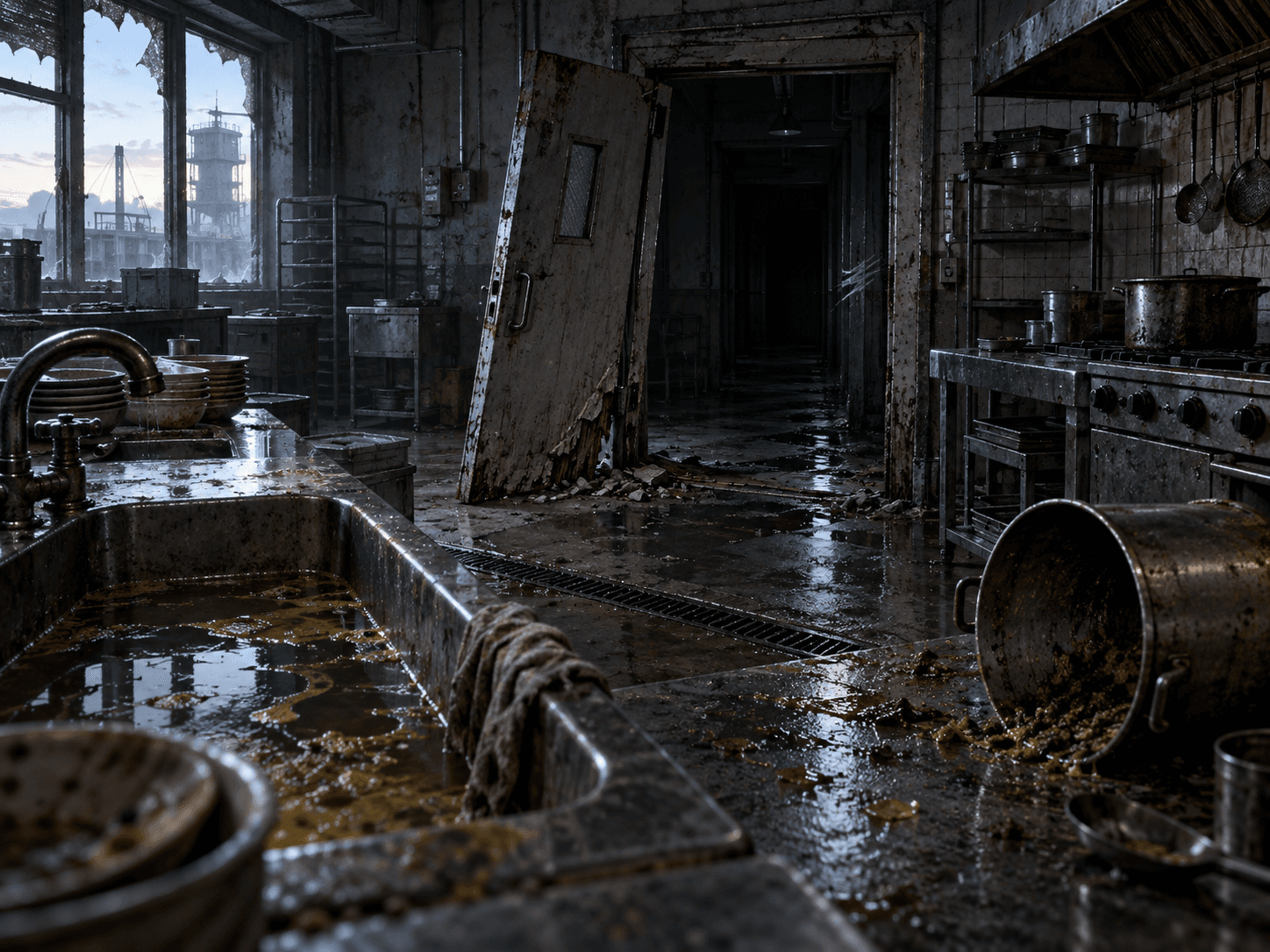
The lower hinge was loose. He had noticed it earlier, after one of the previous contacts. The metal had shifted a few millimeters against the frame. Now a thin smear of moisture showed beneath the door, though no one had passed through it.
Tommy wiped it with a rag.
A gray, greasy residue remained on the cloth.
Echo-7 had once been a logistics base. Faded evacuation diagrams still hung on the walls, but half the rooms had been sealed, and the other half were no longer fit for use. The generator provided light for a few hours a day. Water still ran in the pipes, but no one drank it without boiling it first.
The kitchen and mess room were at the end of the corridor. The main doors opened onto the north side of the complex. Beyond them were a concrete yard, a length of fence, and the forest.
The rear service exit led into a narrow technical tunnel. It could only be opened manually from inside, by a valve set into the kitchen floor. Lev checked that mechanism every day.
Tommy kept notes.
He did not trust memory. Memory rearranged events, gave meaning to silence, joined sounds that might have had nothing to do with one another. Paper was simpler.
On one page he had written:
full cooking — heat, steam, fat, wet sink — contact earlier
On the next:
cold portions — less damp, less movement — contact later
He did not write that something was tracking them. He did not write that something understood his work.
He wrote only what could be checked.
Hour of preparation. Time to first sound. Location of mark. Number of impacts. Door damage.
That evening he found a fresh scratch on the lower frame. Three parallel grooves, shallow but long. Beneath them the wood was wet.
Tommy touched the scratch with his fingertip.
A rustle came from the corridor.
He turned. No one was there.
Farther beyond the door, something scraped along the floor. The sound lasted several seconds, then faded.
Tommy closed the kitchen door and wrote in his notebook:
After warm meal, mark at frame. Decisive signal not established.
The next day he made cold portions.
No stove. No steam. He opened tins, mashed the contents, and added powdered milk. Instead of mixing everything in one pot, he used four small dishes. He washed each separately, without opening the tap to a full stream.
Ruth watched him from the doorway.
"This is breakfast?"
"This is food."
"Mara won't swallow it."
Mara swallowed three spoonfuls.
Then she pushed the bowl away.
Lev picked it up, smelled it, and set it down.
"It tastes like wet cardboard."
"Cardboard doesn't have that many calories," Tommy said.
Lev looked at him but did not answer.
That afternoon contact came only after several hours. First there was a scrape from a distant corridor, then two short knocks against the wall near the storeroom. Not near the kitchen.
Tommy went there with Lev.
On the floor by the steel threshold ran a wet smear. It was not wide. It could have come from a pipe leak. It could have been carried there on someone's boots. It ended before the closed door.
Lev crouched.
"That wasn't here yesterday."
"I know."
"It doesn't have to be connected to cooking."
"I know."
Beyond the door came a rasp. Lev lifted his head.
They both listened.
The sound moved across the metal, left to right. Then it was gone.
Ruth ordered cold portions again that evening.
Mara fell asleep at the table.
On the third day her hands were cold even though she sat beside the heater.
Ruth checked her breathing and counted her pulse. Lev brought a thermometer from storage.
Mara's temperature was low.
"She needs something real," Ruth said.
Tommy stood at the counter and looked at the three unopened tins.
"This isn't about taste."
"I know."
"If I open the stove, if I start cooking, they'll be at the door again."
"They're already at the door."
Tommy looked at the frame.
The lower hinge was more bent than it had been that morning.
Ruth laid her hand on the table.
"Make her a meal."
Tommy opened the valve.
The flame caught with a soft click.
Fat began to drip before the meat had warmed through.
Tommy worked quickly. Not because he was rushing, but because every extra lift of the lid put more steam into the room. Open the pot, stir, close it. Wipe the counter. Throw away the paper. Wash the knife.
Cutting was the one part he could not do without movement.
The metal blade struck the board.
Beyond the door, something scraped across the floor.
Tommy did not stop.
The movement beyond the door ceased.
He did not know whether the sound had ended because he stopped working or simply because it had ended.
He put the meat into the pot.
Steam rose beneath the vent. The damp stain on the metal grate widened slowly. One drop fell to the floor.
Behind the wall came a knock.
Then another.
Ruth entered the kitchen.
"How long?"
"A few minutes."
"Mara doesn't have a few hours."
Tommy stirred.
The impacts quickened. They were not even. One after another, sometimes two at once, sometimes after a longer pause. The sound moved along the wall.
The first marks appeared at the door, not at the vent.
Lev ran in from the corridor.
"The hinge."
Tommy did not turn his head.
"What about it?"
"It shifted. If pressure comes from that side again, it gives."
Mara was already at the table. Ruth had helped her those few steps. Her knees shook.
Tommy set down the bowls.
Mara ate the first spoonful.
Then the door shuddered.
Not like before. This time the whole frame moved in the wall. Plaster sifted down from the ceiling.
Tommy looked at the clock.
Not much time had passed since he had started cooking.
Later, when he tried to write it down, he did not put in any theory.
He wrote:
full preparation — contact before meal ended — hinge shifted — frame working
He did not know whether the most important thing had been smell, heat, damp, noise, movement, or traces of food. He knew only that full preparation had shortened the time in which the kitchen stayed quiet.
"To the tunnel," Lev said.
Ruth looked at Mara.
Mara held the bowl in both hands.
"She won't make it."
"If we stay here, the door gives," Lev said.
"If we go now, she drops halfway."
Tommy stood by the stove. The water in the pot was still trembling.
Then he understood that there was no separate choice between food and safety. There were only different ways of paying for both.
"She has to eat," he said.
Ruth looked at him.
"And then?"
Tommy did not answer.
After the second impact, the lower hinge groaned.
After the third, a gap opened in the door.
Cold air pushed in from the corridor.
Lev went to the rear service exit and knelt by the valve.
"It opens," he said. "But someone has to hold the valve until the end."
Ruth pointed at Mara.
"Her first."
Tommy turned the stove off.
The flame vanished, but the burner stayed hot.
On the floor near the sink lay a puddle of water mixed with fat. The waste bag had slumped sideways and touched the cabinet door. Mara's bowl stood on the counter, nearly empty.
"If we leave the burner open, smoke goes into the tunnel," Tommy said.
Lev looked at him.
"You shut it."
"The floor valve. Under the sink. The supply."
"I'll do it."
"You're holding the passage."
Ruth looked at him for one second.
She did not say no.
That was enough.
Tommy went under the sink.
The metal handle of the valve was slick with fat.
In the corridor, something hit the door.
The whole kitchen shook.
Tommy gripped the valve.
It did not move.
"Tommy!"
"One more."
He pulled harder. His hand slipped. His elbow struck a pipe.
The door shifted inward.
Ruth shouted to Lev to lead Mara.
Tommy caught the valve with both hands and pulled.
This time it gave.
The flame went out completely.
At the same moment the hinge tore free of the frame.
The metal edge of the door struck Tommy in the forearm and pinned it against the wall.
The pain was immediate and clean.
Tommy screamed.
He did not feel a cut. He felt pressure running through bone all the way to his shoulder. His fingers opened on their own. A bowl fell to the floor and shattered.
Lev moved toward him.
"Leave me! The valve!"
He knew that if the flame remained, spilled fat could take the floor. The fire would not have to reach the people to close the passage with smoke.
Tommy clenched his teeth and pulled his arm.
The metal did not give.
From beyond the door came another pressure. Wood cracked higher up. The gap widened, and wet air and the smell of earth pushed through it.
Tommy slid his good hand under the valve.
He turned it.
The flame died.
For one second he heard only his own breathing.
Then the door shifted again. His arm came free. Tommy fell sideways, pulling his hand to his chest.
Lev reached him and dragged him by the jacket.
"Tunnel!"
Ruth was already leading Mara through the rear passage. Mara moved slowly, one hand on the wall. Her face was wet with sweat.
Tommy got up.
His hand did not respond properly. His fingers trembled without his permission. He could not close them around anything.
Behind him, the main door dropped to the floor.
He did not see what was on the other side. He saw only darkness beyond the broken frame and wet marks on the concrete.
Lev shoved him into the tunnel.
The passage was narrow. Tommy went last, bracing himself on the wall with his good hand. With each step, pain moved from his wrist to his elbow.
Ruth and Mara were already at the exit. Lev held the valve open until all of them had passed through the metal hatch.
When Tommy came outside, Echo-7 was behind them.
Cracks and bangs came from the kitchen.
Some came from the door. Others from overturned dishes, pipes, or the generator. Tommy did not try to tell them apart.
At dawn the kitchen was empty.
The door hung from one hinge. The lower part of the frame had broken away and lay on the wet floor. The sink was full of cold, greasy water. On the surface floated a scrap of paper from Tommy's notebook, soaked through and unreadable.
A thin film of fat had hardened on the counter.
Beside the stove lay the overturned pot. A dark layer of food remained at the bottom.
Pale light came through the cracked frame.
Somewhere in the corridor, metal trembled.
Then came a single scrape across the floor.
There was no one in the kitchen to check what had made it.