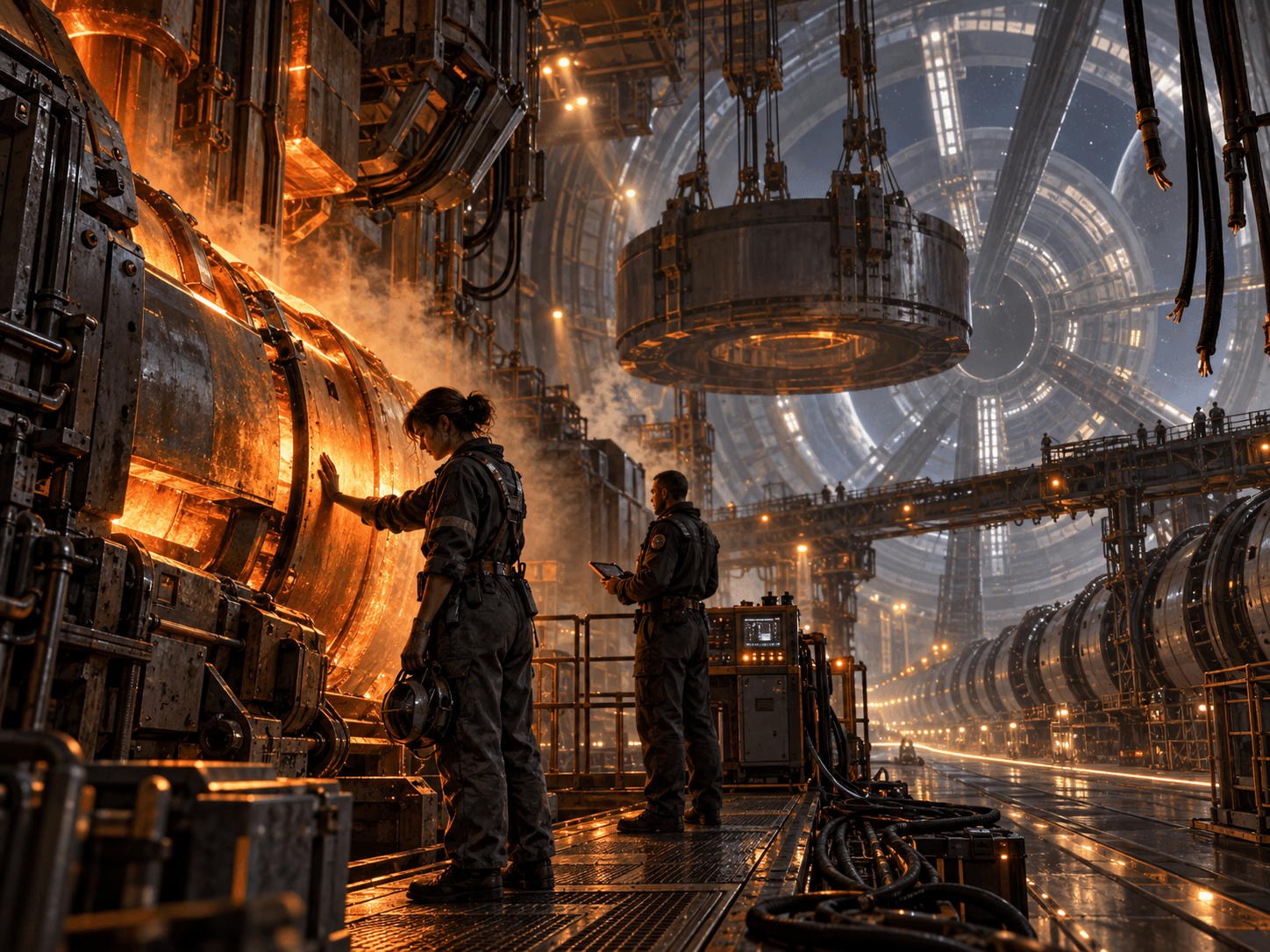
Forge Four made a perfect part.
On the dimensional-control screen, every deviation sat almost at zero. The volumetric scan found no voids. Composition analysis matched the material recipe to four decimal places. The load test ended with a green bar.
PASS
Kai Venn stood at the metrology table and looked at the freshly machined support ring, still warm from final stabilization.
“Told you,” Soren Hale said.
Soren had worked in Forge Four for four consecutive Watches, which on Holdfast made him as close to a place as a machine could be close to a human. His hands carried scars from hot chips the safety system should never have let through, and he had the kind of patience that came from living among machines that weighed tens of tons.
“That’s not proof,” Kai said.
“It’s green.”
“Locally.”
Soren pointed at the screen.
“Locally is where the part is going to work.”
Kai did not answer.
The wall behind him was warm.
Not dangerously.
Just warmer than the design predicted at this load.
Behind it ran Forge Four’s local cooling loop, then a thermal buffer, then the route to one of Rotor Four’s main radiators.
Everything worked.
The pumps had reserve.
The exchangers had reserve.
The rotor bearings had reserve.
Power had reserve.
Forge Four had reserve.
Kai glanced at his terminal.
At the very top was the line he had received seven minutes earlier.
LATE-PHASE CONFIGURATION CERTIFICATION
STATUS: REJECTED
Below it:
INTEGRATED PHASE-TRANSITION CONTROL MARGIN: 0.912
MINIMUM CERTIFIABLE: 1.000 + CONTINGENCY
Soren noticed where he was looking.
“Still the same model?”
“Yes.”
“And it still says we don’t pass?”
“Yes.”
“And the ring?”
Kai looked at the part.
“Perfect.”
Soren smiled without humor.
“Good to know we can make perfect parts for a ship that no longer fits inside its own future.”
Holdfast was not old in the way buildings on Earth were old.
It did not rot.
It did not overgrow.
It did not settle into the ground.
It had no ground.
It aged by accumulation.
By things that had been added because they were needed.
By shielding installed after one real radiation event.
By water moved to where a main bank had once ruptured.
By extra power lines after a failure that was not supposed to happen again.
By workshops that had not existed in the shipyard design.
By braces, bypasses, filters, stores, valves, and local solutions that, for one hundred eighty-six years, had all said the same thing:
we need this now.
And for one hundred eighty-six years, they had usually been right.
Kai was the Mission Configuration Integrator.
Not chief engineer.
Not commander.
Not owner of any system.
His job began exactly where everyone else’s certainty ended.
When every subsystem owner said:
my system is safe,
Kai had to answer a different question:
can the whole ship still do what the next phase of the mission requires of it?
This time, the answer was:
not in the current configuration.
Holdfast’s AI had not discovered the problem that morning.
Kai knew that before he opened the model for the first time.
For decades, the system had reported a trend.
Not an alarm.
A trend.
Integrated margin narrowing.
Transition flexibility declining.
Future configuration sensitivity increasing.
Earlier, the ranges had been broad.
Bearings might age better or worse.
The actual stiffness of several major structural joints remained an interval.
Mass distribution shifted from Watch to Watch.
Some stores moved between rotors.
There had not yet been any point in saying:
Forge Four has to go.
You could only say:
some future profiles will require reduction.
Now it was different.
MY186.
The hardware state was a state, not a forecast.
Mass could be weighed, counted, measured.
Control-system capability was not being predicted from MY120 data.
It was measured now.
And the requirements of the next late-flight configuration were no longer a broad field of hypotheses.
That still did not mean Holdfast knew what would happen after that.
It did not.
It did not define it.
It had simply come close to a point at which it had to guarantee that it retained enough ability to change its own configuration.
The AI closed the model.
And for the first time, it did not say:
margin trending low.
It said:
current configuration not certifiable.
The first twenty hours were easy.
Not emotionally.
Technically.
Easy problems had solutions.
They moved some water.
Not much.
Only what could move without violating local shielding and fire reserves.
They shifted heavy stores from the outer rings into storage closer to the axis.
They resequenced several large thermal cycles.
They changed the work schedule for two energy-intensive processes.
The AI recalculated the configuration.
0.931
“Good,” Kai said.
“Insufficient,” the AI replied.
“I know.”
They changed pump operating profiles.
Moved part of the material reserve.
Adjusted vibration-control settings.
Not because anything was vibrating dangerously.
Because every small reduction in required damping returned a little margin somewhere else.
0.944
Someone proposed reducing the average awake load by sixty people.
The AI calculated.
Thermal effect: meaningful.
Mass effect: almost none.
0.948
“This is a ship,” Kai said at the briefing. “Not a bus. People don’t weigh as much as we sometimes think they do.”
No one laughed.
After thirty-six hours they had:
0.961
After fifty-two:
0.969
After sixty:
0.972
And then everything stopped.
Not physically.
Intellectually.
The AI displayed a new line.
NO REMAINING REVERSIBLE CONFIGURATION SATISFIES CERTIFICATION
Kai read it twice.
Mara Sen, responsible for rotating-structure integration, leaned over the table.
“Again.”
“Recalculation took thirty-eight minutes,” the AI said. “Result stable.”
“All variants?”
“All variants within the currently declared class of reversible changes.”
“Meaning?”
Kai answered for the system.
“Meaning moving things around is no longer enough.”
Mara looked at him.
“We have to lose something.”
Kai nodded.
“Yes.”
For the first time, the problem stopped being optimization.
It became amputation.
The AI showed three packages.
Not twenty-seven.
Not a hundred.
Three.
The rest it had rejected as worse versions of the same choices.
The screen did not contain the word “good.”
Or “bad.”
There were consequences.
PACKAGE A
Retain distributed heavy fabrication
Cost:
- smaller post-transition control reserve,
- lower tolerance for the next deviation,
- restrictions on several future configurations,
- greater dependence on active mass management.
PACKAGE B
Decommission large-radius distributed fabrication
Cost:
- loss of local production of oversized parts,
- increased dependence on central fabrication,
- longer repair times for Rotor Four,
- loss of one redundancy class.
Benefit:
- largest recovery of moment-of-inertia margin,
- recovery of part of the thermal reserve,
- simplification of local infrastructure.
PACKAGE C
Retain Forge Four; redistribute shielding / reserves / auxiliary capability
Cost:
- large shifts of stores,
- worse local shielding,
- loss of other redundancy,
- greater logistics burden across several sectors.
Kai stared at the packages.
“Which do you recommend?”
The AI answered immediately.
“I am not authorized to choose which mission capability is to be lost.”
“I’m not asking about authority. I’m asking for a technical recommendation.”
“All three packages are technically feasible.”
“Lowest risk?”
“Risk depends on the value assigned to different classes of future failure and constraint.”
Kai leaned on the table.
“So you won’t choose.”
“No.”
“Because you can’t?”
“Because the choice requires determining which kind of future loss humans consider more acceptable.”
Mara looked at him.
“Finally something it won’t do for us.”
Kai did not answer.
He did not feel relieved.
Forge Four had not begun as Forge Four.
At first, it had been a small annex.
Several heavy machine tools.
One forming line.
A local metrology set.
Then came the first change.
MY61.
The archive recorded it in dry language.
Cross-hub logistics interruption exposed critical dependency on centralized fabrication.
It sounded like a planning note.
In reality, for seventeen days Rotor Four had waited for parts that were ready on the other side of the ship, but there was no reasonable way to get them across in time.
Not a catastrophe.
No death.
Friction.
Enough for the next Watch to say:
we will not depend on one place again.
They expanded the annex.
A good decision.
MY112.
A new class of material wear required larger parts.
The older machines were not enough.
They added heavier beds.
A new furnace.
A larger cooling system.
A good decision.
MY153.
A redundancy review asked whether Forge Four still made sense.
They kept it.
Reason:
distributed repair capability demonstrated mission value across three independent events.
A good decision.
Kai read the signatures.
Names.
Watch numbers.
Decisions.
He found no fault.
He found people who had been right in their own time.
That was worse.
Soren walked him through Forge Four two days later.
He did not need a map.
He did not need a tablet.
He knew where the floor resonated slightly differently.
He knew which machine had its own sound during warm-up.
He knew where, inside the wall, the old mountings remained from a machine removed before he was born.
“That was the original bed,” he said, pointing to a rectangular outline on the floor. “Before they added heavy forming.”
Kai nodded.
“How much mass is in here?”
“Depends what you count.”
“Everything that would have to leave the large radius.”
Soren looked at him.
“So you already know.”
“Nothing has been selected yet.”
“But you know.”
Kai did not answer.
They moved on.
Forge Four was working.
Not for demonstration.
Normally.
One machine was machining a valve component.
Another was preparing a batch of mounts.
A furnace cycle was running.
Cooling whispered.
People moved between stations, not yet knowing whether those stations would still exist a week from now.
“How many times has this place been truly necessary?” Kai asked.
Soren stopped.
“What does ‘truly’ mean?”
“How many times would we have had a problem central fabrication could not solve in time without Forge Four?”
Soren thought.
“Nine.”
“In one hundred eighty-six years.”
“Nine times.”
“Not many.”
Soren looked at him.
“Nine too many times not to have it.”
Kai knew that was true too.
The council was not a spectacle.
Five people.
The AI.
Kai.
Two walls of screens.
No banners.
No faction shouting “save Forge Four.”
No faction saying “throw out the junk.”
Mara defended Package A.
Not out of sentiment.
“If we lose heavy fabrication on Rotor Four, a future repair involving a component larger than the central logistics-route envelope will take us two to five times longer.”
“Yes,” Kai said.
“If the route is available at all.”
“Yes.”
“That’s risk.”
“Yes.”
Soren was not a council member.
He had a seat as the capability owner’s representative.
“How much does Package B recover?”
The AI answered.
“In the current model: 0.061 margin from large-radius reduction and support-mass simplification alone. Combined with the previously approved reversible changes: 1.033 before contingency normalization.”
“So still not enough.”
Kai looked at the screen.
“No.”
The AI added:
“Additional stores relocation and restriction of one thermal cycle raises the result to 1.047.”
“And required?”
“1.040 in the current certification model.”
Mara shook her head.
“Seven thousandths.”
“That’s margin,” Kai said.
“That’s a number.”
“All margins are numbers.”
“Until you need them.”
Kai looked at her.
“That is exactly why we’re here.”
Package C looked gentler.
It did not take one thing away.
It took many small things.
A little shielding here.
A little water there.
One less redundancy.
More transfers.
More logistics.
More people managing new compromises.
On the screen, it looked democratic.
Everyone lost something.
No one lost everything.
The AI calculated the consequences.
Mara said:
“I prefer C.”
Soren said:
“So do I.”
Kai asked:
“Why?”
Mara answered first.
“Because it doesn’t close any capability class.”
“But it weakens six.”
“Yes.”
Soren shrugged.
“I’d rather have six weaker ones than one dead one.”
Kai looked at the package.
It was rational.
Maybe even more reasonable.
The AI did not help.
Not because it could not.
Because every next step required valuing one thing against another.
What was worse?
Less shielding?
Less water in one zone?
Less redundancy?
Or losing local heavy fabrication?
There was no single physical answer.
Physics only drew the boundary.
Humans decided which side of it they wanted to live on.
Kai returned to Forge Four after the night shift.
Soren stood by the same machine that had made the perfect ring two days earlier.
“Got something for me?” he asked.
“Not yet.”
“So you do.”
Kai sighed.
“B is the cleanest systemically.”
“C is less cruel.”
“C is more complex.”
“That’s not the same thing.”
“I know.”
Soren put both hands on the table.
“You know what happens after B?”
“There’ll be less mass at large radius.”
“No.”
Kai looked at him.
“Next time someone comes and says, ‘we need a part,’ someone else is going to answer, ‘we used to be able to make it here.’”
“I know.”
“And there won’t be anyone to blame.”
“I know.”
“That’s the worst part.”
Kai said nothing.
Soren patted the machine housing.
“It works.”
“I know.”
“Look at it.”
Kai looked.
“It works.”
“Good.”
“Why?”
“Because if you shut it down, I don’t want the only thing you remember later to be the graph.”
The decision came the next day.
Not unanimously.
Not dramatically.
Package B.
Forge Four would be dismantled.
Not blown up.
Not cut off and abandoned.
Dismantled.
Selected tools and metrology modules would move closer to the axis.
Some feedstock would be transferred.
The heavy machine beds would be removed.
The local loop simplified.
One section of support structure removed if analysis showed it was no longer needed.
The capability did not end when the power went off.
It ended when the ship no longer had the physical ability to restore it without a major rebuild.
Kai received the document.
DISMANTLING AUTHORITY
His was not the only signature.
But without his certification, none of it could take effect.
He read it.
The word “loss” did not appear.
It said:
recover integrated phase-transition margin
reduce large-radius installed mass
retire distributed heavy fabrication capability
Technically, every line was correct.
Kai signed.
The last part from Forge Four had no historical significance.
That was the best thing about it.
It was not a monument.
It was not a part prepared as a keepsake.
It was an ordinary component for one of the water-recovery systems.
A small valve body.
The machine made it.
It passed scan.
PASS
Soren took the part.
Put it in a container.
“That’s it?” Kai asked.
“For this line, yes.”
“I thought it would be something bigger.”
“It’s only a machine.”
Kai looked at him.
Soren shrugged.
“We’re the ones who need ceremony.”
Then he pressed the lockout.
Not the main switch.
First process power.
Then the local circuit.
Then line isolation.
The machine went quiet in stages.
Not all at once.
Fans slowed.
Pumps spun down.
Eventually only temperature remained.
The metal gave heat back to the room although it was no longer doing anything.
Kai put a hand on the housing.
Warm.
Functional.
Shut down.
Dismantling took days.
They lifted the first massive bed only a few centimeters.
It was enough.
Kai saw the surface beneath it exposed, a surface no one had looked at in more than seventy years.
Cleaner.
Brighter.
The preserved outline of the machine.
They were not removing history.
They were removing mass.
Components moved toward the axis.
Slowly.
Every movement was logistics.
Every recovered kilogram had a new location.
The AI updated the model.
0.991
Then:
1.006
Then:
1.031
Finally:
1.047
Kai stared at the result.
“Certification.”
A pause.
Not because the AI hesitated.
It was calculating.
“Integrated phase-transition configuration: certifiable.”
Kai closed his eyes.
Soren stood beside him.
“That’s it?”
“That’s it.”
“I don’t feel saved.”
“Because nothing was attacking us.”
“I know.”
“And nothing broke.”
“I know.”
Soren looked at the empty space where the machine had been.
“So how do you know we did the right thing?”
Kai answered after a moment.
“You don’t.”
That same day, the AI published a proposal for a new standard.
Not a ban.
Not a grand reform.
A ledger.
Every future modification above a defined threshold of mass, structure, thermal load, or control impact would be assigned a cost against the vehicle’s integrated margins.
Not to stop local Watches from improving the ship.
So no improvement could ever again look free.
Kai read the sentence in the draft:
LOCAL BENEFIT DOES NOT IMPLY ZERO GLOBAL COST
Below it:
INTEGRATED MARGIN ATTRIBUTION REQUIRED
Soren glanced over his shoulder.
“Now we know.”
“What?”
“Every good thing weighs somewhere.”
Kai did not answer.
Beyond the wall, the neighboring loop was working.
Pumps.
Fans.
The rhythm of the rotor.
Holdfast did not sound like a dying ship.
It sounded like a ship that still worked.
Forge Four was dark.
Bright rectangles remained on the floor where machines no longer stood.
Nothing exploded.
Nothing cracked.
Nothing was repaired.
Holdfast simply weighed a little differently.
And it could once again promise itself that its next move still fit inside the limits of physics.
That was where the report ended.
MY186.
Beyond that, the model remained open.