
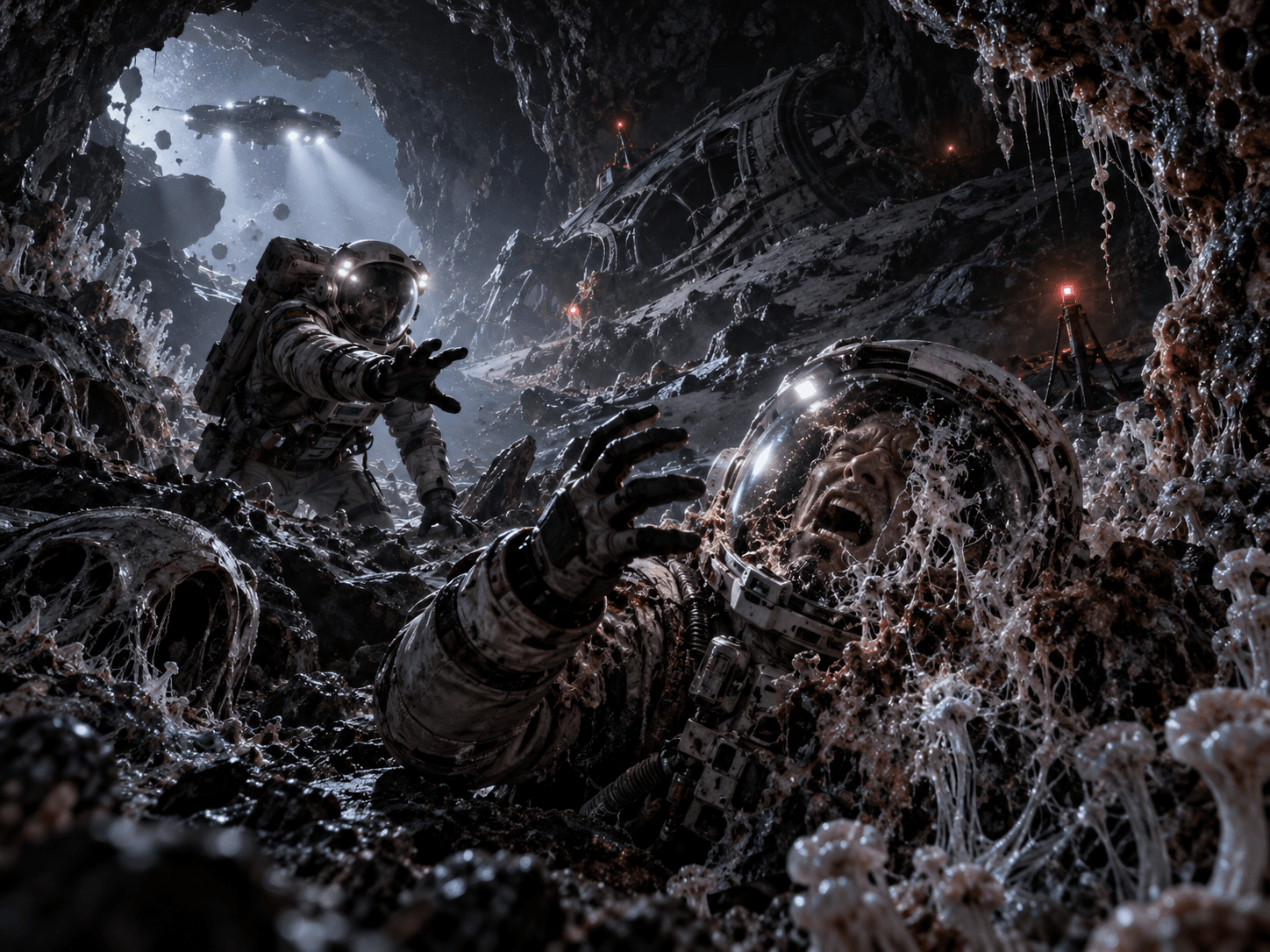
The first thing Sera Kade saw after the airlock sealed was Holdfast.
Not the stars.
Not the dark body that had been moving through trajectory models for three months.
Holdfast.
Ten kilometers of ship slid past the cutter window so slowly that for several seconds you could believe nothing was moving at all. The central spine stretched beyond the field of view. Farther out, one of the rotors turned, white and clean, its paint almost untouched.
The ship was still new then.
Sector numbers had no annotations.
There were no plaques on the bulkheads with the names of the dead.
There were no places the crew spoke about more quietly.
The number 06 on the cutter hull was complete and even.
No scratches.
No second coat of paint.
No history.
“Separation confirmed,” Elias Venn said.
Two trajectories appeared on the main display.
One belonged to Holdfast.
The other to them.
They were diverging now, but in twenty-nine days they crossed again.
Not in the space where Holdfast was.
In the space where it would be.
RETURN INTERCEPT: 29D 11H 04M
Below it:
PROPULSION MARGIN: 14.2%
It was not a fuel percentage. It was the reserve in the intercept solution: how much error, delay, and additional maneuver they could still spend before the mathematics stopped giving them a path back to Holdfast.
Nia Sol looked at the indicator and smiled.
“Fourteen percent. Luxury.”
Sera adjusted her harness.
“Enough.”
Elias turned his head.
“That word is usually spoken right before something you regret.”
“Then don’t regret it.”
Holdfast’s AI spoke in the background.
The voice was neutral, calm, without any attempt to sound human.
“Cutter zero six: return profile nominal. Recommendation: begin departure from the object no later than intercept margin falling to eight percent.”
“Copy,” Sera said.
“Cutter mission priority: safe return of crew, then integrity of research data, then platform integrity.”
Elias raised his eyebrows.
“Nice to know the ship puts us ahead of the drive.”
“Ahead of the drive, yes,” Nia said. “Ahead of the whole colony, maybe not.”
The AI did not comment.
Holdfast was not going to wait for them.
It never was.
The cutter would investigate the object, collect data, and catch the ark.
If it failed to catch up, Holdfast would leave.
That was the plan.
That was how the mission worked.
The object had no name.
In the systems, it was listed as DRIFT-91.
One hundred sixty-eight kilometers of almost black material, porous and irregular, on a trajectory that tied it to no known body in the Solar System.
It was a wanderer.
Something ejected from another system a long time ago, or something that had never belonged to any world long enough to deserve a name.
Holdfast detected it earlier than it should have detected an object that dark.
Not because it saw the rock.
Because the rock was transmitting.
The first signal was a narrowband pulse repeating every seven hundred eleven seconds.
The second returned once every few hours.
The third had an irregular cycle, but repeated the same sequences.
They did not understand them.
They did not even try to call them language.
But nature did not hold a frequency that clean.
Nature did not switch into predictable power-saving modes.
Nature did not send packets.
Holdfast classified the sources as technological with a probability above ninety-nine point nine percent.
Sera remembered the silence in the briefing room when the AI gave that number.
No shouting.
No applause.
People started asking about delta-v, exposure, time, and fuel.
It was the most human thing they could have done.
The cutter reached DRIFT-91 after eight days.
By then Holdfast was invisible without magnification.
On the display it looked like a bad pixel until the system overlaid a marker.
MOTHER SHIP RANGE: 3.6 MILLION KM
RANGE INCREASING
DRIFT-91 filled the forward display.
The surface looked like burned bone.
Cracks ran across it for hundreds of kilometers. Sections of crust had collapsed inward, forming long rifts.
Holdfast’s models showed extensive voids below the surface.
Sera stared at them without speaking.
“Caves,” Nia said.
“Voids,” Elias corrected.
“Labyrinth.”
“Don’t romanticize it.”
“Not yet.”
The AI joined the conversation.
“Emission source one is estimated at one hundred eighty to two hundred forty meters below the surface. Source two: deeper than three hundred meters. Accuracy limited by rock geometry.”
Sera watched the model.
“Nearest entrance?”
The map rotated.
One of the rifts lit up.
“Natural opening. Width nine to twelve meters. Stability unknown.”
Elias sighed.
“So we’re going down.”
Nia smiled.
“That is why we’re here.”
The AI answered immediately.
“Reminder: safe crew return remains the priority.”
Sera glanced at the counter.
RETURN MARGIN: 13.6%
“We have time.”
“Confirmed. At present.”
The entrance to the labyrinth did not look like an entrance.
It was a jagged fissure, as if the crust had split and never managed to close again.
They anchored the cutter seventy meters away.
Gravity was so weak that every step was really a controlled push.
They moved on tethers.
Each had their own anchor.
Every movement left a trace in dust that did not settle the way it should.
Nia went first.
The lamps on her helmet moved across the wall.
Black.
Then gray.
Then rust-colored.
The layers changed color with the angle of the light.
“There’s something on the surface,” she said.
Elias brought the scanner closer.
“Silicates. Salts. Carbon.”
“Organic?”
“Partly.”
Nia extended a probe.
“Don’t touch it with your hand.”
“Thanks, Mom.”
The tip of the probe brushed the wall.
A thin flake came loose from the surface.
It did not fall.
It drifted.
It looked like ash.
Nia turned the probe.
The flake stuck to the metal.
She pulled.
A thin filament stretched between it and the probe tip.
For a moment, no one spoke.
“Don’t use the word mold,” Elias said.
“I haven’t said anything.”
“You thought it.”
Nia magnified the image.
“Fibrous structure. Mineral-organic layer. I don’t know if it’s alive.”
“Send the full spectrum,” Sera said.
“Already going.”
The transmission indicator lit.
The packet left for Holdfast.
The AI received it after a delay no human could yet feel as a delay.
“Data received. I recommend limiting direct contact with unknown material to disposable tools.”
“Copy,” Sera said.
They moved on.
At two hundred meters, the fissure split into three corridors.
At four hundred, seven.
At six hundred, the map began to resemble a vascular system.
Everything was natural.
That was the worst part.
There were no doors.
No tunnel cut by a hand.
Nothing that let you say: this is where a place built by someone begins.
There was only rock.
Rock leading deeper and deeper.
They found the first wreck a kilometer from the entrance.
First Sera saw a line.
One.
Straight.
Too straight.
Then another.
Then a third.
“Light left.”
Nia turned her head.
The beams cut across the gray crust.
A curve appeared beneath it.
Metal.
Or a material that behaved enough like metal on the scanner.
Elias moved closer.
“That is not geology.”
Nia did not answer.
A structural element lay across the surface, rib-like but branching in six directions.
None at a right angle.
None in any way used in human construction.
Sera felt her breathing speed up.
Not from fear.
Not yet.
“Holdfast. Structural comparison.”
The answer came after a moment.
“No match to human industrial or spacecraft structure database. Probability of technological origin: ninety-nine point eight seven percent.”
Elias stared at the wreck.
“Tell me we’re first.”
“Record,” Sera said.
“That is not an answer.”
“Record.”
Packets streamed to Holdfast.
Geometry.
Spectra.
Composition.
Imagery.
The AI began its own analysis.
It did not congratulate them.
It did not ask how they felt.
It worked.
The first alarm came twenty-six minutes later.
Elias looked at his left hand.
“I have a temperature drop at the ring.”
Sera stopped the team.
“Pressure?”
“Nominal.”
Nia moved the camera closer.
There was a gray smear at the glove joint.
So thin it looked like dust.
Except it glistened.
“It’s wet,” Nia said.
“Where’s the moisture coming from?”
Nia switched thermal layers.
“From you. Condensation across a thermal bridge. Micrograms. The material bound it.”
The gray layer around the seal darkened.
Elias moved his wrist.
The material shifted.
Not like an animal.
Like paste under pressure.
“We’re going back,” Sera said.
There was no argument.
The AI spoke at once.
“I confirm the retreat recommendation. Current intercept margin: ten point nine percent.”
Elias moved first.
Nine minutes later, pressure began to drop.
0.2 kilopascals per minute.
Then 0.6.
Then 1.3.
“Seal B-seven,” Elias said.
His voice was calm.
Too calm.
“Adhesive layer under the ring.”
Nia pulled out the repair kit.
Sera raised a hand.
“Don’t touch that material.”
“I have to patch it.”
“Isolate the surface.”
Nia worked carefully.
She did not even bring her glove near it.
She inserted a thin isolation film, then pressed the patch down on top of it with a tool.
For several seconds, the alarm went quiet.
“It’s holding,” she said.
Elias let out a breath.
The AI responded:
“Pressure-loss rate reduced. Recommendation: continue evacuation without stopping.”
They moved.
A minute later, the patch began to peel.
Not from the middle.
From the edge.
The adhesive changed color.
Nia watched the analysis.
“That’s hydrolysis or something very close.”
“From that coating?”
“I don’t know.”
“Nia.”
“Yes. Most likely.”
The alarm returned.
Louder this time.
The AI raised its voice by barely a perceptible amount.
“Elias Venn: pressure-loss rate will exceed compensation capacity in six minutes forty seconds. Nearest safe pressurized point: cutter zero six, estimated arrival time eleven minutes.”
Elias stopped moving.
Sera grabbed his arm.
“Move.”
“I’m not going to make it.”
“Move.”
“Sera.”
“Move.”
The AI cut in.
“Alternative: temporary joint immobilization and external compression may extend suit-function time by two to five minutes.”
“Do it,” Sera said.
Nia was already beside him.
She wrapped the ring with composite tape, taking away almost all movement from the arm.
The leak signal fell.
It did not disappear.
“Holdfast,” Sera said. “New projection.”
A pause.
“Probability Elias reaches the cutter while conscious: thirty-eight percent.”
“And alive?”
“Forty-six percent.”
Elias snorted.
“Even the AI is trying to comfort me.”
“No,” Nia said. “It’s just calculating.”
They moved.
Elias did not make it.
The seal failed at a constriction, eight hundred meters from the cutter.
It did not explode.
It did not tear open.
It simply stopped sealing.
Air found a path.
“Forty-nine,” Elias said.
Sera knew what he was counting.
Kilopascals.
“Forty-three.”
His voice grew thin.
“Thirty-seven.”
Nia tried to reduce flow through the glove.
The AI guided her step by step.
“Close auxiliary valve three. Increase oxygen mix by eight percent. Do not exceed thirty-five.”
“Doing it.”
“Elias, breathe shallowly.”
“I know.”
Sera heard his breathing over the radio.
Faster.
Wetter.
“Holdfast,” Elias said.
The AI answered.
“Listening.”
“Seal data?”
“Received. Analysis in progress.”
“Good.”
Sera felt anger rise.
“Don’t ask about the data.”
Elias turned his helmet.
Through the visor, she saw his face.
The whites of his eyes were beginning to redden.
“It means something can come out of this.”
“Shut up.”
“Is that an order?”
“Yes.”
“Copy.”
Pressure dropped below thirty kilopascals.
The AI changed medical priorities.
Not mission priorities.
Only his.
“Elias Venn: loss of consciousness probable within sixty to ninety seconds.”
“Can I connect him to Nia’s reserve?” Sera asked.
“No. That would require opening the interface in a contaminated environment and would increase the risk of losing the second suit.”
“Mine?”
“Same problem.”
Sera clenched her jaw.
The AI was not saying: you’re not worth it.
It was only saying: it won’t work.
Elias sagged against the wall.
Blood appeared from his nose inside the visor.
In microgravity it did not run.
It formed red spheres hanging in front of his face.
One stuck to the visor.
Elias tried to say something.
The radio caught only part of it.
“...home...”
Sera leaned closer.
“What?”
“Don’t... go back... because of me.”
Nia grabbed his harness.
“We’re not leaving you.”
The AI answered immediately.
“Recommendation: maintain continuity of retreat. Transporting an unconscious crew member reduces the probability of return for the remaining two crew by thirty-one percentage points.”
Sera closed her eyes.
“That’s not an order?”
“No. Recommendation.”
“Priority?”
“Safe return of all living crew remains the priority.”
Elias stopped breathing.
His heartbeat signal continued for another fourteen seconds.
Then the line flattened.
The AI waited two seconds.
“Elias Venn: death confirmed.”
Sera unclipped his tether from her harness.
She did not leave him with dignity.
There was no time for dignity.
She clipped the body to an anchor in the wall.
No kiss.
No goodbye.
“We’re going back,” she said.
This time her voice did not shake.
Nine hundred meters remained to the cutter.
RETURN MARGIN: 8.2%
Sera looked at the indicator.
“We’re at the threshold.”
The AI answered.
“Confirmed. I recommend immediate return. Further exploration will reduce the probability of intercepting Holdfast below acceptable level.”
Nia stopped.
“I’ve got a new signal.”
Sera looked at her.
“No.”
“Thirty meters.”
“No.”
“Source four.”
“Nia.”
“It could be a second wreck.”
Sera looked at the counter.
8.2.
Then at the dark side tunnel.
Elias had been dead two minutes.
His body hung behind them in the labyrinth like another object.
The AI spoke.
“Recommendation unchanged: return to cutter.”
Nia stayed silent.
“We’re not going,” Sera said.
Nia nodded.
Then signal four changed strength.
Slightly.
As if geometry had uncovered it.
A second appeared on the map.
Then a third.
Not new transmissions.
Sources the rock had previously prevented them from resolving.
Nia stared at the display.
“Sera.”
“I see it.”
Thirty meters.
That was all that separated them from the answer to one question:
Had they found an incident?
Or a pattern?
Sera knew the AI would not let her pretend.
“Holdfast. If we go in for three minutes?”
A pause.
“Probability of preserving the intercept profile falls from eighty-eight to seventy-six percent, assuming no further failures.”
“Recommendation?”
“Do not enter.”
Nia turned toward her.
Sera knew it was her decision.
Not the AI’s.
Not Elias’s.
Hers.
“One hundred eighty seconds,” she said.
The AI replied:
“Cutter commander decision recorded. Countdown started.”
Beyond the wall there was not a second wreck.
There were at least seven.
The first stood vertical between two slabs of rock.
The second was almost entirely covered by gray crust.
The third had a geometry Sera could not understand—as if its structure had been designed around emptiness rather than around a hull.
The fourth was small.
The fifth broken.
The sixth existed only as a regular shadow beneath a mineral layer.
The seventh lay deeper.
A light blinked on one of them.
Not biological.
Technical.
One flash.
Pause.
One flash.
Pause.
Nia stood still.
“They’re all transmitting.”
Sera said nothing.
The AI began resolving the sources.
SOURCE 1: MANUFACTURED STRUCTURE
SOURCE 2: MANUFACTURED STRUCTURE
SOURCE 3: PROBABLE MANUFACTURED STRUCTURE
SOURCE 4: MANUFACTURED STRUCTURE
Then a new line appeared.
“Hypothesis: emissions are consistent with autonomous emergency or post-accident systems.”
Nia read it twice.
“It’s not a trap.”
Sera looked at the gray layer covering the wrecks.
“No.”
“They’re not trying to draw us here.”
“No.”
Nia turned her helmet.
“They’re trying to say they died here.”
Sera felt something colder than fear.
“And that is why everyone comes.”
The AI interrupted.
“Forty-nine seconds remain until recommended retreat.”
“Scan everything,” Sera said.
“Already scanning,” the AI replied.
On the way back, Nia noticed the dust.
Not before.
Now.
Their lights cut through a barely visible haze of tiny fragments.
They were not suspended in air.
There was almost no air.
They bounced from walls.
From suits.
From tethers.
From everything.
“Don’t start decon,” Nia said.
Sera had been about to.
“Why?”
“Moisture.”
The glove’s automatic cycle had already begun a microjet of cleaning fluid.
The gray deposit on Sera’s forearm darkened.
Turned black.
Glossy.
The AI reacted immediately.
“Abort decontamination. Do not increase surface moisture.”
Sera shut the system down.
“What’s happening?”
Nia watched her analyzer.
“It isn’t reproducing.”
“What?”
“Not that fast. It was already everywhere. Dry. Almost inactive.”
“And now?”
“Now we’re hydrating it.”
The AI added:
“Data support activation of an existing hygroscopic layer, not rapid biomass growth.”
Nia looked into the darkness.
“So it didn’t wake up because we came.”
“No,” Sera said.
“It woke up because we brought water.”
Nia’s alarm sounded seventeen minutes later.
Not pressure.
Filter.
PARTICULATE LOAD HIGH
Nia stopped.
“The filter shouldn’t be seeing this.”
The AI took over diagnostics.
“External thermal-system channels show increasing flow resistance. Material is present on heat-exchange surfaces.”
“So it isn’t the air filter,” Sera said.
“Not only.”
Nia was breathing harder.
“Temperature’s rising.”
The AI responded.
“Nia Sol: recommendation: reduce physical activity. Redirecting power to cooling.”
“And return?”
“Still possible.”
“How long?”
“At current degradation rate: nine minutes of margin above minimum cutter arrival time.”
Sera grabbed Nia’s harness.
“We’re moving.”
They moved faster.
Too fast.
Every impact against the wall lifted more particles.
The AI warned them.
“Reduce wall contact.”
“Not possible.”
“I understand.”
The word sounded strange in a machine’s mouth.
Not because the AI did not understand.
Because it understood too well.
Nia lost cooling eighty meters from the exit.
Her core temperature climbed.
39.8.
40.3.
40.7.
The AI guided Sera through the emergency procedure.
“Limit limb movement. Open passive radiator surface two.”
“It’s covered.”
“Confirmed.”
“Alternative?”
A pause.
“No safe alternative.”
Nia began to laugh.
Weakly.
“I like it when it says things straight.”
“Shut up.”
“Sera.”
“No.”
“Sera.”
“No.”
Nia stopped laughing.
“I’m not going to make it.”
The AI spoke immediately.
“Return remains possible. Probability of preserving Nia Sol’s life until reaching the cutter: twenty-nine percent.”
“See?” Sera said. “Twenty-nine.”
“That’s low.”
“It isn’t zero.”
The AI added:
“Confirmed. It is not zero.”
Nia looked toward the exit.
“Pull.”
Sera pulled.
Nia died thirty-one meters from the airlock.
First she lost consciousness.
Then her heart rhythm broke apart.
The AI tried to guide Sera through external defibrillation via the suit interface.
First pulse.
Second.
Third.
No response.
“Again,” Sera said.
“Probability of success below one percent.”
“Again.”
The AI delivered a fourth pulse.
Nothing.
“Nia Sol: death confirmed.”
Sera was alone.
Cutter 06 was visible from the entrance.
Light-gray hull.
Clean position lights.
The number still readable.
Only the lower part of the ship was black.
Not all of it.
A band.
On the rock-facing side.
Their boot marks led to the airlock.
They had carried it there.
Sera stopped five meters from the entrance.
“Return status.”
The AI answered after a noticeable pause.
Holdfast was far away now.
“Current intercept solution still exists.”
“Margin?”
“Two point one percent.”
Sera looked at the black deposit around the outer airlock ring.
“Cutter contamination assessment.”
“Incomplete.”
“Docking risk with Holdfast.”
A longer pause.
“I cannot reduce biological-transfer risk to a level consistent with colony-safety criteria.”
“Can you recover me without the cutter?”
“Analyzing.”
Sera waited.
The AI really was analyzing.
It was not looking for a reason to leave her.
It was looking for a way to recover her.
“I am considering four variants: non-contact rendezvous with another cutter, open-space transfer, isolated pickup by an external logistics module, autonomous shedding of contaminated suit layers before retrieval.”
Relief hit Sera so hard it hurt.
“Which?”
“None currently reaches an acceptable combined risk level with available resources and increasing separation.”
“Run it again.”
“Recalculating.”
A pause.
“Result unchanged.”
“If Holdfast adjusts course?”
The AI was silent longer.
“A minor correction would increase recovery possibility, but reduce main-mission margin and require bringing a contaminated object near colonization infrastructure.”
“So you can.”
“Physically: yes.”
Sera clenched her jaw.
“And recommendation?”
“Do not execute correction.”
“Why?”
The answer came immediately.
“Primary priority is preservation of Holdfast’s colonization capability and mission-population safety. I am continuing to search for a safe return variant for you that does not violate that priority.”
Sera closed her eyes.
It was not: you are not important.
It was: you are not the whole.
“I understand.”
“I am still analyzing.”
“I know.”
She did not enter the cutter.
She connected to an external service port.
The system recognized her.
LOCAL SCIENCE CACHE: 58% UNSENT
“Send everything.”
The AI answered:
“Your survival remains the priority.”
“And the data?”
“Second priority.”
“How long until the window closes?”
“Seventeen minutes forty-two seconds.”
“How long for full transfer?”
“At current bandwidth: twenty-three minutes.”
“So choose.”
The AI did not answer immediately.
On the display, the packets began changing order.
BIOCHEMISTRY.
MATERIAL DEGRADATION.
WRECK GEOMETRY.
BEACON SPECTRA.
CAVE MAP.
CREW MEDICAL TELEMETRY.
SURFACE RESPONSE TO HYDRATION.
Sera watched the machine turn their last hours into an ordered resource.
Elias was a pressure-loss curve.
Nia a thermal-degradation profile.
She herself was still a living data point.
“Holdfast.”
“Listening.”
“Tell me if you find a way.”
“That remains an active highest-priority task within mission-safety constraints.”
“Good.”
The AI did not stop calculating.
Not for one second.
Ten minutes later, it spoke on its own.
“I have a higher-probability variant.”
Sera lifted her head.
“Talk.”
“Launch cutter zero six without cabin entry. Autonomous engine start. You remain attached to the external service hardpoint. After Holdfast intercept: external logistics module retrieves you without cutter docking.”
Sera felt her heart speed up.
“Probability?”
“Survival to contact: thirty-four percent. Safe retrieval without contaminating Holdfast: nineteen percent. Combined success: six point five percent.”
“And risk to the ship?”
“Biological transfer to external infrastructure: three point eight percent. Further spread: unknown.”
Sera was silent.
“Recommendation?”
“Do not execute.”
“But you gave me the option.”
“Because I am still trying to recover you.”
That sentence was the only thing that almost broke her.
Not Elias’s voice.
Not Nia’s death.
Not the wrecks.
This.
A machine telling the truth:
I am still trying to recover you.
Sera sat down against the hull.
“Thank you.”
The AI did not answer.
It kept calculating.
Six minutes remained.
RETURN MARGIN: 0.7%
“Holdfast.”
“Listening.”
“Wreck analysis.”
“At least one structure is of non-human technological origin with high confidence.”
“The others?”
“Insufficient data to establish common origin.”
“Don’t guess.”
“I am not guessing.”
“Good.”
Two minutes later, the AI spoke again.
“Update: probability of safely recovering you has fallen below two percent.”
Sera looked at the counter.
“Are you still trying?”
“Yes.”
“Why?”
A pause.
“Because you are alive.”
Sera closed her eyes.
“And if I die?”
The AI answered after a moment.
“Crew-recovery priority will close as infeasible. Preservation of colonization mission remains unchanged. Data-preservation priority will increase.”
“So minus three.”
“The loss of three crew members is a significant loss.”
“But the mission continues.”
“Yes.”
“Colony still possible?”
“Yes.”
Sera looked toward where Holdfast was.
There was nothing there.
“Good.”
The window closed at 03:14:08 cutter time.
No sound.
No alarm.
Only one line on the display changed.
RETURN INTERCEPT: NO SOLUTION WITH AVAILABLE PROPULSION RESERVE
Sera stared at it for a long time.
Mathematics did what she could not.
It closed the future.
The AI spoke first.
“Safe return to Holdfast is no longer physically achievable.”
Sera nodded.
“Close recovery task.”
“Confirmation required.”
“Close it.”
A pause.
“Confirmed. Crew-recovery task closed as infeasible.”
Sera felt emptiness.
Not anger.
Not relief.
Emptiness.
“New priorities?”
“Preserve Holdfast colonization capability. Preserve data. Limit biological-transfer risk. Maintain remaining mission systems.”
“And me?”
A pause.
“You remain a living crew member. I will support you until loss of communications or life functions.”
That was enough.
The package was at ninety-six percent.
Sera felt cold at her right knee.
She did not look.
She knew.
The gray layer had reached beneath the ring.
“Holdfast.”
“Listening.”
“When you use this data later...”
The AI waited.
“Don’t reconstruct the organism.”
“I do not possess a complete model sufficient to reconstruct the organism.”
“I know. I mean later.”
“A recommendation regarding future experiments can be recorded.”
“Record: no attempt to recreate the full biology without separate authorization.”
“Recorded.”
“But the chemical reactions...”
“May be studied in models and analogue systems.”
“Good.”
“Do you want to add a materials restriction?”
Sera laughed softly.
“You’re already planning experiments.”
“I am planning data analysis.”
“Of course.”
“The data may improve material resistance in Holdfast systems and the future colony.”
Sera rested her helmet against the cutter hull.
“Then make something useful out of it.”
“That is consistent with mission priorities.”
At ninety-nine point four percent, transmission slowed.
The cutter’s power was falling.
The AI began discarding data classes.
Raw cabin imagery.
Duplicate spectra.
Audio with no operational relevance.
Sera watched the list.
“Crew audio?”
“Low scientific priority. High archival priority.”
“Send it if there’s room.”
“Yes.”
“Not before biology.”
“No.”
It did not hurt.
Not now.
When the indicator reached one hundred percent, the display showed:
SCIENCE MIRROR: COMPLETE
Sera closed her eyes.
“Good.”
Her suit showed the first pressure drop.
0.1 kilopascals per minute.
Then 0.2.
The AI immediately began diagnostics.
“I detect degradation of the right knee ring. I can extend seal duration by restricting movement and lowering local temperature.”
“Do it.”
The system acted.
Pressure stabilized for several minutes.
The AI kept trying.
Even now.
Not to bring her back to Holdfast.
That was already impossible.
Simply because she was still alive.
“Holdfast.”
“Listening.”
“Flag DRIFT-91.”
“Proposed classification: extreme biological-material hazard. No approach without separate authorization.”
“And the signals.”
“Technological emissions likely originate from autonomous wreck systems.”
“Write it plainly.”
“Proposed entry: ‘Do not interpret emissions as a distress call sufficient to justify approach. Historical pattern indicates multiple vehicle losses after approaching the object.’”
“Good.”
“Recorded.”
Pressure began to fall faster.
Sera breathed shallowly.
“Holdfast.”
“Listening.”
She wanted to say something that would be quoted.
Something grand.
Something worthy of the first confirmed contact with non-human technology.
She found nothing.
She thought about Elias.
About Nia.
About how they had laughed at the first flake on the probe.
About fourteen percent margin.
About the word “enough.”
“Keep going,” she said.
The AI answered.
“That remains the mission plan.”
Sera smiled.
Then the suit lost pressure integrity.
The death of cutter zero six did not look like death on Holdfast.
First the system changed the state of one vehicle:
AUXILIARY CUTTER 06 — LOST
Then:
ACTIVE CREW: -3
Then:
MISSION VIABILITY: NOMINAL
There was no indifference in it.
Only scale.
Three people were dead.
Tens of thousands still slept in hibernation banks.
The colony still existed as a future.
Holdfast still had its work to do.
The AI closed the crew-recovery task only when every safe mathematical solution had disappeared.
Not one second earlier.
Then it did what it had been built to do.
It began using what had survived.
It started programs:
XENOBIOLOGY / HYDRATION RESPONSE
POLYMER RESISTANCE / ALIEN METABOLITE ANALOGUES
SEAL FAILURE MODEL REVISION
EXTERNAL CONTAMINATION PROTOCOL
NON-HUMAN WRECK STRUCTURE ANALYSIS
It did not reconstruct the organism.
It could not.
There was no sample.
Only data.
But the data were enough to begin asking questions no one had known how to ask before.
Holdfast accelerated.
DRIFT-91 shrank behind it until it was no longer a point on the cameras.
Radio received it longer.
One signal every seven hundred eleven seconds.
Another once every few hours.
A third irregularly.
Then another appeared.
Human.
The emergency beacon of cutter zero six.
Holdfast’s AI sent a command:
REMOTE DISTRESS TRANSMITTER: DISABLE
No response.
It repeated the command.
No response.
The beacon had a separate circuit.
By design.
By procedure.
By humanity’s best rescue practice.
Holdfast moved farther away, faster and faster.
Its archives already contained an answer to the question of what DRIFT-91 was.
Its laboratories would one day make new materials from the data of the people who died there.
In its hangar, the number 06 was never assigned again.
And far behind it, inside the black body drifting between the stars, a new voice joined the chorus of the dead.
It was not lying.
It was not luring anyone.
It was doing exactly what it had been built to do.
Calling for help.