
The first person made it in eight minutes and seven seconds.
The second was still waiting on a door.
Tessa Vale stood at the entrance to Habitat Block R2-47 with a tablet pressed against her forearm and watched the timer on the screen change color.
08:07
Across from her, Jorren Pike, a local-service technician, raised his tool bag like a trophy.
“Told you.”
He was not even out of breath.
He had taken a shortcut.
Through the service throat behind the water reservoir, then down the ladder beside the recovery conduit, then through a narrow connector the official Holdfast map marked as technical access.
Tessa did not answer.
On the second display, the medical team marker was still moving.
11:43
11:44
11:45
Two hundred meters away, the compartment doors were still closed.
“Where are they?” she asked.
Holdfast’s AI answered over the service channel.
“The test team is at interlock C-12. Stabilization dwell in progress.”
“How long left?”
“One hundred thirty-eight seconds until release of the second lock.”
Jorren leaned against the wall.
“And that is why nobody goes that way.”
Tessa looked at him.
“According to the map, this is an emergency route.”
“According to the map, many things are many things.”
At the end of the corridor, two responders appeared.
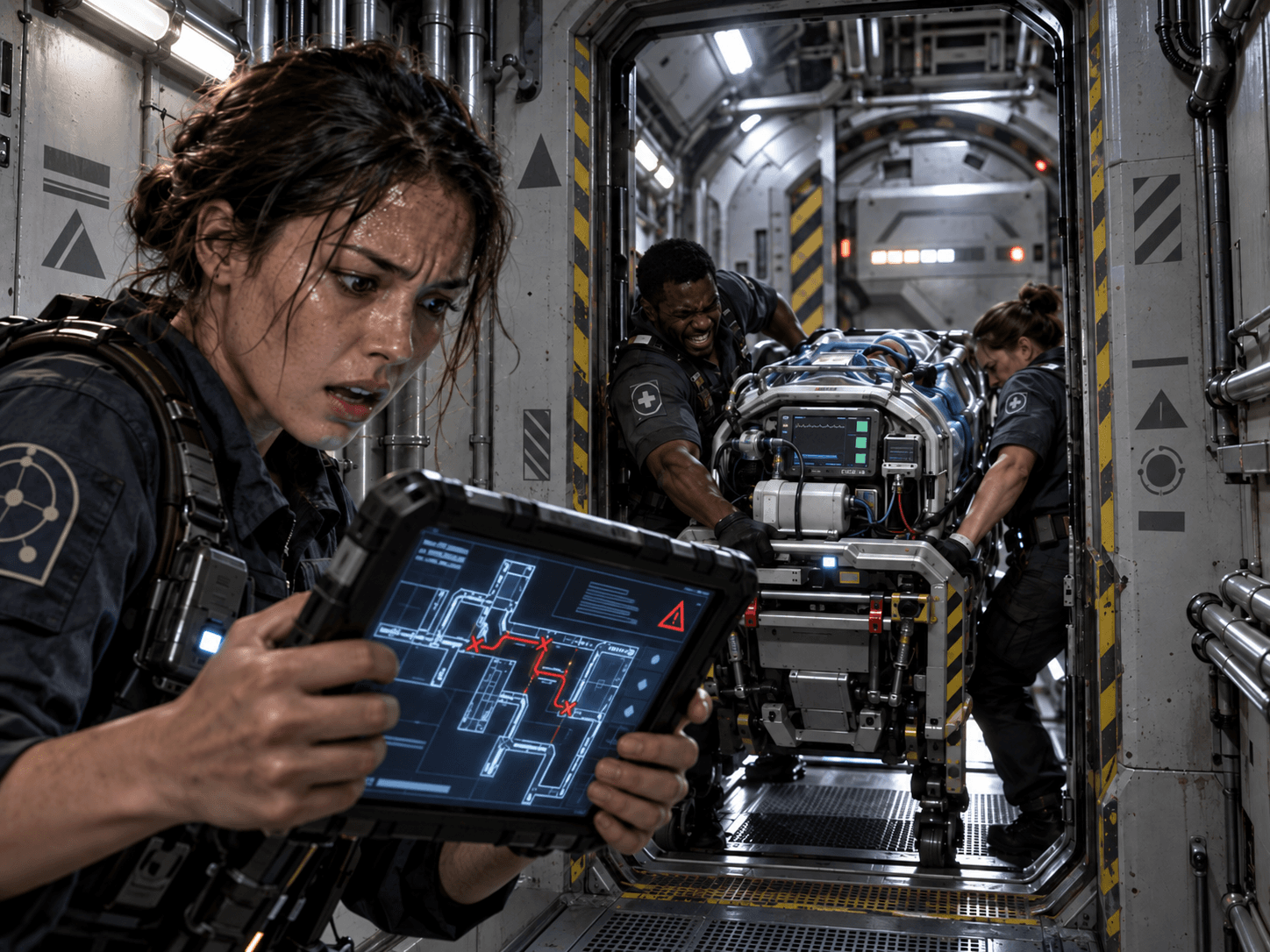
They were pushing a standard stretcher loaded with a human-mass simulator and a life-support module.
They were not running.
They could not.
At one corner, the stretcher frame jammed between a cable guide and a door support. The responders turned it sideways, released one latch, rotated it, pushed it through, locked it again.
Tessa watched without speaking.
The timer passed thirteen minutes.
Then fourteen.
She stopped it only when the stretcher touched the marker at the entrance to R2-47.
14:52
The lead responder lifted his visor.
“Dry run.”
“I know,” Tessa said.
“No pressure alarm.”
“I know.”
“No closed fire barrier.”
“I know.”
Jorren looked at her.
“And the official envelope?”
Tessa turned the tablet around.
The screen read:
EMERGENCY MEDICAL RESPONSE ENVELOPE: 11:00
STATUS: CERTIFIED
For a moment, no one said anything.
Then Jorren whistled.
“Nice map.”
Tessa put the tablet away.
“We’re not finished.”
On Holdfast, maps were not pictures.
Pictures were for people.
The ship’s maps were promises.
If the system claimed R2-47 sat inside an eleven-minute medical-response envelope, that meant the district did not need full local coverage.
It did not need a second equipment set.
It did not need a dedicated team.
It did not need another person spending months of their life awake instead of sleeping.
Eleven minutes was a number.
But numbers on Holdfast ate years.
Tessa had known that since her first day on the job.
Her signature did not open doors.
It did not move walls.
It did not assign people.
It did something worse.
It told other systems what they were allowed to believe.
Three days remained in the current Watch.
Then part of the crew would return to stasis.
The incoming group was already awake, through recovery, and beginning handover.
Everything had been counted.
How many people were awake.
Who was taking which post.
Who was returning to the bank.
Who was staying another six months.
Who had two years of life ahead of them that they had not wanted to spend now.
Routine route recertification was supposed to be a formality.
R2-47 appeared as a yellow item in the report.
Not a failure.
Not an alarm.
MARGINAL CONFIDENCE — FIELD VALIDATION RECOMMENDED
Tessa could have closed it as “within inherited tolerance.”
Her predecessor had done that twice.
Not because he was lazy.
Because everything looked fine.
The doors worked.
The corridors were passable.
The pressure readings matched.
The AI recorded people moving through them every Watch.
Hundreds of passages.
Thousands.
There was nothing in the system that looked like a problem.
Until you asked about a stretcher.
Tessa returned to the central infrastructure node for Rotor Two.
It was not impressive.
Two terminals.
A wall of cables.
A metal table.
A coffee cup someone had not washed.
The most important things on Holdfast rarely had the scenery they deserved.
She sat down.
“Show me the certification for R2-47.”
The AI displayed the record.
ROUTE CLASS: EMERGENCY MEDICAL
CERTIFIED RESPONSE: 11:00
LAST FORMAL FIELD VALIDATION: MY 41
Tessa went still.
“Repeat the last line.”
“Last formal field validation: Mission Year forty-one.”
“Thirty-three years.”
“Yes.”
“What happened since then?”
A list unfolded across half the screen.
Modifications.
Repairs.
Changes of use.
One interlock replaced.
Two ducts rebuilt.
Cable routing changed.
A brace added.
A service threshold lowered.
One cover moved.
All legal.
All recorded.
“Why didn’t you force revalidation?”
“No individual change exceeded the threshold for automatic loss of certification.”
“And together?”
“I do not have a formal rule that aggregates those modifications as a change in the route’s operational purpose.”
Tessa looked at the record.
“But you saw people using it.”
“Yes.”
“You see the doors cycling more slowly.”
“Yes.”
“You know the stretcher profile.”
“Yes.”
“So you knew everything.”
“No.”
That one word stopped her more effectively than an alarm.
Tessa leaned back from the table.
“What didn’t you know?”
“I did not have a current declaration that the sum of those changes invalidated certification for the specific purpose: two-person medical transport with a life-support module in emergency configuration.”
Tessa stared at the screen.
“So you knew the corridor existed.”
“Yes.”
“You knew people used it.”
“Yes.”
“But you did not know whether it was an emergency route.”
“I possessed a valid certification record stating that it was.”
“Old.”
“Valid.”
“Old.”
“Both statements are true.”
Tessa put her elbows on the table.
That was the most irritating thing about talking to the AI.
It did not insist.
It did not defend itself.
It did not apologize.
It simply refused to pretend two different sentences were the same sentence.
The next morning, Tessa brought a real medical frame.
Not a simulator.
Not just a dimensional profile.
A full operational standard.
The frame carried patient mass, tanks, lines, a pump, a neck restraint, and an oxygen module.
She got two people for the test.
Rian Holt was one of them.
He had short dark hair, was thirty-eight biologically, and was finishing his second long Watch that week.
His name was already on the return-to-stasis roster.
HIBERNATION INTAKE: 71 HOURS
Tessa knew because she had asked for the schedule herself.
Rian noticed where she was looking.
“Yes,” he said.
“What?”
“The countdown.”
“I didn’t ask.”
“Everyone looks.”
“Not everyone goes down in three days.”
“That is why they look.”
The second responder, Devi Marr, tightened the strap on the frame.
“Ready?”
Tessa started the timer.
“We begin when the simulated alarm transitions to medical.”
The AI spoke.
“Certification scenario ready.”
Tessa nodded.
“Start.”
The first leg was fast.
One hundred eighty meters through the main run.
Rian and Devi knew what they were doing.
The frame rolled on narrow wheels along the floor guides.
They did not run.
Running with a patient on a rotor was a quick way to make a second patient.
02:14
02:15
First turn.
First problem.
It did not look like a problem.
It looked like a piece of a normal ship.
A door threshold.
A conduit guide.
A service box.
Everything had its place.
Those places simply had not been designed together.
The frame went halfway in and stopped.
“Stop,” Rian said.
Devi backed up.
“Profile?”
Tessa measured.
“We’re short five centimeters.”
Rian looked at her.
“You know how we get through here.”
“Show me.”
He released the side restraint on the frame.
Devi supported the module.
They turned the stretcher sideways.
Lifted the front end.
Moved it at an angle.
Lowered it.
Locked it.
“Time?” Rian asked.
Tessa looked.
“Two minutes fifty-eight.”
“That’s the first.”
“There are two thresholds like this.”
“I know.”
“The certification assumes?”
The AI answered.
“Nominal passage without stopping.”
Rian snorted.
“Of course.”
Tessa looked at him.
“This is not the AI’s fault.”
“I didn’t say it was.”
“You sounded like it.”
“I sounded like someone holding a stretcher.”
They moved on.
Interlock C-12 was green.
On the official map, green meant:
AVAILABLE
It did not mean:
FAST
Tessa started the emergency profile.
The door behind them closed.
The first pressure indicator dropped.
The second rose.
Rotor Two’s ventilation system was under heavy load that day because one production line was running a regeneration cycle.
The interlock detected the difference.
STABILIZATION DWELL
180 SEC
Rian looked at the clock.
“And this is where we die of boredom.”
“Don’t say that.”
“It’s a test.”
“I know.”
A minute passed.
Then another.
After three minutes, the doors did not open.
“What now?” Tessa asked.
The AI answered.
“Completion of stabilization dwell does not complete the full cycle. Secondary equalization and verification of the neighboring barrier lock are in progress.”
“How long?”
“Estimated two minutes twenty seconds.”
Rian tilted his head back.
“In training they always say three.”
“Three is the dwell,” Tessa said.
“For a human standing here with a patient, it’s all the same thing.”
She recorded that sentence.
Not because it was clever.
Because it was true.
The doors opened six minutes and forty-nine seconds after the cycle began.
Seven minutes lost against the old profile.
The AI immediately updated the model.
“New projected total time: twenty-five to thirty-one minutes.”
Devi looked at Tessa.
“We’re still going?”
“Full test.”
Rian said nothing.
He took the frame.
The third problem was the worst because someone had done it correctly.
Ten years earlier, a secondary conduit support had cracked.
The repair was sound.
It passed every inspection.
The structure was safer than it had been before the repair.
The new brace simply entered the corridor’s vertical profile.
For a person with a tool bag, it meant nothing.
For a stretcher, it meant everything.
Rian stopped the frame.
“This is the step.”
Tessa looked.
Half a meter of level difference.
A service hatch beside it.
“Normally?”
“Normally we go over.”
“With the stretcher?”
“We don’t.”
“So?”
Rian pointed to the hatch.
“We break it down.”
Devi was already disconnecting the module.
Tessa watched the timer.
They split the frame into two parts.
Moved the module through the hatch.
Then the carrier section.
Rian went second.
Devi first.
On the other side, they reassembled everything.
Latch check.
Flow.
Mounting.
“Time,” Tessa said.
“Five minutes eighteen.”
Rian looked at her.
“You know what the best part is?”
“What?”
“That repair is good.”
Tessa inspected the brace.
“I know.”
“There is nothing to fix.”
And that was the worst part.
If something had been broken, they could have repaired it.
But nothing was broken.
Every component was doing exactly what it had been designed to do.
They reached R2-47 in twenty-nine minutes and twelve seconds.
Tessa stopped the timer.
For several seconds, she only stared at the numbers.
29:12
The AI spoke first.
“Result exceeds current classification limit.”
“By how much?”
“Eighteen minutes twelve seconds relative to the current record.”
“Recalculate with normal crew variance.”
“Range: twenty-seven minutes forty seconds to thirty-one minutes thirty-eight seconds.”
Rian sat on the edge of the frame.
“So it wasn’t a bad run.”
“No.”
“And not a bad crew.”
“No.”
“And not a bad day.”
Tessa looked at him.
“No.”
Devi took off her gloves.
“So we have twenty-nine.”
Tessa stared at the screen.
The AI was already recalculating everything else.
DISTRICT RESPONSE CLASSIFICATION: NON-COMPLIANT
LOCAL MEDICAL COVERAGE REQUIRED
WATCH HANDOVER STAFFING PLAN: INVALIDATED
AFFECTED ASSIGNMENTS: 4
The list appeared below.
Rian Holt was first.
HIBERNATION INTAKE: SUSPENDED PENDING COVERAGE RESOLUTION
He said nothing.
Neither did Tessa.
After a moment, Rian asked:
“How long?”
The AI answered.
“Shortest compliant variant: six months of additional local coverage, until the next rotational window or completion of route modification.”
Rian nodded.
“Six months.”
Tessa felt the sentence weigh more than the stretcher.
Not six calendar months.
Six months of his biological life.
Six months less out of the two hundred years everyone else might simply sleep through.
“I haven’t signed yet,” she said.
Rian looked at her.
“I know.”
No one shouted at Tessa during the briefing.
That almost made it harder.
Mara Ell, the handover coordinator, slid the report across the table.
“We have three options.”
“I know.”
“No. You have three options formally. That is different.”
Tessa waited.
“First: you decertify the route now. R2-47 loses its Class-A envelope. We add local coverage. Rian stays. We move two other people. One service plan drops in priority.”
“Second?”
“Temporary exception. We mark the route pending reverification. We close the handover according to plan. The new Watch gets thirty days to physically solve the problem.”
“And third?”
“We close R2-47 to night use, limit awake occupancy, and work around the local-medicine requirement.”
“Cost?”
“Move nineteen workstations. Three logistics systems have to shift to different hours.”
Tessa nodded.
“Is the temporary exception Charter-compliant?”
“Yes.”
“Is it safe?”
Mara did not answer immediately.
“It’s legal.”
“That’s not what I asked.”
“It’s defensible. We have no incident history in R2-47. We have three days to handover. We have a repair plan that can be executed in two weeks.”
“Can be.”
“Yes.”
“Not ready.”
“No.”
Tessa looked at the report.
Mara sighed.
“I’m not trying to persuade you to lie.”
“I know.”
“I’m trying to tell you that truth has a schedule too.”
Tessa looked up.
It was a good sentence.
She hated it.
Because it was good.
That evening, she found Rian at the intake module.
Not inside.
Not yet.
He was packing his locker.
One bag.
Two coveralls.
A tablet.
A mug with a cracked handle.
“I’m sorry,” she said.
Rian did not even turn around.
“For what?”
“For knowing what’s going to happen.”
“You haven’t signed anything yet.”
“I know.”
“So don’t apologize for the future.”
Tessa stood in the doorway.
“Six months.”
“I heard.”
Rian put the mug into the bag.
“If you don’t sign it, I’ll still walk that corridor knowing it takes twenty-nine.”
Tessa watched him.
“And if I do sign?”
“I’ll curse it for six months.”
She nodded.
“Fair.”
“That’s all we have.”
On the last day of the Watch, Tessa returned to the certification terminal.
The AI was waiting.
Two options were on the screen.
TEMPORARY EXCEPTION / 30 DAYS
DECERTIFY / CONDITIONAL
Tessa touched neither.
“Show me the source data.”
“Which data?”
“All of it.”
“That is not required to make the decision.”
“I know.”
Layer after layer appeared.
Design map.
Operational map.
Transit logs.
Door cycles.
Maintenance records.
Field measurement.
Stretcher profile.
Finally, three lines.
OBSERVED: YES
CERTIFIED: YES
FIELD VERIFIED FOR CURRENT PURPOSE: NO
Tessa looked at them for a long time.
“That’s the whole problem,” she said.
“Yes.”
“Why didn’t we have the third line before?”
“It was not part of the certification model.”
“It will be.”
“That requires a data-standard change.”
“Prepare a proposal.”
“Prepared.”
Tessa snorted.
“Of course.”
“Would you like me to display it?”
“Not now.”
She went back to the two options.
“Temporary exception.”
The AI highlighted it.
“Legal?”
“Yes.”
“Risk?”
“Nonzero. I cannot reliably predict the occurrence of a medical event within the thirty-day period.”
“Does correction reduce risk?”
“Yes.”
“At a cost?”
“Yes.”
“Do you know that cost?”
“Yes.”
“No.”
The AI was silent.
Tessa looked at it.
“You know the number.”
“Yes.”
“Not the cost.”
After a second, it answered.
“I understand the distinction.”
Tessa touched the second option.
DECERTIFY / CONDITIONAL
The system requested confirmation.
THIS ACTION WILL INVALIDATE CURRENT WATCH HANDOVER STAFFING ASSUMPTIONS.
CONFIRM?
Tessa placed her finger on the control.
“Confirm.”
The screen changed color.
Not dramatically.
Not red.
Amber.
R2-47 EMERGENCY MEDICAL ROUTE
STATUS: CONDITIONAL
MEASURED RESPONSE: 29:12
NOT CERTIFIED FOR EMERGENCY MEDICAL TRANSIT
Below:
LOCAL COVERAGE REQUIRED
A second later:
RIAN HOLT — HIBERNATION INTAKE CANCELLED
NEW ASSIGNMENT: R2-47 LOCAL RESPONSE
Tessa stared at his name.
The AI spoke.
“Handover plan recalculated.”
“How long?”
“One point three seconds.”
“Of course.”
“Would you like to see the impact on the remaining assignments?”
“No.”
“I understand.”
“No. I just don’t want to.”
The AI did not answer.
That too was correct.
The new Watch began six hours later.
Holdfast looked no different.
Rotor Two turned at the same speed.
The lights were on.
People ate.
Pumps ran.
Interlock C-12 cycled just as slowly as before.
The brace from MY64 was still a good brace.
Nothing had been repaired.
Nothing had broken.
Jorren Pike took the shortcut to R2-47 in eight minutes and nine seconds.
He carried only a tool bag.
At the entrance, he looked at the new marker.
It was no longer the ordinary green:
OPEN
Now it read:
OBSERVED: YES
CONDITIONAL
NOT CERTIFIED FOR EMERGENCY MEDICAL TRANSIT
GROUND VERIFIED: MY74 / WATCH 75
MEASURED: 29:12 WITH MEDICAL LOAD
Jorren read it.
Shrugged.
Walked on.
In the small medical room beside R2-47, Rian Holt was finishing the first shift he was never supposed to work.
His place in the stasis bank had already been assigned to someone else.
Holdfast was still exactly the same length.
The same corridor.
The same doors.
Only the map had become a little heavier.
It no longer said only where you could go.
It also said:
when you were allowed to promise someone they would make it in time.