
I
Bio Reserve C-17 sat at the edge of Rotor Three, two levels below the lowest inhabited deck and one above the thick technical layer where human flooring ended and pipes began.
The sector had been closed in Mission Year 61.
It had not disappeared.
It remained because it could.
For sixty-seven years, no one had needed the space beyond its airlock more than Holdfast needed it left alone. Across successive Watches, C-17 carried the same status in the maintenance records: STABLE. ISOLATED. RECOVERY UNJUSTIFIED.
Now there was a justification.
In the neighboring district, the main water-polishing return was going offline for thirty-six hours. Service wanted to use C-17’s old line as a bypass during the outage. On paper, it was dry, isolated, and still connected to the correct collector.
On paper.
Mara Voss stopped in front of the airlock and did not go in.
Behind her, Rotor Three operated normally. A cart carrying filter cassettes passed along the grated corridor. From the canteen two levels up came the smell of hot water, fried onions, and something sharp, maybe fermented sauce. Someone at a side panel was arguing with an automated system about a work-order number.
At C-17, ordinary white light was on.
Not an alarm.
An old label from Year 61 remained on the airlock frame, yellowed at the edges:
BIO RESERVE C-17
CLOSED
STABLE
NO ROUTINE ENTRY
Below it, someone much later had written in thin marker:
verify pressure differential before breaking seal
Jalen Orr knelt by a service cover and replaced the seal on the measurement port even though the old one was still holding.
“That one’s fine,” Mara said.
“I know.”
“Then why are you changing it?”
“Because this one is mine.”
Devi Sen stood nearby with a sampling case. She wore a light environmental suit with positive pressure under the hood. Mara and Jalen wore the same. Not vacuum suits. There was no need. But they were entering a former biological reserve no one had opened in more than half a century. Competence cost less than decontamination.
Mara connected the analyzer.
“Eight pascals in favor of the sector.”
Jalen looked at her.
“That’s nothing.”
“That’s a breath.”
“Composition?”
Devi read from her own display.
“Oxygen twenty point three. Carbon dioxide three times the corridor level, still safe. Humidity sixty-nine. Temperature fifteen point one.”
“Matches the card?”
“Almost.”
“The card is sixty-seven years old.”
“The sensors are nine. They were replaced from outside.”
That mattered.
C-17 had not slept unobserved. It had minimum monitoring: pressure, temperature, humidity, several atmospheric-chemistry points, and a leak alarm. Everything a closed sector needed when no one planned to use it.
Nothing that tried to understand what was happening on a wall.
Mara checked the list again.
Reason for entry: valve C-17-DR-4 on the dead return.
Objective: confirm flow, integrity, and whether the line could be used for thirty-six hours.
Exit condition: any biological nonconformity on the live-collector side.
“We open.”
Jalen removed the mechanical lock. The airlock equalized pressure with a small flow. Eight pascals disappeared so quickly the indicator barely had time to draw them.
A moment later, the bolt released.
The door slid open thirty centimeters and stopped.
Not because something blocked it.
After sixty-seven years, the seal simply did not want to leave its seat.
Jalen used the manual lever.
The rubber broke free with a dry crack.
Air from C-17 entered the lock.
It did not smell like decay.
It smelled of wet insulation, cold metal, and something earthy Mara could not name without thinking of a place she had never seen except in recordings.
Soil after rain.
Devi lifted her head.
“Organic.”
Mara switched on her headlamp.
“We don’t know that yet.”
She went in first.
After seven steps, she stopped.
Not because she saw something.
She heard it.
A soft movement across metal.
Once.
Low, behind the wall to her right.
Jalen froze in the doorway.
“Pipe?”
“Where?” Mara asked.
Not: what.
Where.
“Two meters ahead of you. Low.”
They waited.
Nothing.
Mara moved on.
II
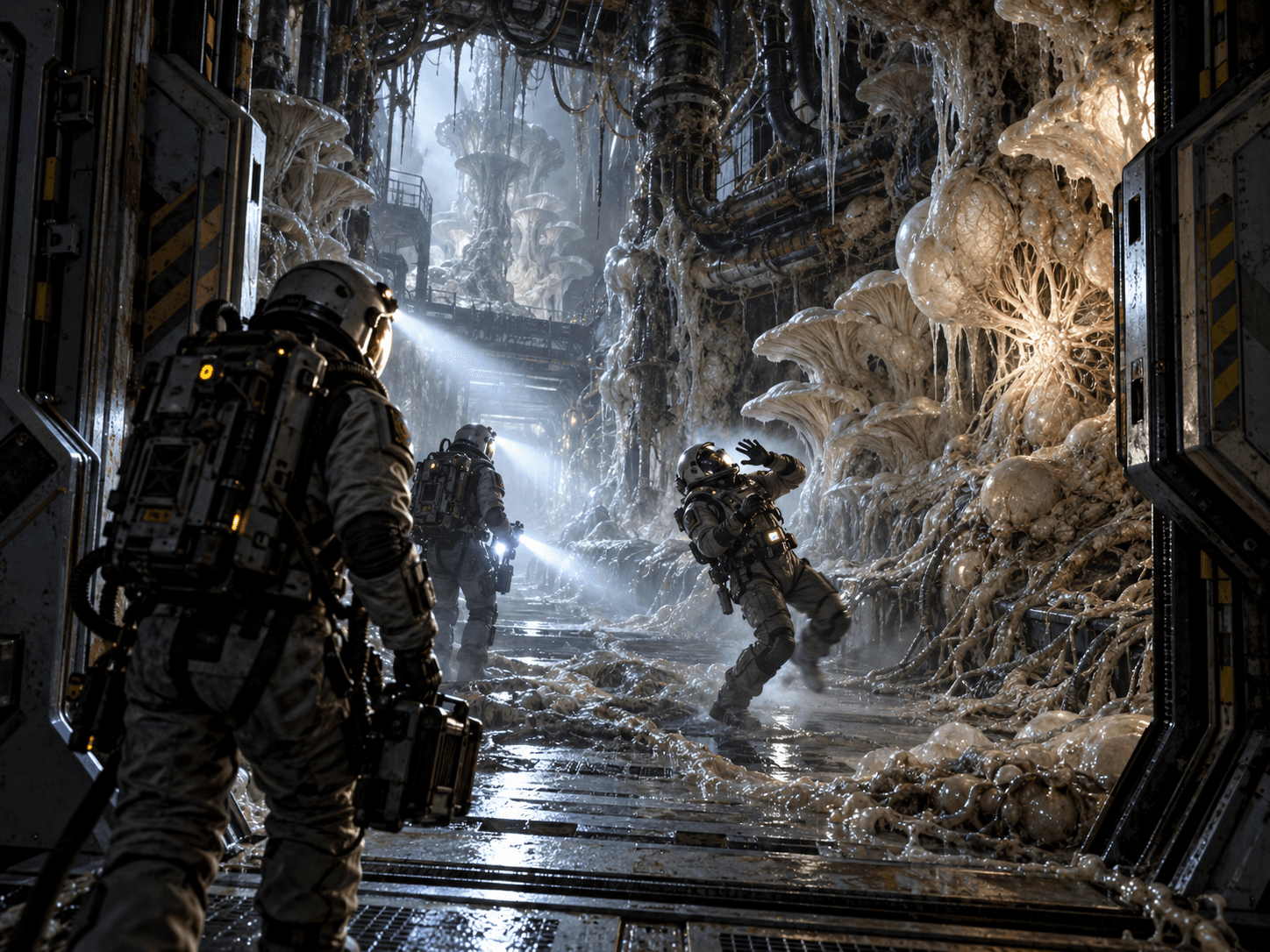
The darkness was not empty.
It was filled with things that had once had names.
Racks where cassettes had been. Drain channels in the floor. Old tool mounts. Pipes painted in colors no longer used in current marking standards. Polymer panels with a texture older than anyone currently working on that level.
Mara’s light moved across dust that did not hang in the air.
It lay still.
Across the middle of the hall, it was almost clean.
Near the walls, it looked different.
Darker streaks followed the gaps between panels and ran down into the channels. They did not form a thick layer. They were thin, like old mineral residue after water.
Jalen crouched beside one.
“Don’t touch it.”
“I’m not.”
Devi knelt next to him and extended a probe.
The layer gave under the tip.
“Biofilm.”
Mara looked farther in.
“How active?”
“We’ll see.”
They did not have far to go. The dead return was beyond the first hall, lower, under a service grate. But Devi asked for two minutes at the former biological-reserve storage area.
Two minutes became five.
Nine containers remained on the racks. Six had closed housings and green passive integrity markers. Three were damaged.
Not torn open.
Old.
One housing had a crack at the lower flange. On the second, the seal had slipped from its seat. The third stood open by two finger-widths, as if the frame material and the lid material had aged at different rates for decades.
The first was still readable:
SOIL FOUNDATION CONSORTIUM
Below it:
decomposer / fungal carrier / nitrogen cycle support / mineral weathering
Jalen read it under his breath.
“They were going to make soil with this.”
“They were going to make the beginning of soil,” Devi said.
Mara lit the floor.
The densest dark film was here, around the containers, the drain channel, and the housing of an old heat exchanger whose far side bordered an active technical riser outside C-17.
There was no jungle.
No trunks.
There were films, thin fibers, matte membranes where metal stayed damp, and white mineral crusts around bolts and welds.
Life clung to the edges of flow.
The center of the hall was dry.
Mara crouched beside the channel.
“Where’s the water coming from?”
Devi brought up the old schematic.
“Main C-17 buffer drained when the sector was closed.”
“And this?”
Devi enlarged the service layer.
“Purge line.”
“Live?”
“Not for C-17.”
“That’s not an answer.”
Devi switched to the current view.
One thin strand of infrastructure still crossed the sector boundary.
“Condensate-polishing reject. Forty to sixty liters every four days, depending on load. It should go to common technical waste.”
“Should?”
“According to the current model.”
Jalen found an old number on the pipe.
Mara compared it with the archive.
In Year 61, when C-17 was closed, the reject line fed a local service buffer. Later, when the main waste route was changed, someone had left that section as a passive segment. There had been no reason to remove it. The buffer was dead, the sector closed, the flow small.
Except the flow was not zero.
“Every four days,” Mara said.
“For sixty-seven years,” Devi replied.
Jalen calculated in his head.
“That’s a lot of water.”
“Not at once.”
Devi took a sample from the damp film.
“And some organic carbon in the reject. Not much. But if the system spends almost nothing on growth...”
Mara looked at the thin biofilm.
“...it doesn’t have to.”
That explained why C-17 had not overgrown.
It had nothing to grow on.
It had only as much life as a small repeating stream could sustain.
The second movement sounded before Devi sealed the vial.
This time higher.
Behind the wall to their left.
Jalen turned his head.
“Where?”
“Three meters farther. Almost waist height.”
Devi raised the thermal imager.
An elongated region appeared on the panel, six-tenths of a degree warmer than background. It did not stay still. The boundary moved slowly along the wall.
As if something large were walking behind it, parallel to them.
Jalen said nothing.
Neither did Mara.
Their headlamps suddenly seemed narrower.
III
They followed the trace.
They had no good reason to track it, except for the very good obligation to know whether they had just opened a sector containing something that was not in the documentation.
The warm boundary moved lower. Sometimes it vanished for a dozen seconds, then appeared farther on. A quiet sound followed it: not footsteps, not scraping, more like something wet shifting inside a pipe.
Jalen held his light steady.
“It has length.”
“What?”
“The trace. Not a point. Two meters. Maybe three.”
Mara could hear her own breathing inside the hood.
“One body would make one trace.”
“That isn’t one trace,” Devi said.
“You don’t know that yet.”
“Neither do you.”
That was enough to make them fall silent again.
At the next panel, the sound appeared directly behind Mara.
She turned so quickly her headlamp swept an arc across the wall.
Nothing.
Only the panel.
Then the panel flexed.
Not much. Maybe two millimeters.
Something pushed it from inside and released.
Jalen stepped back instinctively.
Mara felt a cold point beneath her sternum.
“We open it.”
“You sure?” Jalen asked.
“No.”
They removed four screws.
The panel came out of its seat more heavily than it should have. Something was holding it from behind.
Mara pulled it back a few centimeters.
In the light she saw fibers.
White, thin, stretched between the panel and the pipe.
For a fraction of a second they looked like tendons.
Jalen swore.
Mara let the panel fall back.
“Devi.”
“I see it.”
“What do you see?”
“Nothing yet that I don’t know.”
“Good words.”
They removed the panel completely.
Behind it ran an old condensate drain.
A thin brown mat clung to the underside of the pipe. Dry in places. Glossy in others. The fibers holding the panel were not tendons. Mycelium had spread from the insulation onto the back surface of the polymer.
Jalen put his hand against the metal frame, not the biology.
A vibration passed into the structure.
The mat changed shape.
It did not move.
In one place it swelled; half a meter away, a shallow pocket of water collapsed.
Devi moved the light.
“Again.”
Jalen pressed the frame.
This time they saw the whole mechanism.
The vibration pushed water through a thin layer beneath the biofilm. The wet section brightened in thermal view. Several dozen centimeters away, a second pocket received water and, after a moment, warmed.
Mara did not believe it at first.
“Again.”
Jalen repeated it.
The same.
To the ear, one movement.
To the thermal imager, one warm mass.
To the pipe, several very slow swallows.
“It isn’t walking,” Mara said.
“No,” Devi replied.
“It’s flowing.”
“And reacting where the water reaches.”
Devi pushed the probe deeper.
“We don’t have one organism here. Not even one colony. We have multiple niches connected by what the ship already had: drainage, insulation, heat, conduits.”
Jalen stared into the dark space behind the panel.
“So not a thing.”
“No.”
“The whole sector.”
Mara nodded.
She did not say organism.
That word would have been too easy.
This was an environment that had spent sixty-seven years learning to use geometry built for something entirely different.
Devi looked at the humidity reading.
“Seventy-five.”
Mara turned her head.
“It was sixty-nine at the entrance.”
“Our air is warmer. Circulation started. And we have fresh oxygen.”
Jalen looked at the wet mat.
“Did we wake it up?”
“Not all of it,” Devi said. “We’re changing where it stops sleeping.”
The fear did not disappear.
It changed shape.
Mara stood.
“The tee. Now.”
IV
C-17-DR-4 was beneath the floor of the first hall.
They removed the grate without difficulty.
The plate underneath resisted more.
When Jalen lifted it, warmer, heavier air hit them.
The service space was less than half a meter high.
Pipes ran parallel toward the boundary wall. One was the dead return they wanted to use. The second was the thin purge line. A third, older one had no label in the current view.
Mara checked the archive.
“Flush bypass.”
“Current?” Jalen asked.
“Shouldn’t be.”
“Physically, it is.”
That was enough.
Life on Holdfast did not need a map to use a pipe.
Mara went down first.
She did not crawl through biology. Most of the bottom was dry. The film clung to damp edges, joints, and insulation around the purge line.
They found the tee six meters in.
The handwheel was almost closed.
Almost was not a position.
Mara cleaned the marking.
“DR-4.”
Devi stayed by the hatch and connected a sampler to the underfloor space.
“Oxygen unchanged. CO2 rising locally. Humidity eighty-three.”
Mara touched the valve body through her glove.
Warm.
Not from the biology.
From the neighboring line.
“Does it close?”
Jalen tried.
The wheel moved a few degrees and stopped against soft resistance.
“Something’s sitting in the seat.”
Mara lit the base.
A thin fibrous layer emerged from the gap.
It did not live in the valve because it had chosen a valve.
There was water there.
“Don’t force it.”
Jalen let go.
Devi called down from above.
“I’ve got a change at the boundary.”
“What kind?”
“Moisture on the old bypass line.”
Mara turned her head.
Two meters away, the unmarked pipe crossed the wall toward the active district.
According to the archive, it ended at an old flush point.
According to the current plan, it did not exist.
Mara crawled closer.
At the wall penetration, the insulation had a sheen.
Not much.
Enough.
“What’s on the other side?” she asked.
Devi searched.
“Clean condensate return. Low bioload. Upstream of final polishing.”
That was worse than an ordinary drain.
Not because a few cells from C-17 would poison Holdfast.
They would not.
But if a resilient multispecies biofilm colonized a section upstream of final polishing, they would have to take the line out of service, chemically clean it, replace part of the media, and prove cleanliness before bringing it back.
And that very return was supposed to take load in a few hours during maintenance.
“Do you see material on the live side?” Mara asked.
“Not yet.”
“Yet.”
Opening the sector had not created a new path.
It had created better conditions on an old one.
Warmer air.
More oxygen.
More moving humidity.
A new gradient.
That was enough.
Mara looked at Jalen.
“We’re not using the dead return.”
“So the district maintenance doesn’t go down.”
“They’ll move it.”
“And the boundary?”
Mara pointed to the bypass.
“First we cut this off.”
V
They found a blind disk in the emergency box on the active side of the wall.
Standard size.
That was one of the things Holdfast did well: not every disaster needed a new invention. Sometimes it needed a piece of metal, six bolts, and a person who knew where to put it.
The problem was that the bypass flange sat on the C-17 side.
To open it, they first had to stop the moisture.
Devi lowered the purge-line temperature by four degrees and shut down local heating at the boundary wall. Mara closed the air supply to C-17. They left only the minimum flow the team needed.
They were not killing the sector.
They were taking back what they had just given it.
After seven minutes, the sheen on the insulation began to dull.
“It’s slowing,” Devi said.
Jalen lay on his side beside the flange.
“Bolts are intact. Surface corrosion.”
“Open it.”
The first came free.
The second too.
At the third, the same sound they had heard earlier came from behind them.
A soft movement along metal.
Jalen stopped turning.
Mara swung the thermal imager around.
The warm trace was back.
This time it was moving toward them.
Jalen stared at the display.
“We said it was hydraulics.”
“Because it is hydraulics,” Devi replied.
“Then why is it coming here?”
Devi checked the flows.
“Because the water is coming here.”
Something shifted moisture through the insulation above them, and a thin run appeared at the top edge of the pipe.
It did not rush.
It did not jump.
It grew as a droplet.
“Mara.”
“I see it.”
The droplet was cloudy.
Devi touched a rapid tester to the sample.
“Organic.”
“How much?”
“Enough that I don’t want it on the other side.”
Mara knew what the warm front was now. She knew what it was not.
Her body still wanted to pull back.
Earlier she could have imagined an animal you could see, contain, or kill. Now she was looking at a process that had no reason to know she existed.
Jalen loosened the fourth bolt.
Mara returned to DR-4.
The soft resistance was still in the seat.
She took out a narrow scraper.
“Don’t cut the mat open wide,” Devi said.
“I’m not going to.”
Mara cleaned only the stem entry.
The fibrous mass came away in thin wet strands.
Metal underneath.
She pushed the handwheel.
It moved.
A centimeter.
More.
This time the resistance was metallic.
Correct.
“DR-4 closed.”
Jalen:
“Flange open.”
Mara went back to the bypass.
There was film inside the pipe.
Thin.
Farther toward the live system, the surface was dry.
For now.
Jalen inserted the disk.
New gasket.
First bolt.
Opposite.
The rest in pairs.
He did not go faster than the torque wrench allowed.
That was the worst thing about real work under pressure: the correct pace often looked too slow.
A second droplet formed on the insulation above them.
Mara watched it grow.
“Fifth.”
Click.
“Sixth.”
Click.
Jalen checked the torque again.
“Hard isolation.”
Mara moved the probe to the live side.
Dry.
Devi read the sampler.
“No downstream bioload increase.”
Mara remained still for a moment.
Not because she was waiting for triumph.
She was waiting to see whether the number changed.
It did not.
“We’re leaving.”
As she backed out from beneath the floor, her sleeve caught a thin mat on the pipe.
The material slid off the metal and released a few milliliters of water.
Nothing grabbed her arm.
Nothing tried to stop her.
The water simply found a lower place.
VI
Sterilization appeared in the form automatically.
Not as an order.
As a standard option after biological colonization was detected outside its designed area.
Mara sat at the local environmental table with Jalen and Devi. C-17 was sealed again. The air inlet had returned to minimum safety mode. Temperature was slowly dropping.
Devi had the first results.
“Everything I’m seeing falls within the original reserve families.”
“No new species?” Jalen asked.
“It doesn’t work that fast or that simply.”
“I know.”
“No, you don’t, which is why you asked.”
Mara raised a hand.
“What do we know?”
Devi turned the screen.
“We have at least several cooperating consortia. Organic-matter breakdown. Nitrogen cycling. Mycelium as surface structure. Mineral weathering. All of it was part of the colonization package.”
“What’s new?”
“The arrangement.”
Mara waited.
“Not the ingredients,” Devi said. “How they distributed themselves through the infrastructure. Purge every four days provides water and some readily available carbon. The rest is very slow. During dry periods, most of it drops into low metabolism or dormancy. When water arrives, zones near the flow activate. Dead biomass returns to the cycle. That’s why there isn’t much mass here. Just very good retention.”
Jalen looked at the form.
“So we sterilize?”
Devi did not answer.
Neither did Mara immediately.
“Is it a threat outside C-17?”
“With the bypass hard-isolated and DR-4 closed? I don’t see a path.”
“Can we recreate it?”
“No.”
“Do we know whether it has value for the colony?”
“No.”
“Is sterilization reversible?”
Devi shook her head.
Mara selected:
RESEAL / REMOTE STUDY
Jalen leaned against the table.
“So we leave it.”
“We leave it sealed.”
“That isn’t the same thing.”
Mara looked at him.
“No.”
She added:
No connection to live condensate-polishing systems.
DR-4 mechanically closed.
Historical flush bypass hard-isolated.
Remote sampling only.
No sterilization pending biological review.
She did not write: garden.
She left that word to people.
VII
The new sign on C-17 was white.
BIOLOGICAL CONTAINMENT
NO ROUTINE ENTRY
Below it:
MY 128
Mara stood by the airlock when the lunch cart passed through the corridor for the second time that day.
The operator slowed because Jalen had left a parts box against the wall.
“You done?”
“Yes,” Mara said.
“You bringing the bypass online?”
“No.”
The man grimaced.
“So they’re shifting the water tomorrow?”
“They’re moving the maintenance.”
“Great. Someone’s going to tell me I get three-minute showers again.”
“You’ll survive.”
“That’s not a quality standard, Voss.”
He drove on.
The noise of the canteen drifted down from above. Someone laughed. Someone dragged a metal box across the grating. Ventilation held a steady tone.
Holdfast did not know something extraordinary had happened.
Because nothing had happened that required the whole ship to know.
Mara looked at the airlock.
Behind it, C-17 was becoming colder again.
Airflow was dropping.
Every four days, the old purge would still bring its small portion of water and traces of organics into a buffer that had not been empty for sixty-seven years.
Someone later would decide whether to leave it.
Someone later would decide whether to study it.
Someone later might decide it was worth destroying.
Not Mara.
Not this Watch.
She turned away from the door.
On the other side, in the dark channel beneath the floor, a droplet of service reject gathered on the lower edge of a pipe.
It grew slowly.
Detached.
Fell onto a thin mat.
For several minutes, nothing happened.
Then the surface temperature rose by one-tenth of a degree.
And stopped.