Node 19's calibrator worked in a silence Marek Solari knew by heart.
It was not the silence of vacuum. Vacuum had no voice of its own. This one belonged to Kestrel: to the fans filtering air, the coolant pumps, and the barely perceptible tremor of the hull as the ship's systems adjusted to transit conditions. In eleven years, Marek had learned to recognize a change in load by the sound of the wall behind his chair.
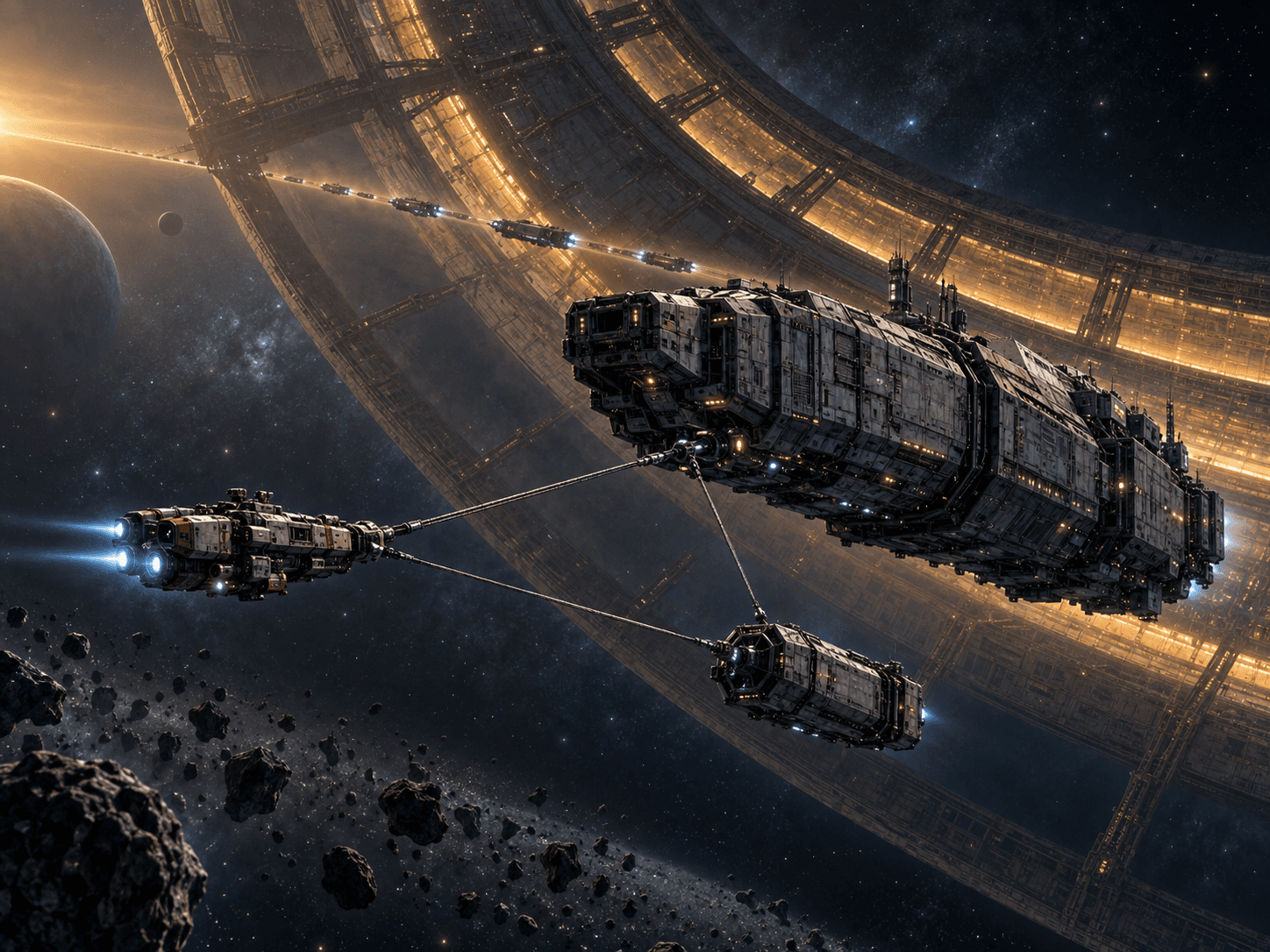
A holographic schematic of the node hung in front of him. The accelerator ring had a diameter larger than many inhabited moons. In reality it was larger still, but the human eye needed a point of reference. Kestrel, a small full-scale service vessel, was barely a point beside that structure. Amber bands of light ran along the arc, vanished beyond the edge of the projection, and returned somewhere else.
Marek enlarged one of the graphs.
"Thermal anomaly in the accelerator ring," he said.
Yuki Tanaka sat to his left, bent over the telemetry console. Her eyes followed rows of data.
"Sector seven-one. Still below alarm threshold."
"The alarm threshold lags."
"I know."
Marek dragged a finger across the plot. The line climbed gently, but its slope was changing in a way the old recordings did not show. It was not a spike. More like a slow, stubborn deviation that became impossible to ignore after a few minutes.
"Record the full run," he said. "Not just values above threshold."
"Procedure records only values above threshold."
"Procedure will not be sitting at this table today."
Yuki glanced at him.
"Is that a quote from your report three years ago?"
"I was right then too."
"The inspector decided that since the node did not fall apart, the readings were stable enough."
"That is a very low standard for transit infrastructure."
On the other side of the bridge, Miriam Chen gave a quiet snort without looking away from the power indicators.
"I'll put that in the report as an official safety-assessment method."
Marek smiled without looking at her. Miriam had worked on Kestrel for almost six years. She had not built the ship with him from the beginning, but she knew every conduit, every improvised repair, and every part they had not replaced only because the new one would cost more than the whole contract.
Kestrel was not beautiful. The hull carried marks from successive refits, paler rectangles remained on the plating where old panels had been, and the main service module had its own history of repairs. To a fleet owner it would have been a worn-out tool. To Marek it was a home, a workshop, and proof that for eleven years he had been able to keep himself outside Confederation structures.
"How long until the convoy enters?" he asked.
Miriam glanced at a side screen.
"About a quarter hour."
Ship markers appeared on the tactical display. Vanguard led. Behind it flew four freighters, a supply vessel, and Callisto, the heaviest of the civilian transports. Kestrel held a technical position, ready to calibrate human interfaces before transit.
Seven vessels. A routine Marek had performed dozens of times.
He switched to the convoy channel.
"Vanguard, this is Kestrel. Confirming increased thermal anomaly in sector seven-one. Still within working limits, but the rate of change is higher than in previous observations."
Dasha Reeves answered after a moment.
"Received. Are you recommending we hold entry?"
Marek looked at Yuki. She shook her head. Not in refusal. She simply did not yet have data that would justify such an order.
"Not recommending. Reporting the deviation and requesting readiness to interrupt synchronization."
"Received. Procedure unchanged until next update."
Reeves spoke calmly. Marek knew her from several earlier convoys. He knew that if she stopped a formation at every uncertainty, freighters lost days, sometimes weeks. If she ignored warnings, she risked everyone's lives. She was responsible for the majority, and the majority could not be led by one technician's instinct alone.
"And that is exactly why I dislike it when she says 'procedure unchanged,'" Miriam muttered.
"She dislikes it too," Marek replied.
Yuki moved a finger over her console.
"The curve changed."
Marek turned his head.
"Which way?"
"Rate of increase accelerating."
She placed the current run beside previous cycles. The lines did not match. The difference was small, but systematic.
"Send the update," Marek said.
Yuki was already doing it.
"Vanguard, this is Tanaka. Confirming acceleration in parameter shift in sector seven-one. Current admissible vectors are narrower than in the transit plan. Sending revised geometry."
Reeves answered at once.
"All vessels, read the correction. Extending preparation. No one enters without confirming their own generators."
The node did not change appearance. The ring still glowed with the same amber light. There was no signal or sound that could be called a beginning. Only the values on the screens slid outside the planned trajectory range.
The convoy entered the access zone.
Seven ships formed up. Vanguard led, the freighters kept spacing, and Kestrel shifted into position among them.
"All vessels confirm synchronization," Yuki reported. "Callisto reports lag in lateral compensation."
"How much?"
"Not critical yet."
Marek glanced at the freighter's schematic. Callisto was a heavy transport designed to carry large cargo, not to make quick maneuvers. Its generators had high output, but they responded more slowly than the systems on smaller ships.
"Slade, Solari here. Confirm generator status."
Captain Orin Slade's answer came with a slight delay.
"Compensation running below optimum. I have no structural alarm."
"Report every further deviation."
"Understood."
Reeves came onto the convoy channel.
"Preparatory procedure complete. All vessels, proceed on current vectors. Maintain formation. Report every deviation immediately."
Marek looked at the graph once more. He could object. He did not, however, have the data that would allow him to override the commander's decision. The parameters remained operational. Callisto was holding position. The procedure was based on what they all had in front of them.
"We go in," he said.
Seven ships moved.
The passage began smoothly. On Marek's display the formation moved along the assigned vectors. Vanguard led, its marker stable. The freighters followed. Kestrel maintained position and readiness for corrections.
Marek allowed himself a breath.
Then every reading changed at once.
The parameters shifted to a new level faster than the compensation systems could complete their previous correction. Alarms burst across the bridge.
"Shift," Yuki said. "Parameters outside forecast."
Marek looked at the tactical screen.
Callisto did not spin. It made no violent motion. Its position began to drift away from the assigned vector, at first so slowly that it could be mistaken for visualization lag. Then the deviation grew.
"Callisto, confirm vector loss."
"Confirmed," Slade answered. "Generators can't keep up. Correction is not holding position."
"Switch to manual assist."
"Already did. No effect."
Reeves reacted immediately.
"All vessels, emergency procedure. Abort transit and withdraw to the access zone. Callisto, maintain current position. Assistance will be assigned if possible without endangering the others."
Marek knew what the last part meant.
It did not mean Reeves did not want to save the freighter. An approach attempt could destroy Kestrel as well, then force the rest of the convoy to remain in the shifting field.
On the screen, the lights of Vanguard and the other vessels began changing position. The convoy was making an emergency withdrawal. The large ships turned slowly, every movement requiring correction. Against the gigantic ring they looked like small moving points.
Callisto was sliding toward a region where its hull could not tolerate the stresses for long.
"Marek," Miriam said, "if we go in, we are outside orders."
"I know."
"If we go in too late, there will be nothing left to reach."
Marek moved the data to the main display.
"Yuki, give me the shortest executable path to Callisto."
"The shortest will not be the safest."
"Give me the one that has a chance to work."
Several variants appeared on her screen. One ran too close to the ring. Another required a sharp turn Kestrel might not survive.
"I have a path," she said. "We will have to enter between Callisto and the outer edge of admissible geometry."
"How long can we hold there?"
"Less than we need."
Marek opened a channel to Vanguard.
"Reeves, Solari here. I'm going in to Callisto."
"Negative. Withdraw from emergency formation."
"Callisto is losing position."
"I know. We are isolating the damaged vessel."
"Isolation will not hold its hull."
"Solari, that is an order."
Marek looked at Miriam. Her face was tense, but calm.
"Prepare towing cables."
Miriam placed her hand on the panel.
"Ready."
"Yuki, guide me."
Kestrel changed course.
There was no heroism in it. There was geometry, inertia, and the working range of engines. The small tug entered a path procedure did not permit, because the slightest delay could send it toward the ring.
"Lateral deviation," Yuki said. "Too fast."
Marek reduced thrust. Kestrel did not answer immediately. Its mass kept sliding through the field, and the compensation systems needed time.
Reeves returned on the channel.
"Kestrel, withdraw. I will not repeat."
"Log the violation," Marek said. "I do not have time for permission."
"You also do not have the right to endanger the whole vessel."
"Agreed."
He cut the channel.
Callisto was nearing the high-stress region. More warnings appeared on diagnostic screens.
Marek moved Kestrel across the drifting ship's path. The ancient ring filled most of the forward view. Its scale made it impossible for the eye to take in the entire structure.
"Miriam?"
"Cables ready. I am not certain they will catch at this parameter differential."
"They have to."
"That is not a technical argument."
"It is the only one we have."
Slade came on the channel.
"Solari, my crew is strapped in. What exactly are you doing?"
"Catching you."
"And then?"
"First I catch you."
"Understood."
Marek reduced thrust nearly to zero. Kestrel slipped into lateral flight. For several seconds the two ships moved relative to each other as if suspended in one enormous mechanism.
"Now."
Miriam fired the cables.
The grapples extended from Kestrel's forward section. They were a human towing system: electromagnetic clamps, power leads, and mechanical locks, designed to work on ship hulls.
The first grapple hit.
The second skidded along Callisto's plating, then caught on the next roll.
Load transferred through the lines.
Kestrel lurched.
Marek slammed a shoulder into the seatback. The harness kept him from the panel. Structural alarms sounded on the bridge.
"Holding?" he asked.
"One grapple full, second partial," Miriam answered. "I need to correct tension."
"Do it."
"If I increase tension, it will tear out our forward mount."
"If you do not, Callisto gets away."
Miriam did it.
Kestrel's hull groaned. Marek held course while the freighter's engines tried to compensate for the drift. The load did not stop Callisto at once. First it reduced the ship's speed relative to its assigned vector; then it changed the direction of displacement.
"Slowing," Yuki said. "A little more."
Marek increased reverse thrust.
The two ships shifted together.
"Holding," Miriam said. "Marek, it's really holding."
Callisto stopped drifting toward the boundary. It had not regained freedom. It was not safe. But its position had stopped deteriorating.
Marek let out a breath.
Reeves came onto the channel.
"Kestrel, confirm Callisto status."
"Drift stopped. Vessels connected."
"Your vessel is in a prohibited region."
"I know."
"The convoy is withdrawing to the access zone. You will remain in position until further procedure is determined."
Marek looked at the receding lights of Vanguard. The escort was leading the remaining ships through the return corridor. It could not turn back for them without endangering the formation again.
"Understood."
Reeves was silent for a moment.
"Solari, if the parameters shift again, detach Callisto and withdraw."
Marek looked at the cable readouts.
"If I detach him, you lose the ship."
"If you do not, we may lose two."
"Understood."
The channel went silent.
Marek kept looking at the screen where the convoy lights were shrinking to sparks. Vanguard led the withdrawal with a precision no one could deny. Dasha Reeves had done exactly what a commander responsible for the majority should do. She had left them here because she could not risk the rest. Marek felt no anger toward her. He felt only the weight of that decision.
For a moment he allowed himself to see the entire situation without the shorthand of icons on a screen. The convoy was not a line of markers, but a row of heavy hulls full of people, cargo, and obligations. Callisto was not a problem on a map, but a freighter with its crew strapped into seats, waiting for another vessel to move. Kestrel was not an intermediate point between them. It was a small ship Marek knew too well to pretend it could survive anything.
Miriam said nothing. She was checking cable temperatures, but Marek saw that every few seconds she glanced at his hands. Yuki did the same with the data: pushing away every interpretation, leaving only measurement, only trend, only the difference between what could still be done and what had already fallen away. That silence was more honest than comfort.
"Kestrel, Reeves here," her voice returned, this time on a private channel. "I am logging a violation of emergency procedure. You will have to file a full report. I understand why you did it. I cannot accept it as standard."
Marek nodded, though she could not see him.
"Understood, Captain. I will file the report."
"Hold on. We are observing from distance. If the situation worsens, I will not be able to send anyone back."
"I know."
The channel went silent. Marek felt the quiet thicken on the bridge. Yuki still sat at telemetry, fingers motionless above the display. Miriam stood at the technical panel, shoulders tight.
"New data," Yuki said after a while. Her voice was calm, but Marek knew her well enough to hear the change in it. "Parameters are still shifting. The admissible vectors around our current position are losing width faster than forecast."
Marek stepped closer. The holographic map showed it clearly: the band in which they could still maneuver safely was shrinking. There was no intention in it. Only a change of state, preceded by a precursor and now developing further.
"How much time do we have in the current configuration?" he asked.
"Less than we need to exit by any of the existing routes."
Miriam leaned over the towing schematic.
"We are tied by the cables. Callisto has not regained full vector control. If we try to move in this geometry, cable stresses will exceed the system's limits. We either break the connection or damage the hulls."
Marek felt something settle inside him. The solution that had seemed briefly effective had just become nonviable. They could not stay. They could not move. They could not separate without risking Callisto drifting again.
"Slade," Marek said on the channel. "How are you?"
Callisto's captain sounded tired but clear.
"Generators are running, but compensation is unstable. We are fully dependent on your tow. If we detach now, we will not hold position."
"Understood."
Marek looked at Miriam. There was no surprise in her eyes. Only acceptance of a technical fact.
"We have to change towing geometry," she said. "That means exterior work. Manual reconfiguration of the power system and cables."
Yuki lifted her eyes.
"The convoy is almost out of visual range behind us. We are alone here with the node."
Marek nodded. He knew what that meant. The scale was crushing. The huge amber structure of the ring dominated everything, and the two of them in suits would have to work on the hull of a small tug while hundreds of kilometers away the convoy withdrew and Callisto hung beside them like a mountain of metal.
"Suit up," he said. "Miriam, you come with me."
She did not object. Both of them knew automation would not be enough under this parameter shift. They had to do it by hand.
Preparation took several minutes. As they went through the airlock, Marek felt the familiar pressure in his chest. Vacuum always reminded him how small a human being was. The moment his boots touched Kestrel's plating, the scale struck him again. The node ring filled half the sky, motionless, indifferent, older than anything humanity had ever built. Far away, at the edge of visibility, the faint engine points of the convoy could still be seen. They were getting smaller, underlining how alone Marek and Miriam now were.
"Panel three," Miriam said over comms. Her voice was muffled by the helmet. "There we switch the main power lines to the alternate path. Then change the cable angle."
Marek clipped onto the safety rail. Movements in the suit were slow; every gesture required focus. The panel sat close to the hull edge where the towing cables emerged. Miriam reached it first. She opened the cover by hand. In vacuum there was no sound, but Marek felt the vibration through his boots.
"The lines are overloaded," she reported. "If we leave them in this configuration, they will not survive more than a few minutes during a vector change."
Marek attached diagnostics. In the background Callisto hung dozens of meters away, its hull lit by the node's amber glow. Slade reported crew status now and then: calm, no panic, but Marek heard the tension of a man who knew his people's lives depended on decisions made by two technicians outside a small tug.
The work was hard. They had to disconnect old couplings, reroute power lines directly from Kestrel's reactors, and manually adjust cable locks. Every tool had to be secured, every line tethered so it would not drift away. Marek felt sweat run down his temples despite the suit cooling system. His arms trembled with effort. Miriam worked beside him in silence, her movements precise but slowing.
The first coupling gave only on the third attempt. Not because it was damaged. Because it had been built not to give when the ship was under load. Marek had to relieve the mount with a short engine correction, and Miriam turned the lock in the same instant. The motion was so small it would have looked like a correction in a table from the bridge. On the hull it meant a second in which both of them held the line in their hands and waited to see whether tension would rip it from the guide.
"Got it," Miriam said.
Her voice was calm, but Marek could hear how hard she was breathing.
"Hold it on axis."
"Holding."
In the background, Callisto shifted almost imperceptibly. A jerk traveled through the lines. Marek felt it in the harness, in his shoulder, in his teeth, though he knew it was not sound, only vibration carried by the structure. He stopped the reflex to look back. If he let go of the panel even for a moment, Miriam would be left with the full load.
"Yuki, what do the readings show?" he asked.
"Geometry continues to narrow," she answered from the bridge. "You are running out of time. The convoy is almost beyond close-scan range."
Marek looked that way. The convoy lights were now barely visible. The monumental node structure dominated everything, and the two of them, two small figures on a hull, worked on human equipment without touching the ancient infrastructure. This was not a fight with the node. It was a fight with physics and time.
For a moment they lost voice contact with the bridge. Not because of any mystery or unusual effect; an ordinary band disturbance as Kestrel corrected position and its own transmitters shifted power. Only static remained in the headset. Marek lifted a hand, and Miriam answered with the same gesture. It was enough. For several seconds they worked without words, the way one works around equipment that must not be dropped or misunderstood.
The next panel was closer to the section where the hull became the service module mount. Marek knew that part of the ship more by touch than by documentation. He remembered replacing the cover plate there after a microimpact. He remembered the invoice for the part, which he had paid off with two dull contracts at orbital warehouses. Now his glove moved across the same notches, and each one reminded him that Kestrel was not a catalog tool. It was a collection of decisions he had made over years.
Miriam began fastening the new cable lock. Her suit hid most of the motion, but Marek saw the work of her wrists: small, stubborn, professional. There was nothing spectacular in it. There were screws, clamps, a line too stiff at the current temperature, and a metal ring that would not seat.
"If we force it, it will crack on the first correction," she said.
"Do you have a better angle?"
"I have a worse one that may survive."
"I'll take worse."
They moved the mount by a fraction of its available range. Not much. As much as could be done without cutting the cover and without detaching the lines that still held Callisto. Under normal conditions Marek would have rejected such a configuration at first inspection. Now he watched diagnostics mark it yellow instead of red and felt almost grateful.
"Main line switched," Miriam said. Fatigue made her voice tremble slightly. "Now the cables. We have to change the angle by a few degrees, or Callisto will not regain even minimal control."
Work on the cables was the hardest. They had to physically shift the mounts, lock them in the new position, and recalibrate tension. Marek felt his muscles burn with the effort. Once he nearly lost balance when Callisto twitched under the changing parameters. Miriam caught his arm and held him.
"Careful," she said, nothing more.
At last they finished. Marek felt the tension in the system change. Callisto stopped pulling in one direction. Its generators began taking some of the load.
"Slade, check now," Marek said.
"Confirmed," the captain answered. "I have minimal vector control. Not perfect, but I can maneuver."
Marek and Miriam returned to the airlock. When they took off their helmets aboard the ship, Marek saw Miriam's face. She was pale, her eyes shadowed. The exterior work alone had cost them a large share of Kestrel's energy reserve.
For several breaths no one moved farther than the nearest handhold. The airlock smelled of hot plastic, filter resin, and sweat trapped under the suits. Marek felt his pulse in his fingers as if he were still clamping them around the exterior panel. When he unclipped his gloves, he saw his hands shake.
Miriam noticed and said nothing. She leaned her forehead against the suit locker and closed her eyes only long enough for her body to believe it had been given rest.
"Bridge," Yuki reminded them over the intercom. "I need you at the main screen."
"We're coming," Marek answered.
It did not sound like a promise. More like another step in a procedure that had to be performed before procedure stopped meaning anything.
"We lost most of our maneuvering power reserve," Miriam said, sitting heavily. "The towing system is in the new configuration, but the reactors are on the edge. We cannot hold this long."
Yuki turned from the console.
"New telemetry. Safe vectors around us are still narrowing. Current towing geometry will not be enough to get out. There is only one configuration left that may work."
Marek already knew what she would say.
"The one that requires detaching the main service module."
Yuki nodded.
Marek sat in the chair. For a moment he looked at Kestrel's schematic. The main service module was the heart of what he had built for eleven years. Without it, Kestrel would cease to be an independent transit vessel. It would lose certification for work around nodes. No more contracts on his terms. No more freedom he had built for so long.
It hurt. Not dramatically. It hurt like something very adult, like losing the workshop that was your whole life. Marek knew exactly what he was sacrificing. He also knew that if he did not do it, Callisto and her crew might not get out.
He looked at Miriam and Yuki. Both were silent. Waiting for his decision.
Marek took a deep breath.
"Prepare the module for detachment."
Miriam did not answer at once. She looked at Marek as if trying to decide whether she had heard a decision or only its beginning.
"For detachment and loss?" she asked.
"Yes."
"No chance of reattaching it?"
"Not in this configuration," Yuki answered. "If we use the module as part of the system, it will not return to its place."
Marek shifted his gaze to the Kestrel schematic. The main service module occupied much of the vessel's aft section. On the map it was only a rectangle surrounded by lines and mount points. In reality it consisted of tools, work cells, certified interfaces, diagnostic arms, and systems he had adapted for years to his own way of working.
It was not simply an expensive device.
It was the reason clients called him directly instead of calling a fleet intermediary. It was the reason he could choose contracts, refuse work on other people's terms, and return to his own ship after every job. Without the module, Kestrel remained a hull with engines, a towing system, and a name painted on the side.
"How do we use it in the system?" Marek asked.
Yuki enlarged the schematic.
"We detach the module from the aft section, but do not release it freely. It stays connected to Kestrel by main power cables and two towing lines. We move the grapples so the module sits between us and Callisto. It becomes the second anchor point."
"A counterweight."
"And a geometry stabilizer," Miriam added. "If we set it at the right angle, we can distribute force through three points instead of two. Kestrel pulls from a different axis. Callisto does not have to rotate only on the forward cables."
Marek already saw it on the schematic. This was not about additional energy. The module would not push anything away or change node parameters. Its mass and position would change the physical towing arrangement. Human engines and human cables would get a way to perform a maneuver that was impossible in the current configuration.
"How long can we use it that way?" he asked.
"Until it leaves our safe corridor or its structure begins to come apart," Miriam said.
"So we do not recover it."
"No."
Marek looked at Yuki.
"What vector do we have?"
"I do not have a full solution yet."
"How long do you need?"
"Do not ask me for time if you want exact data."
"I need both."
Yuki pressed her lips together.
"I need a moment."
Marek nodded. Then he opened a channel to Vanguard.
"Reeves, this is Kestrel. We are preparing to change towing configuration. We will detach the main service module."
Silence on the other side.
"Confirm," Dasha said at last.
"We detach the module and use it as a third point in the stabilization system for Callisto."
"Has this solution been verified?"
"Not by your command center."
"So no."
"It has been verified by the data we have."
Reeves did not raise her voice.
"Solari, if you perform this maneuver, Kestrel will lose certified service capability. You will have to report loss of the module and unauthorized configuration change in an emergency."
"I know."
"I am not trying to stop you for the sake of stopping you. If you send the module at the wrong angle, you can overload both hulls. I will not be able to send a rescue vessel until parameters stabilize."
"I know."
"I have to hold the remaining convoy in the access zone. If your maneuver fails, we will not come back blind."
Marek looked at the distant escort lights.
"That is the right decision."
"You do not have to tell me that."
"I know."
Reeves's voice softened only slightly.
"Send me your geometry when you have it. If I see an executable path, I will pass it to the rest of the convoy and guide you to the exit."
"Understood."
The channel disconnected.
Miriam opened the module detachment panel. Confirmations appeared under her fingers. Systems checked which functions could be separated without cutting life support and Kestrel's basic control.
"The module wants to know whether this is a planned emergency jettison," she said.
"Tell it it is an emergency."
"That is not a technical question."
"Today they all are technical."
Miriam looked at him, but did not smile.
A list of connections appeared on the screen. Diagnostics. Calibration interfaces. External arms. Auxiliary power. Certified transit tools. Each item marked a piece of his professional life, written in the system's language as a function that could be turned off.
"We also have to disconnect the cooling line," Miriam said. "If we leave it with the module, it will not have enough flow after the position change."
"How long can it survive without it?"
"Long enough to execute the maneuver. Not long enough to preserve it."
Marek nodded.
"Disconnect it."
Yuki sent a new image to the main screen. The admissible bands continued to narrow. Their current position lay near an edge, in a place where a small change could force Callisto back onto its earlier drift path.
"I have a solution," she said. "Not a full one."
"What does 'not full' mean?"
"I can define the beginning and the end. The middle depends on how fast we change towing angle."
"So the middle is ours."
"The middle is physics," Yuki said. "You will be at the cables."
Marek opened a channel to Callisto.
"Slade, prepare your engines for maneuvering work. Do not try to lead. You will hold orientation according to Yuki's data."
"Understood."
"When I give you a correction, execute without delay."
"And if the correction conflicts with what I see on my own displays?"
"Report it, but do not wait for permission."
Slade was silent for a moment.
"My crew is ready."
"Good."
Marek looked at Miriam.
"Detach."
There was no single spectacular moment in the preparation. The module did not tear away from the hull. Locks released one after another, and every sound meant the loss of another connection. Kestrel changed in real time. From a service system, it became a simpler tug.
Marek watched the main module indicator.
First the diagnostic tools went dark. Then the interfaces disconnected. Then the system confirmed that the module would no longer accept assignments or perform calibrations. The messages were unnecessary, but no one had removed them from the procedure.
Marek thought of every bill he had paid over the years. Of parts bought one contract at a time. Of nights spent in port with a casing open. Of how long he had built a life in which the ship was not company property or an appendage to a job.
He did not think about future punishment. That was undefined.
He thought about the next job, if he received a license at all. It would look different. He would have to rent equipment. Work under someone else's certificate. Accept terms he had not had to accept in eleven years.
Miriam touched his shoulder.
"Marek."
He tore his eyes from the indicator.
"I know."
"I wasn't asking."
"I know."
The last lock released.
The module moved away from the hull on rails. For a moment it was still part of Kestrel: connected by power cables, controlled from the bridge, and held by two main grapples. Then Miriam disconnected cooling.
A message appeared announcing irreversible separation of functions.
Marek confirmed.
Miriam took over the towing lines. Yuki fed her angles and load sequence. Marek flew Kestrel on its own engines, holding the hull on axis while the module shifted beneath the ship.
For a while the whole configuration was unstable.
Callisto pulled sideways. One forward grapple tightened violently. Kestrel rotated several degrees.
"Too fast," Yuki said.
Marek reduced thrust.
"I can't reduce more."
"You can. Only then we lose position."
"How much?"
"Enough."
Marek switched maneuvering thrusters to a lower range. Kestrel responded with delay, but it responded. The module shifted farther sideways, and its cables drew taut at a different angle.
"Slade, slight correction left," Yuki said over the channel.
"Executing."
Callisto fired its own engines. It did not try to accelerate; it only limited rotation. The change was small, but it transferred part of the load from the forward cables to the system that included the module.
Marek felt it through Kestrel's structure. The vibration changed rhythm. The forward mount stopped groaning with every movement.
"Now the main line," Miriam said.
"Hold it."
"Holding."
"Release auxiliary."
Miriam freed the lock. The module moved several meters relative to Kestrel, held now only by main cables and grapples. Its mass acted as the third point of the system, shifting the towing line away from the axis they had been unable to change.
Nothing happened that looked like a miraculous shove.
There was no sudden push.
Kestrel's human engines changed thrust direction, human cables carried the load, and the weight of the detached module allowed Callisto to be set at a different angle. The maneuver took time and did not look impressive. Every correction was small. Every correction required another.
"We have a new axis," Yuki said.
Marek entered the data.
Kestrel increased thrust. The module shifted farther aside, and Callisto began rotating around the new towing point. The freighter did not accelerate violently. Its movement was heavy, delayed, but aligned with the assigned direction.
"Slade, hold your own orientation."
"I have it. Generator responding."
"Miriam, lines?"
"At the limit. Mains hold. One auxiliary is deforming."
"We do not need it after exit."
"We need it now."
Marek looked at the exit band.
"Yuki?"
"Path executable. Narrow."
"How long?"
"As long as we change nothing."
"Everything is changing."
"Then as long as the changes remain inside this range."
Behind them the node filled the view. Ahead, the withdrawing convoy waited near the access zone. Vanguard's lights led the remaining ships in orderly formation. Even at that distance Marek could see the difference between their calm movement and Callisto's heavy, forced rotation.
"Reeves sent a corridor," Yuki said. "It leads us to exit. Her data matches ours."
Marek opened the channel.
"Reeves, receiving."
"We see you. Do not increase speed until you pass the narrowing."
"Understood."
"Callisto, confirm your own readings."
Slade answered:
"Confirmed. We have enough control to hold orientation."
"That will be enough," Reeves said. "The remaining convoy will stay outside the zone until your passage."
She did not offer a rescue she could not deliver. She also did not press them to detach Callisto, although procedurally it would have been simpler. She guided them with what she had: data, observation, and the decision not to endanger more ships.
Marek increased thrust by a small amount.
Kestrel moved.
The module followed on its cables, swinging with every correction. Callisto remained between them and the node, heavy and slow, but no longer drifting uncontrolled. The freighter's own engines worked together with the towing system.
"Left correction," Yuki said.
Marek made it.
"Too much," Slade said.
"Reduce your own thrust," Marek answered.
"Already."
The module jerked on the cables. One of them gave a short, dull sound carried through Kestrel's hull. Miriam looked at diagnostics.
"Auxiliary line lost its sheath. Still conducting."
"A little longer," Marek said.
He did not know whether he was speaking to Miriam, to the ship, or to himself.
The exit was nearer. There was no boundary visible to the eye. There was a line on the screen, a region where conditions would return to a range human systems could handle. With every movement Kestrel and Callisto came closer to it, dragging the already-lost module behind them.
"Main cables exceeding allowed load," Miriam said.
"How much longer?"
"I don't know."
Yuki answered instead:
"Do not change course. Passage is ahead."
Marek held thrust.
Kestrel shuddered, but did not lose axis. Callisto rotated in accordance with the system. The module, stripped of cooling and most functions, shifted to the outer side of the configuration.
The first cable gave.
It did not explode. Tension simply vanished, and the free end moved away into space. Load transferred to the remaining connections.
"One less," Miriam said.
"Hold."
"Holding."
The second cable gave a moment later.
The module began to drift from the path. Marek watched its marker slide outside the assigned geometry. He did not try to recover it. If he changed course, he would endanger Callisto and Kestrel.
"Release the rest," he said.
Miriam looked at him.
"Now?"
"Now."
The release was her task. She performed it without comment.
The module fell behind. For a moment it kept a similar direction, then began to move away from Kestrel. It did not disintegrate at once. It did not vanish in a flash. In the amber light of the node, it looked like a detached piece of a human ship losing meaning with every meter.
Marek did not look away until Yuki said:
"Continue."
They crossed the exit line.
The change was not violent. First the alarms stopped intensifying. Then stress readings began returning to ranges human systems could handle. Callisto's engines stopped fighting every correction. Kestrel was still damaged, but responded to control.
"We are outside the local hazard," Yuki said.
Marek reduced thrust.
A long mechanical breath moved through the bridge. The fans ran unevenly. One panel shut down for a moment, then returned in emergency mode.
"Callisto?" he asked.
"Safe," Slade answered. "Still connected. I have my own orientation control. Crew uninjured."
Reeves came from Vanguard.
"I see you. Convoy remains ready. Can Kestrel hold course?"
Miriam checked diagnostics.
"Not for long."
Marek took the channel.
"Kestrel requires tow. Main module lost. Towing system damaged, but basic control works."
"Received. Vanguard will approach once we confirm stability of the whole formation."
"Understood."
"Solari."
"Yes?"
"You will file a full report on violation of order and detachment of the module."
"I will."
"I know why you made the first decision. That does not mean the second will not be reviewed."
"I know."
Reeves disconnected.
Marek sat motionless for a while. On the Kestrel schematic, the place where the main module had been was empty. Lines, mount points, and an entry for device loss remained. The ship still functioned, but its primary function had ended.
Miriam sat beside him.
"You did what had to be done."
"The authority will decide that, not you."
"I decide whether the line was disconnected correctly."
Marek looked at her.
"And?"
"Incorrectly. But effectively."
Yuki turned from the console.
"The node is still changing parameters. The record has been sent to Vanguard and the central repository. I do not have an explanation for the cause."
"You do not have to," Marek said.
"I know. I would like to."
"Me too."
Vanguard began its approach. The remaining ships held safe formation, and Callisto shifted behind Kestrel, ready for further towing. The great node structure remained in the distance, unchanged to the eye, although its parameters required new routes and new procedures.
Marek opened the report form.
The first question concerned the reason for violating the withdrawal order.
He typed: loss of position-holding capability by Callisto and direct threat to the crew.
The second concerned detachment of the main service module.
He typed: change of physical geometry of the towing system in the absence of an executable alternative configuration.
He did not type that the module had been his life. There was no place for that in the report, and formally it did not matter.
When he finished, Vanguard took over towing. Kestrel switched to emergency power, and Callisto held its own orientation. No one had died. The freighter had not struck the structure. The convoy remained whole.
Marek looked through the forward viewer.
He saw Callisto, heavy and scraped, but functional. He saw Vanguard and the rest of the convoy returning for them in orderly formation. He also saw the empty schematic of the place where Kestrel's main module had been for eleven years.
He knew what he had saved.
He knew what he had lost.