
Gardziel did not breathe, but Mark Novitzki listened anyway, in case it started.
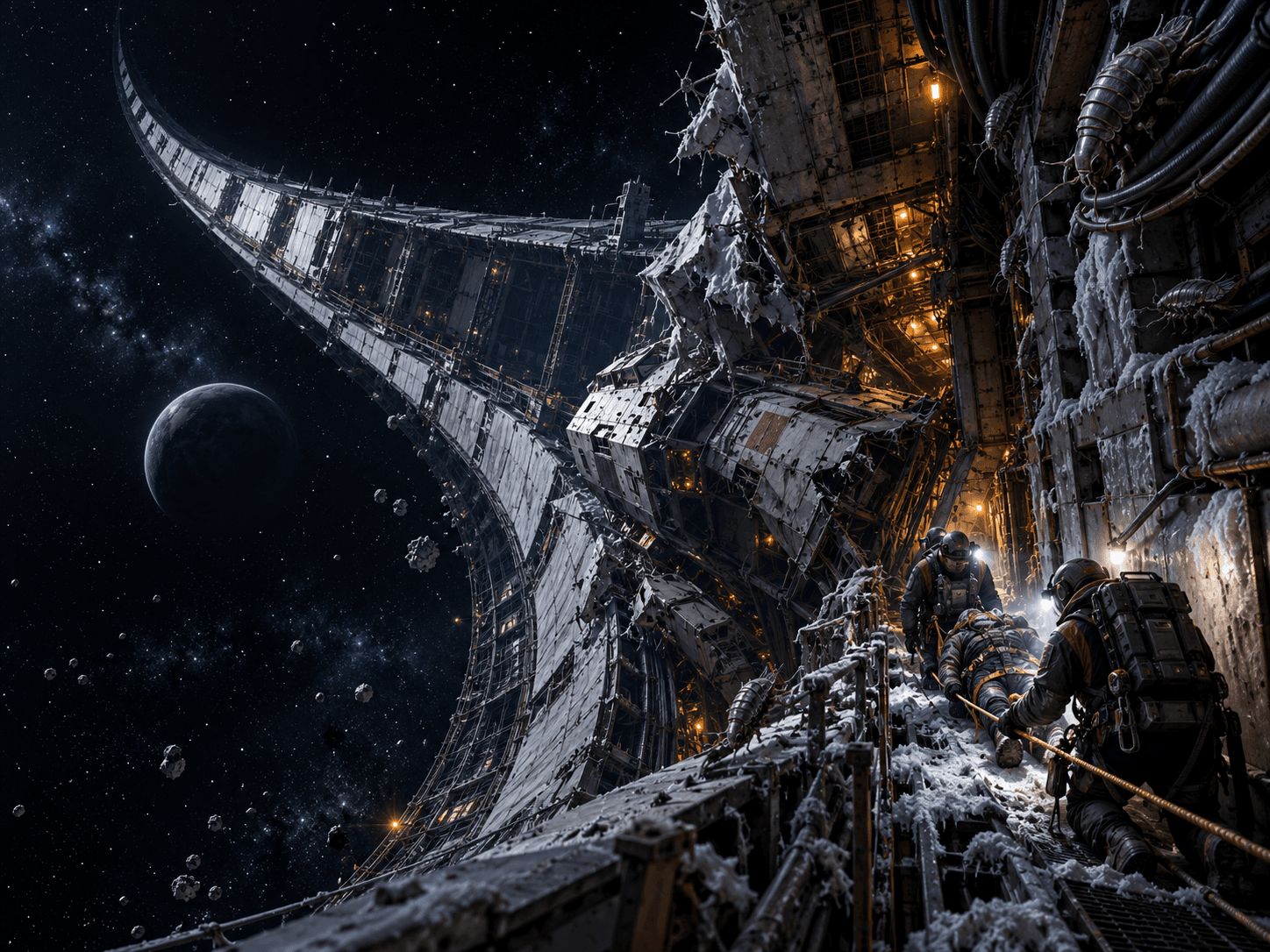
The dead service ring ran off into the dark like a god's discarded rib — kilometres of the First Ones' spent alloy on a blind side-branch of the Deep Corridor, where the route frayed out and no longer led anywhere. The ring had no destination. You could not switch it on, pass through it, or use it as a gate, because it was not a gate; it was a collapsed mineshaft someone had dug a million years ago and forgotten. And yet, when Mark pressed a gloved hand to the inner wall of the throat, in the belly of the ring, he felt through the layers of material a slow, uneven yielding. The metal was settling. Old alloy contracting in the cold, hunting a new shape, millimetre by millimetre, for centuries.
That was legible. That he could read.
He could not read the marks in the ice.
They were by the hatch of the side shaft, in the thin skin of frost that covered everything: scratches no tool and no human leaves. Too regular for accident, too foreign for anything in the catalogue. The lamp's beam slid across them and the back of Mark's neck stood up before his mind had a name for it.
"Someone was here," he said.
"Something was here," Sael Teveen corrected. She hung a metre above him, clipped to a guide rail, long and cold in the helmet lamps. The bone crests at her skull had been darkening toward a blue-violet since they'd entered the throat. Mark read nothing magical in it — a Veyr crest darkens under thermal load and stress, the way a human's knuckles go white. Hers had been darkening for an hour. "We have a saying: don't step into a trace you can't name. We should not have come down here."
"We came down."
"We came down," she agreed. "Each of us out of our own hunger."
There were twelve of them in the dead ring. Four were theirs — Mark, Sael, and two he hadn't yet seen, because they were working deeper. Four Recovery Cartographers: a foreperson with a face worn by the law of first salvage, one technician, a rigger, and a kid at the pumps. And four Contract Markers, who had yet to come in. Twelve warm bodies in a kilometre-long grave of cold alloy.
The rigger turned as Mark drifted past, and the helmet lamps crossed for a second. Mark recognised him and pretended not to. The man held his right glove differently from his left — stiff, not quite his own, like someone who'd learned to live with a hand that doesn't obey. Mark knew that hand. He'd carried it two years, a splinter grown in too deep to dig out. Dov Rhane. He said nothing, because there was nothing to say, and went back to the wall, which at least lied in a way he knew how to read.
They'd come for the log.
The wreck of the Reliable sat in a side shaft of the throat like a bone shoved into too narrow a gullet — a salvage ship lost long ago, clamped by the settling ring so hard that its hull had become part of the structure, and part of its fragile balance. Mark didn't like the thought. The Reliable's mass propped up the bulkheads. Take too much out of her and the throat would start hunting a new shape faster than anyone could unclip.
In the hold lay the module: a human measurement recorder, coffin-sized, in a dense casing that had once shielded it from radiation and heat. It was no gate and no key. It was a diary. And around it, on the old alloy grown into the wreck's hull, ran an array of signs Mark could not read — flat, geometric, dead. Glyphs. They didn't glow. They did nothing. They were simply older than anything humans had ever built, and they watched him out of the cold.
Twelve hours earlier, sensors set out on the structure had logged a change. Measurable, clean, below the formal alarm threshold: a slight drift in a field parameter and a drop in the material's temperature — not in Gardziel itself, because Gardziel was dead and did nothing, but somewhere deeper, in the Corridor's surrounding infrastructure, in one of those phased changes that came on their own rhythm, nobody's will behind them. The effect had carried into the old alloy all the same. The ring was settling a touch faster now. No one halted the salvage over a value below threshold. Mark hadn't either. It was a very low standard for a place he meant to leave alive.
He did not yet know the precursor would turn out to be an index of more than just settling.
Isa Varro was at the module when her face behind the visor changed in a way Mark could see from three metres off.
Tall and thin like all the Asteroid Network, economical in her movements, a hand always reaching for the next grip. She'd come as a broker — a woman who sells interpretation and negotiates risk — and from the threshold she'd known she had already sold too much. It was she, three weeks ago, who had slipped a buyer the corner of this log. Not the whole thing. Enough to be paid. Enough that her habitat — Net Eight, running one filter below its safe minimum — could buy itself one more window of air. And enough that the buyer hired a crew of Contract Markers and sent them here for what he'd already paid for. She had also pulled in the kid, Cael Ims, an air technician from her own habitat — because she'd promised him a simple salvage, and he needed the money as badly as she did.
"What?" Mark asked.
Isa scrolled the record and for a moment didn't answer.
"I thought these were route measurements," she said at last, quietly. "Precursors, passage parameters. Something that looks like a navigational edge. That's how I sold it. That's how he bought it."
"And?"
"And it isn't a route." She turned to him. "The Reliable's crew recorded a breach. A brief, uncontrolled rupture of contact in a damaged stretch of infrastructure. Something opened here once, onto a place that isn't on any human map, held for a moment, and vanished. They measured it. And then they decided it could be used. That it was a road, or an advantage. And they died trying to do something with it."
The silence in the throat thickened.
"This log maps no world," Isa went on. "It doesn't predict where the next one will tear. It gives no one control over it. It records only the conditions around a few ruptures. It isn't an edge. It's proof that something can leak through a broken world. Nothing more." She looked at the dead glyphs. "Stop cutting."
"Worthless," the Cartographer foreperson muttered, not pausing. Heated blades went into the dense casing with a vibration that carried through the whole throat, through the lines, through bone.
"Worse," said Isa. "Priceless to anyone who believes the same thing that crew believed. And they will."
"We hold first-salvage right," the foreperson said. "We located this wreck. We paid for this place in fuel and time. If we don't lift it, someone stronger will, and then no one will ever document a place like this again, because it won't pay. That isn't greed. It's the only reason anyone comes down here at all."
"I know," said Isa. And that was the worst of it. Everyone was right.
That was when the Markers came in.
There were four of them, in worn suits with contract patches, led by a man who moved like someone who had walked too many times into places he wasn't wanted. One of them, Harl Vos, kept to the back and looked around as if nothing here pleased him.
"That module is ours," the leader said. "We hold a certified marker. The client paid."
"We hold salvage right," the foreperson shot back.
"Then settle it with your registry table. We're here to take the cargo."
Two rights, both valid, collided in the dead ring, held by people who could not give way, because behind giving way stood a debt, a contract, or air. And from the side of the throat a new voice spoke — low, slow, as if each word were first laid on a table and checked for whether it would topple.
"Before either side takes anything," said Oza Tomm, "someone has to sign that this place is safe. That someone is me, and I won't sign."
He was short, broad, and compact, like everyone from a high-gravity world, and he moved through the throat slowly, not out of distrust but because the low gravity robbed his body of signals it knew. A safety auditor. A documents analyst. He had been sent so that his signature would legitimise one claim — and only here, on the ground, was he beginning to understand that "neutrality" had been a condition of his contract, not his work.
"Your signature's bought," the Markers' leader threw out. "We all know it."
"Which is exactly why you won't get it," Oza answered, laying an open hand flat on a beam, his people's gesture — this sentence has footing. "In the Ledger of Loads, an empty space is left empty. You don't write a convenient cause into a missing report. And here, everything is a missing report."
"Talk," the leader said, and started toward the module. "My crew finishes what it started."
Mark opened his mouth to say that the cutting was pushing the bulkheads — but the throat answered first.
Out of the cold crevices in the First Ones' alloy, out of voids that had been nothing but cold for a million years, the first one slid.
Mark saw it in the lamp's beam: flat, segmented, armoured, forearm-long, fixed to the wall like rust that had learned to move. Then a second. Then twenty, coming out of the ice that coated the glyphs. Skorupce. They were not cable-vermin. They were predators — alien, armoured things that had crossed here with the same breach the Reliable had recorded, had been trapped when the rupture closed, and had slept through all the years in the cold of the dead wreck, dormant, motionless as part of the structure. Only the heat of the cutting, the shudder of the blades, and twelve warm bodies had woken them from that sleep.
They answered heat. Vibration. Movement. Exposed tissue. And the cutting, the pumps, and twelve bodies were all of it at once.
One of them went onto the Markers' leader's forearm and began gnawing the outer skin at the crook, where the material was thinnest. The man screamed, struck with a tool, and hit his own sleeve. The skin split. There was no bang — only a short, obscene hiss and a white mist that gusted from the tear and froze instantly to ice. The Skorupce rushed that hiss, that sudden heat leaking into the cold, the whole cluster. And they did a thing no cable-vermin would do: they seized him, many at once, by the harness and by the legs, and dragged him — fast, deliberate, strong — into a narrow side shaft, into dark, out of which came only the clatter of shells on alloy and one last, cut-off sound from his channel.
Then the dark swallowed him. It took maybe three seconds.
No one reached him. No one was in time.
"Into the shaft," choked a Cartographer technician. "They took him alive—"
"Kill the pumps," Mark snapped, because it was the only thing he knew for certain. "Lamps to full. Heat and light disorient them. But spare the cells, because when they die we'll be in the dark with them."
"Drive them off you, they go there," Isa said quietly. "They always go to someone. With light you only push them onto the next body."
And then, over all of it, bulkhead three settled.
It did not fall. The old alloy, shoved by the cutting, the vibration, and one warm body too many, found a new shape — and the great service plate slid down in its rails, slow, irrevocable, closing the side shaft the way a hand closes.
On the far side, deeper in, were the ones who had been working closest to the module.
"Roll call," Oza said into the dead silence. "Who's on the other side. Now."
They answered through a crackling channel, its power fading.
"Dov Rhane. Rigger. Three of us alive in here. For now."
Mark closed his eyes.
"Cael Ims," a second voice, young, tight. "Air technician. Net Eight."
Isa went still on her line. Her hand clenched on a grip — the gesture her people used for I won't drift off what I've said — except now it said the opposite: that she had drifted off, long ago, and had just seen where to.
"Harl Vos," a third voice, weak, with the wet drag of pain. "Marker. My leg. And — they're in here with us. In the walls. I can hear them in the walls."
Three people. The rigger Mark had crippled. The kid Isa had pulled in. And a Marker whose crew half an hour ago had threatened to take the cargo. All on one side of a sealed bulkhead, in the dark, with the power dying and predators that hunted in cramped shafts.
"The outer-collar lock," Oza said. "Their only way to the tug. Does it work?"
"In cycles," Dov answered, calmly, too calmly, in the voice of a man who had once lain under a collapsed structure and learned not to scream. "It runs on a failing cell. We won't get through it, at this number, before it shuts on one of us. And even if we could — between us and the lock is their nest. Can you hear it?"
They could. Through the hull came a sound Mark would not forget to his death: clatter, scrape, the dry rattle of shells moving in the dark behind the wall, everywhere at once, like rain falling inward.
Mark was already looking at the schematic. It was the one thing he could do better than feel.
"There's no way through," he said, and he hated the words. "The bulkhead's seated for good. The side shaft runs into the nest. Every other route ends in a solid wall of old alloy, metres thick. There's no reaching them."
And then the wall opened.
It didn't crack. It didn't blow. It simply — stopped being a wall.
It began with the glyphs. The dead, cold signs around the module flared for a moment, not with their own light but with something that passed through them from the far side — pale, cold, outside the spectrum a human eye takes without pain. The air thickened. Mark felt in his teeth, his harness, his bones a vibration that was not the structure's — he knew every tremor of the dead alloy and this was none of them.
And then the solid wall of old alloy, metres of thick metal between the throat and the sealed shaft, stopped being where it was. Not physically — by geometry it should not not be there, and yet a seam opened inward, a corridor no measurement shows. From its depth came the light of Dov's and Cael's and Harl's lamps — but from a distance that didn't fit the space, too far, too cold, flooded with an echo of sound that arrived a second after the image, when it should have come with it.
"This isn't opening to them," Isa said fast, as if afraid someone would think otherwise. "It isn't opening to anyone. I don't know how it works, nobody does — all the measurements say is that the breach caught the edge of the glyph array, and two points of the old structure look as if they've overlapped on the lip of the rupture. By accident. For a moment. It could have opened onto vacuum. Onto solid rock. Onto nothing. It happened to touch the shaft they're in. It isn't a gate to them. It looks like a spark that jumped between two points of a cracked wire and happened to make a bridge right here. And what's on the far side of that spark, I won't tell you, because nobody knows."
"How long?" That was Oza, and for the first time his low voice shook.
"I don't know," Isa said. "Nobody does. It could be gone in a minute. It could come back somewhere else. It could never come back. And we aren't the only ones who can cross it."
She was right. Because out of that same open dark came the sound now — clatter, rattle, the dry rain of shells — louder, whole. The breach had opened a road, and opened it to the Skorupce; it was at once the only chance of rescue and a hunting corridor, and it was utterly indifferent to both. In its cold, alien geometry the old alloy of Gardziel groaned and began to settle faster, as if the mere existence of that hole were stripping away what footing it had left.
"The ceiling over the opening has no support," Mark said, laying a hand where the reading mocked reading. "The passage holds, but the ceiling will seat within minutes. When it does, it closes the corridor with people inside."
"Then prop it," said Sael.
Mark looked at the module. Its dense, massive casing was the hardest thing in the whole throat. The only thing that could go into the ceiling as a wedge and hold it — long enough to bring three people through. Long enough. No longer. And he understood what that meant.
"I can use it as a prop," he said. "Drive it into the ceiling. But once the people are through, the passage has to be brought down, so the throat finds a new shape somewhere other than on us. The module stays inside. Crushed." He swallowed. "You can't use it as a prop and lift it whole. It's one or the other. The people or the log."
"No," said Oza. "If we bring that down, we bring down the only record of what opened here. And that's exactly what has to be written and sealed, not destroyed. Things came out of here that dragged a living man into a wall. Someone has to hold the paper that it happened, and where, so the next person who comes down knows what not to touch."
"The next person who comes down dies the way the Reliable's crew did, your paper or not," said Mark. "And your paper won't bring Dov through that ceiling before it seats."
"Then don't put it in one hand," Isa cut in, already broadcasting on the open port, already breaking it apart. "You all hear me on the channel. I have the raw read. Someone has the coordinates. If I dump as much as I can right now, nobody — not the buyer, not the Service, not any House — gets it whole, so nobody runs to the next rupture with a map that doesn't exist anyway. Leave me the open channel to the last second."
"An open channel is an invitation to a thousand fools," said Sael. Her crests were almost black now. "We don't do it blind. The coordinates to me, to a House that knows how to keep a debt quiet. The image to him—" she nodded at Oza. "A sample to a third. No one holds the whole, but everyone witnesses the rest. That's called responsibility, not a broadcast into the void."
"And I'll tell you one thing," said Mark, staring into the cold depth. "Dov is drowning. The kid is going blue. You've got two minutes to settle an argument you won't settle in two generations. So fight about it on the move, and for now hold my light, because in a moment I'm driving the most expensive thing any of you carried down here into that ceiling, and there'll be nothing to argue over, because there'll be nothing to carry out."
And from the depth, from the corridor that isn't there, Dov's voice, dry as pumice:
"I don't know who you are or what you're on about. I can hear your voices through this hole, and I can hear, at my back, something that's already eaten one of us. So maybe have this conversation on the way."
Mark found Dov on a private channel, because some things you say without witnesses, even when it's cowardice.
"Rhane. It's me. Novitzki."
Silence. Long.
"I knew you," Dov said at last. "The moment you started talking about structure. You always talked about structure as if it were more honest than people. You talked that way at Sector Lirr, too. 'Stable. I'll sign.' Remember?"
Mark remembered. The crack he'd seen and not written down, because writing it meant losing the contract, and the contract meant paying off the debt. He remembered that he, a specialist in reading lies in metal, had turned amber to green in one box on a form. He remembered what came of it. Dov's partner came of it. Dov's hand came of it.
"I remember."
"Then tell me straight. This prop of yours. Does it hold? Or are you turning amber to green again so it sounds better?"
And that was the moment. Mark understood he could say "it holds," and might even be right, but Dov would not believe him — because he'd believed once and paid for it — and that distrust, just, deserved, would now kill three people as surely as the settling alloy. They would believe him only if he stopped being the man who lies so it sounds better.
He switched to every channel he had. To the open port that Isa was holding.
"All of you, listen. Cartographers, Markers, Service. My name is Mark Novitzki. Two years ago at Sector Lirr I signed a false stability report. I saw a load-bearing crack and wrote that it wasn't there, because I needed the contract. A man died of it. Another had his hand crushed. The second man is named Dov Rhane and he is sitting right now behind bulkhead three. I'm telling you this so you know whom you're trusting when I say the next thing. This module, driven in as a prop, holds the ceiling for about nine minutes. No longer. This is told to you by a man who lied once about structure and lost the right to be believed. Check me. Have someone independent confirm my reading. Don't take my word. My word cost too much once already."
The silence after it was unlike any before.
"Confirmed," Oza said, after a while that ran too long. "I recomputed his stresses on a second instrument. Nine minutes is an honest number. Maybe eight. And I refuse to sign the original audit of this salvage. It was set up to legitimise one claim. I won't sign a thing that has no footing. I confirm Novitzki's reading, because it does."
Two independent confirmations. The man who had lied, and the man who refused to sign. Only together were they enough to be believed.
"All right," Dov said quietly. "Now I believe you, Novitzki. Now that you've got nothing left to win."
They did it in nine minutes that can't be described so that someone who wasn't there feels every second.
Mark set the module. There was no great shove in it — suit thrusters, levers, rails, and a mass that had to be slid into the ceiling over the passage just so, so that the alien, cold alloy leaned on human metal instead of human heads. The log's casing, the same one no one had wanted to give the others, went into the ceiling like a wedge and stopped — for nine minutes — the motion he'd felt since they came in.
Sael laid the line. It was her work, the one thing she did better than anyone: leading bodies through closing thresholds. She went into the breach first, into the corridor that isn't there, lamp at full, because heat and light disoriented the Skorupce — though they drained the cell faster than anyone wanted to count, and though each time she pushed them off herself with light she pushed them toward someone else. She passed the crushed corner of the module, where the index sat — her index, coordinates tied to her House's lost endpoint, the one thing she had truly come for.
There was one path that gave her the full coordinates. And another, shorter, that saved the people but cut the first off forever.
She cut the first. Without a word, the way her people turn a bowl over for a lost crew — a gesture, not speech. She led the line the shorter way and took with her only as much of the index as she could copy into memory with one glove, in the dark, on the move. The corner. Not the whole. As much as fits in a single head that knows it must not hold the whole.
In the corridor that isn't there, sound came back from the wrong distances, and the lamp threw a shadow where there was nothing to cast it. Sael led them by touch and by line, because sight couldn't be trusted. Once the line jerked in the dark so hard that Mark felt it through the whole throat, and for one awful moment he didn't know whether it was a person, or something pulling a person sideways, into a crevice. Then Sael's voice, level: "I've got him. I have him. We're moving."
Cael came through first, face white behind the visor, and Isa caught him by the harness with the same hand she'd held a grip with when she promised him a simple salvage. She didn't say "I'm sorry" — her people don't, in a lock. She said only: "You're on my line. You won't drift."
Then Harl Vos, with the dead leg, whom Sael hauled on her own arms, because the strength of the Veyr is in the long tow, not the short jerk, and this was a long tow through hell. The rival. He came through, because the living before the proof didn't ask which side you stood on — or it meant nothing.
Dov was last. He stopped under the module, under that dense casing holding the ceiling along his saved road, and looked at Mark through two visors and through the cold glow of a thing about to vanish.
"Nice wedge," he said. "Out of an expensive thing."
"The most expensive I had," Mark answered.
And that was all they said, because in this trade apologies are useless, and the only thing that counts is who pulled you out when he didn't have to.
When Dov was through, maybe forty seconds were left, and the alloy over the module began hunting its next shape. The cold glow of the breach started to flicker — the spark was dying. Isa was on the open channel. She managed a fragment: a cut-off, incomplete, ugly scrap of the log, flung out on the open port so that it reached everywhere and no one whole. Not a monopoly. Not the whole. A maimed record no side could ever patent.
"I've got what I've got," she said. "The rest is gone. Bring it down."
Mark brought the ceiling down.
Not with a blast. In that quiet, muffled way old structures die: he knocked out the prop, the alloy found a new shape, and the module — the log, the cause so many had come down for — vanished under the mass of the ring, crushed along with the glyphs and the coordinates no one would ever read whole. In the same instant the corridor that isn't there closed — not because Mark had done anything, but because the spark simply went out, jumped elsewhere or nowhere, taking with it the cold depth and the echo and the answer to what they had been witness to. Solid alloy was left. Frost was left. The marks in the ice were left, that no one could name.
In the last fraction, by reflex, Mark tore off one shard — a hard piece of the casing with a splinter of glyph grown into it, hand-sized. Material, unreadable without the rest, cold as nothing he had ever held. He didn't know why.
And just then, tucking the shard into the pouch at his hip, he felt something he couldn't read: through solid, collapsed, metre-thick alloy, where a moment ago there had been a corridor that isn't there — he felt, for a fraction of a second, the space behind the wall open. Cold. Far. Then it passed. The wall was there. The reading said: solid mass. His own, once-honest sense said: a door.
He told no one. Not yet.
The tug out of Dock Eight took them to the Fourth Loop, because there was nowhere else.
The Fourth Loop was a small habitat on a cold asteroid, the nearest inhabited shelter, and even before that night it had run one filter below its safe minimum. Pell Aru, the mechanic, met them at the lock with the face of someone doing arithmetic and not liking the answer.
"How many?"
"Eleven," Oza said. "Three wounded. One badly, a leg. We left one back there. There was no way."
Pell shut her eyes long enough for her body to believe it had been given a moment.
"I've got air for me and mine. Not for eleven. But I won't throw you out into vacuum. Come in and stop breathing so deep."
They didn't bring the creatures with them. The Skorupce stayed where it was cold and dead — in the throat, by the alloy they'd fallen asleep in years ago, when the rupture that let them in closed behind them. This was not a second disaster. It was a bill. The Fourth Loop took in eleven people it had nowhere to put, and paid for it with what can't be recovered: a filter reserve that now had to be divided; living volume that shrank to people sleeping in shifts in the corridors; rations that from tomorrow were smaller for everyone, the children who lived there included. The cost wasn't written in after the fact for effect. It was the condition without which those eleven would not have lived. That's the Corridor. Someone always gives up their own volume so someone else has air to breathe.
Afterward they sat in the cramped mess — four strangers whom the night had turned not into a crew but into witnesses. There was no ceremony. There were four incomplete pieces of one destroyed thing, lying between them like cards no one wanted to gather into a hand.
"I memorised the corner of the index," Sael said. "And to read it in time I had to open my House's archive in front of everyone. Now the whole port knows that the House of the Quiet Causeway lost its endpoint. I'll never again sit down to a negotiation from strength. I wanted to distribute it honestly. And I distributed the scraps of something that no longer exists."
"I have the interpretation and that pathetic public scrap," said Isa. "I thought if I put everything out, no one would have an edge and no one would start the race. What came out is a morsel that satisfies no one and tempts everyone. I lost the buyer, the money for Net Eight's filters, and the trust of my own people." She looked at Cael, asleep in the corner with a kid's face. "And I almost lost something no filter buys back."
"I have the provenance and an audit I didn't sign the way I was told," said Oza. "I wanted to seal this place and describe it, so the next person would know what not to touch. I sealed it with rubble, not a seal. And the other thing — I don't know if it can be sealed at all. A signature doesn't hold a wall that stops being a wall."
"And I have this." Mark set the cold shard with its splinter of glyph on the table. "I wanted to destroy the whole of it, so no one would take a rupture for a gate and run. And what have I got for it? Three pieces on the table and a fourth in my pouch. I didn't kill the race. I multiplied it by four. And none of us knows what it really was that opened, or where the creatures came from, or whether it was the first time. The log gave no answer. It gave only the temptation to go looking for one."
They were quiet over it a while.
"None of us got what we wanted," said Sael. "And each of us thinks that, that night, it made a mistake."
"Then maybe it wasn't one," said Oza. "Four hands, no complete map, no one satisfied. Maybe that's the only honest form for a thing that is at once proof and an invitation."
"One thing I know for certain," Mark said at last, looking at the shard and not at them. "Next time something like this turns up — and it will — no one can be allowed to take a rupture for a gate. And no one can be allowed to make the proof matter more than the people at the bulkhead. Because this proof isn't neutral. When it can become an invitation, it stops being only knowledge. The living first. The proof after. If at all."
They did not shake hands. Among the Veyr you don't touch another's crest without invitation; among the Network people you throw nothing, not even a promise; among the heavy-world people a sentence with no structure beneath it holds nothing; and a man who had lied once had learned not to swear oaths that sound better than they are. Instead Sael took a pinch of salt from her rations — her crews' custom before entering a risky lock, a declaration of a shared store — and divided it into four, a little to each. Not a rite. An agreement that from now on they shared one store.
They were named later, at Vector Anchorage, where stories travel faster than ships — some dockers, half in jest, half in respect, about four lunatics who'd held the whole future of the Corridor in their hands and smashed it to drag three nobodies out of a dead ring where the walls stopped being walls. "Guardians of the trace," someone said over a Vektra table, putting as much mockery into it as regard. "The ones who kept the trace by handing it to no one."
They took the name, because it was someone else's and therefore honest.
And somewhere in a corridor of the Fourth Loop, where people now slept in shifts because taking in strangers had cost them their volume, Mark Novitzki lay with his eyes open and tried not to feel the wall at his back. The wall was solid. The reading was unambiguous. A metre of rock and alloy, nothing behind it.
And still he felt — very faintly, very cold, very far — something on the other side open for a fraction of a moment and close again. He didn't know whether it was the far side, or exhaustion, or something that had woken in him at that wall and now wouldn't sleep. The reading said one thing. His own, once-honest sense said another. And for the first time in his life he couldn't decide which to trust. That was the price he hadn't written in any report.
They were only four. Somewhere there were others, who had heard the open channel that night and could no longer forget it.
That night there were only four of them, four incomplete pieces, one bill paid with someone else's volume, and one rule that did not sound like a victory, because it wasn't.
The living before the proof.
The rest was a trace — and whether a trace ever looked back, Mark did not know, and was afraid he never would.